
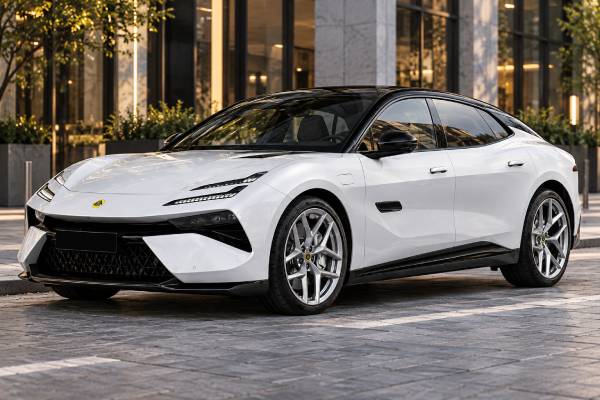
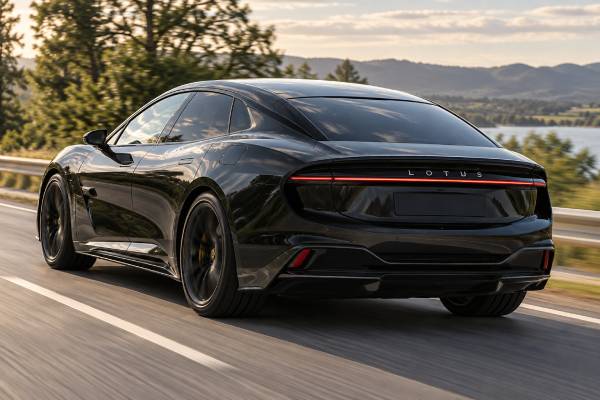
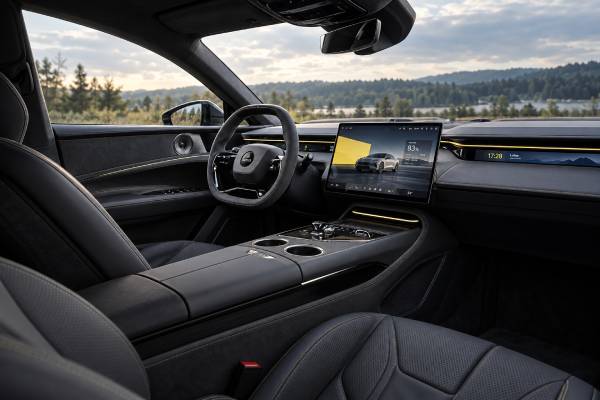
The Lotus Emeya 900 Sport Carbon is the most visually elaborate version of the 675 kW Emeya family, combining the 905 hp two-speed all-wheel-drive powertrain with extended exterior and interior carbon-fiber packages. Its performance numbers are essentially the same as the 900 Sport: about 2.78 seconds from 0–100 km/h, 256 km/h maximum speed, 985 Nm, and a 102 kWh gross battery on an 800-volt architecture. The Carbon badge therefore does not mean another step in motor output. Its value lies in material specification, appearance, and the way Lotus bundles active aero, comfort equipment, and carbon trim around the flagship drivetrain in current markets. That changes the buying process. A used Sport Carbon should be inspected not only for battery, transmission, tires, brakes, and chassis condition, but also for damage, repair quality, clear-coat condition, and authenticity of expensive carbon components. This guide separates the shared 900 engineering from the Carbon-specific proposition and explains what to verify before paying its premium.
Table of Contents
- What the Sport Carbon adds
- Technical specifications and shared 900 hardware
- Carbon-fiber equipment and damage inspection
- Performance, transmission, and chassis demands
- Range, charging, and long-distance comfort
- Maintenance, repair, and purchase strategy
What the Sport Carbon adds
The 900 Sport Carbon is a specification flagship rather than a higher-output drivetrain. Current Lotus configurator material gives it the same 675 kW, 918 PS, 2.78-second 0–100 km/h time, 256 km/h top speed, and 435–485 km combined-range band as the 900 Sport.
Its distinguishing content is the carbon treatment. Lotus describes an extended carbon package and an extended interior carbon package, while regional equipment listings identify carbon on areas such as the center console, door trim, dashboard/HUD surround, overhead console, seat-related panels, and additional exterior aerodynamic or body components depending on market. The exact pieces must be confirmed from the build sheet because configurator content, standard equipment, and options can differ by country.
That last point is especially important for the roof. Some European equipment listings show a carbon roof as a separate option rather than automatic Sport Carbon equipment. A buyer should therefore avoid assuming that every panel that looks black is carbon or that every Sport Carbon has the same exterior material specification.
The model also bundles luxury equipment more heavily in some markets. Current configurator highlights include the Lotus Active Aero package, comfort-seat package, and soft-closing doors. The result is a car positioned to look and feel more special without changing the performance baseline.
There is no reason to treat that as superficial. Materials and equipment can matter greatly in a luxury GT, but their value is different from powertrain value. The premium makes sense to someone who specifically wants the factory carbon appearance and richer standard specification. A buyer focused only on acceleration can obtain essentially the same headline performance from a 900 Sport.
The Carbon trim also creates different used-car risks. A scratched painted bumper may be straightforward to repair; a cracked or delaminated exposed-carbon component can require specialist assessment and may be expensive to replace. Authenticity and repair history therefore matter more than on a simpler trim.
Technical specifications and shared 900 hardware
Under the carbon specification, the drivetrain remains the 900 architecture: dual permanent-magnet motors, all-wheel drive, 675 kW total output, 985 Nm, and a two-speed transmission.
| Item | Specification |
|---|---|
| Vehicle type | Battery-electric five-door grand tourer |
| Drive | Dual-motor all-wheel drive |
| Peak system output | 675 kW / 905 hp (918 PS) |
| Peak system torque | 985 Nm / 727 lb-ft |
| Transmission | Two-speed reduction transmission |
| 0–100 km/h | 2.78–2.8 seconds |
| Maximum speed | 256 km/h / 159 mph |
| Standard cited drive modes | Range, Tour, Sport, Individual, Track |
| All-wheel torque management | Electronically coordinated front/rear drive |
The battery and charge system are likewise shared with the 900 Sport. European technical data publishes 102.0 kWh gross and 98.9 kWh usable capacity.
| Item | Specification |
|---|---|
| Battery capacity, gross | 102.0 kWh |
| Battery capacity, usable | 98.9 kWh |
| Architecture | 800 V class |
| European battery type | Lithium-ion/NMC in cited data |
| Maximum AC charging | 22 kW, three-phase |
| Claimed maximum DC charging | 420 kW |
| Claimed 10–80% charging time | About 15 minutes under suitable conditions |
| European charging interfaces | Type 2 AC / CCS DC |
| Battery preconditioning | Supported through navigation/vehicle strategy |
The large body is unchanged, and European data records the same 2,650 kg EU unladen mass for Sport Carbon as for Sport. Do not assume that visible carbon trim makes the homologated car dramatically lighter.
| Item | Specification |
|---|---|
| Length | 5,139 mm / 202.3 in |
| Body width | 2,005 mm / 78.9 in |
| Width including mirrors | 2,241 mm / 88.2 in |
| Height | 1,459 mm / 57.4 in |
| Wheelbase | 3,069 mm / 120.8 in |
| EU unladen mass | 2,650 kg / 5,842 lb |
| Maximum permitted mass | 3,100 kg / 6,834 lb |
| Rear luggage capacity | 509 L |
| Rear seats folded | 1,388 L |
| Front luggage compartment | 34 L |
| Item | Specification |
|---|---|
| Springs | Dual-chamber air suspension |
| Damping | Continuous damping control |
| Integrated chassis control | Standard in cited 900-series specification |
| Torque vectoring | Brake-based system in cited Lotus specification |
| Front brakes | Six-piston calipers in standard cited specification |
| Standard cited wheels | 21-inch 10-spoke design |
| Front tire size | 265/40 R21 |
| Rear tire size | 305/35 R21 |
| Active rear spoiler | Standard |
| Active front grille | Standard |
| Item | Specification |
|---|---|
| Payload in cited European homologation | 450 kg / 992 lb |
| Braked trailer rating | 1,225 kg / 2,701 lb |
| Unbraked trailer rating | 750 kg / 1,653 lb |
| Maximum nose weight | 75 kg / 165 lb |
| Seats | Five in cited standard specification |
| Area | Typical cited content |
|---|---|
| Exterior | Extended carbon package |
| Interior | Extended carbon trim package |
| Aerodynamics | Lotus Active Aero package |
| Seats | Comfort-seat package in current configurator highlights |
| Doors | Soft-closing functionality in current configurator highlights |
| Roof | Carbon roof may be a separate option depending on market |
| Audio | KEF system; higher-spec Reference system may be optional |
| Wheels/brakes | Multiple factory upgrades may be available |
Carbon-fiber equipment and damage inspection
Carbon-fiber trim changes the inspection process because surface condition can reveal only part of the story. Exposed weave, resin, clear coat, mounting points, and the underlying structure all need consideration.
Begin with consistent weave and finish. Factory carbon should have a deliberate pattern and uniform gloss or satin appearance appropriate to the part. A localized change in weave direction, cloudy clear coat, sanding marks, overspray, or a visible edge where film has been applied can indicate repair or replacement. None of those signs automatically makes the car bad, but they deserve documentation.
Inspect low exterior components especially closely. Splitters, sills, diffuser areas, and bumper-adjacent carbon are vulnerable to curbs, steep ramps, road debris, and careless transport. Use bright oblique light to find hairline cracks, chips, crushed edges, or clear-coat fractures. A crack in the finish may be cosmetic, but damage that reaches the laminate needs specialist assessment.
Tap-testing or advanced composite inspection should be left to a qualified repairer. Owners should not drill, sand, heat, or flex a suspect carbon panel to “see if it is solid.” Composite damage can extend beyond what is visible, and inappropriate repair can make later assessment harder.
Interior carbon usually faces a different problem: scratches, UV exposure, chemical staining, and poorly installed accessories. Check the center console, door switch surrounds, seat backs, HUD surround, and overhead pieces identified in the car’s build specification. A loose trim panel may be a broken clip rather than structural carbon damage, but replacement cost can still be high.
Confirm authenticity before paying a premium for added parts. An owner may have installed aftermarket carbon overlays, replacement mirror caps, or wrapped panels that resemble factory equipment. Compare the car with its original option list and part identification rather than relying on appearance.
The carbon roof deserves separate verification where fitted. Inspect exterior clear coat, edge seals, glass interfaces, and the headliner area for water marks. Because some markets list the carbon roof separately from the Sport Carbon trim, the VIN-linked build data should confirm whether it is factory equipment.
Preserving exposed carbon without hiding problems
Cosmetic care should protect the finish while keeping the material inspectable. Wash grit away before touching the panel, use clean microfiber materials, and avoid aggressive compounds intended to remove deep paint defects. Exposed carbon normally relies on a clear protective finish, and excessive polishing can thin that layer even when the weave beneath remains intact. If the surface has become hazy, a detailer familiar with composite panels can determine whether the defect is in the clear coat or deeper in the resin system.
Protective film can be useful on low front edges and other impact-prone areas, but installation quality matters. A knife cut along an exposed-carbon edge can damage the coating or laminate, and poorly prepared film can seal chips underneath where the next buyer cannot see them easily. When inspecting a used car with film, look from multiple angles for trapped cracks, lifting edges, or a line that suggests the film was installed after damage occurred.
Heat and sunlight also deserve consideration. Long-term UV exposure can discolor some finishes, while high localized heat from an inappropriate repair process can affect resin or clear coat. A panel that looks different from its neighbor may simply have received a different protective product, but the mismatch is worth explaining before purchase.
Avoid treating carbon parts as jacking, leaning, or tie-down points simply because they feel rigid. Decorative and aerodynamic panels may not be designed to carry workshop loads. During service, ask the technician to follow Lotus lifting and bodywork guidance so undertrays, splitters, and sill pieces are not crushed by equipment.
Good care preserves value because a Sport Carbon buyer is specifically paying for the material specification. The goal is not to keep the car untouched; it is to maintain a traceable history in which chips, repairs, film installation, and any replaced carbon component are documented rather than disguised.
Repair history is not automatically negative if the work was performed correctly. A documented factory-part replacement by a capable composite/body specialist can be preferable to an unrepaired crack. The warning sign is unexplained damage or a seller who cannot say what was replaced.
Performance, transmission, and chassis demands
The Sport Carbon is just as fast as the Sport, so its extra trim does not reduce the need for disciplined performance-car inspection. A 2.65-tonne car accelerating to 100 km/h in under three seconds places enormous demands on tires, driveline, brakes, and thermal systems.
The two-speed transmission is central to that experience. It lets the car use a lower ratio for extreme launch performance and a higher ratio for sustained speed. During strong acceleration, the ratio change should be controlled and repeatable. A mechanical bang, repeated interruption, or warning message is not something to dismiss as “normal because it is powerful.”
Tires are the first safety checkpoint. The standard cited 21-inch sizes are 265/40 front and 305/35 rear, with other factory combinations available. Match brand and model across each axle, confirm load and speed ratings, inspect inner shoulders, and check manufacturing dates. Expensive options do not compensate for old or mismatched rubber.
Wheel condition matters equally. Carbon-themed flagship cars are sometimes ordered with larger or more elaborate wheels that are easier to damage on poor roads. Look for bends, cracks, previous welding, and vibration at motorway speed. Replacement cost can be substantial.
Friction brakes need inspection even though regeneration handles routine deceleration. Check disc faces for corrosion bands, heat spotting, cracks, or heavy lips and verify pad thickness. Some markets offer more exotic brake upgrades, so identify the installed system before quoting parts or service.
Air suspension and adaptive damping should keep the body controlled without constant correction. A Sport Carbon that sits low on one corner after parking or repeatedly runs its compressor requires diagnosis. Chassis systems such as rear-wheel steering and intelligent anti-roll control, where fitted, should be scanned for stored faults after any impact or suspension repair.
Active aerodynamic parts are both functional and visually integrated with the Carbon specification. Check spoiler and grille operation, but do not force them. Minor contact damage can affect alignment or actuators even when the carbon surface looks intact.
Range, charging, and long-distance comfort
The Sport Carbon’s touring ability comes from charging speed more than from class-leading range. European figures place the 900 family around 435–485 km WLTP depending on configuration, while the 800-volt system can replenish the battery very quickly at suitable stations.
Wheel and tire choices have a direct effect on energy use. A 22-inch performance setup or aggressive tire compound can reduce range relative to a more efficient 21-inch configuration. Carbon trim itself should not be assumed to create a meaningful certified-range advantage; use the actual homologation figure for the car.
For motorway trips, preconditioning is crucial. Route to the charger through the vehicle navigation when possible so the battery can prepare. Arrive at a relatively low state of charge, take advantage of the fast part of the curve, and leave once enough energy is onboard for the next leg. Waiting for the final 10–20% is usually slower than making another short stop later.
The claimed 420 kW peak requires a charger that can supply the necessary voltage and current, a warm battery, and a favorable state of charge. A lower-rated charger can still provide an excellent session if it holds power steadily. Do not diagnose the car from one slow public charger without testing another known-good site.
At home, up to 22 kW AC charging is available where three-phase infrastructure supports it. A lower-power wallbox can still be sufficient for daily use because most owners do not deplete a 98.9 kWh usable battery every day. Charge planning should match routine mileage rather than copying public-rapid-charge habits.
The Carbon’s comfort equipment also matters on long trips. Test seat ventilation, massage functions where fitted, four-zone climate control, road-noise cancellation, audio, HUD, rear displays, and soft-closing doors. A flagship GT with nonfunctional comfort hardware loses much of the reason for choosing this trim over a 900 Sport.
Cargo space remains practical: 509 liters behind the rear seats, up to 1,388 liters with them folded, plus a small front compartment. Payload is more restrictive than visual space suggests, so calculate passenger and luggage mass when four or five adults are traveling together.
Maintenance, repair, and purchase strategy
Owning a Sport Carbon means maintaining two kinds of value at once: the 900 drivetrain and chassis must remain healthy, and the expensive visual specification must remain authentic and well preserved. Neither should be sacrificed to protect the other.
Mechanically, follow Lotus service documentation for the VIN. Brake fluid, filters, cooling systems, air suspension, driveline hardware, and software still require inspection even without an internal-combustion engine. Keep invoices because documented care helps distinguish a genuinely maintained flagship from a cosmetically polished one.
Inspect the battery enclosure after underbody impacts and insist on correct lifting points during tire or brake work. A workshop unfamiliar with the car can damage aero panels or underfloor protection before it reaches any service component.
For carbon surfaces, use cleaning products safe for the relevant clear coat and avoid abrasive polishing unless a specialist confirms the finish allows it. Chips should be assessed early because water, dirt, and UV exposure can worsen damaged clear coat. A protective film may be sensible on vulnerable exterior areas, but it should be installed without cutting into the panel or trapping existing defects.
Insurance coverage should reflect the actual trim. Confirm that factory carbon options and expensive wheel or brake packages are recorded correctly. An insurer that values the car as a generic 900 may not appreciate the replacement cost of trim-specific components after a claim.
A pre-purchase inspection should start with the build sheet. Verify every carbon package and optional panel, then photograph each component in good light. Check body gaps, fasteners, underside edges, and clear-coat consistency. If a panel has been repaired, ask who performed the work and whether replacement parts were genuine Lotus components.
Then perform the mechanical inspection: tires, wheels, brakes, suspension, underbody, charging, transmission behavior, active aero, and electronics. Use a diagnostic scanner capable of reading Lotus systems and look for stored faults in high-voltage, chassis, steering, body, driver-assistance, and charging modules.
Connected ownership must also transfer correctly. Confirm that the seller releases the car from their Lotus account, that the app can pair in the destination country, and that OTA updates install. An import may have perfect carbon bodywork yet still be inconvenient if local connectivity or warranty support is limited.
Warranty terms should be checked in writing. Published Lotus coverage includes multi-year vehicle and high-voltage warranties with market-specific mileage limits and a battery-capacity threshold, but transfer and territorial rules matter. Never assume that a car imported from another region carries identical support.
When comparing a Sport Carbon with a Sport, price the features you genuinely value. The drivetrain will not justify the difference because it is essentially shared. The premium is for material specification, visual identity, and bundled equipment. That is worthwhile when the carbon pieces are factory-correct, undamaged, and desirable to the buyer; it is much less attractive when the car needs expensive cosmetic or composite repair.
The best Sport Carbon should therefore be judged by completeness. It should charge quickly, deliver its two-speed performance cleanly, ride and steer correctly, carry healthy tires and brakes, run current software, and present every carbon component with documented authenticity and condition. When those requirements are met, the trim succeeds on its own terms: it combines the Emeya’s most powerful drivetrain with the range’s most distinctive factory material specification without pretending that carbon alone creates another level of speed.
That makes provenance unusually valuable. A complete file of factory specification, service invoices, film or detailing records, and documented composite repairs gives a future buyer evidence that the visual premium has been maintained as carefully as the drivetrain. For this trim, history is part of condition rather than a paperwork afterthought.
References
- Lotus Emeya 900 Sport Carbon (ab 04/25): Technische Daten, Bilder, Preise | ADAC 2025
- Lotus Emeya Configurator | Lotus Cars Belgique 2026
- THE LOTUS EMEYA 900 SERIES 2025
- Lotus Emeya 900 (2025-2026) price and specifications – EV Database 2026
- Lotus Emeya – The Fully Electric Hyper-GT | Lotus Cars 2026
- Lotus Cars Official Site 2026 (Warranty)
Disclaimer
This article is for informational purposes and is not a substitute for professional diagnosis or repair. Specifications, torque values, service intervals, composite repair procedures, wheel and brake approvals, charging figures, equipment, software functions, and warranty terms can vary by VIN, market, options, and software version. Verify all work and vehicle-specific data against current official Lotus documentation.
If this Sport Carbon guide was useful, please share it on Facebook, X/Twitter, or another automotive community.