
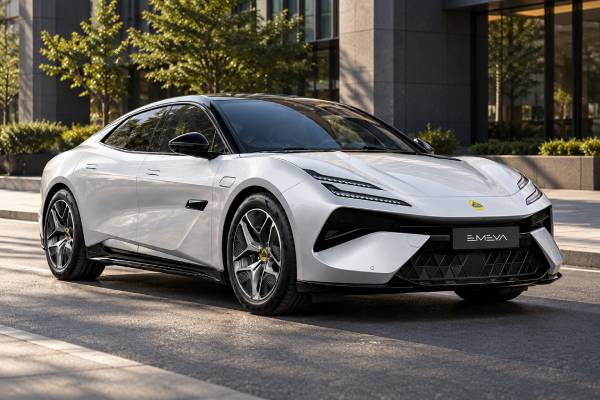
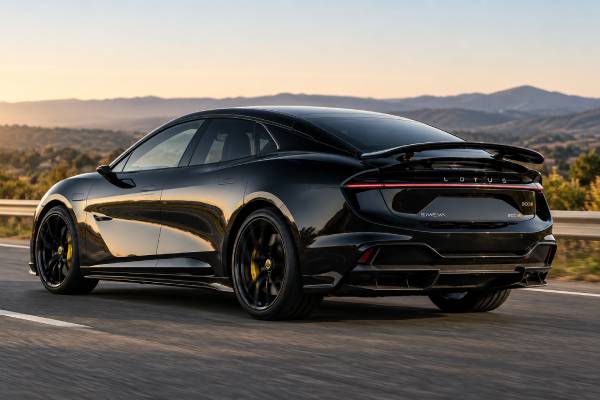
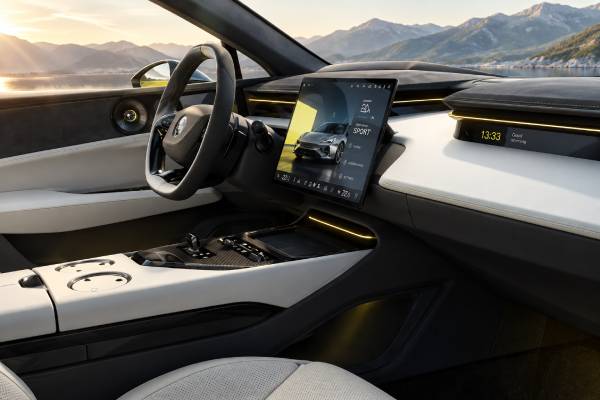
The Lotus Emeya 900 Sport is the European-style performance core of the 675 kW Emeya range. It combines 905 hp, 985 Nm, dual-motor all-wheel drive, a two-speed transmission, Track mode with launch control, and Lotus’s Dynamic Handling package in a five-door grand tourer capable of 0–100 km/h in about 2.8 seconds. Unlike the 900 Sport Carbon, its identity does not depend on an extensive carbon-fiber appearance package. The Sport is fundamentally about the high-output drivetrain and chassis technology. That makes condition more important than cosmetics when evaluating a used car: tires, brakes, alignment, air suspension, rear-steering and anti-roll systems where specified, software, and the behavior of the two-speed transmission all deserve scrutiny. This guide validates the major technical figures, explains how the performance systems work together, covers range and 800-volt charging, and provides a practical maintenance and buying framework for the 2025–2026 Emeya 900 Sport.
Table of Contents
- 900 Sport versus the rest of the 900 family
- Technical specifications
- Launch control, Track mode, and two-speed delivery
- Dynamic Handling and road behavior
- Range, charging, and thermal management
- Maintenance for a 905 hp EV
- Pre-purchase inspection and ownership fit
900 Sport versus the rest of the 900 family
The 900 Sport is the drivetrain-focused high-performance Emeya. It delivers the same 675 kW, 985 Nm, 2.78-second acceleration claim, and 256 km/h maximum speed as the Sport Carbon, but without making the extended carbon packages the center of the specification.
That distinction is useful because the performance difference between the two is effectively not the reason to upgrade. Current Lotus configurator material describes the 900 Sport through its dual-motor 675 kW system, two-speed transmission, Track mode with launch control, Dynamic Handling package, and black badge package. The Sport Carbon adds a stronger visual and luxury specification around the same powertrain.
For a driver choosing purely on dynamic capability, the Sport can therefore be the rational flagship. Money not spent on carbon exterior and interior components can be directed toward desired wheel, brake, audio, or comfort options depending on market. Conversely, buyers who want the most visually distinctive factory specification may prefer the Carbon even though the stopwatch does not meaningfully separate them.
European homologation data lists the 900 Sport at roughly 2,650 kg EU unladen. That mass is substantial, so the car’s performance is not based on lightness in the classic Lotus sense. Instead, its engineering challenge is to control weight with air suspension, electronic damping, integrated chassis control, torque management, active aerodynamics, and high-grip tires.
The model-year timeline is also important. The 900 Sport appears in reorganized 2025-onward lineups, and equipment packaging can change by country or later model year. Treat the build sheet, VIN-linked records, and market-specific configurator as authoritative for an individual vehicle.
Technical specifications
The 900 Sport uses permanent-magnet electric motors on both axles and a two-speed reduction transmission. Published European data records 675 kW total output and 985 Nm, while official Lotus material quotes 918 PS, equivalent to roughly 905 hp.
| Item | Specification |
|---|---|
| Propulsion | Battery electric |
| Drive layout | Dual-motor all-wheel drive |
| System output | 675 kW / 905 hp (918 PS) |
| System torque | 985 Nm / 727 lb-ft |
| Transmission | Two-speed reduction transmission |
| Drive modes | Range, Tour, Sport, Individual, Track in cited Lotus specification |
| Launch control | Included with Track mode in current configurator description |
| 0–100 km/h | 2.78–2.8 seconds |
| Maximum speed | 256 km/h / 159 mph |
The battery architecture supports both high discharge and unusually high charge power. European sources separate 102.0 kWh gross capacity from 98.9 kWh usable capacity.
| Item | Specification |
|---|---|
| Gross battery capacity | 102.0 kWh |
| Usable battery capacity | 98.9 kWh |
| Battery chemistry | Lithium-ion NMC in current database specification |
| High-voltage architecture | 800 V class |
| WLTP combined consumption | 22.4 kWh/100 km in ADAC data |
| WLTP range | 485 km / 301 mi in cited low-energy European configuration |
| Maximum AC charge power | 22 kW |
| Claimed maximum DC power | 420 kW |
| Claimed 10–80% DC time | About 15 minutes |
The 900 Sport’s extra drivetrain hardware adds mass and reduces load capacity compared with 600-series European data.
| Item | Specification |
|---|---|
| Length | 5,139 mm / 202.3 in |
| Width | 2,005 mm / 78.9 in |
| Width including mirrors | 2,241 mm / 88.2 in |
| Height | 1,459 mm / 57.4 in |
| Wheelbase | 3,069 mm / 120.8 in |
| EU unladen mass | 2,650 kg / 5,842 lb |
| Maximum permitted mass | 3,100 kg / 6,834 lb |
| Rear cargo volume | 509 L |
| Rear seats folded | 1,388 L |
| Front luggage compartment | 34 L |
| Item | Specification |
|---|---|
| Suspension | Dual-chamber air springs in cited Lotus specification |
| Dampers | Continuous damping control |
| Chassis coordination | Integrated Chassis Control |
| Torque vectoring | Brake-based intervention in cited Lotus specification |
| Standard cited wheel | 21-inch 10-spoke gloss black |
| Front tire | 265/40 R21 Pirelli P Zero in cited specification |
| Rear tire | 305/35 R21 Pirelli P Zero in cited specification |
| Front brake caliper | Six-piston in standard cited specification |
| Active rear spoiler | Standard |
| Active front grille | Standard |
| Item | Specification |
|---|---|
| Payload | 450 kg / 992 lb in ADAC data |
| Braked trailer rating | 1,225 kg / 2,701 lb |
| Unbraked trailer rating | 750 kg / 1,653 lb |
| Maximum nose weight | 75 kg / 165 lb |
| Seating | Five seats in cited European/Japanese standard specification |
| Item | Specification |
|---|---|
| Central display | 15.1-inch OLED |
| Driver/passenger displays | 12.6-inch displays in cited Lotus specification |
| Rear display | 8-inch in cited specification |
| Head-up display | Augmented-reality capable HUD |
| Phone integration | Wireless Apple CarPlay / Android Auto |
| Audio | KEF 1,380 W / 15-speaker system in cited standard specification |
| Connectivity | 5G-capable embedded eSIM where supported |
| Software | Over-the-air update capability |
Launch control, Track mode, and two-speed delivery
Launch control is the clearest demonstration of what separates the 900 Sport from the 600 family, but it should be treated as a system function rather than a party trick. The car must coordinate battery output, motor torque, traction, tire grip, chassis state, and the two-speed transmission to deliver a repeatable sub-three-second run.
Track mode changes the operating priorities of the vehicle. Exact interventions vary with software and market, but the purpose is to give the driver more direct access to performance while coordinating powertrain and chassis systems for higher loads. Before assuming a used car is functioning correctly, verify that all modes select without warnings and that the display confirms the requested state.
Launch control availability may depend on battery state, temperature, tire condition, and other protection logic. A refused launch does not automatically indicate a fault. Repeated refusal under correct conditions, however, should prompt a diagnostic check rather than repeated attempts.
The two-speed transmission helps the 900 combine brutal low-speed acceleration with strong performance at high road speed. Under hard acceleration, a change in thrust as the transmission moves to its higher ratio can be normal. What is not normal is an uncontrolled bang, repeated flare-like interruption, persistent vibration, or a drivetrain warning.
Owners should avoid using launch control on cold, wet, damaged, or mismatched tires. All-wheel drive can distribute torque, but it cannot create grip. Tire temperature and surface condition determine whether the electronic systems are working with a strong foundation or constantly correcting wheel slip.
Repeated launches also generate heat and wear. The battery, inverters, motors, transmission, tires, mounts, and driveline components all experience high load. The 900 Sport is engineered for performance, but capability does not remove the value of mechanical sympathy.
A useful test drive builds gradually. Start with ordinary acceleration, then use stronger inputs after the battery and tires are warm. If performance delivery remains smooth and repeatable, one properly prepared launch is more informative than a sequence of back-to-back attempts.
Dynamic Handling and road behavior
The 900 Sport’s Dynamic Handling package is as important as the extra motor output because 675 kW is useful only if the chassis can manage it. Lotus combines air suspension, continuous damping control, integrated chassis electronics, active aero, and additional active hardware depending on market specification.
On a normal road, the first sign of a healthy chassis is not cornering speed but composure. The body should settle cleanly after a large bump, maintain ride height, and avoid secondary bouncing. A car that feels nervous or constantly busy may have tire, wheel, alignment, damper, or suspension issues even if no dashboard warning is present.
Rear-wheel steering, where included in the package, reduces the sense of length at low speed and can support stability at higher speed. Test it indirectly by making tight low-speed turns and then driving straight on a smooth road. Steering should center naturally and the car should not feel as though the rear is steering itself unpredictably.
Active anti-roll control, where specified, is intended to reduce body lean without relying on excessively stiff passive anti-roll bars. Its benefit should be a flatter response in corners while preserving compliance over one-wheel bumps. Clunks, chassis warnings, or inconsistent behavior between left and right turns deserve investigation.
Active aero contributes at speed and also creates inspection points. Check the rear spoiler and front grille for impact damage, binding, abnormal gaps, or fault messages. Never force a powered aero component by hand if it does not move as expected.
The 900 Sport is still a grand tourer. Its best road behavior should combine high-speed stability with enough compliance to cover distance comfortably. A car set up or damaged in a way that makes it harsh everywhere is not automatically “sportier”; it may simply be poorly maintained or incorrectly specified.
Living with the Sport outside a performance drive
The strongest test of the 900 Sport is how little effort it demands when nobody is using all 675 kW. In urban traffic, accelerator mapping should be progressive enough to creep and merge smoothly, while regenerative braking should blend into the friction system without a conspicuous step. A car that feels difficult to meter at parking speed may have an abnormal calibration or simply be in an unsuitable drive mode, so compare Tour and Sport before drawing conclusions.
Its width deserves more attention than its acceleration in daily use. The mirror-to-mirror measurement exceeds 2.2 meters, and a long wheelbase can make older parking structures awkward even with cameras. Test the surround-view display in low light, check that mirrors fold consistently, and confirm that parking sensors do not produce persistent false alerts. If rear-wheel steering is fitted, its low-speed benefit is most obvious in exactly these situations.
The hatchback layout makes the car far more practical than the performance figures suggest. A 509-liter rear compartment can carry luggage for a long trip, while the 34-liter front compartment is useful for cables and small equipment. Before relying on the published volume, load the bulky items that matter in your life. A wide boot can still be limited by the shape of a stroller, flight case, or sports equipment.
Passenger comfort also deserves a real test. Sit in the rear with the front seat adjusted for the usual driver, evaluate roof clearance, and run the climate system from cold. On a grand tourer, seat support, wind noise, climate distribution, and audio quality determine fatigue far more than another tenth of a second to 100 km/h.
Finally, use the car at night before purchase if possible. The HUD, matrix lighting, ambient lighting, camera exposure, and display dimming are all easier to judge after dark. A 900 Sport that is impressive only in a daytime demonstration has not yet proved that it can perform the broader GT role its size and price promise.
Range, charging, and thermal management
The same battery that can discharge enormous power can also accept very high charging power, but neither process occurs at a fixed maximum. Thermal management and state of charge decide how much power is available at any moment.
European WLTP data of roughly 435–485 km shows the effect of configuration on the 900 Sport. Larger wheels, performance tires, options, temperature, and test-energy class can move the result. Real motorway range can be lower still, particularly at high speed or in cold weather.
The 420 kW claimed DC peak is most useful as evidence of the architecture’s capability, not as an expected average. Independent data models a very high average through the fast part of the curve, but station limits and battery condition matter. On a road trip, the quickest strategy is usually to arrive with a low state of charge, precondition the pack using navigation, and leave when enough energy is onboard for the next leg.
A 350 kW charger can still be an excellent match even though it cannot supply the car’s absolute claimed peak. Stability is often more important than the label on the cabinet. A derated 500 kW unit can be slower than a healthy 300–350 kW station.
AC charging at up to 22 kW is valuable for destination use. At home, available power depends on the electrical installation. Owners should have a qualified electrician assess supply capacity and load management rather than assuming the car can always use its onboard maximum.
Performance driving creates a different thermal challenge. Repeated full-power acceleration can raise battery and motor temperature, and the car may reduce output temporarily to protect components. After hard use, cooling pumps and fans may continue to run. Allow the system to manage temperature and investigate only if warnings, leaks, unusual odors, or persistent noise suggest a problem.
Battery longevity should not be judged from the displayed range alone. That estimate is influenced by recent consumption. A used-car assessment is stronger when it combines diagnostic battery data, charging behavior, service history, and physical underbody inspection.
Maintenance for a 905 hp EV
The 900 Sport has no engine oil or spark plugs, but it is not a low-attention appliance. Its performance hardware moves the maintenance focus toward tires, brakes, suspension, driveline fluids and seals, cooling systems, software, and sensor calibration.
Tires should be checked often. The staggered setup prevents ordinary rotation, and the combination of mass and torque can expose poor alignment quickly. Inspect inner shoulders, measure tread rather than estimating visually, and keep pressures at the vehicle-specified values for load and temperature.
Brake fluid remains a time-based service item. Mechanical brake use may be reduced by regeneration, yet the car’s ability to stop repeatedly from high speed depends on clean, healthy friction hardware. Inspect discs and pads for corrosion, heat damage, or uneven wear and use the exact approved replacement specification.
The two-speed transmission and electric drive units contain mechanical components and lubricants. Follow Lotus service information for inspection or fluid procedures rather than assuming they are sealed for life. Any leak, abnormal whine, or load-dependent vibration should be diagnosed early.
Air suspension needs visual and functional checks. A corner that drops while parked or a compressor that runs excessively may signal leakage. Repairing the cause early can prevent accelerated compressor wear and geometry-related tire damage.
Software and calibration belong on the maintenance list. OTA updates can alter controls and dynamic behavior, while collision or glass repair can require recalibration of driver-assistance sensors. Keep documentation for both updates and calibration work.
The 12-volt battery is another quiet dependency. It wakes modules and allows the high-voltage system to engage. Test it if the car produces multiple unrelated warnings after storage or struggles to initialize even with a charged traction battery.
Pre-purchase inspection and ownership fit
The right 900 Sport is one whose performance systems work together cleanly. A diagnostic scan, chassis inspection, and charging test are more valuable than choosing solely by mileage or paint color.
Verify the VIN and original market first. Confirm that the car is a 900 Sport and not a differently named 900 imported from another region. Match factory options to the build sheet, including wheel and brake package, Dynamic Handling equipment, comfort features, roof, audio, and camera systems.
Inspect every wheel and tire before the test drive. Repairs on the inside of a rim can be easy to miss. Check tire dates and model matching, then look under the car for battery-protection damage, missing aero panels, or signs of incorrect lifting.
During the drive, evaluate low-speed steering and suspension before using high power. Check ride height, tight-turn behavior, brake blending, and steering centering. On a smooth motorway section, look for vibration or drift. Then, with the car warmed and conditions safe, test stronger acceleration and the two-speed delivery.
Do not use launch control to mask an incomplete inspection. A car can launch spectacularly while still having damaged wheels, worn suspension, old software, or electronic faults. If launch control is tested, do it once the basics are known to be sound.
Test AC charging and, if practical, DC charging. Verify that the charge schedule works and that the connector area shows no damage or overheating. A high-output EV that cannot charge reliably is not ready for ownership regardless of drivetrain performance.
Inside, operate every screen, camera, climate zone, seat, audio function, phone connection, HUD, tailgate, roof feature, and powered convenience item. Confirm the seller releases digital ownership and that the vehicle can be paired with supported local connected services.
Finally, get a Lotus-capable diagnostic report and verify campaigns, warranty eligibility, and service support—especially for an import. Price replacement tires, insurance, and expected brake or wheel work before negotiating.
The 900 Sport is the version to choose when the 675 kW drivetrain and Dynamic Handling hardware are the priorities and extended carbon trim is not. It delivers the same fundamental performance as the Sport Carbon, leaving the buyer to decide how much value to place on visual exclusivity. A sound Sport should feel stable at ordinary speed, coherent when its chassis systems are working, and relentlessly fast only when asked. That breadth—not just the 2.78-second launch—is what makes it a credible electric grand tourer.
For long-term ownership, that breadth is also the best reason to resist buying on headline figures alone. Verify the ordinary functions first: charging, ride quality, steering, braking, climate control, software, and cabin electronics. A car that succeeds at those tasks gives its extreme performance a solid foundation instead of making speed the distraction from unresolved faults.
References
- Lotus Emeya 900 Sport (ab 04/25): Technische Daten, Bilder, Preise | ADAC 2025
- Lotus Emeya Configurator | Lotus Cars Belgique 2026
- THE LOTUS EMEYA 900 SERIES 2025
- Lotus Emeya 900 (2025-2026) price and specifications – EV Database 2026
- Lotus Emeya – The Fully Electric Hyper-GT | Lotus Cars 2026
- Lotus Cars Official Site 2026 (Warranty)
Disclaimer
This article is for informational purposes and is not a substitute for professional diagnosis or repair. Specifications, torque values, service intervals, launch-control requirements, transmission procedures, wheel and brake approvals, charging performance, equipment, and warranty terms can vary by VIN, market, options, and software version. Verify the exact vehicle against current official Lotus documentation.
If this 900 Sport guide helped, please share it on Facebook, X/Twitter, or another automotive community.