
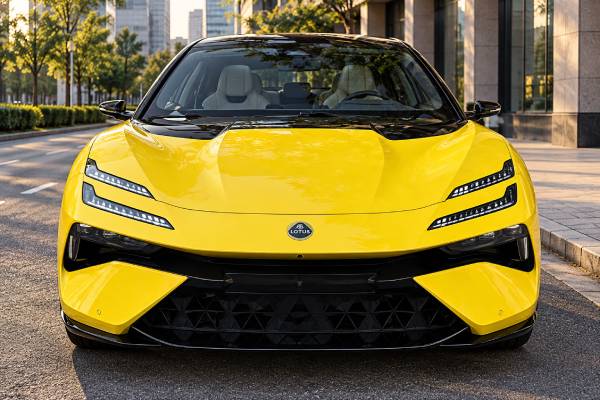
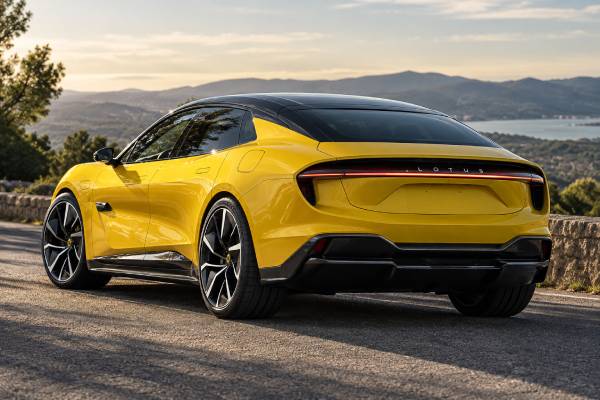
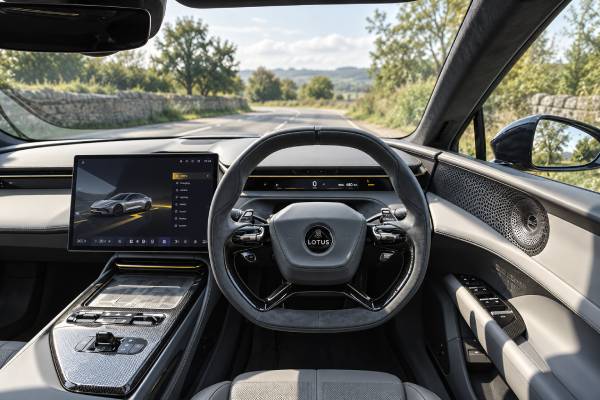
The Lotus Emeya 900 is the high-output version of Lotus’s electric grand tourer, built around a 675 kW dual-motor system, 985 Nm of torque, and a two-speed transmission. In markets that use the simple “900” badge, it sits above the 600 and 600 SE and combines the Emeya’s 102 kWh battery and 800-volt architecture with dramatically stronger acceleration. Published regional figures put 0–100 km/h at 2.78 seconds and top speed at 256 km/h. Those numbers are only part of the story. The 900 is heavier, less efficient, and mechanically more complex than the 600 because its drivetrain is designed to sustain extreme performance across a wider speed range. Buyers should therefore pay close attention to transmission behavior, tires, brakes, battery thermal management, active chassis hardware, and software. This guide explains the 900 as a distinct regional trim, validates its core specifications, and shows how to assess range, charging, maintenance needs, and condition before purchase.
Table of Contents
- Where the Emeya 900 fits
- 900 powertrain and technical specifications
- Why the two-speed transmission matters
- Performance, range, and charging trade-offs
- Chassis, braking, and high-output use
- Maintenance and ownership priorities
- Buying and inspecting an Emeya 900
Where the Emeya 900 fits
The Emeya 900 is the powertrain flagship in markets that use the 600/600 SE/900 naming structure. It is not simply a 600 with software unlocking more output; Lotus pairs a different high-output drivetrain with a two-speed transmission and 985 Nm of system torque.
Regional naming matters. Europe commonly presents the same high-output family as 900 Sport and 900 Sport Carbon, while Korea and China use a simpler 900 designation in current material. A vehicle advertised as “900” should therefore be evaluated against the documentation for its original market. Equipment such as wheel design, carbon trim, seat configuration, powered doors, rear steering, anti-roll control, and brake hardware can differ even when the 675 kW powertrain is shared.
Official Chinese technical data lists 225 kW at the front axle and 450 kW at the rear for the 900, unlike the evenly split 225/225 kW arrangement used by 600-series cars. That rear emphasis helps explain the way the car achieves 675 kW total output while retaining all-wheel traction. The 985 Nm system torque figure is also substantially higher than the 600’s 710 Nm.
Korean Lotus material identifies the 900 with a 102 kWh CATL NCM battery, 918 PS, a 2.78-second 0–100 km/h time, and local certified range data around 374 km on cited wheel configurations. Chinese material publishes 530 km CLTC. European 900-family data uses WLTP and quotes about 485 km in lower-energy configuration. These figures are not interchangeable because they come from different certification procedures.
The 900 should therefore be chosen for performance, not because its higher number implies that it is universally “better.” Drivers who regularly cover long motorway distances may prefer the extra efficiency and towing capacity of a 600. Drivers who specifically want sub-three-second acceleration and the two-speed drivetrain will find the 900’s compromises easier to justify.
900 powertrain and technical specifications
The defining hardware is a pair of permanent-magnet electric drive units with a combined 675 kW output and a two-speed reduction transmission. The system is rear-biased in published Chinese data, with 225 kW front and 450 kW rear drive units.
| Item | Specification |
|---|---|
| Vehicle type | Battery-electric five-door grand tourer |
| Drive | Dual-motor all-wheel drive |
| Front drive unit | 225 kW in official Chinese data |
| Rear drive unit | 450 kW in official Chinese data |
| System output | 675 kW / 905 hp (918 PS) |
| System torque | 985 Nm / 727 lb-ft |
| Transmission | Two-speed reduction transmission |
| 0–100 km/h | 2.78–2.8 seconds depending on published rounding |
| Maximum speed | 256 km/h / 159 mph |
| 80–120 km/h | 1.7 seconds in official Chinese technical data |
The 102 kWh battery is shared in gross capacity with the broader Emeya line. European 900 data gives 98.9 kWh usable, NMC chemistry, and an 800-volt-class architecture.
| Item | Specification |
|---|---|
| Gross battery capacity | 102.0 kWh |
| Usable capacity in European 900 data | 98.9 kWh |
| Chemistry | NMC lithium-ion; CATL pack cited in regional data |
| Electrical architecture | 800 V class |
| Maximum AC charging | 22 kW three-phase in European specification |
| Claimed maximum DC charging | 420 kW |
| Claimed 10–80% DC time | About 15 minutes |
| Navigation battery preconditioning | Supported in current European data |
| European connectors | Type 2 AC / CCS DC |
Range depends heavily on the certification cycle. A buyer should use the figure for the exact market and wheel package rather than choosing the largest number seen online.
| Source context | Published figure |
|---|---|
| European WLTP low-energy configuration | 485 km / 301 mi |
| European WLTP higher-energy configuration | About 435 km / 270 mi |
| Chinese official CLTC | 530 km / 329 mi |
| Korean certified figure in current local material | 374 km / 232 mi on cited 21/22-inch configurations |
| EV Database modeled real range | 465 km / 289 mi |
The body is the same long liftback form as other Emeyas, but the 900’s higher-output hardware raises mass and reduces payload relative to 600-series European specifications.
| Item | Specification |
|---|---|
| Length | 5,139 mm / 202.3 in |
| Width | 2,005 mm / 78.9 in |
| Width including mirrors | 2,241 mm / 88.2 in |
| Height | About 1,459–1,464 mm by regional specification |
| Wheelbase | 3,069 mm / 120.8 in |
| EU unladen mass in European 900 data | 2,650 kg / 5,842 lb |
| Maximum permitted mass | 3,100 kg / 6,834 lb |
| Rear luggage volume | 509 L |
| Maximum rear cargo with seats folded | 1,388 L |
| Front luggage compartment | 34 L |
| Item | Specification |
|---|---|
| Front suspension | Air suspension |
| Rear suspension | Air suspension |
| Adaptive damping | Electronically controlled |
| Front tire size in cited 21-inch specification | 265/40 R21 |
| Rear tire size in cited 21-inch specification | 305/35 R21 |
| Payload in cited ADAC 900-family data | 450 kg / 992 lb |
| Braked trailer rating | 1,225 kg / 2,701 lb |
| Unbraked trailer rating | 750 kg / 1,653 lb |
| Maximum nose weight | 75 kg / 165 lb |
| Item | What matters |
|---|---|
| Active rear steering | Check operation, alignment, and warnings where fitted |
| Intelligent anti-roll control | Verify by market/build specification |
| Active aerodynamics | Inspect spoiler/grille mechanisms and fault history |
| OTA software | Confirm current version and account transfer |
| Vehicle warranty | 5-year examples vary by market and mileage cap |
| High-voltage coverage | Up to 8 years with market-specific mileage limits |
| Battery capacity warranty | 70% threshold in published Lotus terms |
Why the two-speed transmission matters
The 900’s two-speed transmission is the most important mechanical difference from the 600 family. Electric motors can deliver strong torque across a broad speed range, but a second ratio lets Lotus optimize both low-speed acceleration and high-speed performance without relying on a single compromise ratio.
In the lower ratio, the drivetrain can multiply torque aggressively for launch performance. That helps explain how a car weighing roughly 2.65 tonnes can reach 100 km/h in less than three seconds. At higher road speed, the second ratio can keep motor speed in a more useful operating range and support the 256 km/h maximum speed.
The driver does not need to manage the transmission like a conventional manual gearbox. Control is electronic, and the shift is part of the powertrain strategy. Even so, a used-car test should pay attention to the moment load changes under strong acceleration. There should be no repeated hesitation, harsh mechanical bang, driveline warning, or inconsistent delivery.
A single unusual sensation does not automatically prove a transmission fault because traction control, battery state, temperature, tire grip, and drive mode can alter acceleration. The useful test is repeatability. If the car behaves differently on otherwise similar runs, record the conditions and have fault memory checked.
Transmission service requirements should come from Lotus documentation for the VIN. Do not assume that “EV” means the reduction gear has no fluid or inspection needs. Electric drive units still contain bearings, gears, seals, and lubricants, and the two-speed 900 adds more moving hardware than a single-speed 600.
The two-speed system also affects purchase choice. A buyer who never uses the car’s extreme acceleration may gain little from the extra complexity and reduced range. For someone who wants the full 900 experience, it is central to the car’s character rather than a minor specification detail.
What normal two-speed behavior should feel like
Because the 900 can change ratio under very high load, owners should learn the difference between a deliberate shift event and a fault. Under hard acceleration, a brief change in thrust as the driveline selects the higher ratio can be normal. It should feel controlled and repeatable, not like a loss of electrical power followed by a violent re-engagement. The instrument display may also change the way it presents performance information according to drive mode and software version.
Test the car at more than one battery state. Very low charge, a cold pack, or high thermal load can reduce available power, so comparing one launch at 90% with another at 15% tells little about transmission health. A better approach is to repeat moderate and strong acceleration once the battery and tires are at normal operating temperature.
Listen during low-speed transitions as well. Selecting drive or reverse should not produce a persistent clonk, grinding sound, or repeated delay. Some drivetrain lash can be perceptible in a powerful EV, but a noise that worsens with direction changes or load reversal deserves diagnosis. Ask whether the car has received any drivetrain software campaigns and whether previous owners reported shift-related warnings.
Finally, avoid using launch performance as the only test. A faulty wheel, tire, mount, or half-shaft can mimic drivetrain vibration under power. Diagnosis should combine road behavior with a module scan and physical inspection instead of assuming every acceleration-related symptom originates inside the two-speed unit.
Performance, range, and charging trade-offs
The 900 turns the same nominal battery size into much greater peak performance, so efficiency is inevitably lower than in a 600. European data around 22.4 kWh/100 km and 485 km WLTP illustrates the trade-off clearly.
Real consumption can vary even more because the 900 makes very high power easy to access. Repeated full-throttle acceleration converts stored energy into speed and heat at a rate no laboratory range cycle is designed to represent. At restrained motorway speeds, the car can still travel efficiently for its size, but driving style has unusual leverage over range.
Temperature also matters. Cold batteries provide and accept power differently, cabin heating consumes energy, and cold dense air increases aerodynamic drag. In hot weather, battery and motor cooling may run harder after repeated high-load driving. Owners should view thermal-management noise as part of the vehicle’s normal operation unless it is accompanied by warnings or abnormal behavior.
The high-voltage architecture helps recover time on long journeys. Lotus claims up to 420 kW DC and roughly 15 minutes from 10% to 80% under suitable conditions. Independent database modeling places the charge curve slightly differently, which is normal because real sessions depend on charger capability, pack temperature, software, and test method.
The practical strategy is to arrive at a high-power site with a warm battery and low state of charge. A 500 kW charger can be useful because it gives the car room to request its peak, but even a stable 300–350 kW site can produce a very quick stop. Charging to 100% on the road usually wastes time unless the next leg genuinely requires it.
At home, 22 kW AC capability is valuable only if the building can provide three-phase power at that rate. A lower-power wallbox can still replenish normal daily use overnight. Buyers without home charging should calculate their actual local options before assuming the fast DC system will solve every routine need.
Chassis, braking, and high-output use
A 905 hp grand tourer needs chassis systems that manage mass as carefully as they manage power. The 900’s air suspension, adaptive damping, active aero, and market-dependent rear steering and anti-roll systems are essential to its character.
The first priority is tires. The 21-inch European fitment uses 265/40 front and 305/35 rear tires, with larger options available in some markets. Correct load rating, matching performance characteristics, tread depth, and pressure are critical because the car can demand huge longitudinal and lateral grip almost instantly.
Inspect tires across their full width. Inner-shoulder wear can be hidden by the body, and a rear-steering or alignment issue can consume expensive rubber quickly. After any curb impact or suspension repair, use a workshop that understands the correct alignment and chassis calibration procedure.
Braking deserves equal attention. Regeneration handles much routine deceleration, but emergency and repeated high-speed stops depend on the friction system. Check discs for cracking, heavy corrosion, heat spotting, or deep lips, and verify that the pedal remains consistent after several stops. Regional 900 specifications can include different brake packages, so identify the exact fitted hardware before ordering parts.
The suspension should remain level after parking and move through available height settings without excessive compressor noise. A car that slowly sinks at one corner or repeatedly corrects its height may have an air leak or sensor issue. Active anti-roll hardware, where fitted, should not generate clunks or persistent chassis warnings.
Use full acceleration only when conditions permit and tires are warm enough to provide predictable grip. Even with all-wheel drive and electronic control, 985 Nm can overwhelm poor surfaces. Wet paint lines, cold tires, standing water, and loose debris reduce the margin quickly.
Maintenance and ownership priorities
The 900’s maintenance burden is concentrated in high-value systems rather than conventional engine service. Tires, brakes, suspension, cooling circuits, reduction/transmission hardware, sensors, software, and the 12-volt electrical system deserve scheduled attention.
Service the vehicle according to its market schedule and keep records. An EV can appear to need little work while still requiring brake-fluid replacement, cabin filtration, climate-system inspection, coolant checks, chassis inspection, and software campaigns. The 900’s performance makes neglect more consequential because every component operates under greater potential load.
Battery care begins with physical protection. Inspect the underfloor enclosure after any significant impact and use correct lifting points. Do not allow an unqualified workshop to place a jack or lift pad where it can damage battery protection or cooling hardware.
Charging faults should be investigated early. Repeated interruptions at multiple known-good stations, connector overheating, error messages, or a sudden inability to reach expected power can point to the car rather than the charger. Record state of charge, temperature, station type, and fault messages so a technician has useful context.
Software updates are part of the ownership cycle. Lotus can change interface behavior and dynamic calibration through OTA releases. Before buying a used car, verify that updates install successfully and that the vehicle is not stuck on an old release because of account, connectivity, storage, or low-voltage issues.
The auxiliary battery can create disproportionate trouble if weak. It powers controllers and enables the high-voltage system to initialize. If the car has been stored for long periods, test the 12-volt system rather than assuming a charged traction battery guarantees reliable startup.
Finally, budget realistically. Insurance, premium tires, wheel repairs, brake components, and specialist labor can be substantial. The purchase price is only the first part of running a 905 hp luxury EV.
Buying and inspecting an Emeya 900
A used Emeya 900 should be inspected as both a high-performance car and a connected EV. The fastest examples are not automatically the best buys; condition, software, charging health, and market support are more important than a small mileage difference.
First establish identity. Match VIN, registration, original invoice, and build data. Confirm whether the vehicle is a simple regional 900 or a 900 Sport/Carbon from another market, and list the exact brakes, wheels, rear-steering hardware, roof, seats, doors, audio, and driver-assistance equipment.
Inspect wheels and tires before driving. Look for repaired rims, mismatched tires, sidewall damage, and uneven tread. Then examine the underside for battery-enclosure damage and evidence of incorrect lifting. A clean exterior does not prove the car has avoided impacts underneath.
Begin the road test gently. Check steering self-centering, low-speed maneuvering, suspension noise, ride-height warnings, and brake blending. Once the car is warm and conditions are safe, apply progressively more acceleration and pay attention to the two-speed powertrain. Delivery should be strong and repeatable, without mechanical bangs or error messages.
Use a smooth high-speed road to check for wheel vibration. Then test several braking events and recheck the dash for warnings. If the car has active rear steering or anti-roll control, confirm there are no chassis messages and ask for alignment or repair records after any accident.
Charging should be demonstrated. AC charging proves one part of the system; a DC session is even more useful because it exercises additional high-voltage hardware and thermal management. Do not expect headline power if the battery is too full or cold, but repeated faults are unacceptable.
Test the entire digital cabin: displays, head-up display, cameras, parking assistance, seats, climate, roof, audio, phone integration, navigation, app pairing, and powered doors where equipped. Confirm that the prior owner can release the car from their account and that local connected services support the vehicle’s original market.
Have a Lotus-capable workshop run a diagnostic scan and verify outstanding campaigns. Ask specifically about drivetrain, transmission, high-voltage, charging, chassis, steering, brake, and body-control modules. For imported cars, obtain written confirmation of warranty and service eligibility.
The Emeya 900 makes sense when its extraordinary performance is the point, not merely a specification trophy. It gives up some range, payload, towing capacity, and simplicity compared with a 600, but returns acceleration and high-speed capability at a level few large luxury EVs can match. The right example should feel mechanically composed, charge reliably, carry current software, and have tires and chassis systems capable of safely supporting what 675 kW can do.
Ownership also rewards restraint. Using the available performance selectively reduces tire and brake wear, lowers energy consumption, and leaves more thermal headroom for the moments when full output is genuinely useful. That does not diminish the 900’s appeal; it makes the car easier to enjoy repeatedly rather than treating every drive as a demonstration of its maximum acceleration.
References
- 技术参数 2026
- LOTUS EMEYA 로터스 에메야 2026
- Lotus Emeya 900 (2025-2026) price and specifications – EV Database 2026
- Lotus Emeya – The Fully Electric Hyper-GT | Lotus Cars 2026
- Lotus believes processing power is the new horsepower – and Emeya built on NVIDIA DRIVE is a thoroughbred 2023
- Lotus Cars Official Site 2026 (Warranty)
Disclaimer
This article is for informational purposes and is not a substitute for professional diagnosis or repair. Specifications, torque values, service intervals, charging performance, transmission procedures, wheel approvals, warranty terms, and equipment can vary by VIN, market, options, and software version. Verify all vehicle-specific information in current official Lotus service and homologation documentation.
If this Emeya 900 guide was useful, please share it on Facebook, X/Twitter, or another automotive community.