
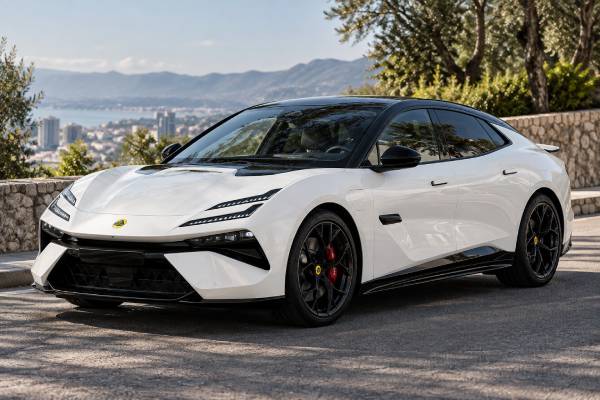
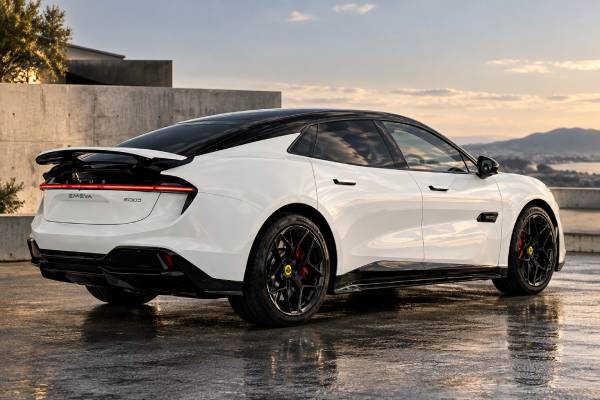
The Lotus Emeya 600 GT is the version to look at when the standard 450 kW Emeya powertrain is already more than fast enough, but the entry specification feels too plain for a luxury grand tourer. It keeps the 603 hp dual-motor AWD system, 102 kWh battery, 800-volt architecture, and single-speed drivetrain, then builds the car around a more upscale GT equipment level. In current European data, the 600 GT uses 21-inch staggered tires, six-piston front brakes, air suspension, a 22 kW onboard AC charger, and a WLTP range figure around 580 km. It still reaches 100 km/h in roughly 4.2 seconds and 250 km/h, so there is no performance penalty for choosing the comfort-oriented 600 power level. The most important buying detail is regional specification: Lotus does not sell the exact same GT package in every country, so the VIN and original options list should always be checked before assuming a feature is standard.
Table of Contents
- Where the 600 GT fits in the Emeya range
- 600 GT technical profile and specifications
- Road behavior: speed without 900-series excess
- Touring efficiency, charging, and range
- Equipment, cabin technology, and practicality
- Service needs and running-cost traps
- New and used 600 GT buying strategy
Where the 600 GT fits in the Emeya range
The 600 GT is a trim-and-equipment step, not a different motor specification. Its value comes from adding a more complete grand-touring setup around the same 450 kW, 710 Nm drivetrain used elsewhere in the 600 family.
That makes the 600 GT easy to misunderstand. A buyer looking only at horsepower may ask why it costs more than a plain 600 when both make 603 hp. The answer lies in the standard chassis, wheel, brake, interior, and convenience equipment chosen for the GT package in a particular market. Current continental European configurator information highlights 21-inch 10-spoke wheels, black six-piston brakes, assistance and parking packages, and interior carbon trim. Those items can matter more in daily use than another power increase.
The 600 GT also occupies an interesting position between efficiency and luxury. It avoids the 900-series car’s 675 kW drivetrain and two-speed transmission, helping preserve the strong range figures associated with the 600 power level. At the same time, it is generally more lavishly specified than the lowest-cost version. For buyers who use the car primarily for commuting, motorway travel, and fast cross-country driving, that can be a more rational allocation of money than buying the quickest model.
There is one complication: the name is not universal. Some markets list a 600, 600 GT SE, and 600 Sport SE without a separate GT, while other European markets sell the 600 GT as the entry point. Because the mechanical platform is shared, online listings sometimes merge specifications from adjacent variants. Always confirm the actual equipment by VIN rather than assuming that every result labeled “600 GT” represents the same national specification.
600 GT technical profile and specifications
The 600 GT is a BEV with a front and rear permanent-magnet synchronous motor in published European technical data, a single-speed reduction transmission, and all-wheel drive. Its 102 kWh gross battery supports an 800-volt-class charging system, while the GT wheel and tire package in ADAC data uses 21-inch staggered fitment.
| Specification | Value |
|---|---|
| Powertrain type | Battery-electric, dual-motor AWD |
| Maximum system power | 450 kW (603 hp; 612 PS) |
| Maximum system torque | 710 Nm (524 lb-ft) |
| Front motor | Permanent-magnet synchronous motor, 225 kW in ADAC data |
| Rear motor | Permanent-magnet synchronous motor, 225 kW in ADAC data |
| Transmission | Single-speed reduction gear |
| Drive | All-wheel drive |
| Battery capacity | 102.0 kWh gross; 98.9 kWh net in European data |
| Battery chemistry | Lithium-ion; NMC in published battery databases |
| Electrical architecture | 800 V class |
| Specification | Value |
|---|---|
| 0–100 km/h | About 4.2 seconds |
| Top speed | 250 km/h (155 mph) |
| WLTP combined consumption | 18.7 kWh/100 km in ADAC-listed German specification |
| WLTP electric range | 580 km (360 mi) in the same listed specification |
| WLTP city range | 657 km in ADAC data |
| Exterior driving noise | 69 dB in homologation data |
| Tailpipe CO2 | 0 g/km |
| Specification | Value or condition |
|---|---|
| AC connector | Type 2 |
| DC connector | CCS |
| AC charging | Three-phase, up to 22 kW |
| Published 22 kW AC full-charge time | About 330 minutes |
| Maximum DC charging claim | Up to 420 kW |
| Published DC 10–80% time | About 15 minutes under suitable conditions |
| Battery preconditioning | Supported on current Emeya software |
| Regeneration | Selectable regenerative braking |
| Specification | Value |
|---|---|
| Length | 5,139 mm (202.3 in) |
| Width without mirrors | 2,005 mm (78.9 in) |
| Width with mirrors | 2,241 mm (88.2 in) |
| Height | 1,459 mm (57.4 in) |
| Wheelbase | 3,069 mm (120.8 in) |
| EU unladen weight | 2,555 kg |
| Maximum permissible mass | 3,100 kg |
| Published payload | 545 kg |
| Braked towing capacity | 2,250 kg |
| Unbraked towing capacity | 750 kg |
| Specification | Configuration |
|---|---|
| Front suspension | Air suspension |
| Rear suspension | Air suspension |
| Adaptive damping | Continuously controlled |
| Front tire size | 265/40 R21 in listed European GT specification |
| Rear tire size | 305/35 R21 |
| Main luggage capacity | 509 L |
| Maximum cargo capacity | 1,388 L with rear seats folded |
| Front luggage compartment | 34 L |
| Maximum ground clearance | 166 mm in ADAC data |
| Coverage | Typical European term |
|---|---|
| Vehicle | 5 years or 150,000 km |
| High-voltage battery and electric drive | 8 years or 200,000 km |
| Battery capacity retention | At least 70% state of health within applicable warranty terms |
| Paint | 5 years |
| Anti-corrosion | 12 years for specified body/chassis coverage |
Road behavior: speed without 900-series excess
The 600 GT is fast enough that the limiting factor on public roads is usually the road, not the drivetrain. The 710 Nm arrives immediately and both axles contribute traction, so the car builds speed with very little drama.
That matters for a GT because smooth speed is more useful than a violent launch. The single-speed drivetrain avoids shifts, and the throttle can be metered precisely in traffic or on a wet road. When full acceleration is requested, a little over four seconds to 100 km/h is still serious performance for a full-size luxury fastback.
The chassis is where the Lotus identity has more work to do. A 2,555 kg EU unladen figure is far removed from the featherweight road cars that built the brand’s reputation. Emeya responds with electronically managed air suspension, adaptive damping, brake-based torque vectoring, and multiple drive modes. The goal is not to pretend the mass does not exist; it is to keep the body settled and the steering response predictable as the forces rise.
The GT’s 21-inch tires add both grip and cost. A 265 mm front and 305 mm rear footprint is substantial, and replacement tires should be treated as a major consumable rather than an incidental expense. The wide rear tire helps transmit torque and stabilize the car, but it also increases rolling resistance and can make alignment errors expensive. Inspect the inner shoulder carefully because visible outer tread may not tell the whole story.
Six-piston front brakes listed in the GT equipment package are another meaningful upgrade over a bare minimum specification. They are useful because regenerative braking cannot cover every high-speed stop, especially during repeated hard use or when the battery is near full and regeneration may be restricted. The friction brakes should feel progressive and vibration-free. A pulsing pedal or steering shake under moderate braking is a reason to inspect discs, hubs, wheel balance, and suspension rather than accepting it as normal EV behavior.
Touring efficiency, charging, and range
The 600 GT’s real strength is the relationship between usable range and recharge time. A 580 km WLTP figure is competitive on its own, but the ability to recover a large portion of the battery in roughly a quarter hour at a sufficiently capable charger changes how the car works on long trips.
WLTP is still a laboratory-based comparison tool. A motorway driver should expect less than 580 km when travelling quickly, especially in winter or in poor weather. The 21-inch staggered tires also carry more rolling and aerodynamic penalty than the most efficiency-focused 20-inch setup available on some 600 variants. That does not make the GT inefficient; it simply means its official figure is tied to a specific configuration and test cycle.
For road-trip planning, battery temperature and charger capability matter as much as the number printed on the station. A charger advertised at 350 or 400 kW may not provide that output if its cabinet is shared, its cable current is limited, or the station is derated. The car may also request less power if the pack is cold, too full, or too hot. Navigation-based preconditioning helps by bringing the battery toward a suitable temperature before arrival.
Owners should think in time rather than only percentage. Charging from a low state of charge to around 70 or 80% uses the fast portion of the curve. Waiting for the final 10 or 20% is often slower and is usually unnecessary when another charger is available later in the route. For overnight use, AC charging is simpler: even an 11 kW supply can replenish a large amount of energy while the car is parked, and a 22 kW three-phase installation can use the onboard charger’s full capability.
Cold-weather preparation helps twice. Preheating the cabin while plugged in preserves more stored energy for driving, and battery preconditioning can improve rapid-charge performance. Owners who regularly make the same journey can schedule charging and climate preparation rather than beginning every morning with a cold battery and cabin.
Equipment, cabin technology, and practicality
The 600 GT earns its suffix by making the cabin and daily equipment feel more complete, not by altering the output figure. In markets where the trim is offered, the standard package should be checked against the local configurator because Lotus changes bundled features by region.
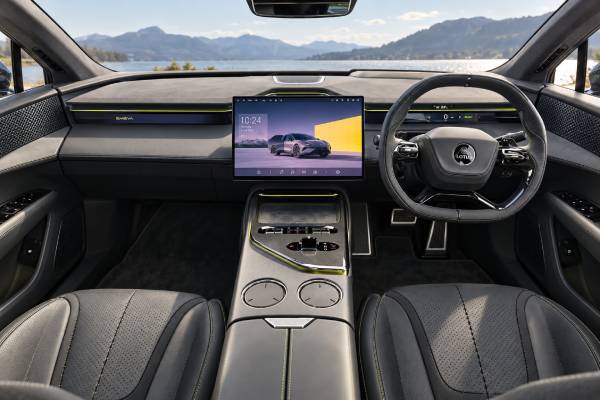
A typical GT specification combines 21-inch wheels, six-piston brakes, parking assistance, driver-assistance hardware, and interior trim upgrades. The broader Emeya platform adds a 15.1-inch OLED center display, head-up display, connected navigation, wireless smartphone integration, over-the-air software support, and a comprehensive sensor system. Current cars can receive software improvements without a workshop visit, which is convenient but also means an older used car may not behave exactly like a new demonstrator until updates are installed.
The hatchback body is one of the car’s underrated advantages. A 509-liter rear compartment is useful for family or business travel, and folding the rear seats increases the space to roughly 1,388 liters. The 34-liter front compartment is small but useful for charging cables or items that owners do not want moving around in the main boot.
Rear-seat comfort is helped by the 3,069 mm wheelbase. The main packaging compromise is the car’s overall footprint. It is more than five meters long and about 2.24 meters wide with mirrors, so underground parking, narrow gates, and older city garages can feel tight. Before buying, measure the actual home parking space rather than assuming that because the car has cameras it will fit comfortably.
The technology suite should be tested methodically. Pair a phone, run the navigation, check camera clarity, test the HUD, operate every seat adjustment, confirm climate zones, and cycle any powered roof or door features present on the car. Also check that the prior owner has removed the vehicle from their account so the Lotus app and connected services can transfer cleanly.
Long-distance ergonomics and load planning
A GT also has to remain easy to live with after the novelty of its acceleration has worn off. Before committing to a 600 GT, spend enough time in the driving position to assess the things that matter after several hours: steering-wheel reach, the relationship between seat base and pedals, visibility past the A-pillars, and whether the head-up display can be placed comfortably in the driver’s eye line. A five-minute showroom sit cannot reveal whether a seat bolster, armrest, or screen angle becomes tiring on a long journey.
The same test should include the rear seats. The long wheelbase provides generous legroom, but comfort depends on the exact seat package and passenger height. Check foot space under the front seats, head clearance with the fitted roof, entry through the low roofline, and access to climate and charging controls. Buyers who frequently carry adults in the rear should judge those details themselves rather than assuming that exterior size automatically guarantees limousine-like accommodation.
Luggage planning is similarly more nuanced than the headline boot volume. The hatch opening makes bulky bags easier to load than in a conventional saloon, while the front compartment is useful for separating wet or dirty charging cables from luggage. For airport runs or family holidays, test the largest suitcase or child equipment you actually use. If the rear seats will be folded regularly, check how flat the resulting floor is with the chosen seating configuration and make sure loose cargo can be restrained securely.
Payload deserves attention when the car is carrying four adults and a full boot. Published mass and maximum-permitted-weight figures leave a finite allowance for occupants, luggage, accessories, and any towball load. Owners planning long trips with several passengers should add those loads rather than relying on visual space alone. The same principle applies to towing: confirm the permitted figure for the exact market car and its homologated equipment before ordering a hitch or trailer.
Finally, remember that wheel and tire choice affects touring character continuously. The standard GT package favors appearance and response, but a driver who values quietness, ride compliance, and replacement cost should compare available wheel sizes before ordering. Tire specification also matters; use the correct load and speed ratings and keep matched performance characteristics across each axle. Those details are mundane compared with 450 kW output, yet they determine whether the 600 GT feels genuinely relaxing on the journeys its badge implies.
Service needs and running-cost traps
The 600 GT removes engine-related maintenance, but its size and sophistication make careless ownership expensive. Tires, brakes, suspension components, wheel damage, sensor calibration, climate-control systems, software, and battery cooling are the areas that deserve most attention.
Tires are the first recurring cost to budget. A staggered setup means front and rear tires cannot simply be rotated in the conventional way, and matching high-performance sizes are not cheap. Keep pressures correct, inspect tread across the entire width, and have the alignment checked if one shoulder wears faster than the other. A pothole strike that bends a 21-inch wheel can also create vibration that is easy to misdiagnose as a driveline problem.
The braking system needs periodic physical inspection even if regenerative braking reduces pad wear. Surface corrosion, uneven deposits, or seized components can occur when friction brakes see little use. Brake fluid remains a time-dependent service item because it absorbs moisture. Follow the official market schedule rather than using pad thickness alone as the maintenance indicator.
Air suspension and adaptive dampers should operate quietly and consistently. A car that sits low on one corner after being parked, takes unusually long to raise, or displays chassis warnings deserves diagnosis before purchase. These systems are fundamental to the Emeya’s ride and handling, not optional decorative technology.
The high-voltage battery has substantial factory coverage, but warranty should not replace inspection. Ask for a battery health report where available and check for damage to the underbody protection. Any sign of impact near the pack should be investigated by a qualified technician. Verify that both AC and DC charging work and that there are no stored charging-system faults.
Finally, maintain the software and connected systems. Lotus has issued OTA updates for Emeya, including dynamic-control changes in some regions. A car that has missed updates may have older menus, calibration, or feature behavior. For an imported vehicle, verify that the local dealer can support its market coding, maps, eSIM services, and warranty status before purchase.
New and used 600 GT buying strategy
Choose the 600 GT when you want the 600 powertrain but prefer a more complete chassis and luxury specification than the most basic car. Do not choose it simply because the badge sounds more prestigious; compare the actual equipment against a 600 GT SE and against a well-optioned 600.
For a new order, begin with wheel choice and the comfort features that are difficult to change later. Larger wheels alter ride, tire cost, and efficiency every day. An intelligent glass roof, seat package, rear-steering system, or powered-door option can matter far more to ownership than paint color. Build the car around usage rather than the showroom impression.
For a used car, inspect provenance first. Match the VIN, trim, original options, and selling market. Then check battery health, charging, tires, brakes, wheel condition, underbody protection, suspension operation, software version, and every major electronic function. A full diagnostic scan is worthwhile because it can reveal stored faults that are not visible during a short test drive.
Accident history deserves extra care because Emeya uses many sensors and electronically controlled systems. A replacement windshield, bumper, mirror, or front-end component may require calibration of cameras, radar, or LiDAR depending on equipment. Ask for repair invoices and calibration records. A cosmetically excellent repair is not enough if driver-assistance hardware was never set up correctly afterward.
Also price consumables before negotiating. If a cheaper example immediately needs four premium 21-inch tires, wheel refurbishment, brake work, and software attention, the apparent saving can disappear quickly. Conversely, a higher-priced car with recent tires, documented service, a healthy battery, clean bodywork, and current software may be the lower-cost ownership proposition.
The 600 GT’s strongest argument is balance. It delivers the full 603 hp 600-series performance, a useful 580 km WLTP figure in published European specification, very fast charging, and the equipment expected of a serious long-distance GT without stepping into the 900’s more extreme drivetrain. For many buyers, that is exactly where the Emeya range makes the most sense.
That balance also makes specification discipline important. A 600 GT with the right wheels, comfort equipment, current software, and documented care can be a better long-term car than a higher trim chosen only for extra options. Judge the actual vehicle, its market specification, and its condition rather than the badge hierarchy alone.
References
- Lotus Emeya 600 GT (ab 04/25): Technische Daten, Bilder, Preise | ADAC 2025
- Lotus Emeya Configurator | Lotus Cars Belgique 2026
- Lotus Emeya – The Fully Electric Hyper-GT | Lotus Cars 2026
- Lotus Emeya – Explore Models | Lotus Cars 2026
- Lotus Cars Official Site 2026 (Warranty)
- Lotus believes processing power is the new horsepower – and Emeya built on NVIDIA DRIVE is a thoroughbred 2023
Disclaimer
This article is for informational purposes and is not a substitute for professional diagnosis or repair. Specifications, torque values, service intervals, charging figures, software functions, and procedures can vary by VIN, market, options, and software version; always verify them against official Lotus service documentation for the exact vehicle.
If you found this guide useful, please share it on Facebook, X/Twitter, or another automotive community to support our work.