
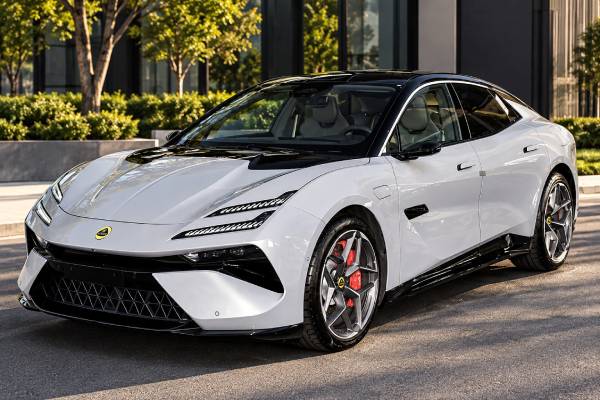
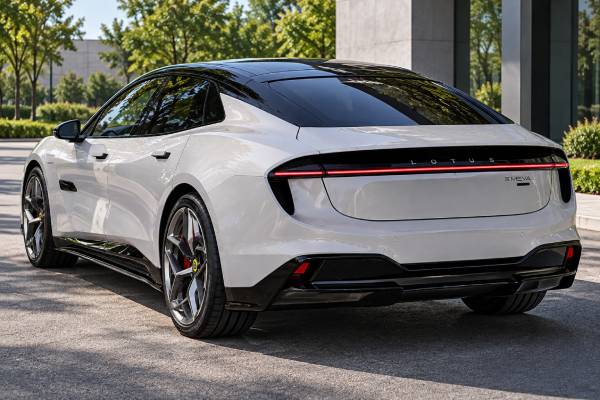
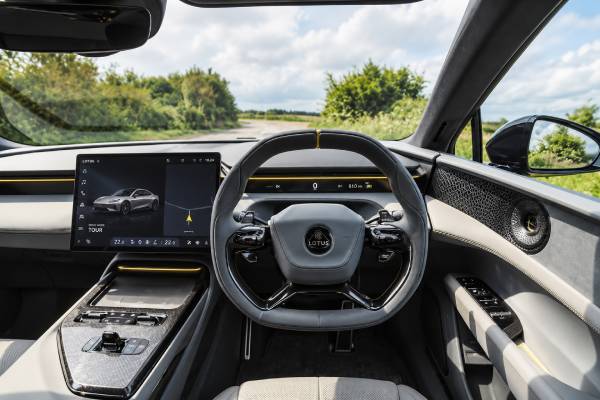
The 2025 Lotus Emeya 600 Luxury Edition is the middle five-seat version of the China-market Emeya 600 range, combining the 450 kW dual-motor drivetrain with more luxury content than the Touring while avoiding the four-seat packaging and much higher price of the Executive. Its core figures are 603 hp, 710 Nm, a 102 kWh battery, 585 km of CLTC-rated range, five seats, and a 509-litre luggage compartment. The documented launch price was RMB 568,000 in February 2025.
Those numbers make the Luxury Edition an important “balance” trim rather than an afterthought. It gives up some certified range to the 650 km Touring, but preserves full family seating and cargo capacity while offering the equipment emphasis implied by the Luxury badge. It also avoids the 900-series two-speed, 905 hp drivetrain, so owners retain the simpler 450 kW single-speed architecture and its lower energy demand. This guide focuses on the exact 2025 Chinese specification, the reasons its range differs from Touring, the features worth checking, and the maintenance and buying decisions that matter in real ownership.
Table of Contents
- Why the 600 Luxury Is the Middle-Ground Emeya
- Technical Profile of the 600 Luxury Edition
- Why Its CLTC Range Is 585 km
- Five-Seat GT Practicality
- Luxury and Technology Features Worth Testing
- Road Manners, Tyres, and Brakes
- Ownership Costs and Used-Car Checks
Why the 600 Luxury Is the Middle-Ground Emeya
The 600 Luxury sits between Touring and Executive because it preserves the regular five-seat fastback layout while adding a stronger luxury emphasis. Its RMB 568,000 launch price was RMB 40,000 above Touring and RMB 140,000 below Executive, yet all three shared the same 450 kW and 710 Nm headline drivetrain output.
That makes trim selection less about acceleration and more about equipment, packaging and range. A buyer choosing Luxury did not pay to make the Emeya faster in a straight line. The car still reaches 100 km/h in about 4.2 seconds and has a 250 km/h maximum speed. Instead, the appeal is a richer specification without sacrificing the centre rear seat or reducing rear luggage capacity to the Executive’s 426 litres.
Compared with Touring, the Luxury’s certified CLTC range falls from 650 to 585 km. The cars use the same nominal 102 kWh battery and the same combined power, so the difference is not evidence of a smaller pack or detuned motor. Equipment, wheel/tyre configuration, ride height, mass, homologation setup and energy consumption can all change the certified result. Archived data lists the Luxury at 2,465 kg and 18.8 kWh/100 km, versus 2,455 kg and 16.8 kWh/100 km for Touring.
That makes the Luxury especially suitable for owners who want one Emeya to do nearly everything: commute, carry five people, cover long highway journeys, and still feel special inside. It is less specialized than the Executive and less range-maximized than Touring. In return, it avoids the compromises at both ends.
The 2025 model-year naming is also important. Earlier Chinese Emeyas used S+, R+ and other labels, while current global material may call comparable lower-output cars 600. A 2025 600 Luxury should therefore be checked against its original Chinese build data. Using an earlier S+ brochure or a later global 600 configurator can introduce incorrect assumptions about equipment, wheels, software or certification.
The car’s physical size remains unchanged in the fundamentals: 5,139 mm long, 2,005 mm wide, and 3,069 mm between the axles. Owners moving from a conventional sports car need to account for that width and the cost of large tyres, while families gain genuine rear accommodation and a large hatchback opening.
Technical Profile of the 600 Luxury Edition
The Emeya 600 Luxury is a five-door battery-electric liftback with permanent-magnet motors on both axles, electric all-wheel drive and a fixed-ratio single-speed transmission. Each motor is rated at 225 kW peak, producing a combined 450 kW and 710 Nm, while the 102 kWh CATL NMC pack supports an 800-volt-class charging system.
| Item | 600 Luxury Edition |
|---|---|
| Front motor peak output | 225 kW |
| Rear motor peak output | 225 kW |
| Combined output | 450 kW / 603 hp |
| Combined torque | 710 Nm |
| Drive | Dual-motor AWD |
| Transmission | Single-speed fixed ratio |
| 0–100 km/h | 4.2 seconds |
| Top speed | 250 km/h |
| Item | Specification |
|---|---|
| Battery capacity | 102 kWh |
| Battery chemistry | Ternary NMC |
| Cell supplier | CATL |
| CLTC range | 585 km |
| Published consumption | 18.8 kWh/100 km |
| Peak DC charging | 420 kW |
| 10–80% DC time | About 0.25 hour in archived data |
| AC charging time | About 5.5 hours in archived data |
| Measure | Value |
|---|---|
| Length | 5,139 mm |
| Width | 2,005 mm |
| Height | 1,464 mm |
| Wheelbase | 3,069 mm |
| Seating | Five |
| Rear luggage volume | 509 litres |
| Curb weight | 2,465 kg |
| Gross vehicle weight | 3,100 kg |
| System | Configuration |
|---|---|
| Front suspension | Multi-link independent |
| Rear suspension | Multi-link independent |
| Air suspension | Yes, adjustable height and damping |
| Front brakes | Ventilated discs |
| Rear brakes | Ventilated discs |
| Regenerative braking | Yes |
| Item | Archived specification |
|---|---|
| Front tyres | 265/40 R21 |
| Rear tyres | 305/35 R21 |
| Body type | Five-door liftback |
| Drag coefficient | 0.21 |
| Steering | Electric power steering |
The archived specification gives a useful baseline, but an individual car may have options that affect wheel size, equipment and software. Verify the VIN before ordering tyres, brake parts or suspension components, and use official service data for torque values and maintenance procedures rather than assuming all 600 variants are identical.
Why Its CLTC Range Is 585 km
The Luxury Edition’s 585 km CLTC figure reflects its exact homologated configuration, not a battery disadvantage. It shares the 102 kWh pack with the 650 km Touring and uses the same 450 kW motor pair, but archived consumption for Luxury is higher at 18.8 kWh/100 km.
The difference is a useful reminder that EV range belongs to the entire vehicle. Wheel and tyre choice changes rolling resistance and aerodynamic disturbance. Additional equipment can add weight. Suspension height and aero calibration matter. Climate and comfort systems consume energy. Even if two versions have identical motors and cells, their certification results can diverge when the completed cars are not configured identically.
For an owner, 585 km should be treated as a comparison figure rather than a guaranteed trip distance. CLTC testing does not reproduce every high-speed expressway journey. Sustained speed, winter temperature, cabin heating, summer air-conditioning, strong headwinds, elevation and wet roads can all reduce usable range. Conversely, mild-temperature urban and suburban driving with effective regeneration may produce lower consumption than a fast highway run.
Trip planning is therefore better done with arrival state of charge. If the navigation predicts a charger arrival with a sensible reserve, the driver has flexibility for a closed stall, detour or stronger-than-expected headwind. Trying to use nearly 100% of the battery between stops may make a theoretically efficient plan fragile.
The Luxury’s high-voltage system can compensate for some range disadvantage through rapid replenishment. A peak of 420 kW and roughly 15-minute 10–80% archived charge time place the platform among very fast-charging EVs under favorable conditions. However, the charger must support the required voltage and power, and the battery must be within a suitable temperature and state-of-charge window.
Preconditioning matters. When the car knows a high-power charger is the destination, it can prepare the battery so the session starts closer to the ideal temperature. Without that preparation, especially in cold weather, initial power may be much lower. A short stop after a cold start is not a fair test of the system’s maximum capability.
Owners should watch long-term consumption trends for maintenance clues. If energy use rises noticeably on the same route and weather, check tyre pressures, wheel alignment, tyre type, brake drag and software changes before blaming battery degradation. A heavy EV with wide tyres can lose meaningful efficiency through a simple alignment problem.
Five-Seat GT Practicality
The 600 Luxury is more versatile than the Executive because it retains five seating positions and the full 509-litre rear luggage volume documented for the regular five-seat body. That makes it a better one-car solution for owners who occasionally carry a third rear passenger or load bulky luggage.
The centre rear seat should still be evaluated realistically. The Emeya is broad, which helps shoulder room, but the cabin is designed as a low performance GT rather than an upright MPV. Adults should test headroom, seat shape and foot placement before treating the fifth position as equivalent to the two outboard rear seats. For children, verify the exact child-seat anchorage and airbag guidance in the owner documentation.
The hatchback opening is one of the Emeya’s practical strengths. Compared with a conventional sedan boot, a large liftback aperture makes it easier to load wide suitcases, folded equipment and awkward items. The sloping roof can limit tall box-shaped cargo, so usable geometry matters as much as the litre figure. Folding rear seats, where permitted by the configuration, can extend utility further.
A 2,005 mm body width creates the opposite practical issue. Narrow underground parking, mechanical car parks and old city streets may be more challenging than the interior suggests. Mirror width is greater still. Before purchase, measure a home garage and consider the space needed to open the doors without touching a wall. The wrong parking environment can turn an otherwise excellent daily car into a recurring inconvenience.
The low nose and long wheelbase also demand attention on ramps. Air suspension can help with ride height, but drivers should still approach steep transitions carefully. Inspect the front undertray, rocker areas and battery-protection panels on any used example for scraping. Damage underneath can be more important than a perfect upper body.
For family travel, charging-stop planning can align with passenger breaks. The car’s very high DC capability means the vehicle may be ready before everyone is, provided the battery arrives in the correct condition and the charger delivers. That is a more practical benefit than a headline peak-power number: short stops reduce the “EV penalty” on long journeys.
Luxury and Technology Features Worth Testing
A Luxury Edition should justify its trim position through equipment that actually works, so a pre-purchase check needs to cover cabin technology as thoroughly as the powertrain. The 2025 Chinese Emeya range was marketed with updated seat choices, sophisticated displays, premium audio, AI-based voice functions and advanced driver assistance, but exact fitment and active services remain vehicle-specific.
Start with seats. Operate every power adjustment through its full travel, including lumbar, recline, bolster, heating or ventilation functions where fitted. Save and recall memory positions. Listen for clicking or hesitation. Inspect the leather or other upholstery for stretch, dye wear and damage around child-seat use. A luxury seat with one failed actuator can be costly to restore.
Then work through displays and controls without rushing. Test driver and passenger screens, navigation, Bluetooth, phone projection if supported, voice input, cameras, parking sensors, wireless charging and USB ports. Reboot behavior matters too. A system that looks fine for five minutes may reveal repeated disconnects, black screens or slow wake-up after several ignition cycles.
Premium audio should be checked at low and moderate volume with balance and fade moved around the cabin. Buzzing from one door or a silent speaker can indicate a loose panel, damaged transducer or amplifier issue. Do not dismiss it as unimportant if the high-grade audio system is one reason for choosing Luxury over Touring.
Driver-assistance capability requires especially careful wording. Hardware such as cameras, radar, LiDAR on particular configurations and high-compute processors may be present, but feature activation can depend on software, maps, subscriptions and local regulation. Ask the car to demonstrate the functions that matter during a supervised test drive. Do not rely solely on an old launch list.
Connected services should transfer to the new owner. Confirm that the seller can remove the car from their account, that the buyer can add it, and that remote climate, charging status, digital key and location services operate in the region where the car will be used. Grey imports can face server or app limitations even when all physical hardware is present.
The roof and climate system deserve their own inspection. Check all zones, temperature response, fan speeds, demisting and any smart-glass operation fitted. Water marks or headliner discoloration around the roof need explanation. Luxury equipment is valuable only when it is maintained, and fixing multiple “small” comfort faults can quickly erase a good purchase price.
Road Manners, Tyres, and Brakes
The 600 Luxury’s dynamic character comes from combining 603 hp with active chassis systems rather than maximizing raw power. Its single-speed drivetrain delivers smooth acceleration, while air suspension and adaptive damping manage the mass of a 2,465 kg luxury EV over both fast roads and broken surfaces.
The equal-output front and rear motors make the car naturally balanced in propulsion terms. Electronic control can vary torque delivery quickly without waiting for a mechanical centre differential or combustion engine. In normal driving, the driver notices secure traction and immediate response rather than the control logic behind it.
Air suspension should be assessed in several modes. The car should change height without warning messages and remain level after parking. On rough roads, listen for knocks; on smooth roads, check for vibration or float. A compressor that runs frequently can indicate leakage. Because suspension hardware supports both comfort and aero height control, ignoring an early fault can affect more than ride quality.
Tyres have a major influence on the Luxury’s refinement. The documented staggered 265/40 R21 and 305/35 R21 sizes are wide enough that tread pattern and pressure alter road noise substantially. Match tyres appropriately by axle and specification. Cheap replacements can undermine braking, wet grip and acoustic comfort—three things the Luxury badge is supposed to improve.
Wheel alignment should be checked after significant pothole impacts or if inner-edge wear appears. A car can still track acceptably while running excess toe that consumes tyres and energy. Because front and rear sizes differ, rotation options are limited, making correct alignment more important for extracting full tyre life.
Regenerative braking reduces friction-brake use in everyday traffic, but ventilated discs still need inspection. Low use can allow corrosion; repeated high-speed use can generate thermal wear. During a test drive, make several smooth stops from moderate speed and feel for vibration, pulling or noise. Check brake fluid service by time, not simply by pad thickness.
Ownership Costs and Used-Car Checks
The main costs on a used 600 Luxury are likely to come from tyres, chassis components, cosmetic/luxury equipment and out-of-warranty electronics rather than traditional engine servicing. A pre-purchase inspection should therefore concentrate on those systems and on proving battery and charging health with data.
Begin with identity and history. Confirm the VIN corresponds to a 2025 600 Luxury, not a Touring advertised with upgraded options or an earlier S+ using later terminology. Compare original equipment, seating, wheel specification and market documentation. A correct badge is not enough when mechanically similar 450 kW variants exist.
Inspect the battery enclosure from below and review diagnostic fault history. A dashboard range estimate is influenced by recent driving and cannot establish state of health. Ask a Lotus-capable service facility what battery-health data is available for the VIN. Look for evidence of pack, charger, inverter or cooling-system repairs and make sure any work was documented properly.
Test AC and DC charging. Confirm the port door, connector lock, cable release, scheduled charging and preconditioning. At a fast charger, judge consistency rather than demanding a 420 kW peak. Record state of charge and temperature; high SOC or a cold pack can make a healthy car charge far below its theoretical maximum.
Check the 12-volt system because many EV faults begin there. A weak auxiliary battery can cause wake-up problems, module errors and failed updates despite a healthy traction pack. Ask whether the car has experienced repeated “dead vehicle” events, and inspect whether a replacement battery is of the correct type and properly registered or initialized if required by Lotus procedure.
Look closely at wheels, tyres and body edges. Large rims are vulnerable to kerb damage, while the low underbody can suffer on ramps. Examine active-aero components for impact or sticking. A minor front collision can affect cooling shutters, sensors and calibration even when the bumper has been cosmetically repaired.
Service history should include time-based items. Brake fluid, cabin filtration, coolant-system inspections, air-conditioning performance, wiper equipment and chassis checks still matter. Follow official Lotus intervals for the exact market. “EVs need no maintenance” is not an acceptable explanation for missing records on a complex air-suspended luxury car.
Warranty support can be more important than a small price difference between used examples. Confirm remaining vehicle and high-voltage coverage by VIN with the dealer that will actually service the car. Imported vehicles may have different entitlement, and connected features can be region-dependent. Get clarity before purchase, not after the first fault.
Also ask how collision repairs affect sensor calibration and parts availability. The Emeya integrates cameras, radar and other driver-assistance hardware with active body systems, so a bumper or windscreen replacement can require more than cosmetic work. An invoice showing correct calibration is reassuring after accident repair. If a seller cannot explain why a sensor warning was cleared or which workshop performed the job, budget for an independent diagnostic check before accepting the car.
Budget for consumables at the car’s performance level. Four quality 21-inch tyres, brake work, wheel refinishing and alignment are not economy-car expenses. Insurance should also use the correct trim and replacement value. The Luxury Edition was not the cheapest 600 when new, and its additional cabin equipment can increase repair complexity after accidents.
When those checks are clean, the 600 Luxury makes a persuasive used proposition. It keeps the five-seat practicality and 509-litre hatch, offers much of the technology and cabin appeal buyers expect from the Emeya, and avoids the additional powertrain complexity and energy demand of the 900. Its value comes from balance, so the best example is the one where range, equipment, comfort and condition remain balanced too.
References
- Emeya 2025 600 Luxury | Data.CarNewsChina.com 2026 (Archived Trim Specifications)
- Lotus Emeya 2025 – detailed specifications and trim levels | Data.CarNewsChina.com 2026 (Historical Model-Year Comparison)
- 路特斯更名莲花跑车后首发新品:夏花 SUV 售价 54.8 万元起,繁花轿车 52.8 万元起 2025 (2025 China Range Launch Report)
- 技术参数 2026 (Official China Technical Specifications)
- Lotus Cars Official Site 2026 (Official Emeya Interior Overview)
- Lotus Emeya | How it Drives | Lotus Cars 2026 (Official Engineering Overview)
Disclaimer
This guide is informational and does not replace qualified diagnosis, maintenance, or repair. Specifications, torque settings, service intervals, software availability, charging limits, and procedures can vary according to VIN, market, production date, options, and later updates. Check the official Lotus service and owner documentation for the exact vehicle before ordering parts or performing work.
If this article helped you, please share it on Facebook, X/Twitter, or another platform to support our work.