
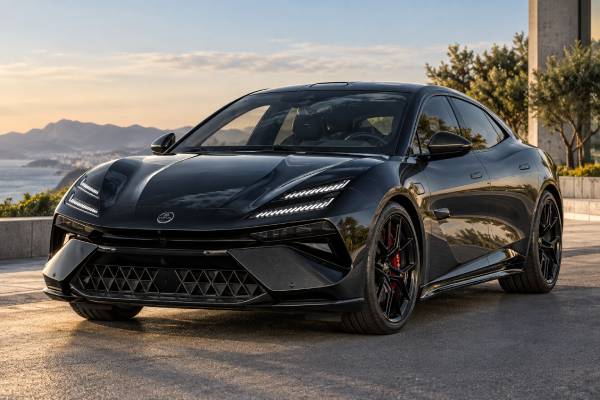
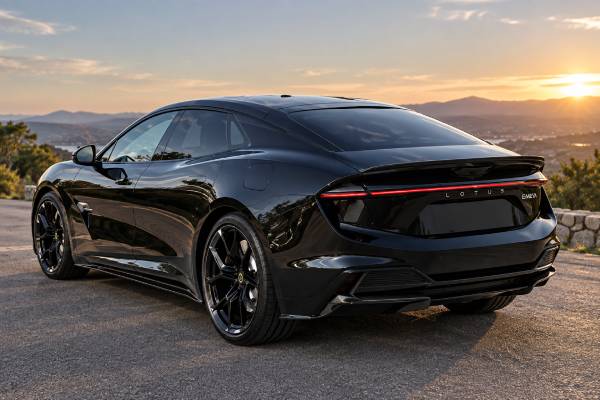
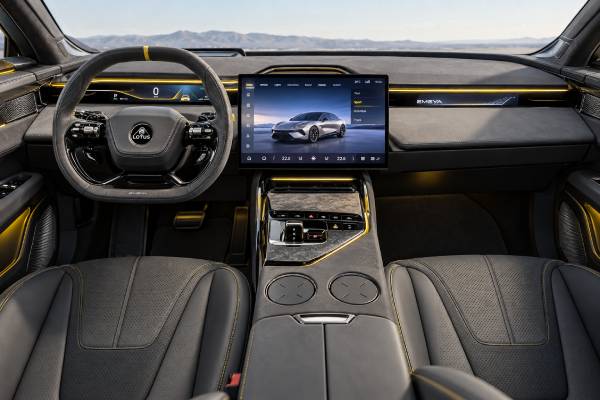
The Lotus Emeya 600 Sport SE is the handling-focused member of the 450 kW Emeya family. Its 603 hp dual-motor drivetrain is familiar from other 600-series cars, but the Sport SE concentrates its extra value in chassis hardware: active rear-wheel steering, Lotus Intelligent Anti-Roll Control in markets where specified, larger performance brakes, 21-inch wheel fitment, and standard active aerodynamic equipment. That makes it a useful alternative to the 900 for drivers who want the most sophisticated chassis without the 675 kW two-speed powertrain. It also means the car should not be judged only by its 0–100 km/h figure. Suspension condition, steering calibration, tire quality, software level, and alignment are central to whether a Sport SE feels as intended. This guide documents the verified drivetrain, battery, dimensions, charging figures, and load ratings, then explains the dynamic hardware, ownership costs, inspection priorities, and specification checks that distinguish a good Sport SE from one that merely wears the badge.
Table of Contents
- The Sport SE concept
- Technical specifications and verified data
- Rear steering, anti-roll control, and active aero
- Brakes, tires, and alignment
- Range and charging without giving up performance
- Maintenance and software priorities
- Buying and inspecting a Sport SE
The Sport SE concept
The 600 Sport SE keeps the same 450 kW and 710 Nm output as the 600 GT and GT SE, so its reason for existing is chassis capability. It is the 600-series choice for a buyer who values response, body control, and steering technology more than a larger power number.
Official Lotus regional configurators identify active rear-wheel steering and Lotus Intelligent Anti-Roll Control as defining Sport SE equipment. Japanese specification material also shows the Sport SE with a standard active rear spoiler, 21-inch wheels, and red six-piston front brake calipers. These features change how the car manages its size and mass rather than how much peak power the motors can produce.
That distinction is important when comparing it with a 900 Sport. The 900 adds 225 kW, 275 Nm, and a two-speed transmission, cutting 0–100 km/h to under three seconds. The 600 Sport SE does not try to imitate that acceleration. Instead, it combines the more efficient 600 powertrain with much of the chassis sophistication a demanding driver may actually notice on winding roads or during fast touring.
It is also not a lightweight sports car. European data puts a 600 Sport SE around 2,555 kg EU unladen, so every dynamic system is working with considerable mass. The interesting engineering question is therefore how effectively the car controls that weight. Active anti-roll hardware can reduce body roll without relying only on very stiff springs, while rear-wheel steering can make the long wheelbase feel more agile at low and medium speed.
Specification varies by market, and optional equipment can blur trim boundaries. A well-optioned 600 GT SE may share several comfort features, while a Sport SE may gain different wheels or carbon parts. Use the factory build sheet and current market configurator rather than assuming that every photographed Sport SE is identical.
Technical specifications and verified data
The Sport SE uses permanent-magnet synchronous motors on both axles and a one-speed reduction drive. European data lists 225 kW and 355 Nm at each axle, giving 450 kW and 710 Nm system output.
| Item | Specification |
|---|---|
| Vehicle type | Battery-electric five-door grand tourer |
| Drive layout | Dual-motor all-wheel drive |
| Front motor | 225 kW / 355 Nm permanent-magnet synchronous motor |
| Rear motor | 225 kW / 355 Nm permanent-magnet synchronous motor |
| System output | 450 kW / 603 hp (612 PS) |
| System torque | 710 Nm / 524 lb-ft |
| Transmission | Single-speed reduction gear |
| 0–100 km/h | 4.2 seconds |
| Maximum speed | 250 km/h / 155 mph |
The 102 kWh battery sits on an 800-volt-class electrical architecture. Published European specification distinguishes 102.0 kWh gross from 98.9 kWh usable, allowing the battery-management system to retain protective buffers.
| Item | Specification |
|---|---|
| Gross battery capacity | 102.0 kWh |
| Usable battery capacity | 98.9 kWh |
| Architecture | 800 V class |
| WLTP combined consumption | 18.7 kWh/100 km in cited European data |
| WLTP combined range | 580 km / 360 mi |
| WLTP city range | 657 km / 408 mi |
| Maximum AC charging | 22 kW, three-phase |
| Maximum DC charging | 420 kW in current European data |
| Published DC time | About 15 minutes to 80% under suitable conditions |
| European connectors | Type 2 AC / CCS DC |
Its body dimensions are shared with the broader Emeya line. They explain why rear steering is meaningful rather than decorative: this is a 5.139-meter car with a 3.069-meter wheelbase.
| Item | Specification |
|---|---|
| Length | 5,139 mm / 202.3 in |
| Body width | 2,005 mm / 78.9 in |
| Width including mirrors | 2,241 mm / 88.2 in |
| Height | 1,459 mm / 57.4 in |
| Wheelbase | 3,069 mm / 120.8 in |
| Maximum ground clearance | 166 mm / 6.5 in |
| EU unladen mass | 2,555 kg / 5,633 lb |
| Maximum permitted mass | 3,100 kg / 6,834 lb |
| Rear luggage compartment | 509 L |
| Rear seats folded | 1,388 L |
| Front compartment | 34 L |
| Item | Specification |
|---|---|
| Front and rear springs | Air suspension |
| Damping | Continuous/electronically controlled damping |
| Active anti-roll system | Lotus Intelligent Anti-Roll Control in Sport SE market specification |
| Rear-wheel steering | Active system in Sport SE market specification |
| Front brake calipers | Six-piston; red finish in cited Japanese specification |
| Standard cited wheel | 21-inch 10-spoke forged/alloy design, market dependent |
| Front tire size | 265/40 R21 in European specification |
| Rear tire size | 305/35 R21 in European specification |
| Active front grille | Standard in cited Lotus specification |
| Active rear spoiler | Standard in cited Sport SE specification |
| Item | Specification |
|---|---|
| Payload | 545 kg / 1,202 lb |
| Braked trailer rating | 2,250 kg / 4,960 lb |
| Unbraked trailer rating | 750 kg / 1,653 lb |
| Maximum nose weight | 75 kg / 165 lb |
| Seat count | Five in cited European homologation |
| Body configuration | Five-door hatchback/liftback |
| Item | Published example |
|---|---|
| Vehicle warranty | 5 years / 150,000 km in cited continental European terms |
| UK vehicle warranty | 5 years / 100,000 miles |
| High-voltage system coverage | Up to 8 years / 200,000 km or 125,000 miles by market |
| Battery capacity threshold | 70% in published Lotus warranty terms |
| Software delivery | Over-the-air updates supported |
| Heat pump | Standard in cited European equipment data |
Homologation and warranty figures are market-specific. Always use the registration document and warranty booklet for the actual VIN before towing, loading to the maximum, or assuming coverage.
Rear steering, anti-roll control, and active aero
The Sport SE’s chassis systems are designed to make a large, heavy GT respond with less delay and less visible body motion. Their value is greatest when they work as a coordinated system rather than as isolated features.
Rear-wheel steering has two useful roles. At low speed, it can reduce the effective turning circle and make parking maneuvers easier. At higher speed, it can support stability and response by coordinating the rear axle with the front. The driver should experience a more willing turn-in and less sense of stretching a long wheelbase around a corner.
Intelligent Anti-Roll Control addresses a different problem: lateral body movement. Conventional anti-roll bars link the two sides mechanically, creating a compromise between cornering support and single-wheel ride comfort. An active system can vary its intervention, allowing strong roll control when cornering while preserving more compliance over uneven surfaces. That is especially valuable in a heavy grand tourer where simply increasing spring stiffness would damage ride quality.
The air suspension and adaptive dampers then manage vertical motion. On a test drive, switch between modes on the same road and look for a clear but coherent change. A Sport SE should become more controlled in a performance mode without feeling as though every surface imperfection is transmitted directly to the cabin.
Active aerodynamics add another layer. The front grille can regulate airflow, while the rear spoiler changes position according to vehicle requirements. Do not treat these parts as cosmetic. Inspect their mechanisms for damage, listen for unusual motor noise, and check that no aero warning remains in the instrument display.
Software matters because these systems are electronically integrated. Lotus has issued OTA updates affecting dynamic-control behavior on Emeya in some markets. A used vehicle on old software may not have the same calibration as a current demonstrator. Before drawing conclusions about ride or steering, establish whether the car is up to date.
Brakes, tires, and alignment
Tires are the Sport SE’s most important consumable because every dynamic claim depends on four correct contact patches. The standard staggered arrangement prevents simple front-to-rear rotation and makes poor alignment expensive quickly.
Inspect the inner shoulder of each tire with a light. A wide 305-section rear tire can look healthy from outside while wearing heavily on the inside. Compare tread depth left to right, note the production date, and check that the two tires on an axle match in model and specification. Mixed performance characteristics can undermine stability systems even if all four sizes are technically correct.
Wheel damage is common enough on low-profile performance cars to deserve more than a visual glance. Run a hand carefully around accessible inner rim surfaces, look for repaired cracks or bends, and pay attention to vibration between roughly 80 and 130 km/h. A bent wheel may balance acceptably at one speed and still produce a repeating shake elsewhere.
The six-piston front brakes require physical inspection. Regenerative braking can reduce pad use, but it also means discs may spend long periods lightly loaded. Look for corrosion bands, scoring, cracking, or an obvious lip, and make several firm but progressive stops during the road test. Pedal feel should remain stable and the car should stop straight.
Alignment is more complicated than on a simple fixed-rear-steer car. After a curb strike, suspension repair, or tire replacement, the rear steering system and chassis sensors may need specific procedures. A printout from a generic alignment machine is useful only if the technician followed Lotus requirements and the vehicle was at the correct ride height and calibration state.
Owners who drive hard should inspect rather than guess. Heavy repeated braking creates heat, and sustained high lateral loads reveal tire pressure or alignment problems quickly. The Sport SE is road homologated, but aggressive use can consume tires and brakes far faster than ordinary touring.
Range and charging without giving up performance
The Sport SE’s appeal is that chassis sophistication does not require the energy consumption of the 900 powertrain. Its cited 580 km WLTP range and 18.7 kWh/100 km figure match other 600-series European specifications, despite the performance-oriented equipment.
Real-world range will be lower at sustained high speed, in winter, during strong headwinds, or with frequent acceleration. Wheel and tire choices matter too. The Sport SE’s wide 21-inch setup is optimized for grip and response, not maximum efficiency, so the highest advertised 600-series range number may belong to a different wheel configuration.
The 800-volt architecture makes short charging stops practical when infrastructure is suitable. Peak power near 420 kW is possible only over part of the battery window and under favorable conditions. What matters on a journey is average power through the useful portion of the session, not the single largest number displayed for a few seconds.
Use navigation-guided battery preparation when available. Arriving at a high-power charger with a cold pack can sharply reduce the initial rate, while arriving with a high state of charge naturally puts the battery into a slower portion of the curve. A better road-trip pattern is to begin charging low, add enough energy for the next leg plus margin, and leave before the final percentage becomes time-inefficient.
At home, the 22 kW onboard charger can take advantage of three-phase supply, but many homes provide less. Even 7–11 kW is enough for substantial overnight recovery. The installation should be sized by a qualified electrician, with attention to building load and local electrical rules.
Track-style driving or repeated maximum acceleration increases battery and motor temperatures and reduces range rapidly. After demanding use, let the car’s thermal-management system complete its work rather than immediately disconnecting auxiliary power or ignoring cooling-fan operation. The sounds of pumps and fans after parking can be normal on a hot high-voltage vehicle.
Planning an enthusiastic road day
For a day built around mountain roads or repeated fast sections, preparation matters more than selecting the most aggressive drive mode. Start with correct cold tire pressures, enough tread depth, clean brake hardware, and a sensible battery state of charge. A nearly full battery can limit regenerative capacity early in the drive, while a very low battery may reduce available performance or leave little flexibility if the planned charging stop is occupied.
Warm the car progressively. Heavy acceleration and braking immediately after departure do not improve the experience, especially when tires and friction brakes are cold. After several kilometers, reassess pressure warnings, steering feel, and brake response. If the road surface becomes wet or dirty, remember that wide performance tires can lose their advantage quickly when standing water, temperature, or contamination reduces grip.
At a break, walk around the car. Look for tire damage, debris around the active aero surfaces, unusual brake odor, or a wheel that feels significantly hotter than the others without an obvious reason. This kind of simple inspection can catch a dragging brake or damaged tire before it becomes a larger problem.
The Sport SE’s technology can make speed deceptively easy, but the chassis cannot change physics. Its mass still increases braking energy and tire load. The most satisfying use of the car is therefore smooth: build speed where visibility and conditions permit, preserve margin, and let the steering and body-control systems demonstrate precision rather than using public roads to chase maximum numbers.
Maintenance and software priorities
The Sport SE removes oil changes and exhaust work, but its most valuable systems are precisely the ones that require careful inspection: air suspension, active anti-roll hardware, rear steering, large brakes, active aero, cooling, and electronics.
Follow the official service schedule for the VIN and market. Generic EV advice cannot replace manufacturer checks because intervals for brake fluid, cabin filters, coolant inspection, chassis inspection, and software campaigns vary. Retain invoices even when a visit consists mostly of inspection and updates; those records are valuable when the car is resold.
Watch ride height after the car has been parked. A corner that settles noticeably, repeated compressor cycling, or slow height changes can signal a leak or control issue. Because suspension geometry changes with ride height, an air-system fault can also accelerate tire wear.
Rear-steering and anti-roll warnings should never be cleared and ignored. These systems affect vehicle behavior, and an intermittent fault may be stored even when no message is present during the inspection. A Lotus-capable diagnostic scan is worthwhile before purchase and after significant chassis work.
Active aero should be kept clean and free to move. Road debris, ice, careless pressure washing, or minor impact damage can interfere with mechanisms. If a spoiler or grille binds, have it diagnosed rather than forcing it manually.
Keep software current. OTA updates can modify control logic and user-interface behavior, but an update that repeatedly fails may indicate connectivity, 12-volt battery, storage, or module issues. Confirm the car is correctly linked to the owner account and that connected services operate in the country where it will be used.
The low-voltage battery deserves attention because it powers control units and enables the high-voltage system to wake. Strange cascades of warnings after the car has sat unused can sometimes originate from low 12-volt voltage rather than multiple simultaneous component failures.
Buying and inspecting a Sport SE
A Sport SE should be purchased for its chassis, so the inspection must prove that the chassis works correctly. A low-mileage example with damaged wheels, poor alignment, old software, or faults in active systems can be a worse buy than a well-maintained higher-mileage car.
Begin with identity. Confirm the VIN, original market, model year, and factory options. Make sure the active rear steering and anti-roll equipment expected for the trim are present in the build record. Verify wheel size and brake package because previous owners can change wheels or cosmetic caliper finishes.
Inspect the underside for battery or aero-panel damage. Look for improper lifting marks, impacts, and missing fasteners. Then inspect tires, inner wheel barrels, brake discs, and suspension joints. A performance GT’s consumables can represent a meaningful percentage of the asking-price difference between two used examples.
On the road, start slowly. Make tight turns in both directions, listen for clicking or binding, and verify steering self-centering. Drive over a sequence of small bumps to assess damping, then use a sweeping corner to feel whether the body remains controlled. The car should not feel nervous, float excessively, or require constant correction.
Test the brakes from moderate speed, then recheck for vibration. Activate different drive modes and confirm the car responds consistently. If possible, use a motorway section to reveal wheel imbalance and wind noise. A Sport SE with perfect acceleration but persistent high-speed vibration is not properly sorted.
Then test charging and electronics. Initiate an AC session, check the charge schedule, inspect the port, and if practical use a DC charger. Operate cameras, parking assistance, HUD, climate zones, seats, phone integration, navigation, audio, tailgate, roof equipment, and active aero status. Confirm that the seller removes the vehicle from their connected account.
A pre-purchase diagnostic scan should follow the physical test. Ask specifically for chassis, high-voltage, charging, brake, steering, driver-assistance, and body-control faults. If the car has accident history, obtain repair and calibration paperwork for sensors and steering-related components.
The 600 Sport SE is compelling precisely because it does not need the 900 drivetrain to feel technically ambitious. Its 603 hp is already substantial; the differentiator is the way active chassis systems make that performance usable in a large GT. Buy one only after verifying those systems, and budget for the tires, brakes, alignment, and specialist care that allow them to work properly. When maintained correctly, the Sport SE can be the Emeya sweet spot for a driver who wants range and rapid charging during the week, then sharper body control and steering response when the road becomes interesting.
References
- Lotus Emeya 600 Sport SE (ab 04/25): Technische Daten, Bilder, Preise | ADAC 2025
- Lotus Emeya Configurator | Lotus Cars Belgique 2026
- THE LOTUS EMEYA 600 SERIES 2025
- Lotus Emeya – The Fully Electric Hyper-GT | Lotus Cars 2026
- LOTUS ELETRE/EMEYA OTAソフトウェアアップデート(Ver1.7.2及び1.8.0、含ダイナミックコントール)のお知らせ | NEWS | ロータス正規輸入総代理店 | LCI Limited 2025
- Lotus Cars Official Site 2026 (Warranty)
Disclaimer
This article is for informational purposes and is not a substitute for professional diagnosis or repair. Specifications, torque values, service intervals, procedures, wheel and tire approvals, towing limits, charging performance, chassis calibration, software, and equipment can vary by VIN, market, options, and software version. Verify all vehicle-specific information with current official Lotus documentation before service or modification.
If you found this Sport SE guide helpful, please share it on Facebook, X/Twitter, or another automotive community.