
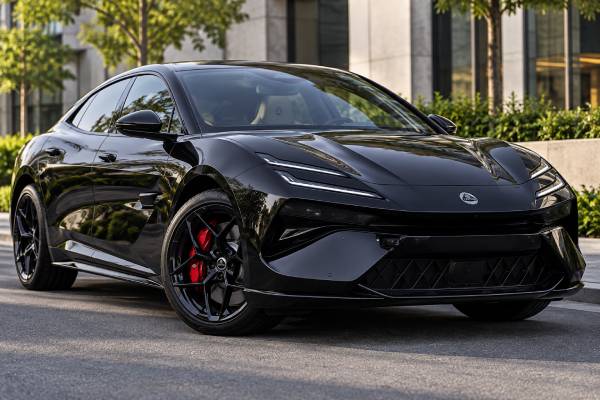
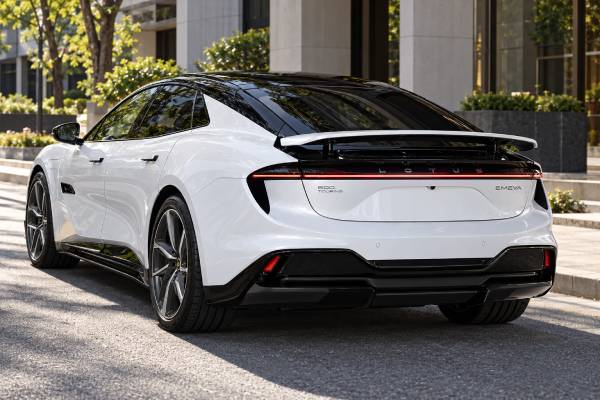
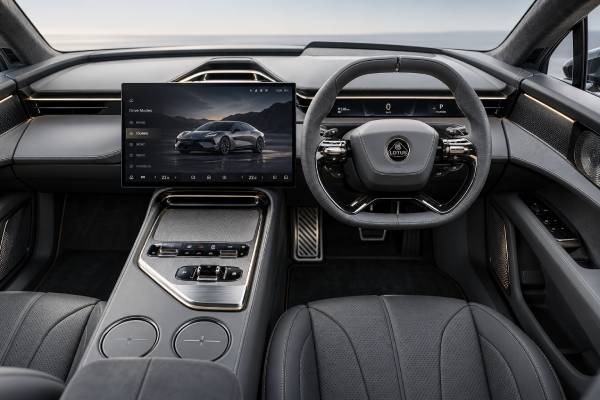
The 2025 Lotus Emeya 600 Touring Edition is the range-oriented version of the China-market Emeya 600, and its specification shows that clearly. It combines the familiar 450 kW dual-motor AWD system with a 102 kWh battery, 650 km CLTC range, 16.8 kWh/100 km published consumption, five seats, and a 509-litre luggage compartment. At 2,455 kg it is slightly lighter than the Luxury and Executive 600 variants, while its listed launch price of RMB 528,000 made it the least expensive of the three.
Touring does not mean slow. The car still produces 603 hp and 710 Nm, reaches 100 km/h in 4.2 seconds, and is rated for 250 km/h. The difference is the way the complete vehicle is configured around efficiency and travel rather than maximum cabin equipment or executive seating. Its archived 20-inch tyre fitment, lower 1,459 mm height, and lower consumption figure are all relevant to that mission. This guide treats the Touring as a distinct long-distance specification and explains how to preserve the advantages that make it useful.
Table of Contents
- A Range-First Emeya Without a Power Penalty
- 600 Touring Technical Data
- Turning 650 km CLTC Into a Real Trip Plan
- The 20-Inch Wheel and Efficiency Advantage
- Charging Strategy for Long-Distance Use
- Touring-Specific Maintenance and Buying Checks
A Range-First Emeya Without a Power Penalty
The 600 Touring is the version to choose when range and running efficiency matter more than maximum equipment. It keeps exactly the same 450 kW and 710 Nm combined output as the 600 Luxury and 600 Executive, so its 650 km CLTC rating is achieved through vehicle configuration rather than by making the car materially slower.
That is an unusual combination. Many long-range EV derivatives reduce motor output, fit a smaller rear motor, or change from all-wheel to rear-wheel drive. The Touring does none of those things. Archived specifications still list 225 kW at the front and 225 kW at the rear, all-wheel drive, a one-speed fixed-ratio transmission, 4.2 seconds to 100 km/h and a 250 km/h top speed.
Instead, the differences show up around the drivetrain. The Touring is listed at 2,455 kg curb weight, 10 kg lighter than the 600 Luxury. Its body height is 1,459 mm rather than 1,464 mm. It is also documented with 255/45 R20 front tyres and 285/40 R20 rears, whereas Luxury and Executive archived data show larger 21-inch staggered fitments. The published consumption figure is 16.8 kWh/100 km, compared with 18.8 kWh/100 km for those higher trims.
No single one of those differences explains the full 65 km CLTC advantage over Luxury. Taken together, however, lower rolling losses, reduced rotational mass, different equipment burden, ride height and homologation calibration can move an EV’s efficiency substantially. This is why a buyer should not assume that adding the largest available wheels to a Touring leaves its range identity unchanged.
The practical package remains strong. Five seats and 509 litres of luggage space mean Touring does not achieve its range by sacrificing the centre rear seat or shrinking the rear compartment. The 3,069 mm wheelbase supports passenger space, and the fastback hatch is useful for luggage. For a family or frequent intercity driver, this is arguably the most internally consistent 600 specification.
Range-focused specification also changes how the car should be optioned. Equipment that increases aerodynamic drag, rolling resistance or mass can reduce the advantage the Touring was engineered to deliver. That does not mean every owner must preserve a bare specification, but modifications should be chosen deliberately. Wider aftermarket wheels, low-pressure styling tyres or poorly fitted exterior accessories can make a measurable difference over hundreds of motorway kilometres. The same applies to permanent cargo: carrying rarely used heavy equipment every day is a small but continuous penalty.
The Touring remains a Lotus-branded performance car, so efficiency should not be confused with economy-car calibration. Its 603 hp output gives effortless overtaking even with passengers and luggage, and all-wheel drive helps deploy torque on wet roads. The practical skill is to use that performance selectively. Repeated maximum acceleration consumes energy quickly and heats tyres; smooth high-speed progress is usually faster over a long journey because it protects both range and passenger comfort.
Its RMB 528,000 February 2025 launch price reinforces that interpretation. Touring was both the least expensive 600 and the longest-range one. The trade-off was not propulsion performance; it was the richer comfort and equipment content available further up the range. Buyers should therefore evaluate whether added options on a used Touring preserve the original value proposition or simply make it resemble a heavier Luxury without the factory documentation.
600 Touring Technical Data
The 600 Touring is a battery-electric five-door liftback built around an 800-volt-class electrical system, a 102 kWh CATL NMC battery and two permanent-magnet motors. Power is split evenly between the axles, and a single fixed ratio sends motor torque directly to the wheels without a multi-speed rear transmission.
| Specification | 600 Touring Edition |
|---|---|
| Front motor peak power | 225 kW |
| Rear motor peak power | 225 kW |
| Total power | 450 kW / 603 hp |
| Total torque | 710 Nm |
| Drive | Electric AWD |
| Transmission | Single-speed fixed ratio |
| 0–100 km/h | 4.2 seconds |
| Top speed | 250 km/h |
| Specification | Value |
|---|---|
| Battery capacity | 102 kWh |
| Battery chemistry | Ternary NMC |
| Battery supplier | CATL |
| CLTC range | 650 km |
| Published consumption | 16.8 kWh/100 km |
| Peak DC charging | 420 kW |
| 10–80% DC time | About 0.25 hour in archived data |
| AC charging time | About 5.5 hours in archived data |
| Measure | Value |
|---|---|
| Length | 5,139 mm |
| Width | 2,005 mm |
| Height | 1,459 mm |
| Wheelbase | 3,069 mm |
| Curb weight | 2,455 kg |
| Gross vehicle weight | 2,980 kg |
| Seats | Five |
| Rear luggage volume | 509 litres |
| Position | Tyre size |
|---|---|
| Front | 255/45 R20 |
| Rear | 285/40 R20 |
| System | Specification |
|---|---|
| Front suspension | Multi-link independent |
| Rear suspension | Multi-link independent |
| Air suspension | Yes, adjustable height and damping |
| Brakes | Ventilated discs front and rear |
| Regenerative braking | Yes |
| One-pedal mode | Yes in archived specification |
| Drag coefficient | 0.21 |
The Touring’s specification is a good example of why trim-level data matters. Using a generic 2025 Emeya 600 table can easily substitute the Luxury’s 585 km range, 21-inch tyres, 1,464 mm height or 3,100 kg gross weight. For tyres, suspension, range comparison and loading, those differences are material.
Turning 650 km CLTC Into a Real Trip Plan
The 650 km CLTC figure establishes the Touring as the longest-range 2025 Emeya in its Chinese lineup, but it is not a promise of 650 km at expressway speed. Long-distance planning should begin with expected energy consumption for the route and a sensible arrival reserve, not the laboratory maximum.
At steady high speed, aerodynamic demand dominates. The Emeya’s 0.21 drag coefficient is excellent for a large liftback, but air resistance still rises rapidly with speed. A journey at 120 km/h will consume more energy per kilometre than a mixed CLTC cycle. Strong headwinds behave like additional road speed, and cold dense air increases aerodynamic load further.
Temperature affects the battery too. In winter, the pack may need heating before it can deliver its best efficiency or charging performance. Cabin heating adds another load. In summer, cooling the cabin and battery after the car has sat in direct sun can create a high initial draw. Preconditioning while the vehicle remains plugged in shifts some of that energy demand away from the traction battery.
Payload matters less than speed on a flat highway, but it becomes more relevant in repeated acceleration and climbing. Five adults plus luggage can add several hundred kilograms. The Touring’s 2,980 kg gross vehicle weight defines the legal loading envelope, so owners should not treat the spacious hatch as permission to exceed vehicle limits.
A useful trip plan includes at least one alternative charger for every critical stop. The Emeya can charge so quickly that a 20-minute detour to a more reliable site may cost less time than waiting for a single occupied or failed ultra-high-power stall. On unfamiliar routes, prioritize stations with multiple compatible units, live status and nearby facilities.
State of charge at arrival is a strategic variable. Fast-charging power is generally highest at lower to mid battery levels and tapers as the battery fills. Arriving with a modest reserve can place the pack in a favorable charging window, while arriving at 60% and charging to 100% can take disproportionately longer. The optimal pattern is often more frequent, shorter stops rather than forcing a nearly full charge every time.
Drivers should also track efficiency over comparable journeys. If the Touring consistently moves away from its usual consumption without a weather or speed explanation, inspect tyre pressure, alignment, brake drag and underbody/aero damage. Its range advantage depends on small efficiency gains, so small mechanical losses can erase more of the car’s defining benefit than they would on a trim that never prioritized range.
The 20-Inch Wheel and Efficiency Advantage
The documented 20-inch Touring wheel setup is more than a styling difference because tyre width, sidewall height and rotational mass can influence comfort, range, replacement cost and damage resistance. Preserving the correct fitment is one of the simplest ways to preserve the character buyers chose Touring for.
Archived data lists 255/45 R20 tyres at the front and 285/40 R20 at the rear. That is still a wide, staggered performance setup, but it is narrower and taller-sidewalled than the 21-inch sizes documented for Luxury and Executive. A taller sidewall can improve impact compliance and provide more wheel protection on broken roads, while narrower tread generally reduces frontal and rolling losses compared with a wider alternative of similar construction.
Tyre model remains important. Two tyres of the same size can have different rolling resistance, acoustic foam, compound, construction and EV load capability. Replacing the original set with an aggressive track-oriented tyre may improve some forms of grip while increasing noise and energy consumption. An ultra-low-rolling-resistance tyre that lacks appropriate load or speed capability is not a safe solution either.
Check the required load and speed ratings on the vehicle placard and official documentation. The Emeya is heavy and fast, so tyre selection must accommodate both. If an owner has fitted larger wheels, verify that offset, width, load rating, brake clearance and overall rolling diameter are correct. An attractive aftermarket wheel can create bearing loads, rubbing or calibration issues if chosen carelessly.
Pressure should be checked cold and adjusted for the vehicle’s stated load conditions. Underinflation increases rolling resistance and heat, which directly undermines range and tyre durability. Overinflation can reduce comfort and alter contact-patch behavior. Do not chase efficiency by exceeding the manufacturer’s pressure guidance.
Alignment is just as important. Excess toe scrubs tyres continuously and can consume energy without producing an obvious steering pull. Uneven inner-shoulder wear is a common clue on wide performance tyres. After a strong pothole strike or wheel repair, have alignment measured rather than waiting for visible wear.
The Touring’s slightly lower published body height should also be respected. Air suspension can alter ride height, but a lower nominal configuration may increase sensitivity to ramps and road debris. Inspect the underbody, aero panels and battery protection when buying used. A damaged panel that disturbs airflow can create noise and potentially reduce some of the aerodynamic benefit that helps Touring achieve its range rating.
Charging Strategy for Long-Distance Use
The Touring pairs long certified range with very high charging power, so its fastest journeys come from using both strengths rather than maximizing either one in isolation. The 420 kW archived peak and roughly 15-minute 10–80% claim require a suitable high-voltage charger, a prepared battery and a favorable state-of-charge window.
The 800-volt architecture allows large amounts of power to be transferred without relying on extremely high current alone. That can reduce conductor losses and heat at a given power level. It does not guarantee that a station marked “fast” can support the car properly. Some chargers are limited by voltage, site power, temperature or load sharing.
Before a major trip, identify the charging networks that reliably support 800-volt vehicles. Save payment methods in advance, and carry any physical access card or app credentials likely to be needed. A powerful car waiting beside a charger because an account cannot authenticate is not benefiting from its electrical architecture.
Use route navigation when it supports battery preconditioning. The pack may need heating in winter or careful cooling after sustained high-load driving. A battery-management system protects cell life and safety by limiting current outside the ideal window; that is normal operation, not evidence that the advertised charger power is false.
For overnight stops, AC charging may be more convenient than searching for a DC station. The archived 5.5-hour figure applies to a defined charging setup, so actual hotel or home time depends on available AC power. Confirm electrical capacity before relying on a destination charger, especially at properties where multiple EVs may share the supply.
A simple touring habit is to separate “energy needed to continue” from “energy available while parked.” At a lunch stop, leave once the car has enough reserve to reach the next dependable charger; at an overnight hotel, use the slower hours to replenish more fully. This avoids wasting time in the upper part of a DC charging curve merely because a round number such as 100% feels reassuring. It also reduces pressure on busy high-power stations.
Battery-care strategy should follow the current Lotus guidance rather than a fixed internet rule. Daily charge targets can differ from long-trip targets, and software can revise recommendations. In general use, there is little benefit in holding the pack at 100% for long periods when the extra range is unnecessary. Charge fully close to departure when a route requires it.
The driver should also plan around human stops. With charging potentially taking around a quarter hour in the best window, a meal or restroom break can exceed the car’s required charging time. Setting a notification for the target state of charge helps avoid occupying a high-power stall after the car is ready to leave.
Touring-Specific Maintenance and Buying Checks
A used 600 Touring should be judged partly on whether it still has the hardware and condition needed to deliver its efficiency advantage. Correct 20-inch wheels and tyres, healthy alignment, intact underbody aerodynamics, functional air suspension and clean charging behavior are more important to this trim than adding luxury equipment after purchase.
Confirm the VIN and original build specification first. The 450 kW output alone cannot distinguish Touring from Luxury or Executive. Check the 650 km CLTC documentation, five-seat layout, 509-litre cargo specification, 20-inch wheel fitment and original market details. If larger wheels are fitted, ask whether the originals are included and whether any range or calibration change was recorded.
Inspect tyres for age, matching specification and wear pattern. The staggered layout prevents a simple front-to-rear rotation, so poor alignment can destroy one axle’s tyres prematurely. Measure tread across the full width, not only the outer shoulder. Check wheels for bends and repairs; a subtle vibration at speed can increase fatigue on a long tour and indicate damage.
Look under the car. Scraped battery shields, loose aero panels, missing fasteners or impact damage should be documented and assessed. The Touring’s low body and efficiency focus make clean airflow and pack protection important. Any significant battery-enclosure impact deserves specialist inspection before purchase.
Battery health should be assessed through diagnostic information where available. Displayed remaining kilometres reflect recent use and are not a degradation test. Review high-voltage fault history, coolant-system service, charging-port condition and any repairs to the battery, inverter or onboard charger. Test both AC and DC charging if practical.
Air suspension must hold level and complete height changes without errors. Drive over a variety of surfaces and listen for knocks or compressor overactivity. Check steering alignment at motorway speed, then make smooth braking stops to identify disc vibration. Regeneration can preserve pads but may allow corrosion on friction-brake surfaces.
Software condition matters on a road-trip car. Verify navigation, charger routing, preconditioning, phone pairing, account ownership, remote climate and OTA updates. If the vehicle is an import, confirm maps and connected services operate in the country where it will be used. A 650 km rating is much less useful if the navigation cannot route reliably to compatible chargers.
Review service records for time-based maintenance as well as mileage. Brake fluid, cabin filters, air-conditioning, cooling circuits, auxiliary 12-volt battery and chassis inspections remain relevant. A weak 12-volt battery can cause network and charging symptoms that appear far more serious than the actual fault.
On a car bought specifically for long journeys, reliability of small systems deserves extra weight. Test both physical keys, the tyre-repair equipment, washer system, cameras, charging cable, navigation, mobile connectivity and climate control before purchase. None changes the 450 kW power figure, but a failed camera in heavy rain or a missing charging cable can disrupt a trip more effectively than a modest difference in battery health. Keep roadside-assistance details and charging-network credentials available offline in case mobile coverage is poor.
Finally, calculate travel costs using real consumption and charging tariffs, not only the CLTC number. Public ultra-fast charging can cost more per kilowatt-hour than home energy. The Touring’s efficiency advantage helps, but the largest saving usually comes from charging routinely on lower-cost AC power and using DC when its time benefit is valuable.
Keep seasonal records as well; they make it easier to separate normal winter consumption from a genuine efficiency change.
A well-kept 600 Touring is arguably the most purpose-built long-distance Emeya 600. It retains full 603 hp performance and five-seat practicality while using its wheel, mass and efficiency specification to travel farther between stops. Preserving that original configuration is not about chasing a laboratory number; it is about keeping the car quiet, comfortable, predictable and economical over the kind of distance its name promises.
References
- Emeya 2025 600 Touring | Data.CarNewsChina.com 2026 (Archived Trim Specifications)
- Lotus Emeya 2025 – detailed specifications and trim levels | Data.CarNewsChina.com 2026 (Historical Trim Comparison)
- 路特斯更名莲花跑车后首发新品:夏花 SUV 售价 54.8 万元起,繁花轿车 52.8 万元起 2025 (2025 China Range Launch Report)
- 技术参数 2026 (Official China Technical Specifications)
- Lotus Emeya | How it Drives | Lotus Cars 2026 (Official Charging and Chassis Overview)
- Lotus Emeya Handbook for Drivers | Lotus Cars 2026 (Official Owner Information)
Disclaimer
This article is for general information and is not a substitute for professional diagnosis, servicing, or repair. Specifications, torque values, maintenance intervals, tyre requirements, charging limits, software functions, and procedures can differ by VIN, market, production date, and equipment. Verify the exact vehicle against official Lotus owner and service documentation before carrying out work.
If the guide was useful, please share it on Facebook, X/Twitter, or another platform to support our work.