
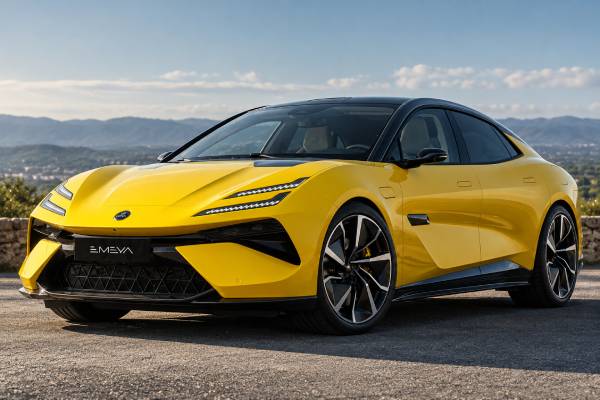
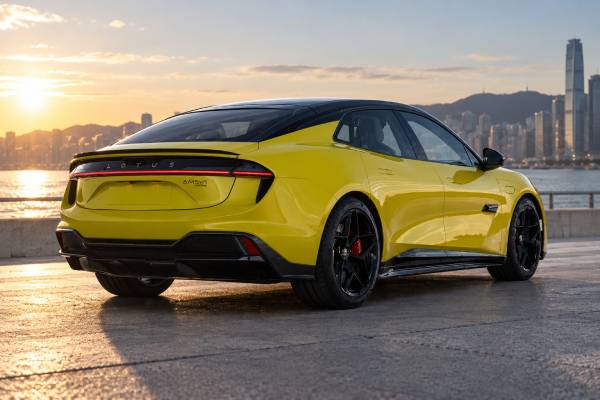
The Lotus Emeya 600 is the range-focused, 450 kW version of Lotus’s electric Hyper-GT, but “base model” is a misleading way to think about it. It still delivers 603 hp, 710 Nm, all-wheel drive, air suspension, an 800-volt battery system, and acceleration that puts many sports cars behind it. The reason to choose the 600 over the 900 is not a lack of performance; it is the combination of simpler single-speed drive hardware, better range potential, lower purchase cost, and less need to exploit extreme output. Depending on market and wheel specification, Lotus quotes up to roughly 610 km of WLTP range, while the 102 kWh pack can accept exceptionally high DC charging power when conditions are right. Buyers should pay close attention to regional trim content because a UK Emeya 600, a Korean 600, and a continental European GT-based specification can differ in standard equipment even when the core powertrain is the same.
Table of Contents
- What defines the Emeya 600
- Emeya 600 specifications and technical data
- Why 603 hp is enough for the road
- Charging speed, range, and trip strategy
- Chassis, cabin, and practical use
- Maintenance and battery-care priorities
- Choosing and inspecting the right 600
What defines the Emeya 600
The Emeya 600 is defined by its 450 kW dual-motor AWD powertrain, not by one universal equipment level. Lotus uses the “600” name to identify the roughly 600-horsepower branch of the lineup, while GT, GT SE, and Sport SE labels add market- and trim-specific equipment around the same basic drivetrain.
That distinction is important because the current range is not identical worldwide. In the UK, the 600 can appear as a named entry model alongside 600 GT and 600 GT SE. In some Asian markets, the 600 is also the clear entry point and may be offered with local option bundles that do not exactly match European cars. Continental markets can emphasize the 600 GT as the starting configuration. If two cars both say “Emeya 600,” their battery and output can match while their wheels, brakes, roof, seats, rear-wheel steering, powered doors, audio, and active-aero content differ.
Mechanically, the 600 is the less extreme of the two main Emeya power levels. It uses one traction motor at each axle, 710 Nm of combined torque, and a single-speed reduction arrangement. The 900 family raises combined output to 675 kW and uses a two-speed transmission to support harder acceleration and high-speed performance. For normal road use, the 600’s simpler layout is attractive because it already reaches 100 km/h in a little over four seconds and tops out at 250 km/h.
The vehicle itself is not small or light. At more than five meters long and roughly 2.5 tonnes in common European specification, Emeya relies on sophisticated chassis control rather than traditional Lotus minimalism. Air springs, continuously controlled dampers, brake-based torque vectoring, and active aerodynamics are used to make the car feel composed and responsive while preserving the long-distance comfort expected of a luxury GT.
Emeya 600 specifications and technical data
The Emeya 600 is a BEV with a 102 kWh gross lithium-ion battery, 800-volt-class electrical architecture, dual permanent-magnet motors in published European technical data, and all-wheel drive. The key ownership advantage is that its performance is paired with a relatively efficient single-speed drivetrain and very high charging capability.
| Specification | Value |
|---|---|
| Powertrain | Dual-motor battery-electric AWD |
| Maximum system power | 450 kW (603 hp; 612 PS) |
| Maximum system torque | 710 Nm (524 lb-ft) |
| Motor placement | Front and rear axles |
| Drive | All-wheel drive |
| Transmission | Single-speed reduction gear |
| Gross battery capacity | 102.0 kWh |
| Usable battery capacity | 98.9 kWh in published European data |
| Battery chemistry | NMC lithium-ion |
| High-voltage architecture | 800-volt class |
| Specification | Value or condition |
|---|---|
| 0–100 km/h | 4.15 seconds |
| 0–62 mph | About 4.2 seconds |
| Top speed | 250 km/h (155 mph) |
| Maximum WLTP range | Up to about 610 km (379 mi) |
| Higher-energy WLTP configuration | About 500 km (311 mi) |
| WLTP rated consumption, most efficient published configuration | About 17.7 kWh/100 km including charging losses |
| Tailpipe CO2 | 0 g/km |
| Specification | Value |
|---|---|
| AC charging | Up to 22 kW |
| AC connector | Type 2 in European-market cars |
| DC connector | CCS Combo 2 in European-market cars |
| Manufacturer peak DC rating | Up to 420 kW |
| Manufacturer DC 10–80% claim | About 15 minutes under suitable conditions |
| Independent database 500 kW-station estimate | About 403 kW peak and 13 minutes for 10–80% |
| Battery preconditioning | Supported, including navigation-assisted preparation |
| Regenerative braking | Adjustable regeneration |
| Specification | Value |
|---|---|
| Length | 5,139 mm (202.3 in) |
| Width without mirrors | 2,005 mm (78.9 in) |
| Width with mirrors | About 2,241 mm (88.2 in) |
| Height | About 1,459–1,464 mm depending on market data |
| Wheelbase | 3,069 mm (120.8 in) |
| Main luggage capacity | About 509 L |
| Maximum rear cargo capacity | About 1,388 L |
| Front luggage compartment | About 34 L |
| Braked towing capacity | Up to about 2,250 kg in published European 600-series data |
| Unbraked towing capacity | About 750 kg |
| Specification | Configuration |
|---|---|
| Suspension | Air suspension with two-chamber air springs in current 600-series specification |
| Damping | Continuously controlled dampers |
| Chassis management | Integrated chassis control |
| Torque vectoring | Brake-based |
| Drive modes | Range, Tour, Sport, Individual, Track |
| Base-market wheel example | 20-inch aerodynamic wheels with 255/45 R20 front and 285/40 R20 rear tires |
| Common 21-inch fitment | 265/40 R21 front and 305/35 R21 rear |
| Coverage | Typical term |
|---|---|
| Vehicle | 5 years or 150,000 km in many non-UK markets |
| High-voltage battery and electric drive | 8 years or 200,000 km |
| Battery capacity | At least 70% state of health within the high-voltage warranty period |
| Paint | 5 years |
| Corrosion | 12 years for specified chassis/body coverage |
Use the warranty terms from the vehicle’s original market, especially with imports, because mileage limits and wording differ by region.
Why 603 hp is enough for the road
The Emeya 600’s 603 hp is not a compromise in normal driving. Its instant torque, all-wheel-drive traction, and 4.15-second 0–100 km/h time mean overtaking and motorway joining require very little throttle travel.
More important than the headline number is how accessible the performance is. A combustion-powered GT often needs a downshift or rising engine speed before maximum acceleration arrives. The Emeya produces immediate response from low road speed, so even partial throttle can feel strong. That is why the 600 can be easier to use smoothly than its output suggests: drivers do not need to chase a power band, and the single-speed reduction drive eliminates conventional gear changes.
The chassis works hard to disguise the car’s mass. Air suspension allows the ride to remain compliant on long trips, while adaptive damping and integrated chassis controls tighten body movement when the pace increases. Brake-based torque vectoring can help the car rotate and maintain a chosen line by selectively controlling wheel forces. This is not the same kind of experience as a lightweight two-seat Lotus, but the engineering objective is recognizable: precise responses, confidence, and a strong connection between steering input and vehicle behavior.
For many owners, the 600 may actually be the more satisfying road car than a higher-output version. The 900’s extra acceleration is spectacular, but there are few public-road situations where 905 hp can be used for more than a brief burst. The 600 leaves more performance available more of the time, while its single-speed driveline avoids an additional transmission stage and supports stronger official range figures.
The brakes and tires still deserve respect. A 2.5-tonne performance EV builds significant kinetic energy at speed. Regeneration can recover some of it, but repeated hard stops rely on the friction brakes and generate heat quickly. The standard braking equipment varies by trim and market, so a buyer who intends to drive hard should verify the actual caliper, disc, and tire package instead of assuming every 600 has the same hardware.
Charging speed, range, and trip strategy
Charging is one of the strongest reasons to consider the Emeya 600. The combination of an 800-volt-class pack and very high DC acceptance can make long-distance use far easier than the battery size alone suggests.
Lotus now advertises charging capability up to 420 kW on current Emeya material. That number is a peak, not a guaranteed constant rate. Battery temperature, state of charge, charger voltage and current capability, software, and ambient conditions all affect what the car actually receives. Independent charging databases model the 600 at just over 400 kW peak on a sufficiently powerful charger and a very high average rate through much of the 10–80% window. Even when real conditions fall short of the maximum, the car can still charge unusually quickly.
The practical lesson is to arrive at a rapid charger with a warm battery and a relatively low state of charge. Using navigation to route to the charger can trigger battery preconditioning where supported. Arriving at 60% and hoping for a headline rate wastes the architecture’s advantage because the pack must taper as it fills. On a long trip, several short stops can be faster than one long session to 100%.
Range depends heavily on configuration. The biggest official number—about 610 km WLTP—corresponds to an efficient setup. Larger wheels, stickier tires, cold weather, strong headwinds, high motorway speeds, and repeated acceleration can reduce that substantially. Buyers who prioritize distance should pay attention to wheel choice rather than focusing only on cosmetic upgrades. The 20-inch aerodynamic package is especially relevant because it reduces rolling and aerodynamic losses compared with some larger options.
At home, 22 kW AC charging is valuable only if the site can supply it. A three-phase commercial or residential installation may make full use of the onboard charger, while many homes will charge at 7.4 or 11 kW. That does not prevent convenient ownership: overnight charging usually matters more than maximum AC speed unless the car is used for unusually high daily mileage.
Chassis, cabin, and practical use
The Emeya 600 is much more practical than its low roofline suggests. The rear liftback opens to a roughly 509-liter luggage area, the rear seats fold for a much larger load space, and a small front compartment adds room for cables or compact bags.
Its long wheelbase helps rear passenger space, but the car’s width is the dimension that owners notice most in cities. At a little over two meters wide without mirrors and roughly 2.24 meters with them, narrow parking structures and older garages require care. Surround-view cameras and parking sensors are therefore not merely luxury features; they are useful protection for expensive wheels and bodywork.
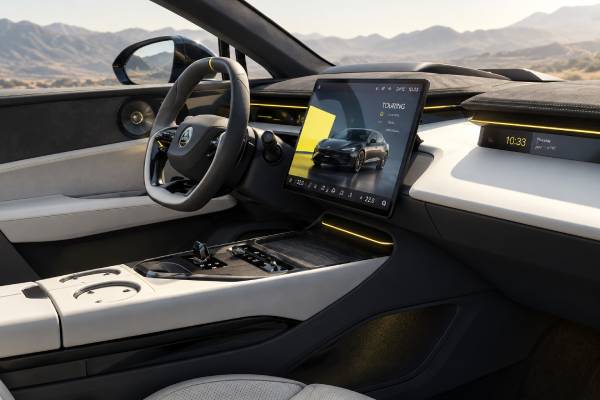
The cabin is technology-led. A central OLED touchscreen, slim driver and passenger information displays, a projected head-up display, wireless phone integration, connected services, and a high-output audio system are available across much of the range. Lotus Hyper OS can receive over-the-air updates, so the software experience may improve after purchase, but it also means a used-car inspection should include connectivity and account-transfer checks.
Current 600-series specifications include four-zone climate control, a heat pump, configurable driver settings, multiple USB-C ports, and a broad driver-assistance suite. Trim steps then add items such as intelligent glass, richer seat packages, powered closures, rear-wheel steering, stronger brake packages, and active anti-roll hardware. Because this equipment is not universal, the options list should be read as carefully as the powertrain data.
Noise and ride comfort also depend on wheel and tire choice. Large performance tires create more road noise and can transmit sharper impacts even with air suspension. Buyers who want the Emeya primarily as a motorway GT may be happier with a smaller, more efficient wheel package than with the most dramatic 22-inch option.
How the 600 compares with nearby trims
A buyer can save time by deciding first whether the powertrain or the equipment level is the real priority. The 600, 600 GT, 600 GT SE, and 600 Sport SE can all share the same 450 kW output, so paying more within the 600 family generally buys hardware, comfort, appearance, or chassis features rather than a faster motor system. That is different from stepping to the 900 series, where the powertrain itself changes substantially.
The plain 600 is the strongest choice for drivers who want maximum range potential and do not need every luxury option. In markets where it uses 20-inch aerodynamic wheels, the smaller rolling package helps both comfort and efficiency. The 600 GT adds a more upscale presentation in markets that offer it, while the GT SE is aimed more directly at grand-touring luxury. Published configurator highlights for GT SE include an intelligent glass roof, hands-free tailgate, configurable ambient lighting, and illuminated metal sills. Equipment can change by country, but the underlying idea is consistent: GT SE spends money on comfort and convenience rather than changing the 603 hp drivetrain.
Sport SE moves the emphasis the other way. Lotus markets it with more overtly dynamic equipment, including active rear-wheel steering and intelligent anti-roll control in regions where those features are part of the package. Those systems can make a large, heavy car feel more agile and controlled, especially in rapid direction changes, but they add complexity and cost. A buyer who mostly drives long motorway distances may not receive as much daily benefit from them as someone who regularly uses winding roads.
The 900 series should be treated as a separate performance decision rather than a richer 600 trim. Its 675 kW output, 985 Nm, and two-speed transmission deliver a completely different acceleration level. The penalty is greater energy demand and, in many specifications, reduced official range. If a buyer’s realistic use is commuting, touring, and occasional fast road driving, the 600 can provide the more balanced package.
This is why comparing list prices alone is not enough. Ask which features are actually fitted, which wheel and tire package is installed, and which options would be expensive to add or impossible to retrofit later. The ideal 600 may be an entry car with the right wheels and seats, or it may be a higher trim whose comfort equipment matters every day.
Maintenance and battery-care priorities
The Emeya 600 reduces traditional engine maintenance, but running costs can still be substantial because it is a heavy, powerful luxury car. The key items are tires, brakes, suspension, climate-control systems, low-voltage electronics, coolant circuits, software, and the high-voltage system.
Tires are the most obvious consumable. Check pressure regularly and inspect both shoulders because aggressive alignment settings, pothole impacts, and high torque can create uneven wear. Replacing only one tire on an AWD EV may be inappropriate if the remaining tires have significantly different tread depth, so follow Lotus guidance and the tire manufacturer’s recommendations.
Regenerative braking does not eliminate friction-brake maintenance. Discs can corrode when the hydraulic brakes are lightly used, and brake fluid still absorbs moisture over time. A periodic firm stop in safe conditions can help keep disc surfaces clean, but inspection and scheduled service remain necessary. Do not confuse low pad wear with a maintenance-free braking system.
Battery care is mostly about sensible use rather than ritual. Keep the software current, use battery preconditioning before very fast charging when appropriate, and follow the charge-target guidance in the owner documentation. There is little value in avoiding DC charging completely if the car was purchased for long-distance travel; the thermal-management system is designed to support high charging rates. At the same time, leaving the pack at very high or very low state of charge for extended storage is generally less desirable than keeping it in a moderate range.
A used buyer should request a battery state-of-health report rather than judging degradation from dashboard range alone. Estimated range changes with recent driving and weather. The factory high-voltage warranty’s capacity-retention threshold gives a useful benchmark, but a battery can be above the warranty threshold and still show measurable age-related loss.
The 12-volt system and software can create symptoms that look more serious than they are. If a car shows intermittent warnings, pairing problems, or modules that fail to wake, a proper diagnostic scan is more useful than guessing. Confirm that all recall, service campaign, and software work has been completed for the VIN.
Choosing and inspecting the right 600
The best Emeya 600 is the one whose equipment matches the intended use, not automatically the cheapest or most highly optioned example. A range-focused buyer should prioritize smaller wheels, healthy tires, clean charging history, and complete service records; a driver who values handling may prefer rear-wheel steering, stronger brakes, and the more dynamic chassis options found higher in the trim hierarchy.
Start by decoding the VIN and original invoice. Confirm the selling market, battery and powertrain designation, factory wheel size, roof type, seat package, braking hardware, active-aero features, and any rear-steering or anti-roll equipment. This prevents confusion between a 600, 600 GT, 600 GT SE, and 600 Sport SE that may share identical 450 kW output.
Then inspect condition. Look underneath for battery-shield damage or crushed jacking points. Check every wheel for bends and curb impact. Measure tire tread across the full width. Test the brakes from several speeds, and listen for vibration or scraping. Operate the air suspension through available modes and confirm that the car sits evenly after being parked.
Next, test charging and electronics. AC-charge the car, and if practical perform a DC session. Check the charge-port door, connector locking, navigation-based preconditioning, mobile app functions, cameras, sensors, HUD, audio, climate control, seat adjustments, and all powered closures. Make sure the car can be removed from the prior owner’s digital account and added to the new owner’s account.
Finally, price the car with future consumables in mind. A set of large premium EV tires, damaged 21- or 22-inch wheels, brake work, or sophisticated body-sensor calibration can erase an attractive purchase-price difference. The 600’s efficiency and simpler driveline make it the rational Emeya, but it remains a high-end performance EV and should be budgeted accordingly.
For buyers who want the Emeya’s design, cabin, charging speed, and chassis without paying mainly for extreme acceleration, the 600 is arguably the sweet spot. Its 603 hp already delivers serious performance, while the combination of long range and very rapid charging better serves the grand-touring mission that defines the car.
References
- Lotus Emeya – The Fully Electric Hyper-GT | Lotus Cars 2026
- Lotus Emeya – Explore Models | Lotus Cars 2026
- THE LOTUS EMEYA 600 SERIES 2025 (Technical Specification)
- Lotus Emeya 600 (2025-2026) price and specifications 2026
- Lotus Cars Official Site 2026 (Warranty)
- Lotus believes processing power is the new horsepower – and Emeya built on NVIDIA DRIVE is a thoroughbred 2023
Disclaimer
This article is for informational purposes and is not a substitute for professional diagnosis or repair. Specifications, torque values, maintenance intervals, charging performance, software features, and procedures can vary by VIN, market, equipment, and software version; verify all technical work against official Lotus service documentation for the individual vehicle.
If this guide helped, please share it on Facebook, X/Twitter, or another relevant community to support our work.