
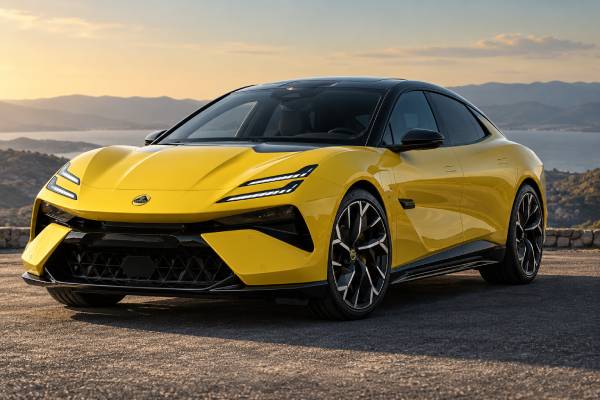
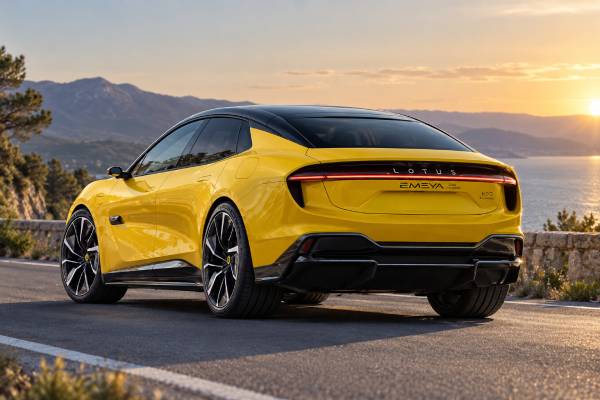
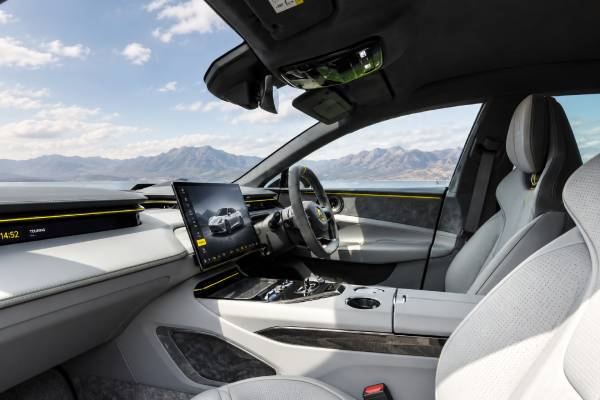
The 2025 Lotus Emeya 900 Executive Edition combines two ideas that rarely occupy the same car: a dedicated four-seat executive cabin and a 675 kW, 905 hp electric drivetrain capable of roughly 2.8-second 0–100 km/h acceleration. Sold in China from February 2025, it pairs a 225 kW front motor with a much stronger 450 kW rear motor, 985 Nm of combined torque, a two-speed rear transmission, 102 kWh battery, and 480 km CLTC range. Its documented launch price was RMB 1.008 million.
That specification makes it fundamentally different from the 600 Executive. Both use four seats and a 426-litre luggage compartment, but the 900 adds the rear-biased high-output powertrain, larger archived 22-inch tyre fitment, ceramic ventilated brake specification, more mass, and substantially higher energy consumption. The result is not simply an Executive with a quicker software map. It is the most mechanically ambitious luxury configuration in the 2025 Chinese Emeya range, and ownership requires understanding the trade between extraordinary performance, rear-seat comfort, shorter range, and higher-cost chassis hardware.
Table of Contents
- Executive Luxury Meets the 900 Powertrain
- Why the Rear Motor Uses Two Speeds
- 900 Executive Technical Specifications
- Four-Seat Cabin at Supercar Pace
- 480 km CLTC Range and Fast-Charging Strategy
- Ceramic Brakes and 22-Inch Tyres
- Buying and Maintaining the Flagship Executive
Executive Luxury Meets the 900 Powertrain
The 900 Executive is not the rational range choice in the Emeya family; it is the configuration for buyers who want maximum drivetrain performance without giving up the dedicated four-seat rear cabin. Its 675 kW output is 50% higher than the 600 Executive’s 450 kW, while combined torque rises from 710 to 985 Nm.
The power split is the first clue to its character. The front motor remains rated at 225 kW and 355 Nm, but the rear motor rises to 450 kW and 630 Nm. That gives the car a pronounced rear power bias even though both axles are driven. Electronic control can still vary torque according to grip and driving mode, but the rear axle has the greater performance reserve.
Acceleration is correspondingly dramatic. Archived Chinese data rounds 0–100 km/h to 2.8 seconds, while Lotus’s current technical material for the 675 kW Emeya 900 states 2.78 seconds. Either way, the number belongs in supercar territory. The 256 km/h top speed is only 6 km/h higher than the 600’s, showing that the extra power is mainly about how quickly the car reaches very high speed and how strongly it continues accelerating.
That output carries an efficiency cost. The 900 Executive is rated at 22.8 kWh/100 km and 480 km CLTC, versus 18.8 kWh/100 km and 570 km for the 600 Executive. Curb weight rises from 2,465 to 2,565 kg. The battery capacity remains 102 kWh, so the shorter range is a direct consequence of the completed vehicle’s performance configuration rather than a smaller energy store.
For chauffeured use, that trade can be difficult to justify unless the owner genuinely values the 900 drivetrain. Rear passengers gain no practical benefit from full-throttle launches, and aggressive acceleration is uncomfortable. What the 900 does offer is enormous overtaking reserve and effortless speed even with four occupants and luggage. A skilled driver can use a small fraction of the available performance to make progress feel unstrained.
The original price hierarchy makes the positioning obvious. The 600 Executive was RMB 708,000, while the 900 Executive was RMB 1.008 million. The additional RMB 300,000 represented much more than one second of acceleration: it bought the more powerful rear drive unit, two-speed transmission, higher-performance running gear and flagship status. On the used market, that same hardware can also create higher replacement and repair costs.
Why the Rear Motor Uses Two Speeds
The two-speed rear transmission is what allows the 900 drivetrain to combine violent low-speed acceleration with strong performance at higher road speeds. The front motor uses its own reduction gearing, while the powerful rear unit changes ratio so the motor can operate effectively across a broader speed range.
A single-speed EV is normally ideal for road use because electric motors make useful torque from zero rpm and can spin very quickly. That is why the 600 needs no shift. Once output and top-speed ambitions rise, however, a fixed ratio becomes a compromise. Short gearing favors launch acceleration but pushes the motor toward its speed limit earlier; tall gearing supports high speed but reduces wheel torque at low speed.
The 900’s second ratio reduces that compromise. First gear can multiply rear-motor torque strongly during launch and early acceleration, while the higher ratio supports continued acceleration and efficiency at greater speed. Lotus’s performance claims around the 900—including sub-three-second 0–100 km/h and high-speed acceleration—depend on that architecture.
For the driver, the shift should be managed by the powertrain rather than treated like a conventional manual event. There is no need to “work” the transmission in normal driving. Its relevance to an owner is mechanical and diagnostic: a 900 has an additional drivetrain system that a 600 does not, so noises, shift irregularities, fluid requirements and software calibration deserve attention.
A used-car test should include gentle and stronger acceleration after the vehicle is fully warmed and in a safe setting. Look for warning messages, unexpected power interruptions, harsh engagement or unusual mechanical sounds from the rear. The exact shift can be subtle under moderate throttle, so diagnosis should rely on fault data and technician assessment rather than a buyer trying to provoke repeated maximum-power runs.
The two-speed unit is also a reason not to describe the 900 Executive as merely a “tuned 600.” Parts, service procedures and control software differ. If an imported car needs rear-drive-unit work, confirm that the workshop can access the correct technical information and replacement components before purchase. Flagship performance is valuable only when the support network can maintain it.
900 Executive Technical Specifications
The 900 Executive is a four-seat battery-electric liftback with dual permanent-magnet motors, electric AWD, a two-speed rear transmission and a 102 kWh CATL NMC pack on an 800-volt-class platform. The high-output rear motor, four-seat interior and performance running gear are the specifications that most clearly distinguish it from other 2025 Emeyas.
| Specification | 900 Executive Edition |
|---|---|
| Front motor peak power | 225 kW |
| Front motor peak torque | 355 Nm |
| Rear motor peak power | 450 kW |
| Rear motor peak torque | 630 Nm |
| Combined output | 675 kW / 905 hp |
| Combined torque | 985 Nm |
| Drive | AWD |
| Rear transmission | Two-speed automatic |
| Measure | Value |
|---|---|
| 0–100 km/h | About 2.8 seconds; Lotus quotes 2.78 seconds for the 675 kW 900 |
| Top speed | 256 km/h |
| CLTC range | 480 km |
| Published consumption | 22.8 kWh/100 km |
| Battery capacity | 102 kWh |
| Peak DC charging | 420 kW |
| 10–80% DC time | About 0.25 hour in archived data |
| Measure | Value |
|---|---|
| Body | Five-door liftback |
| Seats | Four |
| Rear luggage capacity | 426 litres |
| Length | 5,139 mm |
| Width | 2,005 mm |
| Height | 1,467 mm |
| Wheelbase | 3,069 mm |
| Curb weight | 2,565 kg |
| Item | Specification |
|---|---|
| Front tyres | 265/35 R22 |
| Rear tyres | 305/30 R22 |
| Front brakes | Ceramic ventilated disc type |
| Rear brakes | Ceramic ventilated disc type |
| Parking brake | Electronic |
| System | Specification |
|---|---|
| Front suspension | Multi-link independent |
| Rear suspension | Multi-link independent |
| Air suspension | Yes |
| Adjustable suspension | Height and damping |
| Regenerative braking | Yes |
| AC charging time | About 5.5 hours in archived data |
| Battery chemistry | Ternary NMC |
These figures should be kept tied to the 2025 Chinese Executive trim. The 900 Performance uses the same powertrain output but a five-seat body, different range rating and different cargo figure. Likewise, a current-market 900 specification can share drivetrain values while differing in trim content or homologation.
Four-Seat Cabin at Supercar Pace
The Executive cabin requires a different driving mindset because passengers experience acceleration, braking and lateral force more intensely than a solo driver focused on the road. The car can deploy 985 Nm almost instantly, but smooth use of the first third of the accelerator is more appropriate for executive travel than repeated demonstrations of its maximum output.
The four-seat arrangement removes the centre rear position and concentrates the rear cabin around two occupants. As with the 600 Executive, that reduces quoted luggage capacity to 426 litres. Buyers who plan airport work should test actual suitcase combinations because four passengers plus bulky luggage can challenge the fastback’s rear volume even though the body is more than five metres long.
Rear-seat functions are a major value area. Test all powered adjustments, climate controls, media interfaces, charging ports and comfort features fitted to the exact car. Operate them several times, not once. A flagship that moves perfectly under full throttle but has an inoperative rear seat motor is failing at the purpose of the Executive trim.
Ride quality should be evaluated from the rear as well as the driver’s seat. The 22-inch performance tyres have short sidewalls, and the car is 100 kg heavier than the 600 Executive. Air suspension and adaptive damping have considerable work to do. A healthy car should control body movement without transmitting every sharp edge to passengers. Excess harshness can point to tyre pressure, tyre choice, wheel damage or suspension faults as well as drive-mode selection.
The difference in body height—1,467 mm for the archived 900 Executive versus 1,464 mm for the 600 Executive—is small, but buyers should not use exterior dimensions to infer identical underbody or wheel-clearance behavior. Performance wheels and brake hardware affect practical clearance. Inspect the inside of each 22-inch rim for contact or damage after pothole impacts.
Chauffeurs should learn the regenerative braking calibration carefully. Strong regen can produce abrupt deceleration when the accelerator is released. A smooth driver uses anticipation to keep passenger head movement low and reserves the friction brakes for the final stop or stronger deceleration. The objective is not maximum energy recovery on every metre; it is efficient, predictable motion.
Because the car is capable of immense speed, driver-assistance technology should never become an excuse for reduced attention. Verify the actual enabled features, camera and sensor status, and local software support. High-compute hardware can assist with lane keeping, parking and situational awareness, but the driver remains responsible for operating within road conditions and law.
480 km CLTC Range and Fast-Charging Strategy
The 900 Executive has the shortest certified range among the documented 2025 Emeya variants, at 480 km CLTC. That is the cost of combining the 675 kW drivetrain, performance running gear, executive equipment and 2,565 kg curb weight with the same 102 kWh battery capacity used elsewhere in the range.
Real highway range can be lower than 480 km, especially at high speed or in cold weather. That is not a defect in itself. The relevant comparison is with the exact test cycle and conditions. A driver who uses the 900’s acceleration frequently will also see energy consumption rise far above the published 22.8 kWh/100 km figure.
The car offsets some of that range limitation with charging speed. An 800-volt architecture and 420 kW archived peak DC rating can restore a large amount of energy quickly when the pack is warm, the starting state of charge is low enough and the charger supports the required voltage. The roughly 15-minute 10–80% figure should be treated as an optimized-condition benchmark.
For executive travel, charging reliability matters more than theoretical peak. A scheduled passenger journey should not depend on one ultra-high-power stall. Build routes around sites with multiple compatible chargers and a backup location. A 300 kW station that works consistently can be operationally superior to a nominally faster unit with poor uptime.
Preconditioning should be integrated into route planning. The battery-management system may heat or cool the pack before a fast-charge stop, improving both speed and consistency. If a driver arrives at a charger unexpectedly with a cold battery, reduced initial power is normal. Repeatedly chasing peak figures without considering temperature creates bad conclusions about battery health.
At home or a depot, AC charging removes most daily inconvenience. Use scheduled charging and cabin preconditioning so the car begins duty with the desired energy and temperature. The correct daily charge target should follow current Lotus guidance. Charging to 100% shortly before a long trip can be useful; leaving the pack at maximum state of charge for unnecessary periods is a different use case.
The 480 km rating also means tyre pressure, alignment and brake drag matter. An efficiency loss that is barely noticed on a short commuter route can force an extra charging stop on a long itinerary. For a flagship Executive, preventative chassis maintenance is therefore part of route reliability.
Ceramic Brakes and 22-Inch Tyres
The archived 900 Executive specification lists ceramic ventilated discs and 22-inch staggered tyres, making wheel-and-brake condition one of the most expensive areas to assess on a used car. These components support the performance envelope, but they are also vulnerable to damage and costly replacement.
Ceramic brake systems behave differently from ordinary iron discs. They can offer high thermal resistance and lower unsprung mass, but inspection standards and replacement criteria are specific to the component. Do not judge a ceramic disc only by the lip or surface appearance techniques used on an iron rotor. A Lotus-capable technician should inspect for chips, cracks, impact damage, heat effects and measured wear according to the correct procedure.
Pads and discs should be treated as a matched system. Cheap substitute pads can alter feel, noise and wear. If service history shows brake replacement, confirm what parts were used and why. Because regenerative braking handles much light deceleration, low odometer mileage does not guarantee perfect friction components; storage contamination and corrosion can still affect hardware around the brake system.
The 265/35 R22 front and 305/30 R22 rear tyres have very short sidewalls for a 2,565 kg car. Potholes and sharp road edges can damage both tyre carcasses and wheel rims. Inspect sidewalls for bubbles, cuts and repairs, then look at the inner rim barrels for cracks or straightening marks that are invisible from outside.
Tyres should be properly matched by axle and carry the required load and speed ratings. A mixed set can change traction-control behavior, wet grip and noise. On an AWD EV with nearly 1,000 Nm combined torque, maintaining similar rolling circumference and appropriate construction is especially important.
Alignment errors can be expensive because a 305 mm rear tyre can lose an inner shoulder before the outer tread appears worn. Measure tread across the width. A steering wheel that sits slightly off-centre, recent wheel repair or uneven wear should prompt a full geometry check rather than a simple toe adjustment without diagnosis.
Finally, understand replacement economics before buying. A car offered below market price may need four 22-inch tyres and brake work that immediately consumes the apparent saving. Request current parts quotes from the workshop that will service the vehicle. Flagship hardware deserves flagship budgeting.
Buying and Maintaining the Flagship Executive
A 900 Executive should pass three separate inspections before purchase: identity and documentation, high-voltage/powertrain diagnostics, and chassis/cabin condition. The price and complexity are high enough that a casual walkaround is not proportionate to the risk.
Prove the trim first. The VIN should confirm 2025 900 Executive specification, four seats, market origin and original equipment. The 900 Performance shares 675 kW but has five seats, 509 litres of luggage capacity and a 530 km CLTC rating. A badge swap or copied advert can therefore create a materially wrong description.
Review the two-speed rear drive unit for stored faults and service history. Ask whether software campaigns or drive-unit work have been performed. During a supervised road test, note any harsh engagement, unexpected power limitation or warning messages. Do not attempt repeated launch-control demonstrations on an unfamiliar used car simply to validate the claimed acceleration time.
Battery condition should be assessed with diagnostic evidence, charging behavior and physical inspection. Check the underside for impacts, review thermal-management faults, and test AC and DC charging. A range estimate on the instrument panel is influenced by recent 905 hp use and cannot distinguish driving style from cell degradation.
Examine air suspension after the car has been parked. It should remain level, and the compressor should not run excessively. Inspect active aerodynamic elements, cooling openings and underbody panels because high-speed stability and battery cooling depend on more than the visible bodywork. Accident repairs around sensors should include documented calibration.
Inside, confirm all Executive-specific functions and digital services. Transfer the owner account, pair a current phone, test both keys, navigation, remote climate and update status. For imports, establish whether local servers, maps and connected functions are supported. A technically excellent Chinese-market car can lose important convenience if digital services do not travel with it.
Check warranty and parts support by VIN with the actual servicing dealer. Current global Emeya 900 warranty information should not be assumed to apply automatically to a Chinese 2025 Executive. Clarify high-voltage coverage, transferability, remaining term, recall/campaign status and whether the two-speed drive unit and trim-specific cabin parts can be sourced locally.
Ongoing maintenance should include time-based brake-fluid service, cooling-system checks, cabin filtration, air-conditioning, wheel alignment, tyre pressure, auxiliary 12-volt battery condition and software updates. Keep detailed records of ceramic brake inspections and any wheel repairs. On a car whose value depends on sophisticated hardware, documentation is part of the asset.
Insurance deserves careful disclosure. Make sure the policy identifies the 900 Executive rather than a generic Emeya or 600, and that declared value reflects expensive wheels, brakes, glass, sensors and rear-cabin equipment. Collision repairs can require sensor calibration and specialized parts even when the traction battery is untouched.
The 900 Executive succeeds when its contradictions are intentional. It is heavier, shorter-ranged and more expensive to run than a 600 Executive, yet it offers a level of effortless performance few four-seat luxury liftbacks can match. Buyers who genuinely want that combination should seek the best-documented example, because maintaining 905 hp performance and executive refinement simultaneously is where the real ownership standard lies.
References
- Emeya 2025 900 Executive | Data.CarNewsChina.com 2026 (Archived Trim Specifications)
- Lotus Emeya 2025 – detailed specifications and trim levels | Data.CarNewsChina.com 2026 (Historical Trim Comparison)
- 路特斯更名莲花跑车后首发新品:夏花 SUV 售价 54.8 万元起,繁花轿车 52.8 万元起 2025 (2025 China Range Launch Report)
- 技术参数 2026 (Official China Technical Specifications)
- Lotus Emeya – Explore Models | Lotus Cars 2026 (Official 600/900 Powertrain Data)
- Lotus Emeya | How it Drives | Lotus Cars 2026 (Official Engineering and Charging Overview)
Disclaimer
This article is informational only and does not replace professional diagnosis, servicing, or repair. Specifications, torque values, maintenance intervals, brake wear criteria, software functions, charging limits, and procedures can vary by VIN, market, production date, and equipment. Confirm the exact vehicle against official Lotus service documentation before performing work or ordering parts.
If you found this article useful, please share it on Facebook, X/Twitter, or another platform to support our work.