
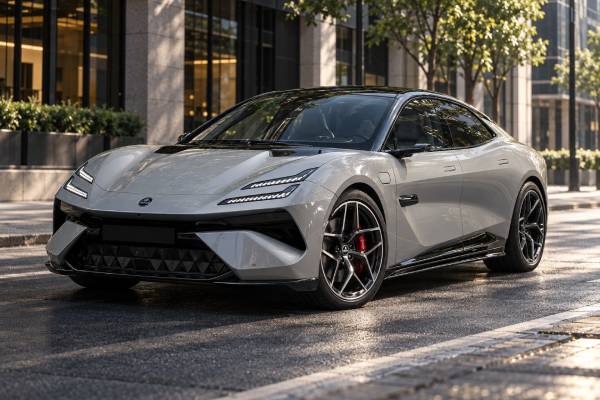
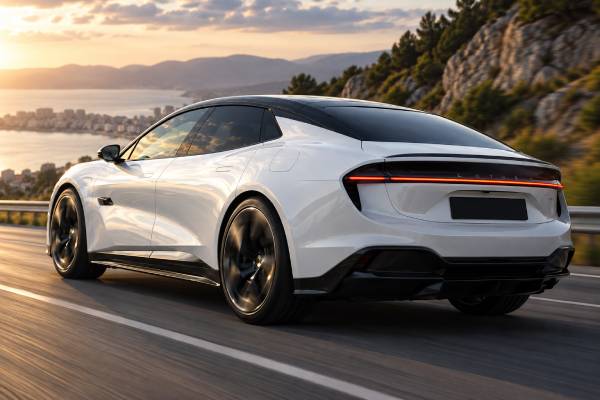
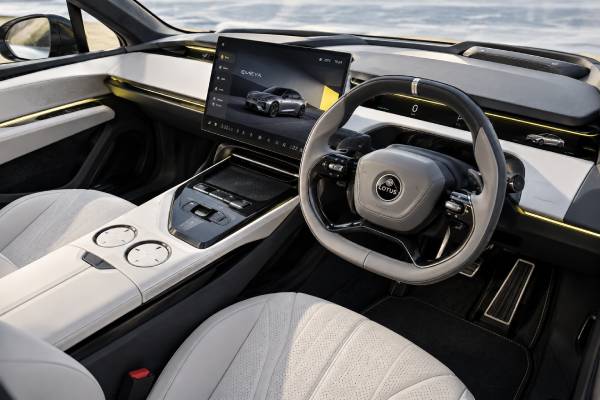
The 2025 Lotus Emeya 900 Performance Edition is the five-seat version of the 675 kW Emeya formula sold in China, combining 905 hp and 985 Nm with a 102 kWh battery, two-speed rear transmission, 530 km CLTC range, and a full 509-litre luggage compartment. Introduced in February 2025 at a documented RMB 808,000, it sits between the 600 range and the four-seat 900 Executive in price while retaining the flagship drivetrain’s roughly 2.8-second 0–100 km/h capability.
Its specification is easy to confuse with the 900 Executive because both share front 225 kW and rear 450 kW motors. The Performance, however, is the more conventional five-seat fastback: archived data lists 21-inch staggered tyres, ventilated disc brakes, a 1,464 mm height, 20.7 kWh/100 km consumption, and 530 km CLTC. Those differences give it more everyday practicality and better certified range than the Executive without reducing motor output. This guide focuses on how that combination works, what the two-speed system changes, and what a used buyer should inspect before paying for flagship performance.
Table of Contents
- The 900 Performance Edition’s Role
- From Launch to High Speed: How the 900 Drivetrain Works
- 2025 Emeya 900 Performance Specification
- A Five-Seat Performance GT in Daily Use
- Range, Heat Management, and Charging
- Chassis, Brakes, and Tyre Wear
- Inspection Before Ownership
The 900 Performance Edition’s Role
The 900 Performance is the most straightforward way to get the 675 kW Emeya drivetrain while keeping five-seat practicality. It uses the same 905 hp and 985 Nm headline output as the 900 Executive, but replaces the four-seat executive package with a conventional rear bench and increases quoted luggage capacity from 426 to 509 litres.
That makes the Performance badge more literal than the Executive badge. The car is built around the highest-output drivetrain without asking the buyer to pay for a dedicated rear-passenger layout. Its RMB 808,000 launch price was RMB 200,000 below the 900 Executive and RMB 240,000 above the 600 Luxury, placing it as the enthusiast-oriented flagship rather than the most expensive Emeya.
The powertrain is heavily rear-biased. A 225 kW front motor contributes 355 Nm, while the rear motor produces 450 kW and 630 Nm. Combined torque is 985 Nm. This layout allows the car to deliver all-wheel-drive traction while preserving a rear axle with enough output to shape high-speed acceleration and dynamic balance.
The 530 km CLTC rating is 50 km better than the 900 Executive’s 480 km despite identical battery capacity and power output. Archived consumption is also lower at 20.7 kWh/100 km versus 22.8. Five-seat packaging does not automatically improve efficiency, so the difference reflects the full homologated configuration—wheels, tyres, equipment, body setup and running gear—not simply the rear-seat count.
Compared with the 600, the Performance makes a very different compromise. It gives up range and some mechanical simplicity in exchange for 225 kW more peak power, 275 Nm more torque, a two-speed rear transmission and much stronger acceleration. A buyer who rarely uses the extra performance may be better served by a 600. A buyer specifically seeking the full 900 experience gets it here without the Executive’s four-seat specialization.
The body remains a large GT. Its 5,139 mm length and 2,005 mm width make it far larger than classic lightweight Lotus sports cars, yet the fastback profile, active aerodynamics, air suspension and low battery placement are engineered to make mass feel controlled rather than invisible. The car still weighs 2,565 kg, so tyre, brake and suspension condition are central to how convincingly it performs.
From Launch to High Speed: How the 900 Drivetrain Works
The 900 Performance uses a two-speed rear transmission because a single fixed ratio would force a bigger compromise between launch torque and high-speed motor operation. The first ratio supports the extraordinary acceleration claim; the second allows the powerful rear motor to remain effective as road speed rises.
Electric motors produce maximum torque very differently from combustion engines, which is why most EVs need only one ratio. The Emeya 600 demonstrates that a single speed can deliver 603 hp, 4.2-second 0–100 km/h acceleration and 250 km/h maximum speed. The 900 asks more of the rear motor: stronger launch performance, continued acceleration well beyond normal road speed, and a 256 km/h maximum.
Giving the rear axle two ratios broadens the usable operating window. In lower gear, rear-wheel torque multiplication helps the car launch with force that would be difficult to sustain using a taller fixed ratio. At higher speed, the second ratio reduces motor speed for a given road speed and supports continued power delivery. The front motor continues contributing through its own reduction gearing.
Lotus’s current technical material quotes 2.78 seconds to 100 km/h for the 675 kW Emeya 900, while archived Chinese trim data rounds the Performance Edition to 2.8 seconds. The difference is rounding, not evidence of a separate motor tune. Both figures describe a car that can reach legal road limits almost immediately.
This capability increases thermal demand. High current produces heat in cells, inverters and motors, while repeated acceleration and high speed add heat to tyres and brakes. The car’s cooling system and battery management therefore matter to repeatability. A 905 hp EV that delivers one launch and then severely limits output would not fulfill the engineering brief; thermal control is what allows the performance to be used more than once.
The owner should not confuse repeatability with immunity from physics. Successive full-power runs deplete energy quickly, raise component temperatures and accelerate tyre wear. On public roads, there is little reason to validate the brochure repeatedly. A pre-purchase inspection should use diagnostics and a controlled test drive, not multiple launch demonstrations from a seller.
Transmission behavior also belongs in that inspection. A healthy two-speed system should not produce repeated warning messages, harsh mechanical shocks or unexplained loss of power. Any unusual rear-drive-unit noise deserves specialist attention because this is one of the major mechanical differences between a 900 and a 600.
2025 Emeya 900 Performance Specification
The 900 Performance is a battery-electric five-door liftback with two permanent-magnet motors, electric AWD and a two-speed automatic rear drive unit. A 102 kWh CATL NMC pack supports the 800-volt-class electrical architecture, while the five-seat body and 21-inch archived wheel setup distinguish this trim from the four-seat Executive.
| Specification | 900 Performance Edition |
|---|---|
| Front motor peak output | 225 kW / 355 Nm |
| Rear motor peak output | 450 kW / 630 Nm |
| Combined power | 675 kW / 905 hp |
| Combined torque | 985 Nm |
| Drive | AWD |
| Rear transmission | Two-speed automatic |
| 0–100 km/h | About 2.8 seconds; Lotus quotes 2.78 seconds for the 675 kW 900 |
| Top speed | 256 km/h |
| Specification | Value |
|---|---|
| Battery capacity | 102 kWh |
| Battery chemistry | Ternary NMC |
| Cell supplier | CATL |
| CLTC range | 530 km |
| Published consumption | 20.7 kWh/100 km |
| Peak DC charging power | 420 kW |
| 10–80% DC time | About 0.25 hour in archived data |
| AC charging time | About 5.5 hours in archived data |
| Measure | Value |
|---|---|
| Length | 5,139 mm |
| Width | 2,005 mm |
| Height | 1,464 mm |
| Wheelbase | 3,069 mm |
| Seating | Five |
| Rear luggage volume | 509 litres |
| Curb weight | 2,565 kg |
| Gross vehicle weight | 3,100 kg |
| Item | Specification |
|---|---|
| Front tyres | 265/40 R21 |
| Rear tyres | 305/35 R21 |
| Front brakes | Ventilated disc type |
| Rear brakes | Ventilated disc type |
| Parking brake | Electronic |
| System | Configuration |
|---|---|
| Front suspension | Multi-link independent |
| Rear suspension | Multi-link independent |
| Air suspension | Yes |
| Adjustable suspension | Height and damping |
| Regenerative braking | Yes |
| Drag coefficient | 0.21 |
The brake and wheel data are especially important because they prevent a common mix-up with the 900 Executive’s archived 22-inch and ceramic-disc specification. Parts should always be ordered against the VIN, but the historical trim data confirms that the two 900 versions were not identical below the body.
A Five-Seat Performance GT in Daily Use
The 900 Performance is more practical than its acceleration figure suggests because it retains five seats and the 509-litre rear luggage compartment of the regular fastback body. That makes it suitable for family or touring use in a way that a two-seat supercar with similar straight-line speed is not.
The fifth seat should still be evaluated as a centre position in a low GT. The outer rear passengers have the most natural seating positions, and adults should test headroom and foot space before assuming all three rear seats are equivalent. The 3,069 mm wheelbase helps legroom, but the sloping roofline is designed for aero and appearance as well as accommodation.
The hatch is a major advantage. Large suitcases and awkward objects are easier to load through a liftback opening than through a shallow sedan trunk. The quoted 509 litres also gives the Performance 83 litres more rear capacity than the 900 Executive. For an owner who wants 905 hp but regularly carries luggage, that is a meaningful reason to choose this version.
Daily driving does not require using the full 675 kW. Electric response at partial throttle is already strong, and the single front/rear torque control gives the car immediate overtaking capability. Smooth inputs make the car quieter, more efficient and easier on tyres. Full acceleration can be reserved for controlled environments where road, temperature and traffic permit it.
Parking is likely to be a greater daily concern than power. The body is more than two metres wide before mirrors, and expensive 21-inch wheels sit close to kerbs. Use the camera and sensor systems, but still verify their calibration and cleanliness. A distorted camera image or failed proximity sensor can turn a wide-car parking manoeuvre into an expensive wheel or body repair.
The air suspension gives useful flexibility over ramps and poor surfaces, but owners should not rely on it to make the car immune to ground contact. Approach steep transitions diagonally when appropriate and inspect the underbody after a hard impact. Battery shields, cooling channels and aerodynamic panels live where a conventional engine car might have more empty space.
Cabin technology should be evaluated as part of performance ownership rather than a separate luxury topic. Navigation can prepare the battery for fast charging, software governs drive modes and torque delivery, and sensors support the chassis and driver-assistance systems. A persistent software or communication fault can therefore affect how the car performs, not just how the screen looks.
Range, Heat Management, and Charging
The 900 Performance’s 530 km CLTC rating is respectable for a 905 hp EV, but it is significantly lower than the 600 Touring’s 650 km because the high-output drivetrain and performance configuration consume more energy. How the driver uses the available power can widen that gap dramatically in real life.
At constant moderate speed, the car benefits from a low 0.21 drag coefficient and efficient electric motors. At high speed, aerodynamic demand rises quickly regardless of drivetrain efficiency. Repeated hard acceleration adds conversion losses and heats the battery, inverters, motors, tyres and brakes. Cold weather adds pack heating and cabin demand. The result is that a driver exploiting the “900” badge should expect more frequent charging than one driving it like a 600.
The battery thermal-management system is central to both performance and fast charging. Cells deliver and accept high power best inside a controlled temperature window. Before a rapid charge, navigation-based preconditioning can bring the pack toward that window. During sustained performance use, cooling protects the battery and power electronics from excessive temperature.
A 420 kW peak DC rating is valuable because it can replenish energy quickly, but peak power is a brief part of a charging curve rather than the average for a session. The roughly 15-minute 10–80% figure assumes a compatible high-voltage charger and favorable battery conditions. Arriving at 70% state of charge will not reproduce it.
For road trips, it can be faster to stop earlier and leave earlier. Charging power usually tapers as the battery fills, so waiting for 100% at every DC stop may take more total time than charging through the strong portion of the curve and continuing to another station. Use a reserve appropriate to route reliability and weather instead of reducing arrival state of charge to an arbitrary minimum.
Home or workplace AC charging remains the foundation for normal ownership. Starting the day with the desired state of charge means the 900’s shorter range relative to a 600 rarely matters in local use. Scheduled preconditioning also improves cabin comfort without consuming as much stored energy immediately after departure.
Battery state of health should be evaluated with diagnostics, not with one range display. The estimated kilometres respond to recent driving. A car that has just completed repeated high-speed runs can show a low prediction even when the pack is healthy; a car driven gently before sale can display an optimistic number. Service data, fault history and controlled charging behavior are more meaningful.
Chassis, Brakes, and Tyre Wear
The 900 Performance depends on tyres, brakes and suspension to make 905 hp usable, so condition in these areas should carry as much weight as battery health when buying used. A neglected chassis can make the car slower, less safe and more expensive than one with slightly higher mileage but proper maintenance.
The archived 21-inch sizes—265/40 R21 front and 305/35 R21 rear—provide a broad contact patch and more sidewall than the Executive’s 22-inch setup. That can be helpful on real roads, but the tyres remain expensive and highly loaded. Use suitable performance tyres with correct load and speed ratings, and avoid mixing radically different tread designs or compounds across axles.
Instant torque accelerates tyre wear when launches are frequent. Inspect the rear shoulders, but also the inner edges on all four tyres. Alignment problems can hide there. A 2,565 kg curb weight also means pothole impacts carry substantial energy into wheels and suspension. Look for wheel repairs, sidewall bubbles and vibration at speed.
The archived Performance trim lists ventilated discs rather than the ceramic ventilated specification shown for the 900 Executive. That can simplify replacement economics, but braking demands remain severe. Regeneration handles normal deceleration, while friction brakes provide emergency capacity and repeated high-load stopping. Inspect disc surfaces, thickness and pad condition according to Lotus procedures.
A car driven gently can suffer from brake underuse. Surface corrosion or deposits may create noise and judder even when pad thickness is high. Conversely, a car used repeatedly at high speed can overheat pads and fluid. Service history should explain brake-fluid changes and any disc or pad replacement, not merely state that “EV brakes last forever.”
Air suspension and adaptive damping must manage both comfort and body control. Test height changes, drive over sharp low-speed bumps, then assess the car on a smooth road. Persistent compressor operation, a sagging corner, clunks or damping warnings deserve diagnosis. A 900 with unhealthy suspension cannot exploit its power safely.
Active aerodynamics should also function cleanly. The Emeya uses managed openings and moveable aero surfaces to balance drag, cooling and stability. Inspect exposed mechanisms for debris or collision damage and check fault memory. At high speed, aerodynamic systems are part of the performance envelope, not cosmetic accessories.
Inspection Before Ownership
A proper pre-purchase inspection of the 900 Performance should verify that the car is genuinely the five-seat 530 km trim, then evaluate the two-speed drivetrain, high-voltage system, chassis and software as separate risk areas. The shared 675 kW output with the Executive makes identity checks especially important.
Start with the VIN, original build sheet and registration. Confirm February 2025-era Performance specification, five seats, 509-litre body configuration, wheel/brake package and market origin. A seller describing a car only as “Emeya 900” leaves unanswered questions that affect parts, value and use.
Review diagnostic history for the rear drive unit, inverters, battery, onboard charger and thermal-management system. Ask whether the car has had drivetrain software updates or component replacements. During a road test, use normal and moderately strong acceleration after warm-up and watch for warning messages, power interruption or rear drivetrain noise.
Inspect the traction-battery enclosure and underbody. Scrapes on superficial panels are not equivalent to pack damage, but any significant impact near the battery deserves expert assessment. Look for coolant leaks, missing fasteners, disturbed shields or evidence of accident repair around high-voltage components.
Test AC charging first because it verifies the port, onboard charger and locking system under routine conditions. Then, where practical, test compatible DC charging. Record state of charge, ambient conditions and whether preconditioning was used. A healthy car does not need to display 420 kW at every session; it should charge consistently without repeated faults.
Assess tyres, wheel alignment and brakes with measurements. Include replacement costs in the negotiation. Four premium 21-inch tyres, brake service and a wheel repair can consume a meaningful portion of any discount. A car wearing mismatched budget tyres may also suggest previous owners saved money in other maintenance areas.
Check the air suspension after the vehicle sits. Verify active-aero movement, steering alignment and the operation of cameras and sensors. If accident history exists, request proof that driver-assistance calibration was completed after windscreen, bumper or sensor replacement.
Inside, transfer or test the digital ecosystem. Both keys should be present, the old owner’s account should be removable, and the new owner should be able to pair the app where supported. Navigation, remote climate, software updates, cameras, premium audio and charging controls should operate without persistent errors. Region-locked services are an important issue for imported Chinese cars.
Warranty and service access should be established before purchase. Ask the Lotus workshop that will maintain the car to check the VIN for remaining coverage, campaigns, software eligibility and parts support. Do not assume that a current 900 warranty or a policy from another market applies automatically.
For long-term ownership, keep records that separate consumable wear from powertrain health. Note tyre dates and alignment, brake measurements, 12-volt battery replacement, charging issues, software versions and any two-speed drive-unit work. Detailed history makes future diagnosis faster and protects resale value on a technically specialized trim.
The 900 Performance makes sense for an owner who will appreciate its engineering without pretending its capability is free. It uses more energy and tyres than a 600, adds a two-speed drivetrain, and demands careful chassis maintenance. In return, it delivers flagship acceleration with five-seat flexibility and better certified range than the 900 Executive. A well-maintained example is not simply the fastest practical Emeya; it is the version where practicality and the full 675 kW system coexist most cleanly.
References
- Emeya 2025 900 Performance | Data.CarNewsChina.com 2026 (Archived Trim Specifications)
- Lotus Emeya 2025 – detailed specifications and trim levels | Data.CarNewsChina.com 2026 (Historical Trim Comparison)
- 路特斯更名莲花跑车后首发新品:夏花 SUV 售价 54.8 万元起,繁花轿车 52.8 万元起 2025 (2025 China Range Launch Report)
- 技术参数 2026 (Official China Technical Specifications)
- Lotus Emeya – Explore Models | Lotus Cars 2026 (Official 600/900 Powertrain Data)
- Lotus Emeya | How it Drives | Lotus Cars 2026 (Official Engineering and Charging Overview)
Disclaimer
This guide is provided for informational purposes and is not a substitute for professional diagnosis, maintenance, or repair. Specifications, torque values, service intervals, brake requirements, software functions, charging limits, and procedures can vary by VIN, market, production date, and installed equipment. Verify the exact vehicle with official Lotus owner and service documentation before carrying out work or ordering components.
If this guide was helpful, please share it on Facebook, X/Twitter, or another platform to support our work.