
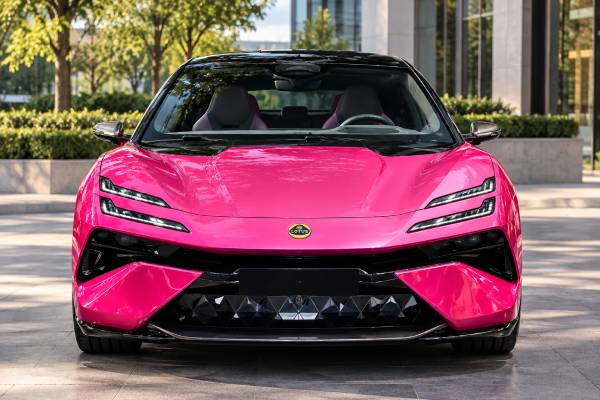
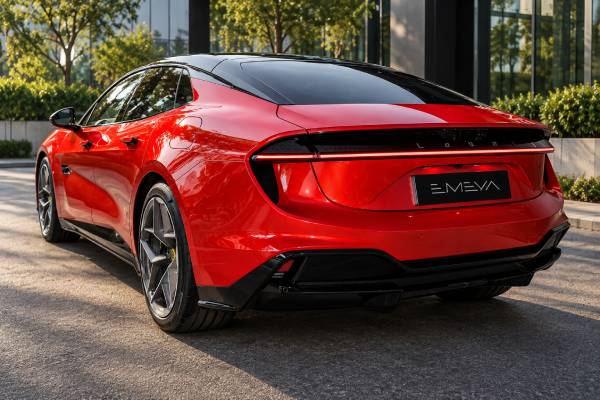
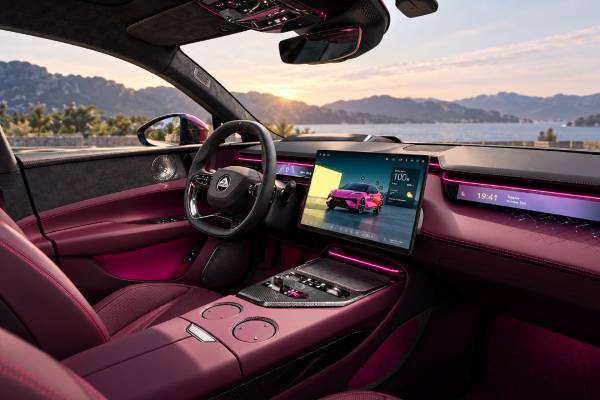
The 2024 Lotus Emeya Blossom Limited Edition is not simply a high-output Emeya with a decorative color pack. It is a Chapman Bespoke collection car built around the 675 kW dual-motor, two-speed Emeya performance platform and then transformed with labor-intensive finishes, numbered production, natural gemstones, and four seasonal design themes. Lotus announced 88 cars globally, with 31 allocated to China, making provenance and originality unusually important for anyone evaluating one today. Under the artwork sits the same core engineering that makes the fastest early Emeya so formidable: a 102 kWh battery, 800-volt electrical architecture, 985 Nm of combined torque, active aerodynamics, air suspension, and very rapid DC charging. That combination creates an unusual ownership problem. Buyers need to inspect a modern high-performance EV and a collectible hand-finished object at the same time. This guide separates those two layers so performance data, charging expectations, bespoke craftsmanship, preservation needs, and authenticity checks are clear rather than blended together.
Table of Contents
- What Makes the Blossom Limited Edition Different
- Craft, Colors, and Collectibility
- Blossom Technical Specifications
- Performance, Range, and Charging
- Preserving a Bespoke Emeya
- Inspection, Authenticity, and Buying
What Makes the Blossom Limited Edition Different
The Blossom is best understood as a factory-backed collectible built on the highest-output early Emeya mechanical package. Its significance comes from the Chapman Bespoke treatment and limited production, not from a unique motor or battery design. That distinction matters because a buyer should expect R-level acceleration and charging hardware while judging the body, cabin, documentation, and numbered identity to a much stricter originality standard.
Lotus introduced the Blossom collection in China in April 2024 as the first lifestyle-vehicle Collection project under Lotus Chapman Bespoke. The company stated a global limit of 88 examples and a China allocation of 31 cars. That is more important than a conventional trim badge: the edition was conceived as a curated design object, with production scarcity, special handwork, and customer experiences tied to the numbered cars. In other words, the appeal is closer to a limited art series than to a normal equipment package that could be replicated by ticking options on a configurator.
Mechanically, the assignment version uses the 675 kW dual-motor AWD system associated with the early high-performance Emeya. Peak output is 675 kW, or about 905 hp, and combined torque is 985 Nm. The rear drive unit uses a two-speed transmission, a major difference from the 450 kW Emeya’s simpler reduction gearing. Lotus quotes roughly 2.8 seconds from 0 to 100 km/h for this performance level and a top speed around 256 km/h. Those numbers place the car firmly in super-sedan territory even though its five-door liftback body is designed for four-adult touring and luggage.
The rest of the platform remains technically sophisticated. Electronically controlled air suspension reads road inputs at very high frequency, while active aerodynamic devices manage cooling, drag, stability, and downforce. A low battery position and long wheelbase help keep the center of gravity low, but the car is still a large EV weighing well over two metric tons. The driving character therefore depends less on old-school Lotus lightness and more on active systems coordinating mass: air springs, adaptive damping, torque distribution, powerful brakes, and aero all work together to make the car feel smaller and more controlled than its dimensions suggest.
For collectors, the key takeaway is simple: do not let the bespoke finish distract from normal EV due diligence, and do not let healthy EV hardware distract from damage to irreplaceable bespoke pieces. Both sides of the car carry value.
Craft, Colors, and Collectibility
The Blossom’s strongest differentiator is visible before the car moves. Lotus described four themed color treatments inspired by the grounds and seasonal atmosphere of the Chapman estate, with hand-applied gradients and floral detailing that cannot be judged like ordinary production paint. The cabin added 42 natural gemstones and 83 precious-metal decorative pieces, so condition and completeness should be recorded in detail before purchase.
The four themes were presented as Spring New Leaves, Blossom Bloom, Forest Gold, and Snowy Night Deep Blue in translated descriptions. The exact English rendering can differ across markets, but the important point is that the finishes are intentional multi-tone compositions rather than a single paint code. The gradient transitions are part of the design. A repair that is technically smooth yet shifts the color boundary, metallic orientation, or tonal fade can reduce authenticity even if it would pass on a conventional luxury car.
Lotus also highlighted hand-pressed British floral decoration on curved exterior surfaces. Because those elements sit on complex shapes, restoring a damaged sill or decorative panel is not comparable with ordering an ordinary painted replacement. Before authorizing body work, an owner should ask whether the affected part can be refinished through a recognized Lotus Chapman Bespoke channel and whether the original motif, color recipe, and surface process are documented for that specific car.
Inside, the gemstone and metal count provides a useful inspection framework. A buyer does not need to treat every decorative element like museum jewelry, but should photograph the cabin systematically: dashboard, center console, door trims, seat details, rear compartment, switch surrounds, plaques, and any areas carrying the bespoke marks. Missing stones, mismatched fasteners, lifted trim, scratched precious-metal surfaces, or replacement panels should be written into the purchase record rather than dismissed as cosmetic wear.
Collectibility also depends on paperwork. The best file will include the original order specification, production or edition number, delivery documentation, Chapman Bespoke literature, invoices for any refinishing, software/service history, keys, charging equipment, and photographs taken before repairs. For a car whose appeal comes from factory authorship, a complete documentary chain can be as important as low mileage.
One practical mistake is to over-protect the car into disuse. Long storage at extreme state of charge, neglected 12-volt support, flat-spotted tires, or unused brake hardware can create mechanical problems. A collectible EV still benefits from regular controlled exercise, moderate battery state of charge, dry storage, and periodic inspection of tires, brakes, suspension, seals, and charging functions.
Blossom Technical Specifications
The Blossom is a BEV with one traction motor on each axle, all-wheel drive, a 102 kWh traction battery, and the high-output Emeya driveline. The performance version pairs its rear motor with a two-speed transmission, while the 800-volt-class electrical system is designed for unusually high DC charging power. The tables below focus on information that is useful for this exact version and avoid filling unsupported service rows.
| Specification | Value |
|---|---|
| Powertrain type | Battery-electric, dual-motor AWD |
| Combined peak power | 675 kW (about 905 hp) |
| Combined peak torque | 985 Nm (727 lb-ft) |
| Motor layout | One electric motor at each axle |
| Battery capacity | 102 kWh |
| Electrical architecture | 800-volt class |
| Rear transmission | Two-speed drive unit |
| Drive | All-wheel drive |
| Specification | Value or condition |
|---|---|
| 0–100 km/h | About 2.8 seconds |
| Top speed | About 256 km/h (159 mph) |
| CLTC rated range | 480 km (298 mi) for the Blossom catalog version |
| Rated energy use context | CLTC figure; real consumption depends strongly on speed and climate |
| Body concept | Five-door electric Hyper-GT / liftback |
| Specification | Value or note |
|---|---|
| DC connector in European-type markets | CCS |
| AC connector in European-type markets | Type 2 |
| Peak DC capability | 350 kW-class on original launch specification; later Lotus material cites higher Hyper Charging capability |
| Typical quoted 10–80% target | About 18 minutes under suitable charger and battery conditions |
| Battery preconditioning | Supported through vehicle thermal management/navigation functions |
| Charge-port location | Rear-side body location |
| Specification | Value |
|---|---|
| Length | 5,139 mm (202.3 in) |
| Width | 2,005 mm (78.9 in), excluding mirrors |
| Wheelbase | 3,069 mm (120.8 in) |
| Height | About 1,459–1,464 mm depending on market specification |
| Front track | 1,712 mm |
| Rear track | 1,694 mm |
| Front luggage compartment | 34 L on corresponding Emeya specification |
| Rear luggage volume | Up to 509 L on five-seat global configuration |
| Specification | Configuration |
|---|---|
| Suspension | Electronically controlled air suspension |
| Steering | Power-assisted steering; rear-steer availability depends on specification |
| Aerodynamics | Active front grille, active rear diffuser elements, and deployable rear wing |
| Driver-assistance processing | Dual NVIDIA DRIVE Orin-based platform in original Emeya launch material |
| Sensor suite | 34 surround sensors cited by Lotus for the platform |
| Infotainment | Lotus Hyper OS with over-the-air update capability |
| Item | Factory description |
|---|---|
| Global production | 88 cars announced |
| China allocation | 31 cars announced |
| Exterior themes | Four seasonal/estate-inspired schemes |
| Cabin gemstones | 42 natural gemstones |
| Precious-metal decorative pieces | 83 pieces |
| Bespoke program | Lotus Chapman Bespoke Collection |
Performance, Range, and Charging
Performance is effortless but not one-dimensional. The 675 kW system has enough power to make the first full-throttle launch the least informative part of a test drive; what matters more is whether the car delivers power cleanly, shifts the rear two-speed unit without abnormal thumps, tracks straight under heavy acceleration, and transitions smoothly between regeneration and friction braking.
A high-output Emeya should feel stable rather than nervous. If the steering wheel shakes under load, the car pulls under braking, or there is a repeating vibration that rises with road speed, investigate wheels, tires, alignment, suspension, and possible wheel damage before assuming it is a normal consequence of very wide performance rubber. Large wheels are vulnerable to pothole impacts, and an expensive bespoke car may have spent more time on low-profile tires than a typical luxury EV.
The 480 km CLTC number attached to the Blossom should not be read as a guaranteed road-trip distance. CLTC is a Chinese laboratory cycle and is generally more optimistic than sustained high-speed motorway use. Climate control, low temperature, repeated acceleration, tire choice, wheel size, payload, and battery temperature all alter consumption. A better ownership habit is to learn the car’s consumption at the speeds and temperatures you actually drive, then plan rapid-charging stops with a reserve rather than chasing the rated maximum.
Charging is one of the platform’s strengths. The original Emeya launch material described an 800-volt battery system and approximately 18 minutes for a 10–80% DC session under favorable conditions. Peak power is only one part of that result. A cold pack, a charger that cannot provide sufficient voltage/current, a nearly full starting state of charge, or a hot battery after repeated fast charging will all reduce the number seen on the charger screen. Use navigation-linked preconditioning before an important fast-charge stop when available.
For a low-mileage collectible, AC charging can be preferable for routine energy replenishment because there is rarely a reason to seek maximum DC power every time. That does not mean fast charging is harmful in normal use; the battery management system controls charge acceptance. It means an owner can prioritize convenience and battery temperature stability when the car is not being driven long distances.
Before purchase, perform at least one meaningful charging test. Confirm the car communicates with a suitable DC charger, begins preconditioning when expected, locks and releases the connector correctly, records charge data, and shows no persistent charging or high-voltage warnings. A static showroom inspection cannot reveal all of those behaviors.
Preserving a Bespoke Emeya
Maintenance on the Blossom has two goals: keep the EV platform healthy and avoid damaging finishes that may be difficult to reproduce. The mechanical service burden is lower than an ICE grand tourer’s, but that does not make the car maintenance-free. Tires, brakes, air suspension, cooling circuits, cabin filtration, wipers, 12-volt systems, software, and body hardware still age with time.
Start with the paint. Do not allow an unfamiliar detailer to machine-polish a gradient panel until the finish structure is understood. On a normal clear-coated panel, a technician can measure paint depth and correct defects within a known margin. On a hand-finished multi-layer bespoke surface, an aggressive correction can alter the visual transition or remove more material than intended. Wash with clean media, minimize dry wiping, and document any paint-protection film before replacement so edges and cuts can be reproduced without harming decorated areas.
The natural stones and precious-metal cabin pieces deserve similarly conservative cleaning. Avoid harsh solvents, abrasive pads, metal polish, or steam directed at bonded decorative parts. Use a soft brush or microfiber method appropriate to the surrounding substrate, and treat any loose piece as a preservation issue rather than gluing it back with an unknown adhesive. A traceable repair is better than an invisible improvised one if future authenticity matters.
EV-specific care is more conventional. Keep software current after confirming update notes, maintain reasonable charge habits, and avoid leaving the traction battery at 0% or 100% for unnecessary long periods. If the car is stored, follow Lotus guidance for state of charge and 12-volt support. Run climate and charging functions periodically, and move the car enough to prevent tire flat spotting and brake surface corrosion.
Because regenerative braking can reduce friction-brake use, inspect discs and pads rather than assuming low mileage means low wear. Performance cars can experience the opposite problem too: a few track sessions can consume pads and tires quickly even when the odometer remains modest. Look for heat discoloration, grooving, cracked friction material, uneven pad deposits, and vibration under repeated stops.
Air suspension deserves a quiet overnight check. Compare ride height after the car has been parked, listen for compressor overactivity on startup, and scan for chassis faults. A slow leak may not trigger a dramatic warning during a short test drive. Finally, inspect underbody shields and battery-protection areas after any evidence of curb or road-debris impact. On an EV, underside damage deserves more attention than a cosmetic scuff on a conventional exhaust shield.
Inspection, Authenticity, and Buying
Buy the best-documented Blossom you can find, not simply the example with the lowest odometer reading. A genuine numbered car with complete bespoke records, original decorative pieces, healthy high-voltage systems, and professionally documented repairs is a stronger purchase than a superficially perfect car whose identity or restoration history cannot be established.
Begin with VIN and edition documentation. Match the VIN on the body, windshield area, electronic diagnostic record, registration documents, purchase invoice, and bespoke paperwork. Confirm the edition number and original theme. If a seller claims a special factory specification, ask for the corresponding order sheet or delivery record rather than relying on photographs of badges.
Next, inspect the bespoke exterior in controlled light. Look along panel edges and color-transition zones for masking lines, overspray, sanding marks, mismatched flake orientation, texture changes, or a gradient that ends differently from side to side. Paint-depth readings can be useful, but interpret them carefully on hand-finished work; an unusual reading is a reason to investigate, not automatic proof of accident damage.
Inside, create a photographic inventory of the stones, metal details, plaques, floral trim, seat embroidery, and other edition-specific elements. Check seat motors, displays, climate zones, audio, cameras, sensors, door handles, charge-port operation, and every powered convenience feature while you are there. A high-value special edition is expensive to troubleshoot piecemeal after purchase.
Then treat it like a performance EV. Review battery and charging diagnostics, check for high-voltage isolation faults or repeated thermal warnings, inspect tire date codes and tread depth across the full width, verify all wheels match the factory specification, test the brakes from low and higher speed, and confirm the air suspension cycles through its modes without errors. During a road test, listen for driveline clunks that repeat with torque reversals and for wheel-bearing or tire noise that changes through bends.
A useful pre-purchase sequence is:
- Verify VIN, edition number, original color theme, and ownership paperwork.
- Photograph all bespoke components before discussing price.
- Run a diagnostic scan and review software/service history.
- Inspect underbody, battery protection, suspension, wheels, tires, and brakes on a lift.
- Complete a road test from cold, including strong acceleration and repeated braking.
- Confirm AC and DC charging operation if practical.
- Obtain written estimates for any missing bespoke parts or cosmetic restoration before committing.
Do not assume rarity guarantees appreciation. The market for a modern electric collectible can change with battery technology, software support, brand strategy, and regional demand. Buy the Blossom because its combination of Chapman Bespoke craftsmanship and Emeya performance appeals to you, and treat future value as uncertain. The best protection is originality, documentation, careful storage, proper exercise, and maintenance that can be traced.
A final pricing check should separate reversible wear from loss of edition identity. Tires, brake pads, a tired 12-volt battery, or ordinary stone chips have fairly understandable remedies. Missing numbered documentation, substituted bespoke trim, an incorrectly repainted gradient panel, or undocumented structural work are harder to price because the correction may require factory involvement and may never restore the same provenance. That is why two Blossom cars with similar mileage can deserve very different valuations.
Insurance deserves advance planning as well. A normal replacement-value policy may not reflect the cost of hand-finished paint, unique decorative material, or scarce edition parts. Before purchase, ask the insurer how agreed value, specialist repair authorization, transport to an approved body facility, and replacement of bespoke components would be handled after a claim. Keep high-resolution photographs of each exterior theme transition and every important cabin detail away from the car itself; those images can help with both claims and future provenance.
Ownership also becomes easier when the car is treated as a system rather than a display object. Record charging behavior over time, including typical peak power at a familiar fast charger and normal energy use on a repeat route. Note any software changes after over-the-air updates. Keep tire pressures consistent, because the Emeya’s mass and wide tires make small pressure differences noticeable in wear and range. If a new noise appears, document speed, road surface, temperature, state of charge, and whether it changes under acceleration or regeneration. Those details help a technician distinguish tire roar from wheel-bearing noise, suspension movement, or driveline behavior.
For long-term collectors, reversibility is a useful rule. Paint-protection film, removable interior protection, and sympathetic wheel care can preserve the original car. Permanent color changes, aftermarket drilling, nonstandard badges, aggressive lowering, or irreversible cabin modifications can undermine the very factory authorship that makes the Blossom interesting. The edition already contains its visual statement; preservation usually adds more value than personalization.
References
* 路特斯EMEYA繁花绽放 高级定制版开启预售 2024 * Lotus Emeya – The Fully Electric Hyper-GT | Lotus Cars 2026 * Lotus Emeya – Explore Models | Lotus Cars 2026 * Lotus Emeya | How it Drives | Lotus Cars 2026 * Lotus unveils Emeya, its first Hyper-GT – Lotus Cars Media Site 2023 * Lotus believes processing power is the new horsepower – and Emeya built on NVIDIA DRIVE is a thoroughbred – Lotus Cars Media Site 2023
Disclaimer
This article is for informational purposes and is not a substitute for professional diagnosis, repair, or a factory pre-purchase inspection. Specifications, torque values, service intervals, software functions, and procedures can vary by VIN, market, production date, and equipment; verify all work against the official Lotus documentation for the exact vehicle. If this guide was useful, please consider sharing it on Facebook, X/Twitter, or another community you use to support our work.