
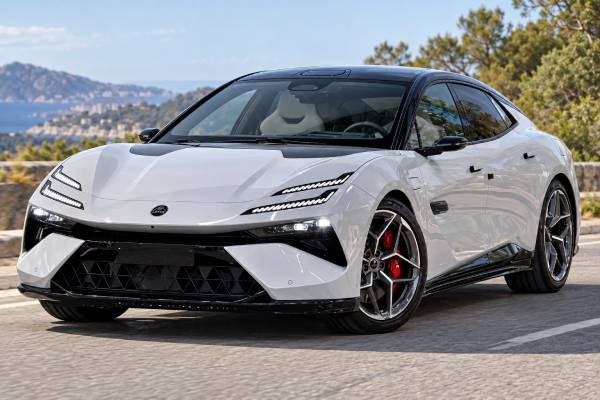
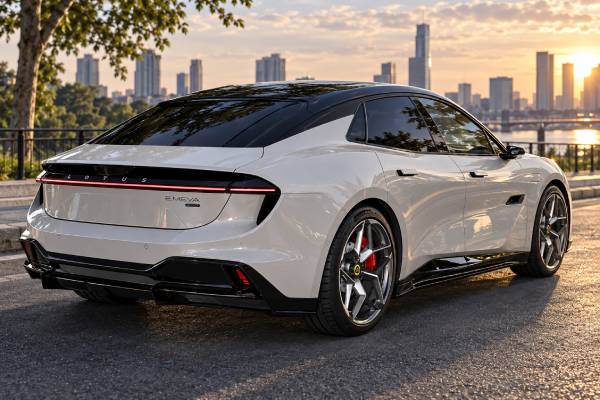
The 2025 Lotus Emeya First Launch Limited Edition is best understood as an early-market version of Lotus’s first four-door electric Hyper-GT, built around the 450 kW dual-motor all-wheel-drive powertrain rather than the later 900-hp flagship hardware. Its core appeal is not a special engine tune but the Emeya package itself: a low-slung five-door body, 800-volt electrical architecture, a 102 kWh battery, air suspension, active aerodynamics, and unusually fast DC charging. The “First Launch Limited Edition” name is market-specific and is not documented as clearly in Lotus’s current global catalogue as later 600, GT SE, Sport, and 900 designations. That matters when buying one used, because option content should be verified from the VIN and original build record instead of inferred from the badge. For a correctly identified 450 kW car, however, the mechanical fundamentals are well established and make this an unusually rapid, long-legged luxury EV.
Table of Contents
- Identity and model scope
- Verified technical specifications
- Performance, chassis, and driving character
- Range, charging, and trip planning
- Ownership and maintenance priorities
- Used-buying checks for a launch-edition car
- Who this version suits
Identity and model scope
The first job with a First Launch Limited Edition is to verify what the name means on the individual car. The 2025 vehicle covered here is the 450 kW, 603 hp dual-motor AWD Emeya, not the higher-output 675 kW car with the two-speed rear drive unit.
Lotus introduced Emeya before later reorganizing the range around the “600” and “900” power-level names. Contemporary Lotus technical information for the underlying 450 kW car establishes the important engineering facts, while later regional catalogues show that equipment packages and model names can differ by country. The “First Launch Limited Edition” wording appears in Chinese-market vehicle listings, but it is not a trim label that should be treated as globally standardized.
That distinction changes how a buyer should evaluate the car. A later Emeya 600 GT SE can be compared against a published trim matrix. An early limited-edition car should instead be checked against its own build sheet, invoice, VIN-linked dealer record, and physical equipment. Items such as wheel size, seat package, glass roof, rear-wheel steering, brake package, powered doors, exterior carbon, and audio specification may influence value, but they should not be assumed merely because another Emeya of similar age has them.
The Type 133 designation identifies the Emeya program in enthusiast and market references, while Lotus markets the finished car simply as Emeya. The body is a long, low electric grand tourer with four passenger doors and a large rear liftback. That hatchback layout is useful because it gives the car much more luggage flexibility than the sedan-like silhouette suggests.
For ownership decisions, the safest mental model is therefore simple: treat “First Launch Limited Edition” as an identification and provenance question layered on top of a technically well-defined 450 kW Emeya. The drivetrain, battery architecture, chassis concept, dimensions, and charging capability can be validated; special-edition cosmetic and comfort content should be documented car by car.
Verified technical specifications
This version is a battery-electric vehicle with two traction motors, all-wheel drive, a high-voltage lithium-ion battery, and an 800-volt-class charging system. The 450 kW powertrain uses a single-speed reduction arrangement rather than the two-speed transmission associated with the 675 kW Emeya 900 family.
| Specification | Value |
|---|---|
| Powertrain type | Battery-electric, dual-motor AWD |
| Maximum system power | 450 kW (603 hp; 612 PS) |
| Maximum system torque | 710 Nm (524 lb-ft) |
| Motor arrangement | One motor at each axle |
| Drive | All-wheel drive |
| Transmission | Single-speed reduction drive |
| Battery capacity | 102.0 kWh gross |
| Usable battery capacity | 98.9 kWh |
| Battery chemistry | Lithium-ion, NMC |
| Electrical architecture | 800-volt class |
| Specification | Value or condition |
|---|---|
| 0–100 km/h (0–62 mph) | About 4.15 seconds |
| Top speed | 250 km/h (155 mph) |
| WLTP range | Up to about 610 km (379 mi), configuration dependent |
| WLTP range, higher-energy configuration | About 500 km (311 mi) |
| WLTP rated consumption | As low as about 17.7 kWh/100 km including charging losses in the most efficient test configuration |
| Tailpipe CO2 | 0 g/km |
| Specification | Value |
|---|---|
| AC connector | Type 2 in European-market specification |
| DC connector | CCS Combo 2 in European-market specification |
| Maximum onboard AC charging | Up to 22 kW |
| Manufacturer peak DC claim | Up to 420 kW on compatible equipment |
| DC 10–80% claim | About 15 minutes under suitable conditions |
| Battery preconditioning | Supported; navigation-assisted preconditioning is available on current Emeya software |
| Regeneration | Driver-adjustable regenerative braking |
| Specification | Value |
|---|---|
| Body style | Five-door electric fastback / Hyper-GT |
| Length | 5,139 mm (202.3 in) |
| Width, excluding mirrors | 2,005 mm (78.9 in) |
| Width, including mirrors | About 2,241 mm (88.2 in) |
| Height | About 1,459–1,464 mm, market specification dependent |
| Wheelbase | 3,069 mm (120.8 in) |
| Main luggage volume | About 509 L |
| Maximum rear cargo volume | About 1,388 L with rear seats folded |
| Front luggage compartment | About 34 L |
| EU unladen weight of comparable 450 kW specification | About 2,555 kg |
| Specification | Configuration |
|---|---|
| Suspension | Air suspension with continuously controlled damping |
| Chassis control | Integrated chassis control |
| Torque vectoring | Brake-based torque-vectoring function |
| Drive modes | Range, Tour, Sport, Individual, and Track on current 450 kW specifications |
| Steering | Electric power steering |
| Active aerodynamics | Active front grille plus active aerodynamic elements; rear spoiler fitment depends on specification |
| Coverage | Typical European-market term |
|---|---|
| Vehicle warranty | 5 years or 150,000 km |
| High-voltage battery and electric drive | 8 years or 200,000 km |
| Battery capacity retention | At least 70% state of health within high-voltage warranty terms |
| Paint | 5 years |
| Anti-corrosion | 12 years for specified chassis/body coverage |
Warranty terms vary by country, so the original selling-market policy remains the controlling document for an imported launch-edition car.
Performance, chassis, and driving character
The 450 kW Emeya is already extremely quick, but its character is closer to a fast grand tourer than a drag-race special. The roughly 4.15-second 0–100 km/h time gives effortless road performance without the more complex two-speed rear transmission and 985 Nm output of the 900-series cars.
Both axles are driven electrically, so torque delivery is immediate and traction is strong in poor weather. What makes the Emeya more interesting than its headline output, though, is the way Lotus integrates the mass of a large battery car. The pack sits low in the floor, the body is relatively low for a four-seat luxury EV, and electronically controlled air springs and dampers continuously manage pitch, roll, and wheel movement. Lotus also uses active aerodynamics to balance cooling, drag, and high-speed stability.
That does not make a roughly 2.5-tonne car light. A buyer expecting an Elise-like sense of minimal mass will be using the wrong reference point. The achievement is instead that Emeya attempts to make a heavy, long, high-performance EV respond with the precision expected from the brand. The steering, suspension, torque distribution, braking, and aero systems are all part of the same dynamic strategy.
Wheel and tire choice matters. Larger wheels can sharpen appearance and response, but they normally increase tire cost, expose the rims more to pothole damage, and can reduce the official range compared with the most efficient configuration. A launch-edition car may also have a wheel package that differs from later published trim specifications, so replacement tires should be matched to the actual wheel size, load index, and speed rating fitted to the car.
The braking system deserves the same attention. Regeneration reduces some friction-brake use in daily driving, yet a powerful and heavy EV still places serious demands on discs, pads, tires, and suspension joints when driven hard. Cars that have spent their life in urban traffic can also develop surface corrosion on friction discs if the hydraulic brakes are rarely used aggressively enough to clean them. During a test drive, braking should feel smooth and straight, with no steering shake, pulsing, scraping, or persistent warning messages.
Range, charging, and trip planning
The standout touring feature is charging speed. With a warm battery and a genuinely high-output charger, the 800-volt system can accept power at a level that makes a short charging stop more useful than obsessing over the last few percentage points of starting range.
The maximum WLTP figure of roughly 610 km belongs to favorable vehicle configuration and test conditions. It should not be treated as a promise for every wheel package, season, speed, or market version. At sustained motorway speeds, in winter, or with repeated hard acceleration, consumption rises substantially. That is normal for any EV, and especially noticeable in a wide, powerful car on performance tires.
For everyday use, home or workplace charging is still more important than peak DC power. A 22 kW three-phase AC supply can make good use of the Emeya’s onboard charger where that electrical service is available. Many homes supply less, and the car simply charges at the lower available rate. There is no practical reason to install a charger that exceeds the electrical capacity of the building merely because the car can accept 22 kW AC.
On a road trip, preconditioning is critical. A cold battery may not accept its headline power even if the charger is capable of supplying it. Setting a rapid charger as the navigation destination allows the vehicle to prepare the pack when supported by the software and operating conditions. Arriving at very high state of charge also reduces the benefit of a fast charger because charging naturally tapers as the battery fills.
A useful habit is to plan around the fastest part of the charging curve rather than trying to reach 100% at every stop. On a long journey, charging from a low state of charge to around 70 or 80% can be much quicker than waiting for the final portion. At home, owners can choose a lower daily charge target when their driving pattern allows it, while still charging higher before a long trip. The exact battery-care guidance in the vehicle manual and current software should take priority over generic EV advice.
Charging history can also reveal useful information when buying. Repeated high-power charging is not automatically harmful—the car is engineered for it—but a prospective buyer should still check for charging faults, warning messages, damaged connector pins, a loose charge-port door, and evidence that both AC and DC charging work correctly. If possible, test a real charging session instead of relying only on the seller’s statement.
Ownership and maintenance priorities
Emeya has no engine oil, spark plugs, timing belt, or exhaust system, but it is not a maintenance-free vehicle. Tires, brakes, suspension, HVAC, coolant circuits, 12-volt electronics, wipers, cabin filtration, and software all remain relevant, and the high performance of the car can make wear items expensive.
The most important routine expense is likely to be tires. The car combines high torque, considerable mass, wide staggered fitments on many specifications, and performance-oriented geometry. Inspect the inner and outer shoulders, not just the center tread. Uneven wear can point to alignment issues, damaged suspension components, incorrect pressures, or a car that has been driven hard. A matching set of premium tires with the correct EV load and speed ratings is a positive sign because it shows the owner did not economize on the component that transfers every steering, braking, and acceleration force to the road.
Brake condition should be judged physically rather than from mileage alone. Regenerative braking can reduce pad wear, but corrosion or uneven disc surfaces may develop when friction brakes see light use. Brake fluid also ages with time and moisture exposure. Follow the market-specific maintenance schedule for inspection and replacement intervals rather than assuming low mileage means nothing is due.
The climate-control system matters to both comfort and range because it also interacts with battery thermal management. Make sure cabin heating and cooling work quickly, the heat-pump system operates without warnings, and no unusual fan, pump, or compressor noises are present. A fault here can be more consequential than a conventional luxury-car air-conditioning problem.
Software is another maintenance item in the modern sense. Lotus has issued over-the-air updates for Eletre and Emeya, including dynamic-control changes in some markets. Before purchase, check the installed software version, confirm that the car can connect to the manufacturer services appropriate to its market, and verify whether an imported car retains app, map, eSIM, and OTA support in the country where it will be used.
The 12-volt system deserves attention as well. Like other EVs, Emeya still relies on low-voltage electronics to wake control modules and operate many accessories. A weak auxiliary battery can produce confusing warning messages even when the traction battery is healthy. If the car has been stored for long periods, ask how it was maintained and whether the 12-volt battery has been replaced.
Finally, document all service work. A limited-edition badge may attract buyers, but a complete dealer or specialist history, clean diagnostic scan, current software, healthy tires, functional charging, and evidence of correct repair work are more important to long-term ownership than cosmetic rarity alone.
Cabin technology and early-car usability
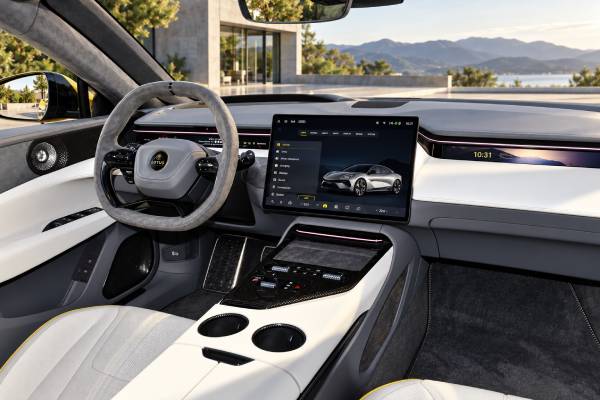
The Emeya’s cabin deserves a full operational check because much of the car’s value is tied to software and electrically controlled hardware. The central 15.1-inch OLED display carries the main interface, while slim displays ahead of the driver and passenger and a large projected head-up display reduce the need to look away from the road. Wireless Apple CarPlay and Android Auto have been added to current software specifications, and the platform supports over-the-air updates. On an early 2025 car, verify what functions are actually enabled rather than assuming the latest brochure description applies automatically.
The sensor suite is also unusually extensive. Lotus has described a system using dual NVIDIA DRIVE Orin processors with multiple cameras, radars, and deployable LiDAR units on suitably equipped cars. These components support parking, collision avoidance, lane assistance, adaptive cruise functions, and the vehicle’s broader perception system. Their presence makes calibration history important after windshield replacement, bumper work, mirror damage, or body repairs. During an inspection, check the camera views for distortion, make sure driver-assistance warnings clear normally, and confirm that retractable sensor hardware moves without sticking or producing fault messages.
Comfort equipment should be tested long enough to reveal intermittent faults. Run both front seats through their full range, test heating and ventilation if fitted, change climate zones, operate the steering-column adjustment, pair a phone, test every USB port, and listen to the audio system at low and moderate volume for speaker distortion. If the car has an intelligent glass roof, powered doors, or a hands-free tailgate, cycle each function several times. Small electronic defects can be easy to ignore during a short viewing but frustrating in daily use.
Finally, consider whether the cabin specification actually suits the intended role. The Emeya can be configured as a very technology-heavy luxury GT, but early market cars may differ in rear-seat features, upholstery, roof treatment, and seat packages. A buyer who regularly carries passengers may value rear comfort equipment more than exterior carbon trim, while a driver focused on range may prefer smaller wheels and fewer weight-adding options. The best launch-edition example is therefore not necessarily the one with the longest options list; it is the one whose verified equipment matches how the car will be used.
Used-buying checks for a launch-edition car
The best inspection strategy is to separate provenance from condition. First establish what the car is; then establish how well that individual example has been cared for.
- Match the VIN to the original specification. Ask a Lotus dealer or knowledgeable market specialist to confirm build date, powertrain, exterior and interior specification, factory options, and selling market. Do not rely on a translated auction title alone.
- Verify the 450 kW drivetrain. The covered car should correspond to the 603 hp/612 PS dual-motor AWD setup with 710 Nm, not the 675 kW system used in the higher-output version.
- Check battery state of health with evidence. A dashboard range estimate is not a battery-capacity test. Use a manufacturer-supported diagnostic report where possible and compare it with warranty terms.
- Test AC and DC charging. Confirm charge-port operation, cable locking, preconditioning behavior, and the absence of charging-system warnings.
- Inspect the underside and battery enclosure. Look for impact damage, crushed jacking points, scrapes, fluid traces, or poorly repaired shields. Any meaningful damage near the high-voltage pack deserves professional evaluation.
- Review tires, wheels, and alignment. Bent large-diameter wheels and uneven tire wear can create vibration and may indicate pothole impacts or hard use.
- Exercise every powered feature. Seats, mirrors, glass roof if fitted, doors, tailgate, cameras, sensors, HUD, audio, climate control, charging door, and mobile connectivity can be costly and time-consuming to diagnose.
- Scan for stored faults and confirm software status. A warning-free dashboard at startup is not the same as a clean diagnostic history.
Imported cars require an extra layer of checking. Confirm charging connector compatibility, navigation and connectivity support, warranty transferability, parts availability, homologation status, language settings, and whether local dealers will perform software campaigns. A car can be mechanically sound yet inconvenient to own if its digital services are tied to another region.
Also inspect collision repairs closely. Emeya uses sophisticated sensors for driver assistance and active chassis functions. A repaired bumper, windshield, mirror, or body panel may require calibration of cameras, radar, LiDAR, or other sensing hardware depending on specification. Documentation showing that repairs and calibrations were completed correctly is worth more than a freshly polished exterior.
Who this version suits
The First Launch Limited Edition makes the most sense for a buyer who values early-production provenance and wants the 450 kW Emeya’s balance of range, speed, and simpler driveline hardware. It is still far faster than most drivers need, but it avoids the 900-series car’s higher output and two-speed performance focus.
Its strongest case is as a rapid long-distance EV. The cabin is spacious, the hatch is practical, the air suspension is tuned for both comfort and body control, and the 800-volt system can cut charging stops dramatically when the infrastructure cooperates. It also offers a more unusual ownership experience than the established German electric luxury cars without sacrificing modern infotainment and driver-assistance technology.
The trade-off is complexity. This is a technologically dense vehicle with active aero, electronically controlled suspension, multiple high-resolution displays, extensive sensors, powerful charging electronics, and large performance hardware. Used values can make such cars look tempting, but maintenance and repair exposure does not fall in proportion to depreciation.
Buy the example with the clearest provenance, best documentation, healthiest battery, cleanest chassis, and most complete functional test—not simply the one with the most dramatic special-edition description. Because the “First Launch Limited Edition” label is market-specific, confirmation of the actual factory build is part of the purchase, not an optional extra. Once that is established, the 450 kW Emeya is a compelling mix of Lotus chassis ambition and modern electric-GT usability.
References
- Lotus unveils Emeya, its first Hyper-GT 2023
- Lotus believes processing power is the new horsepower – and Emeya built on NVIDIA DRIVE is a thoroughbred 2023
- Lotus Emeya (2024-2025) price and specifications 2025
- Used Lotus under 100k Miles for Sale – Export from China | Guazi 2026
- Lotus Cars Official Site 2026 (Warranty)
- Lotus Emeya – The Fully Electric Hyper-GT | Lotus Cars 2026
Disclaimer
This article is for informational purposes and is not a substitute for professional diagnosis, repair, or a VIN-specific factory inspection. Specifications, torque values, service intervals, software functions, charging capability, and procedures can vary by VIN, market, equipment, and software version; verify all work and purchase decisions against official Lotus service documentation for the individual vehicle.
If this guide was useful, please consider sharing it on Facebook, X/Twitter, or another automotive community to support our work.