
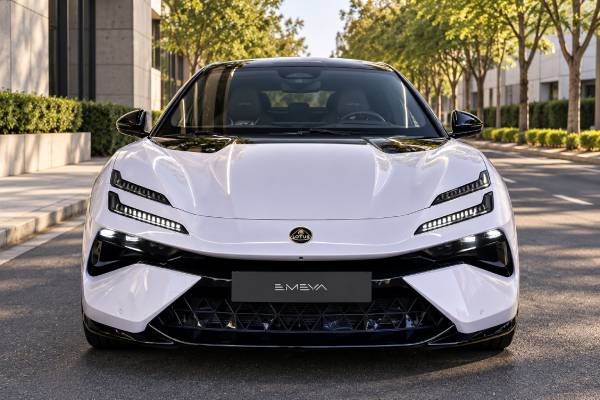
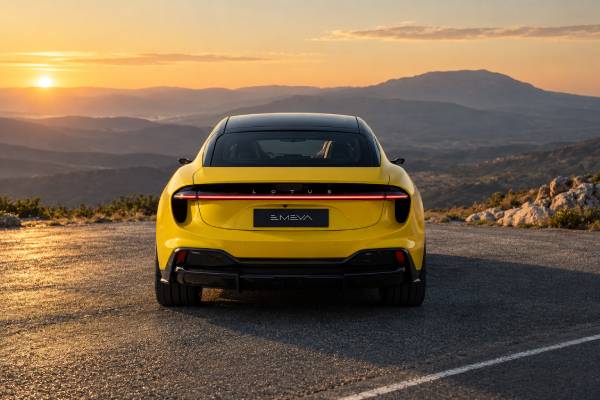
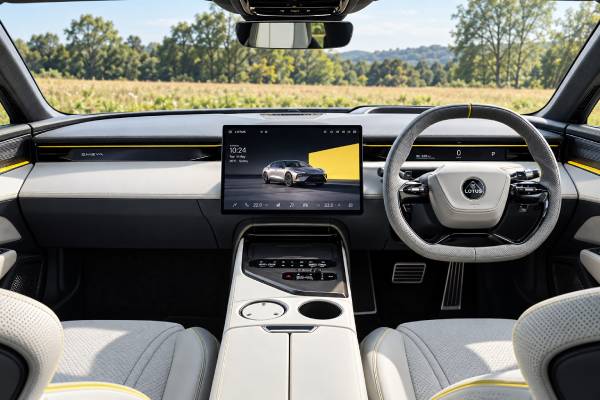
The Lotus Emeya L+ is the China-market version that puts the 450 kW dual-motor drivetrain into a clearly defined luxury-performance package. Launched at RMB 668,000, it pairs 603 hp, 710 Nm, and all-wheel drive with a 102 kWh battery and a 650 km CLTC range rating, making it the long-range entry point to the original Chinese Emeya family. Its appeal is not just price. The L+ keeps the 800-volt charging system, air suspension, active aerodynamics, advanced driver-assistance hardware, and five-door practicality that make the Emeya technically interesting, while avoiding the R+ model’s two-speed high-output rear drive unit. That makes it a useful choice for owners who want fast cross-country performance and a full five-seat cabin more than extreme acceleration. Because L+ is a market-specific trim, buyers also need to understand software region, connected services, charging compatibility, and equipment differences before importing one. This guide treats those China-market details as central ownership issues rather than footnotes.
Table of Contents
- Where L+ Fits in the China Lineup
- L+ Powertrain and Chassis Data
- Five-Seat Cabin and Equipment
- 650 km CLTC Range in Context
- China-Market Software and Charging
- Service, Tires, Brakes, and Suspension
- Buying or Importing an L+
Where L+ Fits in the China Lineup
The L+ sits at the rational end of the original Chinese Emeya range. It delivers the same basic 450 kW performance level as the standard-power global car, but its trim identity, pricing, equipment bundles, and CLTC certification belong to the Chinese market. That is why an L+ should not be described simply as a rebadged European Emeya.
At launch, Lotus China listed the L+ at RMB 668,000, below the S+ and R+ variants. The powertrain uses one motor at each axle for 450 kW combined output and 710 Nm. Official 0–100 km/h performance is about 4.15 seconds, and top speed is 250 km/h. Those figures make the car objectively quick even before considering that electric torque is available without waiting for engine speed or a conventional gearbox to select a ratio.
The more important distinction is what L+ does not chase. It does not use the 675 kW, 985 Nm performance system or the rear two-speed transmission that defines the R-family cars. That reduces the need to trade range for acceleration. The result is the 650 km CLTC catalog rating, which became one of the L+ model’s identifying numbers in China.
Five-seat packaging also gives L+ a straightforward role. Some higher Emeya configurations offered a four-seat rear compartment with separate executive-style seating, but L+ is typically encountered as the five-seat version. For owners who actually need to carry three people across the rear bench, that can be more useful than the visually richer four-seat console arrangement.
Lotus did not strip the car to reach its lower position in the range. The platform still carries sophisticated chassis and digital technology, including air suspension, active aero, connected infotainment, and an extensive sensor suite. In practical terms, the L+ is closer to “full Emeya with the efficient drivetrain” than to a conventional base model.
That framing helps when shopping used. Do not ask only whether an R+ is faster. Ask whether the extra acceleration, more complicated rear drive unit, shorter rated range, and often more expensive wheel/brake specification solve a real need. For long journeys, family use, and daily charging, the L+ can be the more coherent package.
L+ Powertrain and Chassis Data
The L+ is a BEV using dual permanent-magnet motors and all-wheel drive. Its 102 kWh battery and high-voltage architecture are shared with the wider early Emeya family, but the 450 kW calibration and single-speed drive units distinguish it from the high-performance R+ branch. China-market dimensions are commonly quoted with the 1,464 mm body height.
| Specification | Value |
|---|---|
| Combined peak power | 450 kW (603 hp; 612 metric PS) |
| Combined peak torque | 710 Nm (524 lb-ft) |
| Motor count | Two |
| Motor layout | Front axle and rear axle |
| Drive | All-wheel drive |
| Transmission type | Single-speed reduction gearing |
| Battery capacity | 102 kWh |
| Battery chemistry | Ternary lithium/NMC listed in Chinese specification databases |
| Measure | Figure |
|---|---|
| 0–100 km/h | 4.15 seconds |
| Top speed | 250 km/h (155 mph) |
| CLTC electric range | 650 km (404 mi) |
| Energy type | Battery electric |
| Seating | Five seats in the L+ catalog configuration |
| Body | Five-door large liftback / Hyper-GT |
| Item | Detail |
|---|---|
| High-voltage platform | 800-volt class |
| DC fast charging | High-power Lotus charging system |
| China fast-charge context | Lotus promoted 480 kW flash-charging infrastructure in China |
| Charge time listings | About 0.2–0.25 hour fast-charge windows in period Chinese catalogs, depending on stated SOC window |
| Battery conditioning | Active thermal management |
| Home/destination charging | AC charging supported; connector and supply should match market hardware |
| Dimension | Value |
|---|---|
| Length | 5,139 mm |
| Width | 2,005 mm |
| Height | 1,464 mm |
| Wheelbase | 3,069 mm |
| Front track | 1,712 mm |
| Rear track | 1,694 mm |
| Ground-clearance context | About 146 mm at the stated loaded condition in Chinese listings |
| System | L+ context |
|---|---|
| Suspension | Electronically controlled air suspension |
| Damping | Adaptive electronic control |
| Aerodynamic hardware | Active grille, active rear elements, deployable wing |
| Steering | Electric power steering; verify rear-steer fitment by VIN/equipment list |
| Brake system | High-performance disc setup; package differs across later special editions |
| Drive-mode integration | Powertrain, chassis, regeneration, and stability functions coordinated electronically |
| Feature | Description |
|---|---|
| Infotainment | Lotus Hyper OS |
| Software delivery | Over-the-air update capability |
| ADAS compute | NVIDIA DRIVE Orin-based platform |
| Driver display | Wide head-up display plus digital interfaces |
| Connectivity | 5G-era connected services, market dependent |
| Audio | KEF premium system available according to trim/equipment |
Five-Seat Cabin and Equipment
The L+ makes the most sense when its rear bench is treated as useful space rather than as a styling compromise. Three-across rear seating, a large liftback opening, and the long wheelbase turn the car into something closer to a fast family grand tourer than an oversized four-door sports car.
Before buying, sit in all the positions you expect to use. The sloping roof creates a more dramatic silhouette than a traditional luxury sedan, so rear headroom should be judged with actual occupants rather than from wheelbase numbers. Check the center rear position too. If a child seat will be used, confirm anchor locations and door-opening clearance, then make sure the front seat can return to the driver’s normal position without contact.
The cabin’s digital design places many functions in software. That gives the interior a clean appearance, but it also means a thorough test takes time. Work through climate zones, seat heating/ventilation, seat memory, mirrors or camera-based exterior view where fitted, steering-wheel controls, HUD positioning, navigation, Bluetooth, smartphone integration, voice control, parking cameras, and remote app functions. A used-car inspection that lasts only fifteen minutes can easily miss a regional software problem.
Material condition tells a story about use. Inspect seat bolsters for transfer dye and abrasion, rear-seat controls for scratches, glossy surfaces for poor cleaning, and door-card edges for marks from frequent entry. On a five-seat L+ that served as family transport, minor cosmetic wear is normal; inconsistent wear can be more revealing. A nearly untouched driver’s seat with heavily worn rear trim may indicate chauffeur use, while the opposite pattern suggests a conventional owner-driven car.
The liftback should rise smoothly and stop without jerking. Check the seal, drainage channels, luggage floor, and underfloor compartments for moisture. Fold the rear backrest and confirm latches engage securely when returned upright. Large electric liftbacks can hide past cargo damage under mats, so remove them and inspect the floor edge and side trims.
If the car is being imported, test language support and account functions before purchase. Some connected features may depend on a Chinese phone number, app account, mapping service, or data connection. A feature list is less useful than proof that the functions important to you actually operate in the destination country.
650 km CLTC Range in Context
The 650 km CLTC rating is a trim identifier and a laboratory result, not a prediction for every trip. The L+ can be an efficient large performance EV, but high-speed motorway use, winter heating, steep terrain, and wide tires can move real range far away from the catalog number.
CLTC testing uses a different speed profile and methodology from WLTP or EPA procedures. That makes direct numerical comparisons misleading. If you are choosing between an imported L+ and a locally sold 450 kW Emeya, compare battery size, wheel/tire setup, drivetrain output, and credible real-world consumption rather than subtracting one official range number from another.
For owners, the most useful range metric is kWh per 100 km on repeat routes. Build your own baseline after a few weeks. Record a mild-weather motorway run, a cold-weather run, and a mixed urban route. Once those baselines exist, a significant unexplained shift can point toward pressure loss, alignment changes, brake drag, roof/cargo changes, software updates, or thermal-management issues.
State of charge at departure matters less when home charging is available. A daily limit below 100% normally gives ample commuting range while avoiding unnecessary time at the very top of the pack. Before a long journey, raise the target so charging completes close to departure. That approach provides maximum trip range without turning 100% into the car’s permanent parking state.
On road trips, plan the charging stop around the fast part of the battery curve. Arriving with a lower state of charge and a preconditioned battery can save more time than driving slowly to stretch every last kilometer. The L+ platform was engineered around rapid DC charging, so its touring advantage comes from both battery capacity and short stops.
Cold weather changes two things simultaneously: the cabin needs heat and the battery may need energy to reach its preferred operating temperature. Short winter journeys can therefore show poor consumption even when the battery is healthy. Judge degradation over comparable routes and seasons, not from a single winter dashboard estimate.
China-Market Software and Charging
Software region is a real ownership specification on an imported L+. The car may be mechanically identical in many respects to an export-market Emeya, yet navigation databases, voice services, mobile-app pairing, emergency calling, data subscriptions, and charging protocols can be tied to the country where it was sold.
Before export, create a written list of functions that must work in the destination market. Include navigation, live traffic, app login, remote climate, remote lock status, OTA updates, digital key if used, streaming services, emergency call, phone projection, and public-charger routing. Test those functions rather than accepting a seller’s assurance that “the screen works.”
Charging deserves the same attention. The physical connector must match local infrastructure, but connector shape is only the beginning. The vehicle and charger must negotiate voltage, current, authentication, and communication correctly. Adapters can solve some mechanical compatibility issues, but they do not automatically convert every protocol or unlock maximum power. For an import, use specialist advice based on the exact VIN and charge-port hardware.
OTA support can become complicated after a region change. If the car cannot reach its original servers, future updates may require dealer equipment or may simply not be offered. That matters because Emeya uses software across infotainment, driver assistance, chassis coordination, and charging. Ask for the installed software version before purchase and whether a recognized Lotus service point in your country can support that version.
Driver-assistance features are particularly sensitive to regional mapping and regulation. A function demonstrated in China may be restricted or unavailable elsewhere. Never assume that hardware presence guarantees legal or functional availability after import. Treat any advanced assistance feature as secondary until it has been verified in the destination market.
The safest import purchase is therefore one where the buyer understands what may be lost and values the car accordingly. Mechanical performance can remain excellent even if some connected services are unavailable, but discovering those limitations after registration is frustrating and can affect resale.
Service, Tires, Brakes, and Suspension
L+ maintenance is dominated by chassis and supporting systems rather than by the electric motors themselves. A heavy, powerful car can consume tires and suspension components even when its traction battery and motors require little routine attention.
Tires should be measured across inner, center, and outer tread. Wide performance rubber can hide inner-edge wear, especially if toe has drifted. Check date codes, sidewall damage, repairs, and whether all four tires are the approved size, load rating, and compatible model. A bargain replacement tire may save money initially while degrading steering precision, wet braking, and range.
Air suspension should hold ride height after parking. Look at the car before it has been unlocked in the morning if possible. One low corner can indicate a leak, while a compressor that runs for a long time every startup may be compensating for lost pressure. Scan the chassis module for stored faults even if the car rises normally after a minute.
Brake inspection is equally important because regenerative braking changes the usual relationship between mileage and disc wear. A low-mileage car can have corroded discs from underuse; a spiritedly driven car can have heat damage. Inspect both faces where possible, not only the visible outer surface. During the test drive, use the friction brakes firmly enough to reveal vibration or pulling once conditions are safe.
Cooling systems for the battery, motors, inverter, and cabin need the correct fluids and procedures. Do not infer coolant specification from color. If the service history shows cooling-system work, verify that it was performed by a facility familiar with high-voltage isolation and the exact Lotus procedure.
Finally, check the 12-volt auxiliary supply. Modern EVs depend on it to wake control modules and close high-voltage contactors. A weak auxiliary battery can create a cascade of apparently unrelated warnings. Cars stored in showrooms or collections are especially vulnerable because low mileage does not mean the 12-volt battery had an easy life.
Buying or Importing an L+
Buy an L+ on three layers: physical condition, electronic health, and market compatibility. A car can pass the first layer beautifully and still be a poor import if charging or connected functions are unsupported where you live.
Start with the VIN and original invoice. Confirm that it is a genuine L+ and that the initial specification matches the five-seat 450 kW model. Chinese model naming can be translated inconsistently in export advertisements, so do not rely on a seller-created English trim name. Match power, torque, CLTC range, seating, and factory equipment to the original records.
Next, obtain a diagnostic report before faults are cleared. High-voltage isolation, battery temperature sensors, inverter history, air-suspension modules, ADAS sensors, charge-port modules, and 12-volt system faults are more useful than a dashboard photograph. Ask whether any collision required sensor or camera calibration.
Inspect the underside on a lift. The car is long and low enough to collect damage at ramps or steep entrances. Look at battery protection, aero panels, jacking points, suspension links, and the lower edges of bumpers and sills. Any impact near the battery enclosure needs professional assessment.
For a local Chinese purchase, service access is relatively straightforward. For export, call the destination Lotus service network before sending money. Ask whether they can obtain parts for a China-market VIN, perform software updates, access diagnostic systems, and support the charging hardware. A written answer is better than assuming global branding means global service interchangeability.
A sensible road-test sequence is to begin with a cold car, check ride-height behavior and low-speed noises, then drive on a smooth road to assess wheel balance. Add moderate acceleration, regenerative deceleration, and repeated friction braking. Finish with parking maneuvers so cameras, sensors, steering assistance, and close-range warning systems can be tested when the brakes and tires are warm.
The L+ is a strong choice when range, five-seat practicality, and value matter more than having the most powerful badge. Its 450 kW output is already extravagant for normal roads, and the 650 km CLTC certification gives it a clear identity in the Chinese lineup. The right example can be an unusually capable long-distance EV; the wrong import can become a software and charging project. Make that distinction before price negotiations, not after delivery.
An imported L+ needs a practical support plan before purchase. Start with charging. Photograph the vehicle inlet and confirm what AC and DC connector standards the exact China-market car uses, then compare them with public infrastructure and home equipment in the destination country. Do not assume an adapter solves every problem: communication protocols, payment/authorization, cable temperature limits, and high-voltage handshake behavior can matter. A test on the charging networks you will actually use is more valuable than a seller demonstrating charging on a familiar Chinese unit.
Connected services deserve the same attention. The vehicle can drive perfectly while an account-bound app, eSIM, map package, voice service, streaming function, remote-control feature, or over-the-air update path is restricted after export. Ask the seller to remove the car from the previous owner’s account while you are present, then verify that the vehicle accepts the new account and that remote functions work. Save screenshots of the installed software version and any available update history. If official support in the destination market is uncertain, price the car on the assumption that some China-only digital features may never be fully usable abroad.
Parts logistics can turn a minor repair into long downtime. Before committing, ask a local Lotus repairer whether it can identify the VIN, order L+-specific components, obtain service information, and perform high-voltage work. Pay particular attention to glass, lamps, cameras, lidar/radar-related exterior parts, air-suspension components, wheels, and interior electronics. Mechanical commonality with other Emeya versions helps, but regional part numbers and calibration requirements can still differ. An inexpensive imported car is not a bargain if one damaged sensor or headlamp leaves it unusable for months.
Tire and wheel condition should influence the purchase price immediately. The L+ is heavy, torquey, and capable of sustained high speed, so cheap mismatched tires are a warning sign rather than a saving. Read all four sidewalls for brand, model, size, load index, speed symbol, and date code. Measure tread at the inside, center, and outside of each tire. Uneven inner wear points toward alignment or suspension issues that should be solved before another expensive set is installed. Check wheel barrels for welds or cracks as well as visible curb marks.
Insurance should be quoted with the exact VIN and declared import status, not with a generic “Lotus Emeya” description. Confirm agreed or market value, battery and charging-cable coverage, glass limits, choice of repairer, and treatment of imported parts. If the insurer cannot identify the trim, provide the original invoice or configuration sheet showing that it is the 450 kW L+ rather than a high-output R+ or a later differently named model. Accurate classification prevents disputes after a loss and helps establish realistic replacement value.
Finally, keep a destination-country folder alongside the Chinese documents. Include registration inspection results, translations of the original sales/configuration paperwork, charging tests, software screenshots, service contacts, and part-number correspondence. This is not bureaucracy for its own sake. It converts the unusual aspects of an imported L+ into a traceable ownership record, which makes diagnosis, resale, and insurance substantially easier.
References
* 纯电超跑轿车路特斯EMEYA繁花正式上市 2024 * 唤醒驾驶本能 2024 * 莲花 EMEYA 2026 * Lotus Emeya – The Fully Electric Hyper-GT | Lotus Cars 2026 * Lotus Emeya | How it Drives | Lotus Cars 2026 * EMEYA参配信息_2024款 EMEYA R+参数配置表详细介绍_2024款 EMEYA R+报价|油耗|动力详解-太平洋汽车 2026
Disclaimer
This article is for informational purposes only and is not a substitute for professional diagnosis, repair, import-compliance advice, or a VIN-specific inspection. Specifications, torque values, service intervals, software functions, charging behavior, and procedures can vary by VIN, market, equipment, and production date; use official Lotus documentation for the exact vehicle. If the guide was useful, please share it on Facebook, X/Twitter, or another community to support our work.