
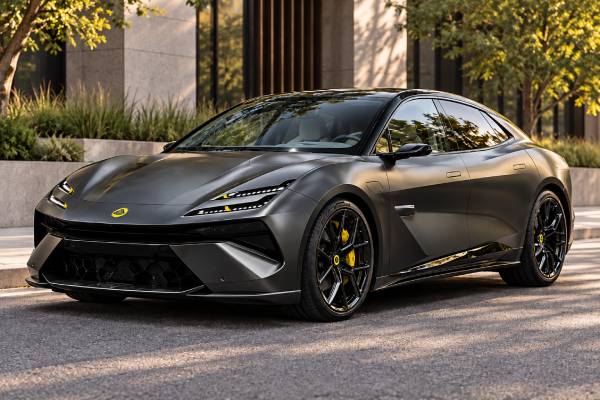
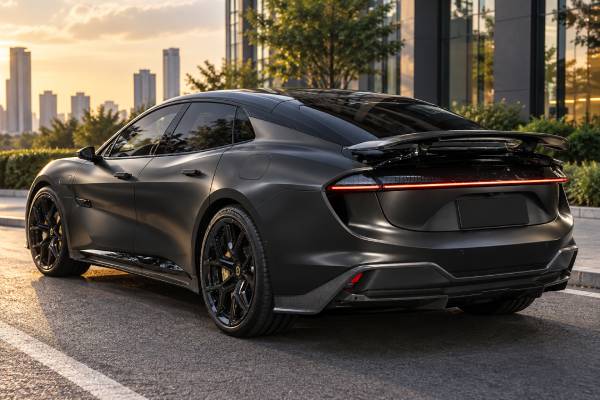
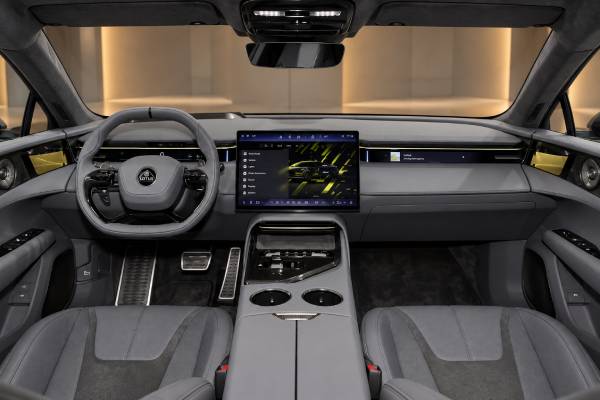
The Lotus Emeya R+ Dark Edition is a China-market special that turns the 675 kW Emeya into a more severe, track-referenced package rather than merely adding black paint. Launched in 2024 at RMB 1.08 million, it pairs the R+ dual-motor AWD system, 985 Nm of torque, rear two-speed drive unit, and 102 kWh battery with exclusive matte-black paint, matte-black carbon-fiber elements, and conspicuous yellow 10-piston carbon-ceramic brakes. Period Chinese coverage places the high-output version at 520 km CLTC, with 0–100 km/h in 2.78 seconds and a 256 km/h top speed. The appearance references the black-and-yellow visual language associated with Lotus’s Evija X track program, while the broader Dark/Platinum launch drew inspiration from motorsport’s chequered flag. Because several 2024 Emeya specials share the same basic powertrain, the Dark Edition should be authenticated by its complete factory specification, not horsepower alone. This guide focuses on the hardware, finish care, charging, brake inspection, software, and purchase evidence that matter for this exact version.
Table of Contents
- Dark Edition’s Track-Inspired Role
- Dark Edition Technical Specifications
- Ten-Piston Carbon-Ceramic Brakes in Practice
- Matte Black Carbon and Finish Care
- 520 km CLTC, Charging, and Heat Management
- Four-Seat Use, Software, and Storage
- Dark Edition Buying and Inspection
Dark Edition’s Track-Inspired Role
The Dark Edition’s defining idea is contrast: almost-black body and carbon surfaces are set against bright yellow high-performance brakes. It is mechanically rooted in the R+ rather than being a separate higher-output derivative, so its appeal lies in the factory combination of 905 hp-class performance, carbon-ceramic braking, and a deliberately monochrome exterior.
Lotus introduced the Dark and Platinum treatments around the 2024 Chengdu Motor Show. The two themes were opposites. Platinum used pearl-inspired white, gold details, and a lighter luxury presentation, while Dark used matte black paint, matte black carbon fiber, and “champion yellow” brake hardware. Contemporary coverage connected the design to racing’s black-and-white chequered flag and, more specifically for the Dark car, to the black-and-yellow visual identity used on Evija X. That context matters because the car can otherwise look like a regular R+ that has been wrapped and fitted with colored calipers.
The Dark Edition was announced from RMB 1.08 million. Its powertrain remained the established high-output Emeya setup: dual motors, all-wheel drive, 675 kW combined output, 985 Nm, and a two-speed rear transmission. The quoted 2.78-second 0–100 km/h figure therefore comes from the R+ engineering, not from a special Dark-only motor map. The ten-piston carbon-ceramic brake package is the more meaningful hardware differentiator.
That distinction should guide buying decisions. If outright acceleration is the only priority, a normal R+ can deliver the same headline output. The Dark Edition makes sense when the buyer also values the factory finish and the brake package enough to preserve them. It is consequently a poor candidate for casual repainting, aftermarket color changes, or wheel/brake substitutions unless those modifications are fully reversible and the original parts remain with the car.
Do not confuse it with the R+ Black Gold Edition. The Black Gold car uses a different visual program with gold details and period reports describe gold six-piston calipers, while the Dark Edition’s signature is the yellow 10-piston carbon-ceramic system. The range figures also differ in period Chinese configuration data: 520 km CLTC for Dark versus 480 km for the Black Gold Edition. Those differences are useful authentication clues when advertisements collapse every special into “R+ 905 hp.”
Dark Edition Technical Specifications
The Dark Edition is a battery-electric, dual-motor AWD Emeya using the 102 kWh battery and 800-volt-class electrical architecture. Its high-output rear axle incorporates a two-speed transmission, while the front motor supplies additional traction and system power. The most useful Dark-specific data are the 675 kW/985 Nm output, 520 km CLTC rating, RMB 1.08 million launch positioning, and yellow 10-piston carbon-ceramic brake package.
| Specification | Value |
|---|---|
| Powertrain type | Battery-electric dual-motor AWD |
| Combined peak output | 675 kW (about 905 hp; 918 metric PS) |
| Combined peak torque | 985 Nm |
| Rear driveline | High-output e-axle with two-speed transmission |
| Battery capacity | 102 kWh |
| Battery chemistry | Ternary lithium-ion in period Chinese configuration data |
| Electrical architecture | 800-volt class |
| Measure | Dark Edition figure |
|---|---|
| 0–100 km/h | 2.78 seconds |
| Top speed | 256 km/h (159 mph) |
| China test-cycle range | 520 km CLTC in period high-output Dark/Platinum reporting |
| Drive type | All-wheel drive |
| Body type | Five-door electric performance GT / liftback |
| Item | Published context |
|---|---|
| DC fast charging | High-power 800-volt system |
| 10–80% reference | About 15 minutes in period Chinese configuration/launch data under favorable conditions |
| Battery preconditioning | Thermal preparation supported as part of Emeya charging strategy |
| Home/AC charging | Supported; connector and onboard-charger details should be verified for the exact market car |
| Charging check when imported | Confirm physical connector and network communication in destination country |
| Measurement | Value |
|---|---|
| Length | 5,139 mm |
| Width | 2,005 mm excluding mirrors |
| China-market height reference | 1,464 mm |
| Wheelbase | 3,069 mm |
| Suspension | Electronically controlled air suspension with adaptive damping |
| Aerodynamics | Active front grille/aero devices and deployable rear wing within the Emeya platform |
| Feature | Edition-specific detail |
|---|---|
| Launch price | RMB 1.08 million from period China launch coverage |
| Exterior | Exclusive matte-black paint treatment |
| Carbon fiber | Matte-black carbon-fiber elements on visible aero/body areas |
| Front brakes | Yellow 10-piston carbon-ceramic composite system |
| Design reference | Motorsport chequered-flag theme and Evija X black/yellow cues |
| System | Emeya platform context |
|---|---|
| Vehicle operating system | Lotus Hyper OS family, market dependent |
| Over-the-air capability | Supported on the Emeya platform |
| Processing | Dual NVIDIA DRIVE Orin systems cited at Emeya launch |
| Sensing | Up to 34 intelligent-driving sensors cited in Chinese delivery material |
| Regional limitation | Maps, accounts, connectivity, and ADAS functions can depend on Chinese-market support |
The tables should be read as a specification map, not as a substitute for the car’s build record. Wheels, seats, entertainment equipment, software functions, and even charging interfaces can differ by market or option. For an imported Dark Edition, the VIN-specific equipment list is more authoritative than a generic online configurator.
Ten-Piston Carbon-Ceramic Brakes in Practice
The yellow 10-piston carbon-ceramic brake package is the Dark Edition component that deserves the most careful inspection. It is both a visual signature and a potentially expensive performance system, so condition should be evaluated before a buyer pays a premium for the edition.
Ten-piston front calipers spread clamping force across a large pad area, while carbon-ceramic composite rotors are intended to manage repeated high-energy braking with lower unsprung mass and strong heat resistance. That does not make them wear-free. Carbon-ceramic discs can be damaged by impact, incorrect wheel handling, contamination, extreme thermal events, or service mistakes. Replacement cost can be substantial enough to change the economics of an otherwise attractive used car.
Begin with a cold visual inspection. Compare both front rotors under similar light. Look for chips along the outer edge, unusual surface patches, deep scoring, cracks or damage beyond the manufacturer’s acceptable appearance criteria, and evidence that a wheel has contacted a caliper. Inspect the yellow caliper finish for heat discoloration, impact marks, fluid staining, or repainting. A cosmetic repair is not necessarily a problem, but the seller should be able to explain it and provide an invoice.
Pad thickness must be checked on the inner as well as outer side. A large multi-piston caliper can hide uneven pad wear when viewed through the wheel. A specialist should also measure or assess the discs using the procedure Lotus specifies for the exact brake system; conventional iron-disc assumptions about minimum thickness, resurfacing, or appearance may not apply. Never authorize machining simply because a general repair shop uses that practice on steel rotors.
On the road, test brakes progressively. Regenerative braking can leave friction brakes underused in normal traffic, so first make several moderate applications to establish a clean, consistent feel. When safe, apply stronger braking and watch for steering pull, pedal pulsation, judder through the body, warning messages, or a wheel that smells substantially hotter than the others. Carbon-ceramic systems can have different cold feel and noise characteristics from ordinary iron brakes, but repeatable vibration or an electronic warning deserves diagnosis rather than being dismissed as “race brakes.”
Brake fluid remains a time-dependent service item even if the discs and pads show little wear. Moisture absorption can reduce boiling performance and affect corrosion control. Follow the interval and fluid specification in the VIN-specific Lotus service information. If the car has been used for track days or repeated high-speed driving, ask whether fluid was changed or tested afterward and whether any brake-temperature warnings occurred.
A genuine Dark Edition with worn brakes may still be a good buy if the price reflects correct replacement work. The mistake is assuming that special yellow calipers guarantee a healthy ceramic system. Condition, diagnostic history, and a credible repair quote matter more than how impressive the hardware looks through the wheel spokes.
Matte Black Carbon and Finish Care
The Dark Edition’s matte surfaces cannot be corrected like conventional gloss paint. Prevention is therefore more valuable than polishing: contamination should be removed gently and quickly, and any protective film or coating should be chosen specifically to maintain the factory sheen.
Inspect the car in diffuse daylight before buying. Matte paint should have a consistent texture from panel to panel. A shinier local patch can indicate polishing, repeated rubbing, unsuitable wax, or a repair with mismatched clearcoat. A duller patch may reflect overspray, mineral deposits, or poorly blended refinishing. Open doors and the liftback and compare visible edges with exterior panels; differences can reveal repainting that is hard to see under showroom lighting.
Matte-black carbon fiber adds another layer. Examine resin surfaces for stone chips, lifting film, cloudy areas, edge delamination, impact marks, and inconsistent weave appearance. On lower aero pieces, inspect from underneath because curb contact may damage the structure while leaving only a small mark on the visible face. Carbon components should not be condemned for every cosmetic chip, but structural impact needs specialist assessment.
Washing technique should minimize rubbing. Rinse loose grit, use a clean matte-safe wash product, work with uncontaminated mitts, and dry with soft towels using light pressure. Avoid automatic brushes and ordinary polishing compounds. Bird droppings, insects, tree sap, and hard-water spots should be dealt with promptly using a product approved for matte finishes; leaving them until they etch the surface can create damage that cannot be machine-polished away.
Paint-protection film can be sensible on a car this expensive, especially around the nose, mirror areas, sills, wheel arches, and loading edge, but the film’s finish matters. Gloss film over matte paint changes the appearance. A matte or satin product may preserve the visual character more convincingly. Ask for the installer, brand, installation date, and panel coverage, and inspect edges for trapped dirt or lifting. If film is removed, use a specialist familiar with matte clearcoat and carbon surfaces.
The black finish also makes body repairs difficult to hide. A technically excellent repair can still reduce collector confidence if the sheen is inconsistent. Before authorizing work, ask whether the repairer has refinished factory matte vehicles and whether a larger panel area must be painted to achieve uniform texture. Keep photographs of the damage, repair stages, paint code, materials, and final result.
Yellow calipers attract brake dust and road grime against the otherwise dark theme. Clean them with chemistry suitable for the painted finish and carbon-ceramic system. Strong acidic wheel cleaners may be inappropriate. Do not use tire dressing or silicone sprays where overspray can reach friction surfaces. Small habits matter more on this edition because every bright component becomes a focal point.
520 km CLTC, Charging, and Heat Management
The 520 km CLTC figure is best used to identify the Dark Edition’s period Chinese configuration, not to promise a fixed trip distance. At sustained motorway speed, in cold or very hot weather, on large performance tires, or with frequent acceleration, real range can be substantially lower.
CLTC and WLTP are different test procedures, so comparing their numbers directly without context is misleading. A prospective owner should instead learn the car’s energy use on the roads and speeds that matter locally. During a test drive, note starting state of charge, distance, average speed, ambient temperature, HVAC use, and indicated consumption. One short city drive cannot predict a long winter motorway journey, but it can reveal implausible consumption or a battery/thermal warning.
Fast charging depends heavily on battery temperature and starting state of charge. The 800-volt architecture allows very high power at compatible stations, but peak numbers occur only in favorable parts of the charge curve. A good pre-purchase test therefore begins with the battery low enough to request high power, uses navigation/preconditioning if available, and records the station’s capability. The goal is not to demand a specific peak for a few seconds; it is to confirm reliable handshake, stable charging, normal thermal behavior, and a session that continues without faults.
On an imported China-market car, connector compatibility is a separate issue from battery health. Inspect the physical inlet, confirm the AC and DC standard fitted to the exact vehicle, and verify what adapters or conversion equipment are legally and technically supported in the destination country. High-power DC charging requires more than a mechanical plug match because communication and safety protocols must agree.
Heat management links performance and charging. Repeated 675 kW acceleration, high-speed running, rapid charging, and hot ambient conditions all add thermal load. Pumps, valves, chillers, fans, sensors, refrigerant circuits, and software work together to keep the battery and drive units inside protective limits. A fault can therefore appear as slow charging, reduced power, weak cabin cooling, warning messages, or unusual pump/fan behavior rather than as a single obvious “battery failure.”
During inspection, run the cabin climate system through heating and cooling, listen for abnormal compressor or pump noises, and scan every relevant module before faults are cleared. After the car is warm, make several strong accelerations where legal and safe, separated by normal driving. Consistency matters more than recreating 0–100 km/h figures. Sudden derating with a warning, repeated drivetrain errors, or a charging session that stops as temperatures rise needs professional diagnosis.
For trip planning, keep a reserve that reflects station density and weather rather than treating the last kilometers of the display as usable certainty. The Dark Edition can be a capable long-distance GT, but its reason for existence is not maximum range efficiency. Owners who understand the charging curve and thermal system will travel faster and with less stress than owners who chase the highest possible state of charge at every stop.
Four-Seat Use, Software, and Storage
A Dark Edition should be checked as a luxury four-door as thoroughly as it is checked as a performance EV. High-output China-market cars were available with executive seating layouts, and the exact Dark Edition build should be confirmed from its factory specification rather than inferred from the R+ badge.
If the car has four individual seats, operate every rear-seat motor, heating/ventilation or massage function fitted, center-console control, power outlet, display, storage lid, and climate function. A rear executive module that fails can be expensive even though the vehicle drives normally. Inspect the center console and seat rails for signs of liquid spills; modern powered seats and local control modules do not benefit from drinks migrating into connectors.
If the exact car is configured differently, match the physical seating count to its registration and build record. Cross-border registration can become difficult when paperwork says five seats but the car has a four-seat interior, or vice versa. Do not plan a casual conversion between layouts. Seat structures, belts, airbags, wiring, coding, trim, and homologation can all be involved.
The infotainment and connected-services check needs to happen before export. Pair a phone, test Bluetooth, navigation, audio, cameras, parking aids, HUD, voice functions, and every physical control. Ask the seller to remove the vehicle from the previous owner’s account and demonstrate transfer to the new account where the platform permits it. Record the software version and available updates.
Regional services can be the most frustrating ownership issue. Chinese maps, app servers, eSIM connectivity, remote functions, voice services, and advanced driver-assistance features may depend on the car remaining within a supported market. A workshop in another country may be able to service brakes and suspension yet have limited ability to provision a China-market connected account. Obtain a written answer from the intended service center rather than relying on an exporter’s claim that software “should work.”
A Dark Edition that is driven regularly may actually be easier to assess than one stored as a trophy. Regular charging sessions, dated service invoices, tire replacements, and software updates create a history. Extremely low mileage is attractive only when the battery, brakes, seals, climate system, and low-voltage electronics have also been maintained.
Dark Edition Buying and Inspection
Buy the Dark Edition on evidence, not on black paint and yellow calipers. The correct car should have documentation that connects the VIN to the special specification, and its physical details should be internally consistent in age, finish, and equipment.
Start with the original sales invoice or order sheet. Confirm the model wording, price context, seating configuration, options, wheel specification, brake package, and exterior/interior finish. Then compare VIN labels and identification points with registration papers. Search the service record for accident repair, wheel replacement, brake work, software campaigns, battery or charging faults, and suspension repairs. A complete history is more persuasive than a seller’s claim that the car is “one of very few.”
Authenticity inspection should be systematic. The matte-black paint should have consistent sheen; visible carbon should match the factory Dark treatment; the yellow 10-piston brake hardware should be present and correctly finished; wheels and aero components should match the order data. Be suspicious of a car where one visual cue is new but everything around it is aged differently. That can be innocent repair work, but the invoice should explain it.
Put the car on a lift. Inspect the battery enclosure, underbody shields, jack/lift points, suspension arms, air-suspension components, brake cooling areas, and lower carbon/aero pieces. Damage underneath can be more important than a small body stone chip because the high-voltage pack and active chassis sit low in a heavy, fast car. Any impact near the battery case deserves professional evaluation using Lotus procedures.
Read diagnostic data before codes are cleared. Save the report. Look across high-voltage battery, charging, inverter/drive-unit, two-speed rear transmission, thermal, air-suspension, rear-steering, brake, stability-control, ADAS, body, and infotainment modules. A stored historic code is not automatically a defect; the combination of frequency, mileage, freeze-frame data, and whether it returns after a road test gives it meaning.
Check tires across their full tread width and read all sidewall specifications. A powerful AWD EV can hide severe inner-edge wear when the steering is straight ahead. Mismatched brands, incorrect load ratings, old date codes, or one newly replaced tire can reveal cost-cutting or a past puncture/impact. Spin suspect wheels on a balancer and investigate vibration before blaming the heavy vehicle or road surface.
Test the air suspension from cold if possible. The car should sit evenly and change height/mode without repeated warnings. Listen over small bumps at low speed before the cabin is filled with music. Then check rear steering and active aero through their supported self-tests or driving behavior. Do not force components manually. A fault in one active system may trigger limitations elsewhere because the chassis controls share information.
The road test should progress from quiet, low-speed listening to normal motorway behavior and only then to strong acceleration and braking when legal and safe. The rear two-speed unit should deliver repeatable power without bangs or persistent hesitation. Regeneration should blend predictably with friction braking. Strong stops should be straight and free of repeated judder. After the drive, look again for warnings, fluid leaks, unusual smells, or one brake that is much hotter than the others.
Charging belongs in the inspection, not after delivery. Demonstrate AC charging, then perform a DC session if infrastructure permits. For an export car, ideally use the same connector/adaptor solution planned for ownership. A seller who refuses any meaningful charge test leaves a major system unverified.
Finally, price the special parts before negotiating. Obtain realistic numbers for a 10-piston caliper, carbon-ceramic rotor, wheel, matte-carbon aero component, headlamp/sensor assembly, and matte paint repair. Add premium tires, insurance, and potential cross-border software support. The Dark Edition can depreciate like a luxury EV while retaining supercar-level component costs; the purchase price is only the entry point.
The best example is not necessarily the lowest-mileage one. Favor a car whose identity is documented, whose brakes and underbody have been professionally inspected, whose software and charging work in the intended market, and whose matte surfaces have been preserved without disguised repairs. That combination lets the Dark Edition remain what Lotus intended: a high-output Emeya with an unusually focused black-and-yellow factory character, not merely a modified R+ that photographs well.
References
* 路特斯以“稀缺性”赛道美学,呈现成都车展最具含「金」量展台 2024 * 路特斯 EMEYA 繁花暗黑版 / 白金版纯电轿跑上市,售价 69.8 万元起 – IT之家 2024 * 2024成都车展丨 路特斯EMEYA繁花暗黑版/白金版亮相-新浪汽车 2024 * 加3万买限量版!路特斯新繁花69.8万起售 专属配色_凤凰网 2024 * Lotus Emeya – The Fully Electric Hyper-GT | Lotus Cars 2026 * Lotus Emeya | How it Drives | Lotus Cars 2026
Disclaimer
This article is for informational purposes only and is not a substitute for professional diagnosis, repair, detailing, brake inspection, or a VIN-specific pre-purchase inspection. Specifications, torque values, service intervals, software functions, charging behavior, brake procedures, and repair methods can vary by VIN, market, build date, and equipment; verify all work with current official Lotus documentation. If this guide was useful, please share it on Facebook, X/Twitter, or another enthusiast community to support our work.