
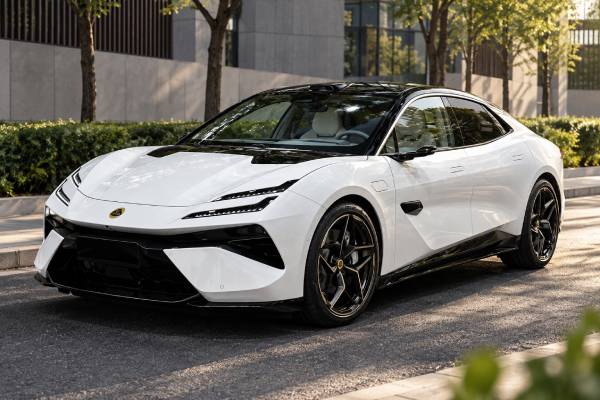
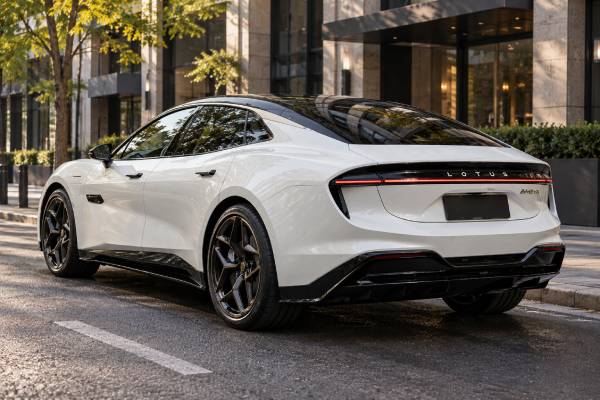
The Lotus Emeya R+ Platinum Edition is the most focused version of the original China-market Emeya R+ formula: a 675 kW dual-motor electric fastback with a two-speed rear drive unit, air suspension, active aerodynamics, and the stronger 10-piston braking package associated with the Platinum specification. Launched in China in August 2024, it kept the R+ powertrain rather than adding more output, so its appeal is not a bigger number on paper. The point is the way braking hardware, appearance details, chassis technology, and the high-performance drivetrain are combined into one factory configuration.
For buyers looking at a 2024- or 2025-registered example, the important distinction is market specification. Chinese R+ data is quoted on the CLTC test cycle, while European Emeya R/900 figures use WLTP and should not be mixed directly. This guide keeps the R+ Platinum Edition in its original market context and explains what the numbers mean for charging, performance, maintenance, and used-car inspection.
Table of Contents
- What Makes the R+ Platinum Edition Different
- R+ Platinum Edition Specifications and Technical Data
- How the 675 kW Two-Speed Powertrain Delivers Performance
- Range, Charging, and Long-Distance Use
- Chassis, 10-Piston Brakes, and Active Aerodynamics
- Cabin Technology and Daily Usability
- Maintenance Priorities and Used-Buying Checks
What Makes the R+ Platinum Edition Different
The R+ Platinum Edition is best understood as a high-spec R+ rather than a separate powertrain derivative. Its defining mechanical identity remains 675 kW (about 905 hp), 985 Nm, dual-motor all-wheel drive and a two-speed rear transmission, while the Platinum package adds a more distinctive finish and, in the documented R+ configuration, 10-piston front braking hardware.
That matters because the Emeya range became complicated quickly. The original Chinese lineup launched with Emeya, S+, R+ and R+ Black Gold versions. Later in 2024, Lotus added Platinum and dark-themed packages, and in 2025 the naming moved toward 600 and 900 derivatives. A used listing that simply says “R+” is therefore not enough to identify the car. The brake package, factory equipment, build date and option content should match the VIN-linked documentation.
The Platinum treatment was introduced as part of Lotus China’s “race-track aesthetic” theme. It used gold exterior accents and badges, gold brake-caliper detailing, amber-toned interior elements and a light Alcantara headliner. Unlike a purely cosmetic special edition, the R+ Platinum specification was sold with the 10-piston brake setup, which is relevant to running costs because the components are more specialized than conventional steel-brake hardware.
There is another useful way to place this model in the Emeya family. The later Emeya 900 uses the same headline 675 kW and 985 Nm output and the same basic high-performance dual-motor concept. That does not make every R+ Platinum part interchangeable with later 900 cars, but it shows that the R+ was not an experimental one-year powertrain. It was the first naming phase of Lotus’s top-output Emeya architecture.
For a buyer, the practical takeaway is simple: confirm the car as an R+ Platinum by build specification, not by exterior appearance alone. Wheels, trim pieces and caliper colors can be changed after delivery. Factory documentation is the reliable identifier.
R+ Platinum Edition Specifications and Technical Data
The R+ Platinum is a battery-electric vehicle built around a 102 kWh ternary-lithium battery, an 800-volt-class electrical architecture and permanent-magnet synchronous motors on both axles. The front motor is rated at 225 kW and the rear at 450 kW; the rear axle uses a two-speed transmission, which is the key mechanical difference between the 675 kW R+ and the 450 kW single-speed Emeya variants.
| Specification | Value |
|---|---|
| Powertrain type | Battery-electric, dual-motor AWD |
| Combined peak power | 675 kW (about 905 hp; 918 PS) |
| Combined peak torque | 985 Nm (726 lb-ft) |
| Front motor | Permanent-magnet synchronous, 225 kW |
| Rear motor | Permanent-magnet synchronous, 450 kW |
| Battery capacity | 102 kWh |
| Battery chemistry | Ternary lithium/NMC |
| Battery supplier | CATL |
| Drive | Electric all-wheel drive |
| Specification | Value | Notes |
|---|---|---|
| 0–100 km/h | 2.78 seconds | Lotus engineering target/official figure for the high-output Emeya |
| Top speed | 256 km/h (159 mph) | High-output R+/900 specification |
| Transmission | 2-speed automatic reduction transmission | Rear high-performance drive unit |
| Front/rear power split | 225/450 kW | Peak motor ratings |
| Front/rear motor torque | 355/630 Nm | Published individual peak values |
| Drive layout | Front motor + rear motor | AWD without a mechanical prop shaft between axles |
| Specification | Value | Standard or condition |
|---|---|---|
| Official electric range | 520 km (323 mi) | CLTC, China-market R+ Platinum |
| Rated energy consumption | 19.0 kWh/100 km | Published China-market figure |
| Peak DC charging capability | Up to 420 kW | Charger, temperature and state of charge dependent |
| Fast-charge window | 10–80% | Published charging window |
| Fast-charge time | About 15 minutes | Published for suitable high-power charging conditions |
| AC full-charge time | About 5.5 hours | High-power AC supply |
| Charge-port location | Left side | AC and DC connection area |
| Battery thermal support | Low-temperature heating | Part of battery temperature management |
| Specification | Value |
|---|---|
| Body style | 5-door liftback |
| Seats | 5 |
| Length | 5,139 mm (202.3 in) |
| Width | 2,005 mm (78.9 in), excluding mirrors |
| Height | 1,464 mm (57.6 in) |
| Wheelbase | 3,069 mm (120.8 in) |
| Front/rear track | 1,712/1,694 mm |
| Curb weight | 2,565 kg (5,655 lb) |
| Maximum permissible weight | 3,100 kg |
| Drag coefficient | 0.21 Cd |
| Rear luggage volume | Up to 509 L depending on seating configuration |
| Specification | Value |
|---|---|
| Front suspension | Independent multi-link |
| Rear suspension | Independent multi-link |
| Springing | Electronically controlled air suspension |
| Damping | Continuously controlled adaptive damping |
| Steering | Electric power steering |
| Front brakes | 10-piston high-performance setup on R+ Platinum |
| Common front tire size | 265/40 R21 |
| Common rear tire size | 305/35 R21 |
| Aerodynamic systems | Active grille, air dam, rear diffuser and deployable rear wing |
| Parking brake | Electronic |
The most important caution with these tables is test-cycle discipline. The 520 km figure is CLTC and should not be presented as a WLTP or EPA number. Likewise, charging time is a best-case published value, not a promise that every charger will deliver the same session.
How the 675 kW Two-Speed Powertrain Delivers Performance
The R+ feels different from the 450 kW Emeya versions because it is not simply running stronger motors through the same gearing. Its rear 450 kW drive unit uses a two-speed transmission, letting Lotus combine extreme low-speed acceleration with a 256 km/h top speed and strong high-speed pull.
At launch, both motors can contribute to traction, but the rear axle is the dominant unit. That 225/450 kW split gives the car a rear-biased performance character even though the electronic AWD system can use the front axle to stabilize and deploy torque. With 985 Nm available at the system level, tire condition and road temperature matter enormously. The published 2.78-second 0–100 km/h figure assumes the battery, tires and surface are in the right operating window.
The second gear is especially relevant above normal road speeds. A single reduction ratio that is short enough for maximum launch force can make a very fast EV run out of motor speed earlier. A taller second ratio gives the rear motor more room at higher vehicle speeds. The tradeoff is additional mechanical complexity and another component that deserves attention during a pre-purchase drive.
A healthy car should shift without obvious shock, warning messages or repeated hesitation. An EV two-speed transmission does not behave exactly like a conventional multi-gear automatic; there are far fewer shifts. That makes any persistent clunk, flare in power delivery or driveline warning easier to notice. Software calibration can also affect shift behavior, so the car’s update history matters.
Performance also changes with state of charge. A 675 kW rating is a peak figure, and no high-performance EV can guarantee maximum output at every battery percentage or temperature. If a test drive begins with a cold battery or very low charge, subdued acceleration is not automatically a fault. What matters is whether the vehicle behaves consistently once it reaches normal operating conditions.
Range, Charging, and Long-Distance Use
The R+ Platinum sacrifices some rated range for its higher-output hardware and performance-oriented configuration. Its 520 km CLTC figure is useful for comparing it with other China-market Emeyas, but it is not a realistic expectation for sustained motorway driving at high speed.
Several factors work against long-range efficiency. The R+ carries the heavier high-output rear drive unit and two-speed transmission, wears wide tires, and is designed to exploit very high speeds. Large wheels and performance tire compounds also increase rolling and aerodynamic losses. Climate control, cold weather and repeated hard acceleration can move consumption far above the official cycle figure.
The 800-volt architecture is the counterweight. On a compatible high-voltage DC charger, the Emeya can accept unusually high power. Lotus’s later global material quotes up to 420 kW hardware capability and very short 10–80% sessions under ideal conditions. Owners should still plan around the charging curve rather than the peak number. Peak power normally appears only through part of the session, and a charger labeled 350 or 400 kW can be limited by its own voltage, current, cable temperature or site load.
For road-trip use, three habits help most:
- Navigate to the rapid charger through the vehicle system when battery preconditioning is supported and available in the relevant software version.
- Arrive at a low but comfortable state of charge instead of stopping at 50–60%, because the fastest part of a charging curve is usually lower in the pack.
- Leave once charge power has tapered heavily unless the next leg requires more energy; charging the last 10–20% is normally slower.
Home charging is less dramatic but more important for ownership convenience. The quoted roughly 5.5-hour AC time assumes a suitably powerful AC source. Actual home charging depends on the local electrical installation and the onboard charger configuration. An imported China-market car may require extra attention to connector standards, communication protocols and public-network compatibility in the country where it is registered.
That last point is central to a used R+ Platinum purchase outside China. Do not assume an adapter solves every compatibility issue. Check the physical connector, AC phase support, DC protocol, app authentication, navigation-to-charger integration and whether software services remain available in the destination market.
Chassis, 10-Piston Brakes, and Active Aerodynamics
The R+ Platinum’s chassis hardware is what turns its power output into a usable GT rather than a straight-line novelty. Air springs, adaptive damping, a long wheelbase and active aerodynamic devices allow the car to change character between low-speed comfort and high-speed body control.
Lotus uses active airflow management extensively on Emeya. The front grille can open when cooling is required and close when drag reduction matters. Additional active elements manage air around and beneath the body, while the rear wing deploys for stability and downforce. This helps explain how a 5.1-metre liftback can combine a claimed 0.21 drag coefficient with serious high-speed performance.
The R+ Platinum’s 10-piston braking setup deserves special attention. Regenerative braking handles a portion of routine deceleration, which can reduce friction-brake use in normal traffic. But a 2.5-tonne car capable of 256 km/h still needs enormous thermal capacity when driven hard. Performance calipers, large rotors and the associated pads are expensive consumables, and low annual mileage does not make condition irrelevant.
On inspection, look for rotor surface condition, lip or cracking where applicable, even pad wear, caliper damage and vibration under progressively harder stops. A car that has spent time on track can look immaculate cosmetically while carrying significant brake and tire wear. Conversely, a lightly used car can develop surface corrosion if friction brakes have seen little use in damp storage.
Tires are just as important. A staggered 265/40 R21 front and 305/35 R21 rear fitment means replacement sets are costly, and mixing brands or substantially different tread depths can affect an AWD car’s behavior. Check the exact factory wheel package because 22-inch options and special-edition wheels also exist. Never order tires from a generic Emeya fitment chart without confirming wheel diameter, load rating, speed rating and VIN-specific equipment.
Air suspension should raise and lower the car evenly. After the vehicle has been parked, a corner that sits noticeably lower than the others may justify further diagnosis. Listen for repeated compressor operation, suspension warnings or harsh impacts that suggest a sensor, damper or air-spring issue.
Cabin Technology and Daily Usability
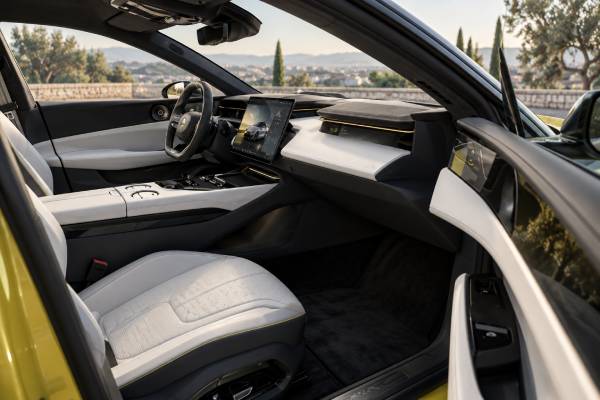
Despite its R+ badge, the Platinum Edition is still a luxury fastback designed for daily use. Its long 3,069 mm wheelbase gives the cabin genuine rear-seat space, while the liftback opening and roughly 509-litre maximum five-seat luggage figure make it more practical than its low roofline suggests.
The digital environment is equally important to the ownership experience. Early China-market Emeyas used Lotus Hyper OS, twin Qualcomm Snapdragon 8155 cockpit chips and NVIDIA DRIVE Orin-based driver-assistance processing. The central display is 15.1 inches, with slim driver and passenger information screens and an augmented-reality head-up display on many configurations. OTA software updates can change interface behavior and available functions during the car’s life.
That means a pre-purchase test should go beyond pairing a phone. Check every display, camera view, seat control, climate zone, audio channel, digital key, charging menu and driver-assistance sensor. Confirm that the car can connect to its intended mobile network and Lotus services in the country where it will be used. Imported connected cars can lose features if their original-market account, SIM provisioning or map service is unsupported abroad.
The Platinum theme should also be inspected as a package. Factory gold accents, interior trim and headliner details are part of the edition’s identity. Replacement pieces may be expensive or difficult to source later. If a used car has been wrapped, repainted or retrimmed, compare it with build documentation before assuming every visible detail is original.
For daily comfort, the air suspension does much of the heavy lifting. The car is wide at 2,005 mm before mirrors, so urban parking spaces and narrow garages deserve a real-world check. The low nose and long body can also make steep ramps awkward despite adjustable suspension height. Test the surround-view camera system and parking sensors because those features are more than conveniences on a car this size.
Maintenance Priorities and Used-Buying Checks
The R+ Platinum has no engine oil, spark plugs or exhaust system, but it is not maintenance-free. Its most expensive risks are concentrated in tires, braking hardware, suspension, high-voltage components, cooling systems, electronics and accident damage.
A sensible ownership routine starts with the tires. Check pressures frequently, inspect inner shoulders as well as outer tread, and investigate abnormal wear before simply replacing rubber. A powerful AWD EV can hide alignment problems because traction remains strong even when a tire is wearing unevenly. Wheel damage also matters because large low-profile tires provide limited protection against potholes.
Brake inspection should include both friction components and brake-fluid condition. Regeneration can make pads last longer in gentle use, but it can also mean the mechanical brakes work less often. Periodic firm braking in a safe situation, when appropriate and permitted by the manufacturer, helps keep friction surfaces active; service decisions should follow the handbook rather than an improvised interval.
Battery and drive-unit cooling is another specialist area. The pack, motors and power electronics depend on thermal control for performance and charging. Any coolant warning, reduced-power message, charging fault or persistent pump/fan behavior warrants proper diagnostic work. Do not let a general workshop open the high-voltage system without the correct training and equipment.
Before buying, work through the car in this order:
- Confirm identity. Match VIN, build sheet, R+ drivetrain, Platinum equipment and 10-piston brake specification.
- Check charging. Test AC charging and, ideally, a real DC fast-charge session. A successful plug-in at one slow charger is not enough to prove rapid-charging health.
- Scan the vehicle. Use Lotus-capable diagnostics to check stored faults in battery, drive units, air suspension, braking, ADAS and body controllers.
- Inspect the underbody. The traction battery sits beneath the cabin; impacts, crushed shields or incorrect lifting can be expensive.
- Evaluate tires and brakes. Price a full replacement set before negotiating, because wear items on the R+ are not economy-car expenses.
- Test suspension and steering. Use smooth roads, broken surfaces and low-speed full-lock maneuvers to expose noises or height-control problems.
- Verify software and connected services. Confirm OTA status, app pairing, maps, digital keys and region compatibility.
- Review collision history. Active aero, sensors and cameras make front- or rear-end repairs more complex than cosmetic bodywork suggests.
Battery health deserves context rather than a single dashboard percentage. Ask for diagnostic state-of-health data if the service system provides it, but also examine charging behavior, cell-balancing faults and usable range under similar conditions. A high-performance EV that has been DC-charged frequently is not automatically a bad buy; battery temperature management and how the car was stored are also important.
For imported examples, parts support can be a bigger issue than mechanical condition. The R+ Platinum is a specific China-market trim, and regional dealers may not stock its decorative pieces, brake components or electronic modules. Before committing, identify a service route for warranty questions, software access and high-voltage repairs.
Insurance and repair planning deserve the same preparation. The R+ Platinum combines edition-specific trim with expensive performance hardware, so a seemingly minor collision can involve active-aero parts, cameras, radar calibration, large wheels and specialized brake components at the same time. Ask the insurer how imported-market parts and approved repairers are handled before purchase, not after a claim. Keep photographs of the underbody, wheels and Platinum details when the car is acquired, then retain invoices for any replacement components. That record helps distinguish routine cosmetic change from accident repair and gives a future workshop a useful baseline when sourcing parts for a short-lived configuration.
If the car will be stored for extended periods, follow Lotus guidance for traction-battery state of charge, keep the 12-volt system healthy, and avoid leaving damp brake surfaces untouched for months. A high-performance EV can accumulate storage problems even when it accumulates almost no mileage.
The strongest R+ Platinum purchase is therefore not simply the cheapest low-mileage car. It is the example with verifiable specification, clean underbody, healthy charging behavior, matching high-quality tires, documented software history and evidence that its complex systems have been serviced by people who understand the platform. When those pieces line up, the car offers something still unusual: four-door GT practicality with performance that remains supercar-fast even by current EV standards.
References
- 技术参数 2026 (Official Technical Specifications)
- 纯电超跑轿车路特斯EMEYA繁花正式上市 2024 (Official Launch Information)
- 路特斯以“稀缺性”赛道美学,呈现成都车展最具含「金」量展台 2024 (Official Platinum Edition Information)
- Lotus Emeya | How it Drives | Lotus Cars 2026 (Official Engineering and Charging Information)
- Lotus Emeya Handbook for Drivers | Lotus Cars 2026 (Owner’s Handbook Portal)
- Lotus Emeya 2024 R+ 10-Piston Platinum | Data.CarNewsChina.com 2026 (Archived Trim Specifications)
Disclaimer
This article is for informational purposes only and is not a substitute for professional diagnosis, maintenance, or repair. Specifications, torque values, service intervals, charging behavior, software functions, and procedures can vary by VIN, market, production date, and installed equipment. Verify any service or repair information against the official Lotus documentation for the exact vehicle before work begins.
If this guide was useful, please consider sharing it on Facebook, X/Twitter, or another platform to support our work.