
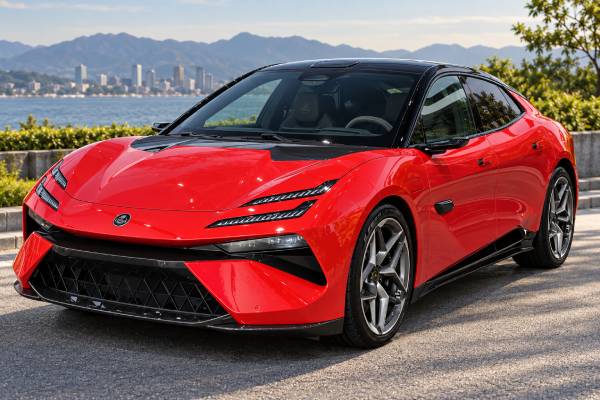
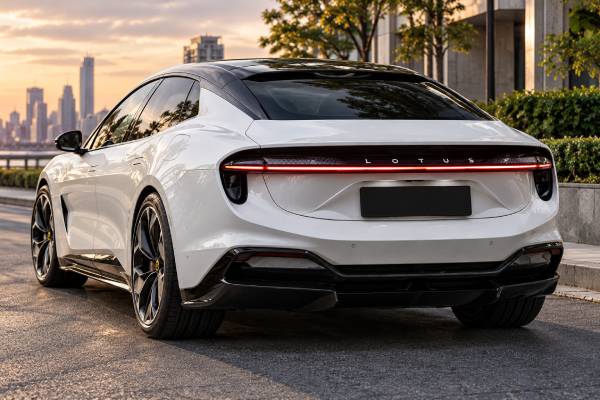
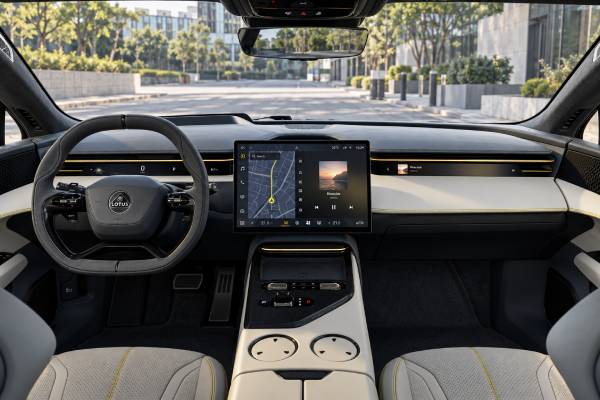
The Lotus Emeya R+ is the original China-market high-performance flagship, combining the 675 kW dual-motor system and 985 Nm of torque with equipment choices that were specific to the Chinese lineup. Its 520 km CLTC rating, 2.78-second 0–100 km/h time, 256 km/h top speed, and rear two-speed drive unit match the engineering brief of the fastest early Emeya, but R+ adds an important purchasing choice that is easy to miss in translated listings: it was offered in both five-seat and four-seat form. The five-seat car was listed around RMB 968,000, while period configuration sources show a higher-priced four-seat version. That seating difference changes rear-cabin hardware and practicality without changing the core powertrain. For a used buyer or importer, the exact seating specification, software region, charging compatibility, and original brake/wheel equipment therefore matter as much as the horsepower. This guide separates those issues so an R+ can be judged as a specific China-market vehicle rather than as a generic global Emeya R with a plus sign added.
Table of Contents
- R+ in the Original Chinese Range
- Four-Seat Versus Five-Seat R+
- R+ Specifications and Hardware
- Two-Speed Performance and Chassis Control
- 520 km CLTC and Fast Charging
- China-Market Service and Import Issues
- R+ Pre-Purchase Inspection
R+ in the Original Chinese Range
The R+ was the performance core of the 2024 Chinese Emeya lineup. It sat above the 450 kW cars and below or alongside special appearance/bespoke editions, giving buyers the 675 kW drivetrain without requiring the Black Gold, Dark, Platinum, Blossom, or Type 79 themes.
Lotus China announced the regular R+ at RMB 968,000 when the Emeya went on sale in January 2024. In period Chinese configuration databases, the five-seat version appears at that figure, while a four-seat R+ was listed at a higher price. That is important because advertisements often reduce the model to “R+ 520 km” and omit the seating layout, even though the rear cabin is a major part of the ownership experience.
Mechanically, R+ uses a 225 kW front motor and a stronger rear motor in early Chinese data, producing 675 kW combined. Total torque is 985 Nm. The rear drive unit uses two ratios, allowing very strong launch performance while keeping the motor in a useful speed range as road speed rises. Lotus’s 2.78-second 0–100 km/h figure makes the car one of the quickest production four-door EVs of its period.
The 520 km CLTC range places it between the 650 km 450 kW cars and the 480 km Black Gold/Blossom special versions. That number is useful for trim identification but should not be treated as a promise of real motorway range. Wheel size, tire choice, ambient temperature, and driving speed can move consumption considerably.
R+ is therefore the sensible reference point for the Chinese high-output family. When evaluating a special edition, compare it back to the regular R+: same core acceleration may come with different seating, brake hardware, wheels, colors, and price. When evaluating a regular R+, ask whether paying for a special appearance version adds something you personally value or simply increases the cost of replacing cosmetic parts later.
Four-Seat Versus Five-Seat R+
The four-seat and five-seat R+ share the same basic performance identity, but they serve different owners. The five-seat version maximizes flexibility, while the four-seat layout turns the rear compartment into a more executive space with separate seating and additional controls or console hardware depending on specification.
For families, the five-seat car is usually easier. A continuous rear bench can carry three passengers when necessary, allows a center seating position, and generally offers more adaptable cargo/passenger combinations. Before buying, verify the rear backrest folding arrangement and luggage access on the exact car, because four-seat executive layouts can change how cargo is carried.
The four-seat version should be inspected almost like a separate trim. Check the rear center console, seat motors, heating/ventilation/massage functions where fitted, rear display or control interfaces, USB/power points, cupholders, and any electrically operated storage. A fault in a rear executive seat may be expensive even if it has no effect on drivetrain performance.
Rear-cabin condition can reveal how the car was used. A four-seat R+ with heavily worn rear controls and an almost untouched driver area may have served as chauffeur transport. That is not automatically bad; chauffeur-driven cars can receive regular professional maintenance. It simply changes what to inspect. Look more closely at rear seat mechanisms, door trims, climate outlets, and the 12-volt system if powered rear features were used extensively while the car idled or waited.
On a five-seat example, check child-seat anchor points, center belt operation, head restraints, and signs that the rear bench was folded frequently. Scuffed load-through areas or damaged seatback trim are normal wear items, but water staining or damaged latches need attention.
For an importer, seating can affect registration paperwork and insurance. Make sure the destination documents reflect the physical number of seats. Converting between four and five seats later is not simply a matter of bolting in a bench; restraint systems, trim, electronics, coding, and type approval can be involved. Buy the layout you actually need.
R+ Specifications and Hardware
The R+ is a dual-motor high-output BEV with a 102 kWh battery, all-wheel drive, and a rear two-speed drive unit. Chinese catalog data for the regular 2024 R+ identifies the car by its 675 kW output and 520 km CLTC range, while seating could be four or five depending on order.
| Specification | Value |
|---|---|
| Combined peak power | 675 kW (about 905 hp; 918 metric PS) |
| Combined peak torque | 985 Nm |
| Front motor | 225 kW in early Chinese specification data |
| Rear motor | 450 kW in early Chinese specification data |
| Drive | All-wheel drive |
| Rear transmission | Two-speed |
| Battery capacity | 102 kWh |
| Battery chemistry | Ternary lithium/NMC in Chinese listings |
| Measure | Published figure |
|---|---|
| 0–100 km/h | 2.78 seconds |
| Top speed | 256 km/h (159 mph) |
| CLTC range | 520 km (323 mi) |
| Five-seat launch price | RMB 968,000 |
| Seating availability | Four-seat and five-seat versions in period listings |
| Item | R+ detail |
|---|---|
| High-voltage architecture | 800-volt class |
| DC fast charging | High-power Lotus system |
| China charging ecosystem | 480 kW-class Lotus flash chargers promoted during the period |
| Fast-charge time context | Short 0.2–0.25 hour published windows, depending on stated SOC interval |
| Thermal preparation | Battery preconditioning/thermal management supported |
| AC charging | Supported for routine destination charging |
| Measurement | Value |
|---|---|
| Length | 5,139 mm |
| Width | 2,005 mm |
| Height | 1,464 mm in China-market data |
| Wheelbase | 3,069 mm |
| Front track | 1,712 mm |
| Rear track | 1,694 mm |
| Body type | Five-door large liftback |
| System | Configuration |
|---|---|
| Suspension | Electronically controlled air suspension |
| Damping | Adaptive electronic control |
| Rear steering | High-spec Emeya equipment; confirm by VIN/configuration |
| Aerodynamics | Active grille, rear diffuser/aero elements, deployable wing |
| Brakes | High-performance discs; special editions may use different caliper/carbon-ceramic packages |
| Wheel packages | Large staggered performance fitments depending on order |
| Feature | Platform detail |
|---|---|
| Operating system | Lotus Hyper OS |
| Updates | OTA capable |
| ADAS compute | NVIDIA DRIVE Orin-based system |
| Head-up display | Large projected HUD |
| Audio | KEF premium system available/commonly specified |
| Rear cabin | Equipment differs materially between four- and five-seat cars |
Two-Speed Performance and Chassis Control
The R+ feels different from the 450 kW cars because the rear motor and gearbox continue pulling hard as speed rises. The short first ratio supports the launch; the second ratio extends the performance envelope. That makes consistency and smooth shift behavior central to a road test.
Do not test maximum acceleration with a cold battery or questionable tires. Warm the car normally, make sure state of charge is adequate, and choose a safe legal environment. The first observation should be traction: all four tires should work together without steering pull or persistent wheel hop. Then notice the transition in the rear drive unit. A slight change in thrust can be normal; a violent bang or repeated fault message is not.
Power output can be limited by battery temperature, state of charge, or system protection. If one launch feels weaker than the next, note the conditions before assuming hardware failure. Conversely, a car that repeatedly shows reduced-power warnings in mild conditions deserves a diagnostic scan and cooling-system check.
The active chassis has to manage more than straight-line speed. Air suspension and adaptive damping should keep the body controlled over undulating roads. If rear steering is fitted, the car should feel surprisingly maneuverable at low speed for a 3,069 mm wheelbase. Any steering fault after wheel alignment or suspension work may require calibration rather than another mechanical adjustment.
Tires are the final link. A 905 hp EV on cheap or mismatched tires is not a bargain. Check approved sizes, load ratings, tread depth, date codes, and inner-shoulder wear. If a four-seat car has spent much of its life carrying rear passengers, also inspect rear tire wear and alignment because sustained load can highlight a marginal setup.
520 km CLTC and Fast Charging
The 520 km CLTC rating differentiates the normal R+ from 650 km 450 kW cars and 480 km special high-output versions. It should be used as a certification label and planning reference, not as a guaranteed road-trip distance.
High-speed use is especially expensive in the R+. Aerodynamic drag rises with speed, and the wide performance tires add rolling resistance. A calm motorway trip can therefore travel much farther than a sequence of hard accelerations and very fast cruising even with the same weather and payload.
Build a real-world consumption baseline for the exact car. Record kWh/100 km on a known route at a known speed and temperature. Repeat the route in cold weather. Those observations are more useful for trip planning than a seller’s displayed range at the moment of viewing, because the display learns from recent driving.
Fast charging is a genuine strength. The high-voltage architecture allows the R+ to accept substantial DC power when the battery is properly conditioned and the charger can supply it. Precondition before arrival when possible. A charger’s headline rating does not guarantee what the car will receive; site voltage, current limit, temperature, and state of charge all matter.
If buying used, ask for a live charging demonstration. Confirm the port door, connector lock, communication, thermal behavior, and session stability. An imported car needs an additional check: physical connector and protocol compatibility with the destination network. An adapter is not a universal solution for high-power DC charging.
For daily use, a moderate charge limit is convenient and leaves 100% for journeys that need it. The 102 kWh battery gives enough buffer for most commuting without chasing full charge. Long periods parked at either extreme state of charge are less desirable than simply keeping the car in a middle range when it is not needed.
China-Market Service and Import Issues
An R+ can be mechanically excellent and still become difficult to own outside China if software, parts, or charging support are not planned. Market compatibility belongs in the pre-purchase inspection just as much as brakes or battery condition.
Ask the destination Lotus retailer whether it can identify the China-market VIN, access diagnostic data, order R+-specific parts, and perform software programming. Do this before shipping. A workshop may be able to service tires and suspension yet be unable to authorize a control module or complete a regional software campaign.
Connected services can be more restrictive than mechanical service. Navigation maps, traffic data, mobile app login, remote climate, digital key, streaming, voice control, and OTA updates may depend on a Chinese account or data service. Test each function you care about and record which ones remain usable in the destination country.
High-voltage charging is another regional layer. Confirm AC connector compatibility, DC protocol, voltage support, and any adapter limitation. A car that can charge slowly through an adapter may still be unable to use the fast network effectively. Road-trip buyers should verify this before purchase, not after registration.
Parts availability also differs for four-seat cars. Rear seats, console electronics, trim panels, screens, and control modules may not be stocked in markets that sold only a five-seat configuration. Photograph part labels where possible and keep the original order sheet. Documentation can save hours when a technician is trying to identify an unfamiliar rear-cabin component.
Insurance and recovery should be arranged with the market issue in mind. Tell the insurer that the car is a China-market R+ and specify seating. Ask where a high-voltage breakdown would be transported and whether agreed value reflects special equipment. Cheap insurance is less useful if the policy directs the car to a repairer without access to Lotus diagnostics.
R+ Pre-Purchase Inspection
A proper R+ inspection should prove identity first, then mechanical condition, then regional usability. The powertrain is impressive enough that a short test drive can distract from expensive details; use a written checklist so that acceleration does not become the entire buying decision.
Verify VIN, original invoice, seating configuration, 675 kW output, 520 km CLTC specification, wheel/brake equipment, and service history. If the seller calls a car “four-seat” but registration or order data says five, resolve that discrepancy before proceeding.
Scan all electronic modules before codes are cleared. Record high-voltage faults, drive-unit history, thermal-system events, ride-height and damper faults, rear-steering messages, ADAS calibration, and charge-port errors. Check whether software campaigns were completed and whether the car can still receive updates.
On a lift, inspect the battery enclosure and protective panels, cooling lines, suspension links, jacking points, and underbody aero. Examine wheel barrels for cracks or repairs. Measure tire tread at inner and outer edges. Check the brake discs on both faces if possible and look for one wheel that shows unusual heat or dust compared with the others.
Road-test from cold. A long air-suspension compressor run, low corner, or repeated clicking before movement can reveal problems hidden after the car has self-leveled. Drive slowly over rough surfaces before using high power so suspension noises are audible. Then add stronger acceleration and braking after the car is warm.
For a four-seat car, operate every rear function. For a five-seat car, test folding/latching and all rear belts. In either layout, check the liftback, luggage floor, seals, cameras, parking sensors, HUD, climate, audio, and charge port.
The regular R+ is often the best value in the Chinese high-output range because it delivers the essential 675 kW engineering without making the owner preserve a rare paint or decorative theme. That makes condition and equipment more important than collectibility. Buy the car that works completely, has transparent history, and fits your service market; the performance will be there on every correctly maintained example.
The seating layout should influence parts planning as well as comfort. On a four-seat R+, the rear console, individual seat frames, motors, switchgear, and trim can be more specialized than a conventional bench. Before import, ask for photographs of part labels beneath accessible covers and confirm whether a Lotus service center in the destination country can order those components. If a rear control module fails, a generic upholstery shop cannot solve a software or network problem simply because the seat still looks intact.
A charging test should be performed as a sequence rather than a single yes/no check. First confirm ordinary AC charging and that the car recognizes the expected current. Then, if practical, use a compatible DC charger with the battery at a state of charge low enough to request meaningful power. Watch for repeated handshake failures, premature session termination, warning messages, or a charge rate that remains unusually low after the battery has been thermally prepared. Peak power is never guaranteed because the charger, battery temperature, state of charge, and station sharing all influence the result, but consistent communication is essential.
Thermal-system inspection is especially important on a 675 kW car. Run cabin heating and cooling, listen for abnormal pump or fan noise, and review diagnostic history for coolant-valve, chiller, compressor, battery-temperature, or inverter faults. During a road test, compare the car’s behavior before and after several strong accelerations when conditions are safe. Some output reduction at unfavorable temperature can be protective and normal; warning lights, abrupt derating, or repeatable faults require diagnosis. The objective is not to force the car to prove a magazine acceleration number but to confirm that its thermal controls behave predictably.
Price a regular R+ against the special editions with a replacement-cost mindset. The Black Gold, Dark, Platinum, Blossom, and Type 79 cars can justify premiums to buyers who value their factory themes, but they also introduce finishes and trim that may be expensive to restore. A regular R+ often lets an owner enjoy the same 675 kW core hardware while using conventional exterior colors and more readily replaceable details. That can be an advantage if the car will cover high annual mileage rather than live in a collection.
For cross-border ownership, create a written list of what will and will not be supported locally before money changes hands. Include warranty transferability, recall access, high-voltage repair authorization, navigation map region, eSIM/connected services, app pairing, over-the-air updates, roadside assistance, and parts ordering. A seller may truthfully say that “everything works” in China while none of that proves the same services will function after export. Treat regional software support as a separate purchase criterion from the physical health of the car.
The pre-purchase scan should be saved, not merely summarized verbally. Ask for a copy showing modules, fault codes, freeze-frame data where available, and mileage. Compare it with the instrument cluster and service history. Clearing codes immediately before inspection removes valuable context, so a recently reset car deserves extra scrutiny. After the scan, verify the hardware that software depends on: camera and radar/lidar areas should be correctly mounted and undamaged, suspension height should be even, the active rear aero should operate cleanly, and no underbody panel should show evidence of being removed carelessly.
Finally, calculate a first-year reserve that reflects the actual car. Include a full set of premium tires if tread is marginal, wheel straightening or replacement if vibration exists, alignment, brake work, 12-volt battery condition, insurance, software/support costs, and a contingency for imported parts. The R+ can be excellent value relative to its original price, but depreciation does not make 905 hp hardware inexpensive to repair. A realistic reserve turns a tempting purchase into a sustainable one.
When two R+ examples appear similar, prefer the one whose seller can demonstrate every system calmly. A rushed handover with missing account credentials, no charging test, no lift inspection, and recently cleared diagnostics transfers uncertainty to the buyer. The strongest deal is the car whose condition can be verified before payment rather than explained away afterward.
References
* 纯电超跑轿车路特斯EMEYA繁花正式上市 2024 * 莲花 EMEYA 2026 * 〖EMEYA纯电动 〗 2024款EMEYAEMEYA R+报价_图片_太平洋汽车 2026 * 〖路特斯EMEYA繁花配置表〗路特斯_路特斯EMEYA繁花参数_价格单_EV视界 2026 * Lotus Emeya – The Fully Electric Hyper-GT | Lotus Cars 2026 * Lotus Emeya | How it Drives | Lotus Cars 2026
Disclaimer
This article is for informational purposes only and is not a substitute for professional diagnosis, repair, import-compliance advice, or a VIN-specific inspection. Specifications, torque values, software functions, service intervals, and procedures can vary by VIN, market, equipment, seating configuration, and production date; verify all work in official Lotus documentation. If the guide helped you, please share it on Facebook, X/Twitter, or another community to support our work.