
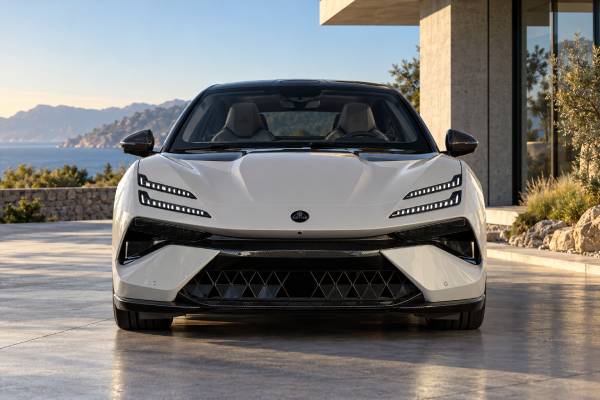
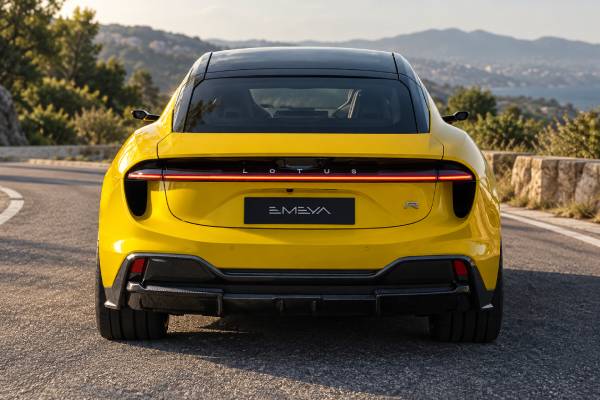
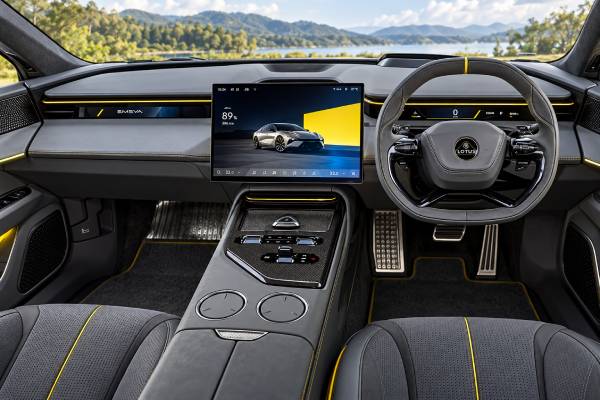
The Lotus Emeya R is the early high-performance version that changes the car most substantially beneath the body. Power rises to 675 kW, or about 905 hp, torque reaches 985 Nm, and the rear motor works through a two-speed transmission that helps the car combine 2.8-second 0–100 km/h acceleration with a 256 km/h top speed. That hardware turns the Emeya from an already quick electric GT into a machine with genuine supercar straight-line performance, but it also changes the ownership priorities. Range is lower than on the 450 kW car, tires and brakes work harder, thermal condition matters more during repeated acceleration, and the rear drive unit adds mechanical complexity that deserves attention on a used example. The R still uses the same 102 kWh battery concept, 800-volt-class charging architecture, active aerodynamics, and air-suspension platform, so it remains capable of long journeys. This guide focuses on what the R-specific drivetrain adds, how to inspect it, and where performance use can leave evidence even when mileage is modest.
Table of Contents
- What Changes in the Emeya R
- Emeya R Specifications and Technical Data
- Two-Speed Rear Drive Unit Explained
- Chassis, Brakes, and Tire Demands
- Performance Range and 800-Volt Charging
- Maintenance After Hard Use
- How to Buy a Used Emeya R
What Changes in the Emeya R
The R is not just an Emeya with software unlocking more motor output. Its rear drive system is materially different, and that difference shapes acceleration, high-speed performance, range, and used-car inspection. The front motor contributes to all-wheel-drive traction while the much stronger rear unit and two-speed gearbox deliver the character most buyers associate with the R badge.
Peak system output is 675 kW and torque is 985 Nm. That is enough for Lotus to quote roughly 2.78 seconds from 0 to 100 km/h under suitable conditions. More revealing is the 256 km/h top speed. Many performance EVs use a single fixed ratio and prioritize launch acceleration; the R’s rear two-speed arrangement broadens the useful operating range of the rear motor so strong acceleration can continue as road speed climbs.
The performance gain comes with an efficiency cost. The 450 kW car can reach much longer official range figures, while the high-output Emeya is commonly quoted around the high-400-kilometer WLTP area depending on wheel and specification. That is not a flaw; it is the consequence of a drivetrain optimized for stronger performance and often paired with more aggressive tire and wheel packages.
The R also places greater demands on cooling. A single full-power launch is easy for a modern EV to deliver when the battery is warm and sufficiently charged. Repeating maximum acceleration or driving at very high speed creates heat in the battery, motors, inverter, transmission, tires, and brakes. Software may reduce output to protect components. A buyer should therefore distinguish normal thermal protection from a fault while also checking whether the car can deliver consistent performance once properly conditioned.
Most owners will rarely use all 675 kW. The value of the R is that the extra reserve changes the feel of every overtaking maneuver and gives the car a wider performance envelope. The trade is that more hardware must be kept healthy. For buyers interested mainly in range, the standard Emeya is rational. For buyers who specifically want the engineering of the two-speed rear axle and extreme acceleration, the R is the version to inspect carefully rather than simply the most expensive trim to choose automatically.
Emeya R Specifications and Technical Data
The Emeya R is a dual-motor AWD BEV with the same 102 kWh nominal battery size used across the early family, but its motor split and rear transmission are different from the 450 kW version. The tables below emphasize R-specific information while keeping configuration-dependent equipment clearly identified.
| Specification | Value |
|---|---|
| Powertrain | Dual-motor battery-electric AWD |
| Combined peak output | 675 kW (about 905 hp) |
| Combined peak torque | 985 Nm (727 lb-ft) |
| Front motor output | Approximately 225 kW in early high-output configuration data |
| Rear motor output | Approximately 450 kW in early high-output configuration data |
| Rear transmission | Two-speed |
| Battery capacity | 102 kWh |
| Electrical architecture | 800-volt class |
| Measure | R figure |
|---|---|
| 0–100 km/h | 2.78 seconds |
| Top speed | 256 km/h (159 mph) |
| WLTP range context | Up to roughly 485 km (301 mi), configuration dependent |
| Drive type | All-wheel drive |
| Body | Five-door electric Hyper-GT / liftback |
| Specification | Detail |
|---|---|
| Battery architecture | 800-volt class |
| Original DC peak reference | 350 kW-class |
| Quoted 10–80% time | About 18 minutes under favorable conditions |
| European AC connector | Type 2 |
| European DC connector | CCS |
| Preconditioning | Battery thermal preparation supported |
| Measurement | Value |
|---|---|
| Length | 5,139 mm |
| Width | 2,005 mm excluding mirrors |
| Wheelbase | 3,069 mm |
| Height | About 1,459–1,464 mm depending on market specification |
| Front luggage area | 34 L in corresponding European data |
| Rear luggage volume | 509 L in five-seat configuration |
| Kerb-weight context | High-output European derivatives listed around 2,650 kg |
| System | Configuration |
|---|---|
| Suspension | Electronically controlled air suspension |
| Damping | Adaptive electronic dampers |
| Rear steering | Fitted/available according to market and high-spec configuration |
| Active anti-roll control | Available on high-performance specification; verify by VIN |
| Aerodynamics | Active front grille, active rear surfaces, deployable rear wing |
| Brakes | High-performance disc system; carbon-ceramic package availability varies |
| Feature | Detail |
|---|---|
| Vehicle software | Lotus Hyper OS |
| Updates | Over-the-air capable |
| ADAS processing | Dual NVIDIA DRIVE Orin systems cited at launch |
| Road sensing | Air-suspension control reacts to road information at high frequency |
| Surround sensors | 34 sensors cited by Lotus for the platform |
| Connectivity | 5G-era connected functions, market dependent |
Two-Speed Rear Drive Unit Explained
The rear two-speed transmission is the engineering feature that most clearly separates the R from the 450 kW Emeya. It gives the rear motor a short ratio for launch and a taller ratio for sustained speed, reducing the compromise that a single fixed reduction ratio would impose at opposite ends of the speed range.
In first gear, the rear motor can multiply torque strongly at the wheels, helping the car reach 100 km/h in less than three seconds when traction, battery state of charge, and temperature are favorable. After the shift, the taller ratio allows the rear motor to continue contributing meaningful power without spinning as quickly as it would in a short fixed ratio. The front motor does not need a conventional mechanical connection to the rear axle; software coordinates both e-axles.
A driver may notice the ratio change as a brief change in acceleration rather than as the pronounced shift of an ICE automatic. That behavior should be consistent. Harsh bangs, repeated hesitation, warning messages, or a shift that feels different from one acceleration run to the next at similar temperature deserve investigation. Because the transmission is integrated with the electric drive unit, diagnosis should use Lotus procedures rather than conventional gearbox assumptions.
Thermal condition influences performance. If the battery is cold, the car may restrict discharge power. If repeated acceleration heats the system, protection strategies may reduce output. A seller demonstrating only one fully charged launch proves little about sustained health. A better test begins after the car has reached normal operating temperature and includes several strong accelerations separated by ordinary driving. Watch for warnings and consistency rather than chasing an exact stopwatch result on public roads.
Listen during low-speed torque reversals too. Transition from light acceleration to regeneration and back again. Some driveline take-up is normal, but repeated metallic clunks can indicate mount, half-shaft, or drive-unit issues. The cabin’s sound insulation can mask subtle noises, so perform part of the test with audio and climate fans reduced.
For long-term ownership, use the transmission as designed rather than trying to “protect” it by avoiding normal acceleration. What matters is correct fluid/service procedure if specified, software updates, thermal management, and investigation of abnormal behavior early. A sophisticated system benefits from regular exercise more than from indefinite storage.
Chassis, Brakes, and Tire Demands
The R asks more from its chassis because speed builds so quickly. Wheel and tire condition, alignment, air suspension, rear-steer calibration, and brake health affect confidence far more than the horsepower number once the car is moving.
Wide tires must be inspected on the inner shoulders. A heavy, powerful EV can consume the inside edge while the visible outer tread still appears healthy. Ask for alignment records after tire changes, curb strikes, or wheel repairs. If the steering wheel is off-center on a flat road, do not assume the car’s active steering is responsible; diagnose conventional alignment first.
Wheel damage is common on large-diameter low-profile fitments. Spin each wheel on a balancer if vibration exists, because a visually repaired rim can still be bent. Replace tires in appropriate axle pairs and keep specifications matched. The all-wheel-drive control system can accommodate normal tread differences, but a collection of mixed brands and radically different tread depths is not a good foundation for a 905 hp car.
Brakes require both visual and dynamic checks. Regenerative braking means discs may see little use during gentle commuting, while a few hard sessions can produce substantial heat. Look for surface corrosion, scoring, cracks around drilled or slotted features where applicable, heat discoloration, and uneven pad deposits. A pulsing pedal or steering vibration during braking needs diagnosis before purchase.
Air suspension should settle the body quickly and quietly. Leave the car parked overnight if possible, then inspect stance before unlocking. A corner that has dropped can reveal a leak. During the drive, cycle chassis modes and confirm meaningful changes in body control. If a mode command is accepted on-screen but the car behaves identically and a scan shows stored damper faults, repair the hardware rather than blaming software calibration.
Rear steering can make the long wheelbase feel unexpectedly agile. At parking speed, it reduces the effective turning circle; at higher speed, it can support stability. If the system is fitted, calibration after alignment or suspension work matters. Uneven steering response or warning messages after wheel alignment should prompt a scan and calibration check.
Performance Range and 800-Volt Charging
The R’s shorter official range is the cost of choosing the more aggressive drivetrain, not evidence that it uses a smaller battery. The 102 kWh pack remains substantial, and the 800-volt charging system helps the car recover energy quickly during long trips.
At motorway speed, aerodynamic drag grows rapidly, so using all of the R’s top-end capability is expensive in energy terms. A journey at legal cruising speed can be efficient for a car of this power, while repeated 200 km/h running where lawful will cut range dramatically. Wheel size and tire compound also matter; a grippier, wider setup can reduce efficiency even when the driver uses little of the available power.
The best way to understand a particular car is to record consumption on a repeat route. Compare mild-weather and winter numbers, then use them for trip planning. The displayed range is a prediction based on recent behavior and conditions, not a direct battery health meter. A car recently driven hard may show a pessimistic estimate that improves after normal use.
High-power DC charging is most effective when the pack arrives warm and at low state of charge. Use navigation-linked preconditioning when possible and avoid judging the system from a session that begins with a cold battery at 70%. The original Emeya’s 18-minute 10–80% claim illustrates what the platform can do under suitable conditions, not what every public charger will deliver.
For repeated fast-charge road trips, monitor whether charging behavior changes after several sessions. The thermal system may reduce power if pack temperature rises beyond its preferred range. That is normal protection. Persistent slow charging in mild conditions after proper preconditioning, however, can justify diagnostic work on the cooling system, charge port, contactors, or software.
Owners who charge at home can keep daily operation simple by using a moderate routine limit and raising it before long journeys. The R does not need special battery superstition; it needs sensible habits and functioning thermal management. Use the performance, but avoid leaving the pack at extreme states of charge for long storage periods without reason.
Maintenance After Hard Use
Performance use shifts maintenance from mileage-based thinking to condition-based inspection. A low-mileage R that has seen launch events, mountain roads, or track sessions can need tires, brakes, alignment, and fluid checks earlier than a higher-mileage touring car.
After hard driving, inspect tires for tearing, overheating, or pressure changes. Street pressures measured cold can rise significantly with sustained load. Do not bleed hot tires down to cold targets without understanding the consequence; they may become underinflated after cooling. Record cold pressures before and after any performance event so changes are deliberate.
Brake condition should be checked after repeated high-energy stops. Heat can create pad deposits that feel like warped rotors even when disc thickness is uniform. A specialist can measure runout and thickness before parts are replaced unnecessarily. Carbon-ceramic systems, where fitted, need their own inspection method and should not be evaluated only by visual rotor color.
Cooling systems are equally important. The battery, motors, inverter, and cabin climate system all depend on controlled temperatures. After a hard-use history, inspect coolant reservoirs, hoses, underbody heat exchangers, and front openings for damage or blockage. Use only the specified coolant and bleeding procedure for the exact VIN.
Check underbody aero panels after track curbing or steep ramps. The Emeya manages airflow beneath the car, so missing fasteners or distorted panels are more than cosmetic. A damaged battery shield or enclosure needs high-voltage-qualified assessment before the car returns to hard use.
The 12-volt system can still cause problems on a performance EV. Long periods parked between events, accessory use, or failed updates can weaken the auxiliary battery. Test it rather than waiting for random warning messages. Likewise, complete official software updates and campaign work because powertrain, charging, and chassis behavior are deeply software controlled.
Finally, keep records of hard use instead of hiding it. A future buyer may prefer a car that attended track days but received fluid checks, alignment, pads, tires, and inspections afterward over one with vague history and fresh cosmetics. Maintenance evidence tells a better story than an artificially clean odometer narrative.
How to Buy a Used Emeya R
The safest used R purchase is a car whose high-performance systems can be demonstrated repeatedly, not one that merely looks flawless and delivers one dramatic launch. Start with the exact specification, then inspect the drivetrain, thermal system, chassis, and charging behavior as a connected package.
Confirm the VIN, market, original wheel/brake package, seating configuration, and service history. Emeya equipment differs by region, and later naming changes can confuse advertisements. Make sure the car being sold as an R has the 675 kW/985 Nm high-output drivetrain and two-speed rear unit rather than a 450 kW car with cosmetic additions.
Before the road test, scan all modules and save the report. Pay attention to high-voltage isolation, drive-unit faults, thermal-system history, ride-height sensors, active aero, rear steering, ADAS calibration, and charging modules. Stored faults that have not returned may still help explain a past repair.
Inspect the underside on a lift. Look for damage to battery protection, cooling lines, aero panels, suspension links, and jacking points. Examine wheel barrels for cracks or weld repairs and measure tire tread across the full width. Check brake components with the wheels removed if the purchase value justifies it.
On the road, begin gently. Listen for bearing hum, suspension knocks, driveline take-up noise, and tire roar. Then build to stronger acceleration when the car is warm and safe conditions permit. Power delivery should be consistent. Test friction braking after regeneration has been used, and verify the car remains straight and vibration-free under deceleration.
A complete buying checklist is:
- Verify VIN, 675 kW drivetrain, market equipment, and original order specification.
- Read diagnostic history before codes are cleared.
- Inspect battery protection and chassis from below.
- Measure tires, check wheel runout, and review alignment records.
- Inspect brakes for corrosion, heat damage, and uneven wear.
- Confirm air suspension, rear steering, and active aero function.
- Test AC and high-power DC charging where practical.
- Confirm software version, OTA support, connected services, and all cameras/sensors.
The R is the right Emeya for a buyer who values the two-speed drivetrain and the ability to sustain extreme performance. It is not automatically the best Emeya for every use case. If most journeys are motorway touring at normal speeds, the 450 kW car can go farther and still feel very fast. If the engineering and acceleration of the 675 kW system are the point, buy the R—but budget and inspect like a 905 hp performance car, not like an ordinary electric sedan.
Hard-use records can make an R easier, not harder, to buy when they show competent maintenance. A car that has attended performance events with documented fluid checks, fresh correctly rated tires, alignment reports, brake inspections, and post-event diagnostics may present less uncertainty than a supposedly gentle car with no history. Ask what temperatures, warning messages, or power reductions the driver observed and whether any event was followed by a workshop inspection. Consistent answers help distinguish normal thermal management from unresolved faults.
Wheel and tire replacement deserves special discipline because the R’s performance can mask a compromised setup until speeds are high. Keep the same approved tire family across an axle, respect load and speed ratings, and investigate why a tire failed before simply replacing it. A bent wheel, persistent alignment error, or damaged suspension link can rapidly ruin the next tire. If vibration occurs only under power, broaden the diagnosis beyond wheel balance to include half-shafts, mounts, and drive-unit behavior.
Software changes should be recorded alongside mechanical service. Note the installed vehicle version before and after workshop visits, especially if shift behavior, regenerative braking, thermal strategy, charging, suspension response, or driver-assistance behavior changes. The R integrates its two-speed rear unit, battery limits, torque distribution, and chassis systems through software; a clear version history gives a technician useful context when a symptom began after an update rather than after a physical repair.
If the car will be used on closed-course events, ask Lotus or a qualified specialist which consumables and inspections apply before and after that use. Road service schedules are not automatically a track-use plan. Tire temperatures, pad condition, brake fluid, wheel torque, underbody inspection, and diagnostic checks deserve their own routine when the R is repeatedly driven near its performance limits.
References
* Lotus Emeya – The Fully Electric Hyper-GT | Lotus Cars 2026 * Lotus Emeya – Explore Models | Lotus Cars 2026 * Lotus Emeya | How it Drives | Lotus Cars 2026 * Lotus unveils Emeya, its first Hyper-GT – Lotus Cars Media Site 2023 * Lotus believes processing power is the new horsepower – and Emeya built on NVIDIA DRIVE is a thoroughbred – Lotus Cars Media Site 2023 * Lotus Emeya 900 Sport Carbon (ab 04/25): Technische Daten, Bilder, Preise | ADAC 2026
Disclaimer
This article is for informational purposes only and is not a substitute for professional diagnosis, repair, track inspection, or a VIN-specific service procedure. Specifications, torque values, service intervals, software behavior, repair methods, and component procedures can vary by VIN, market, equipment, and build date; verify them with official Lotus documentation. If this guide was useful, please share it on Facebook, X/Twitter, or another enthusiast community to support our work.