
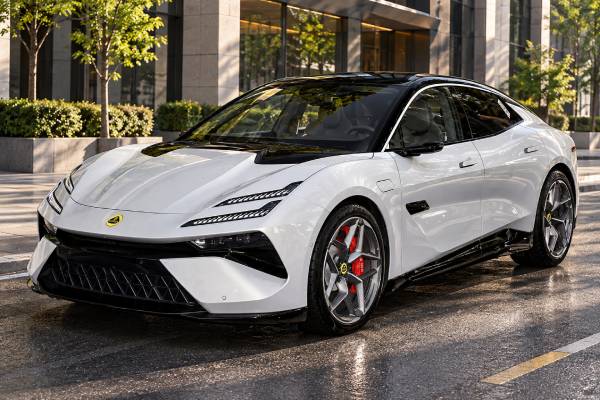
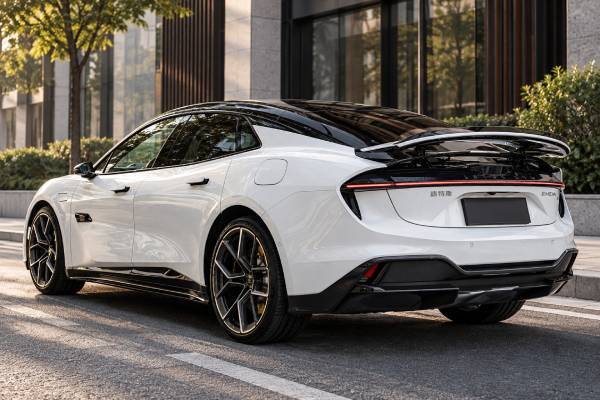
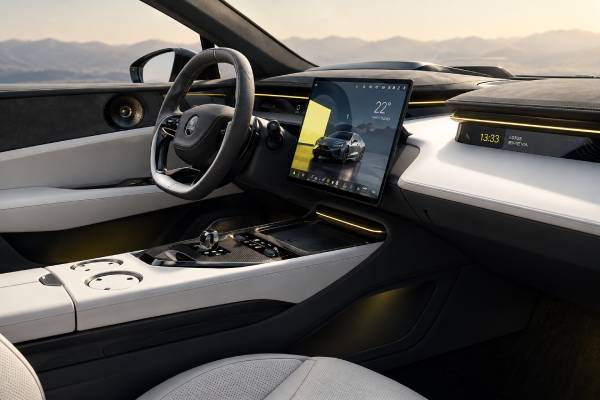
The Lotus Emeya S+ Platinum Edition is best understood as a factory appearance-and-hardware upgrade layered onto the 450 kW S+ drivetrain, not as a more powerful S+. Introduced in China in August 2024 around the Chengdu Motor Show period, the Platinum treatment added gold exterior details, gold brake calipers, an amber-toned cabin, and a white Alcantara headliner while retaining the 102 kWh battery, dual-motor AWD system, 710 Nm output, and 650 km CLTC range associated with the S+.
There is one especially important complication: archived Chinese listings document both a 6-piston Platinum version at RMB 788,000 and a 10-piston Platinum version at RMB 868,000. That means “S+ Platinum” alone does not identify the brake package. Buyers, insurers, parts departments, and workshops should verify the exact factory configuration rather than treating one piston count as universal. The following guide keeps those two variants separate while covering the shared drivetrain, charging system, chassis, styling details, maintenance needs, and used-car checks that define the S+ Platinum family.
Table of Contents
- What the Platinum Package Actually Changed
- 6-Piston Versus 10-Piston Platinum Versions
- S+ Platinum Technical Specifications
- Performance Without the R+ Drivetrain
- Charging, Range, and Trip Use
- Preserving Platinum-Specific Parts and Finish
- Verification Before You Buy
What the Platinum Package Actually Changed
The Platinum Edition changed the S+ primarily through design details and selected chassis hardware, while leaving its 450 kW propulsion system intact. Lotus’s own China-market communication described the Platinum package with gold body accents, gold badging, gold brake calipers, an amber interior, and a white Alcantara headliner.
That distinction matters because the word “Platinum” can suggest a top-output flagship. In the Emeya range it did not automatically mean 675 kW. The S+ Platinum remained a 603 hp car with 710 Nm, front and rear 225 kW motors, all-wheel drive, and a single-speed transmission. The R+ Platinum used the 905 hp drivetrain, while the S+ Platinum concentrated on a different blend of presentation, braking equipment, and the existing S+ range advantage.
The edition appeared after the original January 2024 launch. Lotus used the Chengdu show period to promote both matte-black and Platinum styling packages inspired by racing imagery. The Platinum treatment was deliberately more elegant than the black-and-yellow track aesthetic: gold highlights replaced the visual aggression of the matte-black package, and the cabin combination emphasized warmth and luxury.
For collectors or used buyers, that chronology is useful. An early 2024 S+ cannot simply become a factory Platinum Edition because someone later fitted gold badges or painted the calipers. Cosmetic conversion may look convincing, but it is not the same as an original factory specification with matching build data. If originality affects value, request the original order sheet, VIN-linked equipment record, invoice, or dealer documentation.
Platinum trim also introduces replacement-part questions that a standard S+ owner may never face. A damaged gold badge, unique trim strip, caliper finish, amber cabin panel, or white headliner may not be stocked as commonly as ordinary Emeya components. Repairs after even a modest parking incident can therefore involve sourcing and color-matching issues beyond the underlying mechanical damage.
The package should not be viewed purely as decoration, however. The documented availability of upgraded braking equipment means that at least some S+ Platinum cars combine the 450 kW drivetrain with hardware aimed at higher repeated braking loads. That is valuable on a 2.4-tonne-plus car, but it also raises the importance of identifying exactly which brake system is fitted before ordering pads, discs, wheels, or service parts.
6-Piston Versus 10-Piston Platinum Versions
There were two documented S+ Platinum configurations in the 2024 Chinese range: a 6-piston version listed at RMB 788,000 and a 10-piston version listed at RMB 868,000. Both retained the same 450 kW drivetrain and 650 km CLTC rating, so the brake specification and associated equipment—not motor output—are what separate them.
This is the most important fact to establish on any used S+ Platinum. A classified advert that says only “Platinum Edition” leaves a material part of the specification unresolved. The price difference when new was large enough that the distinction can also affect valuation, replacement costs, insurance descriptions, and the credibility of a seller’s claim.
Piston count by itself does not tell the full story of braking performance. Caliper stiffness, piston sizing, disc material and diameter, pad compound, tyre grip, brake cooling, regenerative blending, pedal calibration, and vehicle load all contribute. The reason the 10-piston configuration matters is not that ten is automatically “better” in every stop; it is that it identifies a different factory hardware package with different servicing implications.
A physical inspection should therefore go beyond counting visible piston bulges. Check the caliper part numbers and service documentation. Determine whether the discs are the original type or later replacements, whether the pads are approved for the system, and whether the wheel specification provides correct clearance. If the vehicle has carbon-ceramic or composite brake components in a particular package, replacement economics can be radically different from conventional iron discs.
Condition matters more than badge prestige. Regenerative braking allows the electric motors to do much of the gentle deceleration in normal driving, which can leave friction brakes underused. Discs may corrode, especially if the car is stored in damp conditions. At the other extreme, repeated high-speed use can generate heavy thermal load. Look for cracking, unusual surface deposits, vibration, pulling, warning messages, and uneven pad wear.
The brake fluid is still a time-sensitive hydraulic service item. An EV does not make moisture absorption disappear. Follow the Lotus service schedule for the exact VIN rather than assuming that low pad wear means the whole braking system can be ignored. Any workshop touching the system should also understand the interaction between friction braking, regenerative braking, ABS, stability control, and electronic parking-brake functions.
Finally, do not infer the brake package from caliper color alone. The Platinum theme itself uses gold calipers, and calipers can also be refinished. Documentation and part identification are stronger evidence than paint. For a high-value car, a pre-purchase inspection by a Lotus-capable workshop is a sensible way to resolve the difference before negotiating price.
S+ Platinum Technical Specifications
Both S+ Platinum variants are battery-electric five-door GTs using the same 102 kWh NMC battery, 800-volt platform, 450 kW dual-motor AWD system, and single-speed transmission. Their shared mechanical specification is much closer to the standard S+ than to the R+ Platinum, despite the common Platinum name.
| Specification | S+ Platinum |
|---|---|
| Powertrain | Battery electric, dual motor |
| Front motor peak power | 225 kW |
| Rear motor peak power | 225 kW |
| Combined peak power | 450 kW / 603 hp |
| Combined peak torque | 710 Nm |
| Drive | All-wheel drive |
| Transmission | Single-speed |
| Specification | Value |
|---|---|
| Battery capacity | 102 kWh |
| Battery type | Ternary lithium (NMC) |
| Battery supplier | CATL |
| Electrical architecture | 800-volt class |
| CLTC range | 650 km |
| Peak DC charging power | Up to 420 kW in archived trim data |
| AC charging time | About 5.5 hours in archived trim data |
| Measure | Value |
|---|---|
| 0–100 km/h | 4.2 seconds |
| Top speed | 250 km/h |
| Published consumption | 18.8 kWh/100 km |
| Drag coefficient | 0.21 |
| Measure | Value |
|---|---|
| Length | 5,139 mm |
| Width | 2,005 mm |
| Height | 1,464 mm |
| Wheelbase | 3,069 mm |
| Seating | Five seats |
| Rear luggage volume | 509 litres |
| Curb weight | 2,465 kg |
| Version | Original listed price | Shared power | CLTC range |
|---|---|---|---|
| S+ 6-Piston Platinum | RMB 788,000 | 450 kW | 650 km |
| S+ 10-Piston Platinum | RMB 868,000 | 450 kW | 650 km |
The table deliberately does not invent a universal brake-disc specification for both cars. Archived sources establish the separate piston-count versions, but exact brake component details should be confirmed from the VIN-linked parts catalogue or service documentation. That is preferable to borrowing an R+ or matte-black package specification simply because it appears in the same model-year range.
Performance Without the R+ Drivetrain
The S+ Platinum is exceptionally quick by ordinary road-car standards, but it is engineered around the 450 kW single-speed system rather than the R+’s 675 kW rear-biased two-speed drivetrain. The result is a calmer performance hierarchy: 4.2 seconds to 100 km/h and 250 km/h maximum speed, with fewer reasons to trade range for acceleration that is difficult to exploit legally.
Two equal 225 kW motors give the car all-wheel-drive traction and the ability to control torque independently at each axle. Electric response is immediate, so there is no combustion-engine buildup and no conventional multi-ratio shift during acceleration. From a driver’s perspective, the car simply produces strong, continuous thrust until aerodynamic drag and motor speed become the main limits.
That simplicity does not make the whole chassis basic. Air suspension, adaptive damping, active aerodynamic devices, electronic stability systems, regenerative braking, and sophisticated control software work together continuously. On a car weighing about 2,465 kg, these systems are not optional theatre; they are what allow comfort, body control, braking stability, and efficiency to coexist.
The S+ Platinum’s most interesting dynamic difference from a standard S+ is therefore not acceleration. It is the possibility of stronger brake hardware while retaining the range-focused drivetrain. For a driver who descends long mountain roads or uses the car briskly on repeated high-speed sections, greater thermal reserve can be more useful than another 225 kW of motor output.
Regeneration should still do much of the work in light and medium deceleration. That reduces energy waste and friction-pad wear, but it also means the driver may not exercise the physical brakes often in urban use. A car with expensive performance brakes can paradoxically develop rusty disc surfaces if it is driven gently and stored damp. Periodic inspection remains essential.
Tyres are the final link. A powerful brake package cannot stop the car faster than the tyres can transmit force to the road. The archived family specification shows staggered 21-inch fitments, and replacement tyres should preserve the correct load rating, dimensions, speed capability, and axle pairing. A premium used car on four unrelated tyres is a stronger warning sign than a small cosmetic scratch.
Charging, Range, and Trip Use
The S+ Platinum retains the S+’s 650 km CLTC certification, so its long-distance character is fundamentally different from that of the higher-output R+ Platinum. The certification number is optimistic compared with many real journeys, but within the same Chinese test cycle it confirms that the Platinum styling and brake choices did not turn the car into the shorter-range performance derivative.
For trip planning, use state of charge and expected consumption rather than dividing 650 by the route distance. Sustained expressway speeds, cold weather, cabin heating, rain, headwinds, elevation, tyre pressure, and wheel choice all change energy use. A driver who leaves a comfortable reserve and selects reliable high-power stations will usually travel with less stress than one trying to reproduce a laboratory maximum.
The 800-volt electrical architecture supports very high charging power at compatible stations. Archived Chinese trim data lists up to 420 kW DC, while Lotus’s launch marketing highlighted rapid range recovery in a short stop. Neither figure means the car draws peak power from every charger. Battery temperature and state of charge must be favorable, and the station must support the required voltage and power without sharing or derating.
A healthy charging curve matters more than a single peak. During a pre-purchase test, note the starting state of charge, whether navigation preconditioning was used, ambient temperature, charger rating, and whether the session proceeds without errors. If the car starts cleanly and sustains appropriate power for the conditions, that is more useful evidence than failing to reach an advertised maximum at a warm battery or high state of charge.
Routine AC charging is gentler on the owner’s schedule. If home or workplace charging is available, the car can replenish while parked and can precondition the cabin using external energy. The exact AC time depends on the supply and onboard limits; the archived 5.5-hour figure should be treated as a specified condition rather than a promise for every socket or wallbox.
Drivers should also distinguish CLTC and WLTP when comparing an imported S+ Platinum with European Emeya models. A 650 km CLTC label is not directly “40 km better” than a 610 km WLTP rating. The test procedures differ. Cross-market comparison should focus on battery size, drivetrain, real-world use, and charging compatibility rather than on the largest printed range number.
Preserving Platinum-Specific Parts and Finish
Platinum ownership adds cosmetic maintenance to the normal Emeya checklist because several edition-specific details are part of the car’s identity and potential resale value. Gold trim, badges and calipers, amber interior materials, and the white Alcantara headliner all deserve inspection with the same care as wheels and body panels.
Exterior gold accents can be damaged by aggressive polishing, harsh chemicals, or poor repair work. Before using a compound or coating, identify whether the surface is painted, plated, anodized, coated, or a decorative insert and follow the correct product guidance. A body shop that treats every gold piece like conventional clear-coated paint can permanently change its finish.
Gold calipers live in a much harsher environment. Brake dust, iron contamination, road grit, and high temperature attack their appearance. Cleaning should be done when the brakes are cool and with products compatible with the finish. A freshly repainted caliper may look attractive, but on a used car it should prompt questions: was the work cosmetic, or was it hiding heat discoloration, corrosion, or a replacement component?
The white Alcantara headliner is visually distinctive but unforgiving of dirty hands and inappropriate cleaners. Blot contamination rather than scrubbing aggressively, avoid soaking the backing, and use material-specific methods. Sagging, staining around roof openings, or water marks deserve investigation because they may indicate more than simple cosmetic neglect.
The amber interior similarly benefits from gentle cleaning and UV-aware care. Inspect seat bolsters, steering wheel surfaces, high-touch console areas, and rear-seat controls. Color transfer from dark clothing can be obvious on lighter materials. Replacement trim may be expensive or difficult to match, so an apparently minor stain can matter more on a special-edition cabin.
Mechanical preservation is equally important. Keep the correct tyre pressures, inspect alignment, service brake fluid on schedule, check air-suspension operation, and maintain software updates. The 12-volt system deserves attention because a weak auxiliary battery can trigger communication and wake-up faults across a highly networked EV. These issues can be mistaken for major high-voltage failures if diagnosis starts with assumptions rather than fault data.
When the car is stored, avoid leaving it with an unsuitable traction-battery state of charge for long periods and follow Lotus guidance for extended parking. Keep the vehicle where rodents, standing water, and extreme heat are controlled if possible. A special finish does not change battery chemistry, but collectors who drive fewer kilometres may create storage-related problems that daily users rarely see.
Verification Before You Buy
The best S+ Platinum purchase is the one whose factory identity, brake package, service history, and support path are proven before money changes hands. Because two Platinum brake versions exist and the model name was short-lived, documentation is unusually valuable.
Begin with the VIN and original build record. Confirm production date, market, S+ Platinum designation, brake package, wheel specification, interior color, exterior treatment, and any options. Compare those records with the physical car. A mismatch is not automatically evidence of fraud—parts can be replaced legitimately—but it requires a clear explanation.
Next, examine accident history. Gold trim and unusual finishes can make a repaired panel look “close enough” in photographs while differing under daylight. Measure panel gaps, inspect paint texture, look at fasteners, and check the underbody. Battery-protection damage from a ramp or road object is especially important because the pack sits low in the floor.
Have the brakes identified by part number. Confirm the 6-piston or 10-piston setup, disc type, remaining pad and disc life, and whether any non-original components have been installed. Obtain replacement-cost estimates before purchase. A car priced attractively because it needs a complete performance-brake refresh may not be a bargain.
Then assess high-voltage health through service diagnostics rather than dashboard guesswork. Review stored faults, battery state-of-health information when available, charging history clues, thermal-management behavior, and any previous battery or power-electronics repairs. Test AC charging and a compatible DC session. Check the port lock, cable release, scheduled charging, preconditioning, and app connection.
Drive the car from cold if possible. Listen for air-suspension compressor overuse, knocks, wheel-bearing noise, tyre vibration, and brake judder. Verify that ride-height changes complete normally and that active aerodynamic components do not generate faults. Use a straight, flat road to check steering alignment and braking stability.
Software and account transfer are the final technical gate. Confirm that the previous owner’s digital access can be removed, the new owner can pair the vehicle, maps and connected services work in the intended region, and all relevant campaigns are complete. An imported Chinese-market example may face limitations in another country that no amount of mechanical condition can solve.
Warranty should also be verified by VIN with the servicing Lotus representative. Do not assume a warranty published for a European or later 600-series car applies to a Chinese S+ Platinum. Ask what remains, what transfers, which high-voltage components are covered, and whether local dealers can order edition-specific parts.
Once those checks pass, the S+ Platinum has a coherent appeal: the efficient 450 kW drivetrain, 650 km CLTC certification, distinctive factory styling, and a choice of serious braking packages. Its rarity is a reason to document it carefully, not a reason to accept vague claims. The more precisely the car can be identified, the easier it is to service, insure, value, and preserve.
For an owner planning to keep the car long term, retain photographs and invoices whenever an edition-specific part is replaced. Record caliper part numbers, wheel specifications, paint or trim codes, software campaign dates, and the identity of the supplying dealer. That archive may seem excessive when the car is new, but it becomes valuable as original parts become less common and later owners try to distinguish factory equipment from cosmetic modification. It also gives a workshop a reliable baseline when ordering components for a version that was sold for only a short period.
References
- 路特斯以“稀缺性”赛道美学,呈现成都车展最具含「金」量展台 2024 (Official Platinum Package Release)
- Lotus Emeya 2024 S+ 6-Piston Platinum | Data.CarNewsChina.com 2026 (Archived 6-Piston Trim Specifications)
- Lotus Emeya 2024 Emeya S+ 10-Piston Platinum | Data.CarNewsChina.com 2026 (Archived 10-Piston Trim Specifications)
- 纯电超跑轿车路特斯EMEYA繁花正式上市 2024 (Official China Model Launch)
- 技术参数 2026 (Official China Technical Specifications)
- Lotus Emeya | How it Drives | Lotus Cars 2026 (Official Engineering Overview)
Disclaimer
This material is provided for information only and does not replace professional diagnosis, maintenance, or repair. Specifications, torque values, service intervals, brake components, software features, charging limits, and procedures can vary by VIN, market, production date, and equipment. Always confirm the exact car against official Lotus service information before ordering parts or carrying out work.
If you found the guide useful, sharing it on Facebook, X/Twitter, or another platform is a helpful way to support our work.