
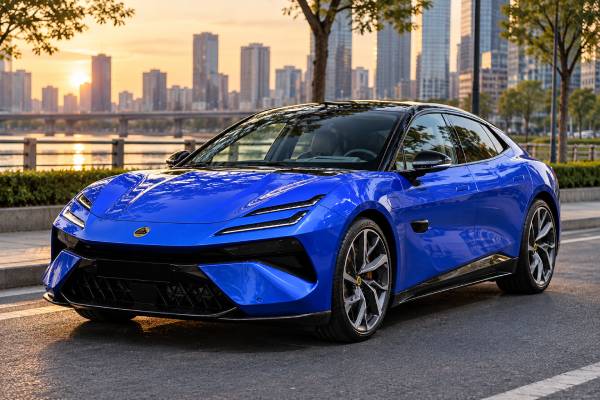
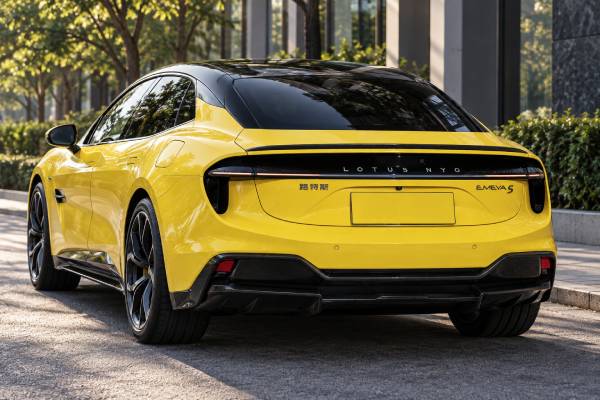
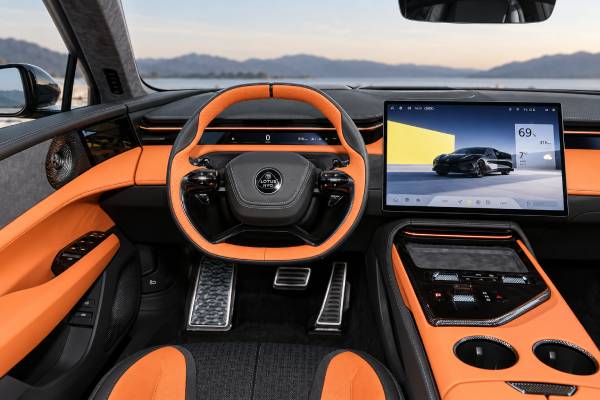
The Lotus Emeya S+ was the original China-market specification that paired the Emeya’s 450 kW dual-motor drivetrain with a richer equipment position and a long 650 km CLTC range claim. Introduced with the Chinese launch in January 2024 at RMB 768,000, it sat below the 675 kW R+ but above the entry Emeya, making it the version aimed at buyers who wanted the car’s sophisticated chassis, luxury cabin, and high-speed capability without paying for the two-speed 905 hp powertrain.
Its numbers can be misleading when removed from that context. The 650 km figure is a CLTC homologation result, not a WLTP rating, and the S+ badge was not the same trim used across Europe. Later 600-series naming also should not be treated as proof that every specification carried over unchanged. The useful way to understand the S+ is as a distinct 2024-era Chinese configuration: 102 kWh battery, 800-volt electrical architecture, 450 kW AWD, 710 Nm, five seats, and a single-speed drive system shaped around range and everyday performance.
Table of Contents
- The China-Market S+ in Context
- Emeya S+ Specification Sheet
- What the 650 km CLTC Rating Means
- Chassis Technology Over Straight-Line Theatre
- Ownership Practicalities, Charging, and Software
- How to Buy an Original S+ With Confidence
The China-Market S+ in Context
The S+ was the high-spec 450 kW choice in the original Chinese Emeya range, not a halfway version of the R+. Its engineering priority was to retain the lower-output drivetrain’s range advantage while adding the comfort, chassis, and technology content expected of a premium four-door Lotus.
At the January 2024 Chinese launch, Lotus listed four headline versions: the Emeya at RMB 668,000, S+ at RMB 768,000, R+ at RMB 968,000, and R+ Black Gold at RMB 1.18 million. That hierarchy explains why the S+ should be evaluated on more than horsepower. Buyers paid a meaningful premium over the base car, yet did not receive the R+ drivetrain. The value proposition was equipment and experience rather than a different output figure.
The core powertrain consists of a 225 kW motor at the front and another 225 kW motor at the rear. Combined output is 450 kW with 710 Nm of torque, and both axles are driven through a single-speed arrangement. Archived Chinese trim data lists 0–100 km/h in 4.2 seconds and a 250 km/h top speed. These are still extreme road-car figures, but they create a different character from the 675 kW R+, whose stronger rear motor and two-speed transmission are designed to extend acceleration at very high road speeds.
This distinction also helps explain the range gap. The S+ was rated at 650 km CLTC, while high-output R+ configurations were substantially lower. A more modest rear motor, one-speed gearing, and calibration aimed at efficient road use reduce the energy cost of carrying supercar-level reserves that may rarely be used. The S+ therefore suits the buyer who sees a 600-plus-horsepower EV as already sufficient.
The car remained physically imposing. It is 5,139 mm long, 2,005 mm wide, and 1,464 mm high, with a 3,069 mm wheelbase. Five-seat packaging and a 509-litre rear luggage compartment make it closer to an executive fastback than a traditional Lotus sports car. That matters in China, where rear-seat comfort and urban technology can be as important as a lap time.
The S+ name later disappeared as Lotus revised its product naming. That makes historical accuracy especially important today. A used S+ should be identified through VIN, original configuration records, and market documentation. A seller using current Emeya 600 marketing to describe a 2024 S+ may be directionally right about the drivetrain family but can still be wrong about wheels, option bundles, software, brake hardware, range certification, or warranty coverage.
Emeya S+ Specification Sheet
The Emeya S+ is a battery-electric five-door performance GT with a 102 kWh CATL-supplied ternary-lithium battery, 800-volt architecture, dual permanent-magnet motors, all-wheel drive, and a single-speed transmission. The most important mechanical point is symmetry: front and rear peak motor output are each 225 kW, unlike the rear-biased 675 kW variants.
| Item | 2024 Emeya S+ |
|---|---|
| Powertrain type | Battery electric |
| Front motor peak power | 225 kW |
| Rear motor peak power | 225 kW |
| Combined peak power | 450 kW / 603 hp |
| Combined peak torque | 710 Nm |
| Drive | Dual-motor AWD |
| Transmission | Single-speed |
| Item | Specification |
|---|---|
| Battery capacity | 102 kWh |
| Battery chemistry | Ternary lithium (NMC) |
| Cell supplier | CATL |
| Electrical architecture | 800-volt class |
| CLTC range | 650 km |
| AC charging time | About 5.5 hours in archived Chinese specification |
| Peak DC charging power | Up to 420 kW in archived Chinese specification |
| Measure | Value |
|---|---|
| 0–100 km/h | 4.2 seconds |
| Top speed | 250 km/h |
| Published energy consumption | 18.8 kWh/100 km |
| Drive layout | Front and rear electric motors |
| Measure | Value |
|---|---|
| Length | 5,139 mm |
| Width | 2,005 mm |
| Height | 1,464 mm |
| Wheelbase | 3,069 mm |
| Curb weight | 2,465 kg |
| Gross vehicle weight | 3,100 kg |
| Drag coefficient | 0.21 |
| Item | Specification |
|---|---|
| Seating | Five seats |
| Rear luggage capacity | 509 litres |
| Front tyre size in archived specification | 265/40 R21 |
| Rear tyre size in archived specification | 305/35 R21 |
| Suspension | Air suspension with adaptive damping and height control |
The specification should be read as a snapshot of the original Chinese trim, not a universal promise for every Emeya carrying 450 kW. Wheel options, equipment, software and certification can change the usable result. In particular, published charging descriptions vary across Lotus material: the launch communication emphasized very rapid range recovery, while archived trim tables list 420 kW peak DC capability. The exact performance of a real charging session depends on battery state, charger voltage and power, temperature, and software.
What the 650 km CLTC Rating Means
The 650 km figure is useful for comparing the S+ with other Chinese-market versions tested under the same CLTC procedure, but it should not be compared directly with a European WLTP number. Different test cycles use different speed profiles, temperatures, accessory loads, and calculation methods, so equal-looking kilometres do not represent equal real-world driving.
Within the original Emeya range, however, the number tells a clear story. The S+ was one of the long-range configurations. Its 450 kW powertrain sacrifices none of the everyday response expected from a premium EV, yet it avoids the additional energy demands of the 675 kW rear-biased system. For a driver covering intercity distance, that can matter more than another second or two of acceleration performance at already illegal speeds.
Real driving will still move significantly around the certification result. Highway speed is the biggest variable because aerodynamic power demand increases quickly as velocity rises. The Emeya’s low drag coefficient and carefully managed airflow help, but its frontal area, wide tyres, and 2,465 kg curb weight remain physical realities. Cold weather adds battery and cabin-heating demand; hot weather can require strong air-conditioning and battery cooling. Heavy rain, headwinds, elevation gain, and repeated high-power acceleration also reduce distance between stops.
The best owner strategy is to view range as a dynamic energy budget. Before a long journey, set the desired charge target early enough that the battery reaches it close to departure. Use the car’s navigation to plan charging and, where supported, to precondition the pack for a high-power stop. Arrive with a useful reserve instead of forcing the battery toward zero. A charging network with reliable 800-volt-capable hardware often matters more to trip time than squeezing an extra few percentage points from the starting charge.
The published 18.8 kWh/100 km figure provides another comparison point, but owners should not use it as a diagnostic threshold. Energy-consumption displays can be affected by trip length, climate use, terrain, and whether charging losses are included. A short winter urban trip may look dramatically worse than a mild-weather suburban run. Long-term averages taken over similar routes are more useful for detecting change.
Tyres and alignment are particularly important. The original 21-inch staggered sizes put substantial rubber on the road. Underinflation increases rolling loss and heat; excessive toe can scrub energy continuously; mismatched replacement tyres can alter noise, grip, and efficiency. Because torque arrives instantly at both axles, careless use can also wear tyres faster than the odometer alone suggests. Checking pressures cold and inspecting the inner shoulders should be routine.
For cross-border buyers, the cycle difference has a second consequence: an imported S+ may be advertised beside European Emeya S cars as if 650 km CLTC were automatically superior to 610 km WLTP. That comparison is not valid. The right question is whether the car’s charging standard, navigation services, warranty, software support, and homologation suit the country where it will actually be used.
Chassis Technology Over Straight-Line Theatre
The S+ makes its strongest engineering case through chassis systems rather than a larger power number. Lotus paired air suspension, adaptive damping, active aerodynamics, rear-steering capability on the platform, powerful braking hardware, and networked vehicle controls to make a large electric GT respond more like a smaller performance car.
That approach is necessary because mass cannot be ignored. At about 2.5 tonnes before passengers and luggage, the S+ carries far more inertia than the classic lightweight Lotuses that established the brand’s reputation. Electronics do not make that mass disappear; instead, the car uses active systems to control how quickly it moves, rolls, pitches, and transfers load.
Air springs allow ride height to change without requiring a fixed compromise between ground clearance and aerodynamic efficiency. Adaptive dampers can increase control when the car is being driven hard and relax when the road surface becomes rough. Lotus has described the Emeya’s chassis as sampling road and vehicle information at very high frequency. The practical result should be composure: quick body response when asked, but enough compliance to cover distance without the brittle ride that often accompanies very large wheels.
Active aerodynamic devices work alongside the suspension. The front grille can open when cooling is needed and close when reducing drag is more valuable. The rear spoiler changes position to contribute stability and downforce. Air is routed through and around the body rather than simply over a smooth shell. These systems matter even on a lower-output S+ because stability, cooling, and efficiency are all important at sustained speed.
The 450 kW output itself remains more than sufficient. With two 225 kW motors, torque can be distributed between axles without a mechanical driveshaft linking front and rear. All-wheel-drive traction helps launch performance and wet-road confidence, while motor control can respond faster than a conventional combustion drivetrain waiting for engine torque and gearbox changes. The single-speed layout keeps the response continuous from low speed to the 250 km/h maximum.
Braking deserves equal respect. Regeneration can recover energy during everyday deceleration, but it cannot replace the friction brakes in emergency stops or repeated high-load use. The S+ was offered in a period when Lotus also marketed different caliper packages on related trims, so buyers should identify the hardware actually fitted rather than assuming a particular piston count from the badge alone. Condition is more important than internet specification: disc surface, pad life, fluid service, tyre grip, and calibration all affect stopping performance.
A test drive should therefore include more than one hard acceleration run. Check whether the car tracks straight on a level road, whether steering self-centres consistently, whether the air suspension changes modes without warnings, and whether low-speed manoeuvring is smooth. Listen for wheel-bearing hum and suspension knocks. Feel for vibration through the seat or steering wheel at motorway speed. A sophisticated chassis can hide minor faults surprisingly well until they become expensive.
Ownership Practicalities, Charging, and Software
The S+ is practical enough to serve as a primary car, but its ownership experience depends heavily on charging access, software support, and physical size. A buyer who can charge regularly at home or work will use its 102 kWh battery very differently from someone dependent on public DC stations.
For routine use, slower AC charging is usually the easiest solution. It reduces the need to spend time at a fast charger and lets the vehicle precondition while connected to external power. The archived Chinese specification lists about 5.5 hours for AC charging under its stated conditions, but actual time depends on supply power and starting state of charge. Never assume the wallbox can deliver the car’s maximum; building service, phase availability, cable rating and local electrical rules set the ceiling.
High-power DC charging is where the 800-volt platform shows its advantage. Lotus’s Chinese launch communication promoted five minutes of charging as enough to add 180 km of CLTC range under suitable conditions, while later Emeya material describes very high peak charging capability. Such claims are best understood as favorable-window performance. Peak charge power occurs only when the battery is at an appropriate temperature and state of charge, and a compatible charger must actually sustain the requested voltage and current.
Software affects the charging experience as much as hardware. Route planning, battery preconditioning, charger selection, remote climate control, state-of-charge notifications, and digital-key features all rely on software and connected services. An imported S+ can therefore lose some of its intended convenience if the account region, cellular service, mapping, or app support does not transfer cleanly.
The same is true of driver assistance. Lotus launched the Emeya in China with an emphasis on high computing power and advanced assisted-driving functions, including OTA-delivered features. Availability can change with software version and regulation. A used buyer should test what the car does today instead of purchasing on the promise that a video or launch presentation showed the platform could do more.
Inside, the 3,069 mm wheelbase creates genuine passenger space, and the five-seat layout keeps the S+ versatile. The hatch and 509-litre rear compartment suit luggage better than the fastback silhouette suggests. Yet the car is more than two metres wide before mirrors are counted, so narrow garages and urban parking spaces can be its least glamorous limitation. Measure the actual parking environment before purchase and check wheel edges carefully; kerb damage is common on wide, heavy cars with large rims.
Climate and glass-roof equipment should also be tested. The Emeya was marketed in China with sophisticated roof glazing and multi-zone cabin technology. If fitted, confirm every roof opacity or shading function works evenly, not just the main infotainment screen. Test seat ventilation/heating, rear controls, audio, cameras, door operation, and every charging cable supplied with the car. Luxury features are part of why the S+ cost more than the base trim, and faults can erase that value quickly.
How to Buy an Original S+ With Confidence
Buying an original S+ safely starts with proving exactly what the vehicle is. Because Emeya naming changed and many listings reuse current specifications, the VIN, original Chinese order/build data, registration documents, and physical equipment should agree before price or condition is judged.
First, confirm that the car is the standard S+ rather than one of the later S+ Platinum variants. The standard launch S+ carried a RMB 768,000 official retail price in January 2024. Platinum versions appeared later with different pricing and brake-package distinctions. A seller may use “Platinum” casually to describe color or trim, but the later factory edition should have supporting documentation.
Second, inspect high-value chassis hardware. Air suspension should raise and lower evenly; a corner that sinks after parking can indicate leakage. The compressor should not run continuously. Active aerodynamic elements should move without binding. Check the underside around battery protection panels for scrape or impact damage, because a car this long and low can contact ramps even if the exterior paint looks excellent.
Third, inspect the wheels and tyres as a system. The archived S+ specification uses staggered 265/40 R21 front and 305/35 R21 rear tyres. Verify that replacements are correctly sized and suitable for the axle. Uneven inner-shoulder wear can reveal alignment issues that a quick walkaround misses. A mismatched budget tyre on one corner is also a warning sign on a 450 kW AWD car.
Fourth, assess the battery with diagnostics where possible. Dashboard range is not a state-of-health test. Ask for battery-health data available through Lotus service tools, check for high-voltage warnings in stored fault history, and review whether the vehicle has had battery, charging-port, cooling, or power-electronics repairs. Inspect coolant levels and service records according to the official schedule rather than assuming an EV requires no fluid maintenance.
Fifth, test charging twice: AC and high-power DC. Make sure the connector locks and releases correctly, scheduled charging starts, the car communicates with the station, and no repeated isolation or temperature faults appear. A healthy session does not need to hit 420 kW to be valid; a charger may be limited and the battery may not be in the peak window. Consistent operation is more important than chasing a screenshot-worthy number.
Sixth, verify software ownership. Remove old user profiles where appropriate, transfer the Lotus account, pair the current owner’s phone, and confirm that remote services work in the intended country. Check all available software updates and any VIN-specific campaigns. If the car was imported, establish in writing which local dealer is willing and able to service it and whether parts ordering differs from locally delivered examples.
Routine maintenance should focus on the components an EV does not eliminate: tyres, brakes, suspension joints, wheel alignment, cabin filtration, air-conditioning, cooling systems, low-voltage battery, wipers, and software. Friction brakes can corrode because regeneration does so much light stopping; periodic inspection is still necessary. A weak 12-volt battery can also trigger multiple electronic faults even when the 102 kWh traction pack is healthy.
Finally, check warranty status by VIN rather than copying a term from another country. Chinese-market warranty language, imported-vehicle coverage, battery provisions, and roadside assistance may not transfer to another jurisdiction. The most valuable purchase file is therefore not a glossy brochure but a complete chain of original order data, service history, software/campaign records, and documentation showing who will support the car next.
A well-documented S+ remains one of the more rational original Emeya configurations. It delivers 603 hp, sophisticated chassis technology, a large battery and strong certified range without the added complexity and consumption of the 905 hp drivetrain. The right example is the one whose identity and support network are as clear as its performance numbers.
References
- 纯电超跑轿车路特斯EMEYA繁花正式上市 2024 (Official China Launch Release)
- Lotus Emeya 2024 S+ | Data.CarNewsChina.com 2026 (Archived Trim Specifications)
- Lotus Emeya 2024 – detailed specifications and trim levels | Data.CarNewsChina.com 2026 (Historical Range Data)
- 技术参数 2026 (Official China Technical Specifications)
- Lotus Emeya | How it Drives | Lotus Cars 2026 (Official Engineering Overview)
- Lotus Emeya Handbook for Drivers | Lotus Cars 2026 (Official Owner Information)
Disclaimer
This article is informational only and is not a substitute for professional vehicle diagnosis, servicing, or repair. Specifications, torque values, intervals, charging behavior, software functions, and procedures can vary with VIN, market, production date, and equipment. Verify the exact vehicle against current official Lotus service and owner documentation before performing work or relying on a specification.
Please share this guide on Facebook, X/Twitter, or another platform if you found it useful and would like to support our work.