
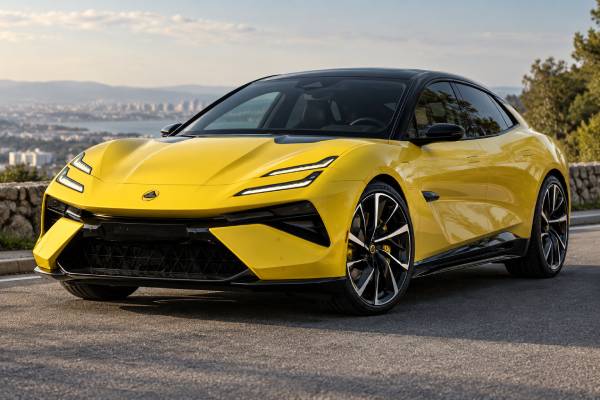
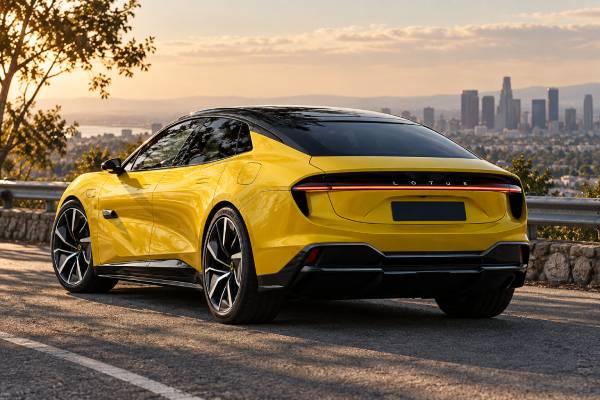
The Lotus Emeya S is the version that turned Lotus’s first electric four-door GT into a serious long-distance performance car without chasing the extreme acceleration of the R. Sold in European markets for the 2024 and 2025 model years, it combines a 450 kW dual-motor all-wheel-drive system with 710 Nm, a 102 kWh battery, a single-speed transmission, and a WLTP range of up to 610 km. Those figures place it in an unusually useful middle ground: genuinely rapid, but still configured around range, refinement, and repeatable everyday performance.
That balance also makes specification accuracy important. The Emeya S name belongs to the earlier European/global range and should not be confused with the China-market S+ or with the later Emeya 600 naming that replaced it. Charging claims can also differ according to charger rating and source. This guide therefore keeps the 2024–2025 Emeya S in its original market context and focuses on the hardware, range, ownership checks, and decisions that matter most.
Table of Contents
- Where the Emeya S Fits in the Original Range
- European Emeya S Technical Data and Specifications
- Range Beyond the WLTP Number
- Charging at Home and on the Road
- GT Chassis, Performance, and Road Behaviour
- Living With the Emeya S Every Day
- Used-Buying and Maintenance Priorities
Where the Emeya S Fits in the Original Range
The Emeya S is the comfort-and-equipment step above the original base Emeya while retaining the more efficient 450 kW powertrain. It is not a detuned R: the S uses a different drivetrain philosophy, with equal-output front and rear motors and a single-speed reduction drive rather than the R’s more powerful rear motor and two-speed arrangement.
That distinction is useful when shopping because an Emeya S can look almost as dramatic as an R while behaving very differently in the areas that matter over a year of ownership. Peak output is 450 kW, equivalent to roughly 612 metric horsepower or 603 mechanical horsepower, and maximum torque is 710 Nm. Lotus paired that output with all-wheel drive and a claimed 0–100 km/h time of 4.2 seconds. A 250 km/h top speed is far beyond normal road use, yet the acceleration is progressive enough that the car’s long-distance GT role remains obvious.
The S also belongs to a naming period that ended quickly. Lotus later reorganized the Emeya range around 600 and 900 badges. The 600 effectively carries forward the lower-output drivetrain concept, but that does not mean every later 600 specification can be backfilled into an earlier S. Software, equipment packs, market homologation, wheel fitments, and even published charging numbers can change. A used-car listing that labels a 2024 S as a “600 S” or simply copies current-model specifications should therefore be treated as a prompt to check the VIN and original build sheet, not as authoritative evidence.
The body itself is a large five-door fastback rather than a conventional compact Lotus. At 5,139 mm long and 2,005 mm wide excluding mirrors, it occupies executive-car space. The 3,069 mm wheelbase gives the battery and rear cabin room to coexist, while the low roof and active aerodynamic devices keep the visual mass under control. This is important context for ownership: parking width, tyre costs, kerb weight, and wheel damage are more relevant concerns than they are on an Elise or Emira.
The S makes the most sense for a driver who wants Emeya design and chassis technology but values motorway range and one-speed mechanical simplicity over the R’s headline launch performance. That does not make it a “slow” choice. A 4.2-second sprint to 100 km/h remains sports-car quick, and the instantaneous response of two motors means overtaking rarely requires planning around gearbox behavior.
European Emeya S Technical Data and Specifications
The 2024–2025 Emeya S is a battery-electric five-door GT with two permanent-magnet drive motors, one on each axle, all-wheel drive, and a single-speed transmission. Its 102 kWh gross battery operates through an 800-volt-class architecture, which is central to the car’s combination of high charging power and sustained high-performance operation.
| Specification | Emeya S |
|---|---|
| Powertrain | Dual-motor battery electric |
| Drive | All-wheel drive |
| Maximum power | 450 kW / 603 hp |
| Maximum torque | 710 Nm |
| Transmission | Single-speed reduction drive |
| 0–100 km/h | 4.2 seconds |
| Top speed | 250 km/h |
| Specification | Emeya S |
|---|---|
| Battery capacity | 102 kWh gross |
| Architecture | 800-volt class |
| WLTP range | Up to 610 km |
| AC charging | Up to 22 kW where supported |
| DC fast charging | Up to 350 kW in original European specification |
| 10–80% DC charge | About 18 minutes at a suitable high-power charger |
| Measurement | Value |
|---|---|
| Length | 5,139 mm |
| Width excluding mirrors | 2,005 mm |
| Width including mirrors | 2,241 mm |
| Height | 1,464 mm |
| Wheelbase | 3,069 mm |
| Drag coefficient | 0.21 |
| Specification | Value |
|---|---|
| Passenger layout | Five seats |
| Rear luggage compartment | 509 litres |
| Maximum luggage volume | 1,388 litres |
| Front luggage compartment | 34 litres |
| Wheelbase-to-length ratio | Long-wheelbase GT packaging |
| System | Configuration |
|---|---|
| Suspension | Air suspension with continuously controlled damping |
| Aerodynamics | Active front grille, active rear spoiler, and airflow management features |
| Steering support | Electronic driver-assistance integration; equipment varies by market |
| Brake-energy recovery | Regenerative braking blended with friction braking |
The headline numbers need two qualifications. First, the 610 km figure is a homologated WLTP maximum, not a promise that every S will travel 610 km between charges. Wheel choice, temperature, speed, climate-control demand, elevation, battery temperature, and payload all matter. Second, Lotus’s later charging communications reference higher peak figures with newer 420 kW charging hardware and infrastructure. For an original European S, the safest approach is to use the period specification for the exact VIN and regard later platform-wide claims as evidence of the architecture’s potential rather than an automatic retrofit of the published rating.
Range Beyond the WLTP Number
The Emeya S is the original range-focused performance trim, but its useful trip range is governed more by speed and conditions than by the 610 km laboratory figure. Independent modelling puts a mixed real-world figure around 520 km under moderate assumptions, with motorway driving in cold weather capable of reducing that materially.
This is normal for a large, powerful EV. Aerodynamic drag rises sharply with speed, and the Emeya’s low 0.21 drag coefficient cannot eliminate the energy needed to push a two-tonne-plus car through the air at sustained motorway pace. Wide performance tyres add rolling resistance, while a cold battery must be heated into an efficient operating window. Cabin heating, demisting, wet roads, headwinds, roof-mounted accessories, and frequent hard acceleration all push consumption upward.
A better way to plan a journey is to work from arrival state of charge rather than theoretical maximum range. If a route has reliable high-power charging, leaving a buffer at both ends is usually faster and less stressful than trying to stretch every charge to near zero. The Emeya’s strength is that it can recover energy rapidly when battery temperature, charger output, and state of charge align. That changes the optimization problem: the quickest trip may involve shorter, well-timed charging stops rather than one very long session.
Wheel and tyre configuration deserves special attention on used cars. Larger wheels and stickier tyre specifications can trade some efficiency for appearance and grip. A seller’s advert may therefore quote the maximum 610 km figure even if the exact wheel package was homologated at a lower value. The correct comparison is the certificate or original configuration for that particular car.
Seasonal expectations should also be realistic. In winter, preconditioning while connected to AC power can reduce the energy that would otherwise come from the traction battery at departure. On a long trip, using navigation-based charger routing can allow the car to prepare the battery for DC charging. A battery that reaches a rapid charger too cold can initially accept far less than its advertised peak; a very hot pack after repeated hard running can also be managed conservatively by the thermal system.
Owners should watch trends rather than obsess over a single consumption reading. A sudden, persistent efficiency change after fitting tyres, receiving a software update, or experiencing alignment damage is more informative than one windy journey. Correct tyre pressures, clean underbody panels, free-running brakes, and proper wheel alignment all help a heavy EV deliver the efficiency its engineering allows.
Charging at Home and on the Road
The Emeya S works best when most routine charging happens on AC power and rapid DC charging is reserved for travel. Its ability to accept up to 22 kW AC in markets and installations that support three-phase charging is unusually useful for a premium EV with a battery of this size.
At home, actual charging power depends on the property’s electrical supply, wallbox, cable, local regulations, and the onboard charger. An installation below 22 kW simply limits the car to the lower available rate. Buyers should therefore confirm the home electrical situation before assuming the car’s maximum AC figure translates directly into a short overnight session.
For battery longevity and convenience, there is usually no need to recharge to 100% after every local journey. The practical strategy is to use the charge-limit controls appropriate to normal driving, then select a higher target shortly before a long trip when the additional range will actually be used. Owners should follow Lotus’s current guidance in the vehicle and handbook because battery-management recommendations can be updated through software and can vary with market.
On DC power, the original Emeya engineering was demonstrated around a 350 kW class fast charger, with roughly 10–80% in 18 minutes under favorable conditions. That is an exceptionally short stop for a battery exceeding 100 kWh gross, but peak power is not constant through the entire session. Charging curves normally rise, plateau, and taper as state of charge increases. Arriving at 60% and plugging into a 350 kW charger will not reproduce a 10–80% test.
The 800-volt architecture is especially valuable because higher voltage can deliver substantial power without requiring proportionally higher current. Lower current for a given power level can reduce cable and conductor losses, help thermal control, and make very high charging rates more practical. It does not mean every public charger can feed the car at its maximum. Older 400-volt equipment, shared stalls, site power limits, charger temperature, or payment-network problems can become the bottleneck.
For used-car evaluation, perform at least one DC session if possible. The purpose is not to demand a specific peak number for a few seconds; it is to verify that the car communicates with the charger cleanly, initiates charging without repeated faults, preconditions as expected, and sustains a sensible curve for the starting state of charge and temperature. Repeated charging errors deserve diagnosis before purchase, even if AC charging appears normal.
GT Chassis, Performance, and Road Behaviour
The S is engineered to feel fast without making maximum acceleration its entire personality. Its equal 225 kW front and rear motor outputs, all-wheel-drive traction, air suspension, active aerodynamics, and electronically coordinated chassis systems give it a broad operating range from quiet motorway travel to very rapid cross-country driving.
A single-speed drivetrain contributes to that character. There is no physical gear change during a full-throttle run, so acceleration is uninterrupted and mechanically straightforward. Compared with the R’s two-speed rear transmission, there is one less performance-oriented mechanism changing ratio at speed. That does not make the S mechanically simple in an absolute sense—the car is filled with networked controllers, actuators, air-suspension hardware, and high-voltage electronics—but the power delivery itself is easy to understand.
Air suspension is central to how a car of this mass can work as a Lotus-branded GT. The system can vary ride height, while continuously controlled dampers respond to road conditions. Lotus has publicized suspension sensing and adjustment at very high frequency, allowing body control to be managed without relying only on very stiff passive springing. The result owners should look for is not floaty isolation; it is a car that can settle on a motorway yet retain disciplined body movement when loaded laterally.
Active aerodynamics supplement the chassis. The Emeya uses moveable surfaces and managed air paths to balance drag, cooling, and stability. At ordinary speeds the owner may barely notice them. At higher speeds and under braking, they contribute to the car’s ability to control airflow and load. Because these are moving components, they also belong on a used-car inspection list: listen for abnormal operation, check for warning messages, and inspect exposed mechanisms for impact damage or debris.
Regenerative braking adds another layer. The electric motors can recover kinetic energy during deceleration, reducing reliance on the friction brakes during light everyday stops. But a powerful, heavy GT still needs substantial conventional braking capacity. Low friction-brake use can sometimes create its own maintenance issue if discs develop corrosion from long periods of gentle regenerative driving. Periodic inspection matters even when pad wear seems unusually slow.
Tyres are perhaps the most underestimated part of Emeya S ownership. High torque, high mass, wide wheels, and aggressive chassis settings can make poor-quality or mismatched tyres obvious. All four tyres should be an approved or suitable matched specification with similar wear characteristics. Uneven inner-edge wear can indicate alignment or suspension issues, and a badly repaired wheel can create vibration that gets blamed on the drivetrain. On a test drive, use smooth road surfaces as well as broken ones so wheel balance, bearing noise, tyre roar, and suspension knocks can be separated.
The key dynamic advantage of the S is usable speed. It has enough output to overwhelm normal legal limits quickly, yet its performance does not depend on managing a two-speed gearbox or the R’s higher rear-axle output. For many owners, that makes the S the more coherent grand tourer rather than merely the cheaper one.
Living With the Emeya S Every Day
Daily usability is better than the low roofline suggests, provided the car’s size suits where it will be driven. Five seats, a 509-litre rear luggage area, a small front compartment, and a large hatch make the Emeya S practical enough for family travel, but its 2,005 mm body width demands care in narrow parking structures and older city streets.
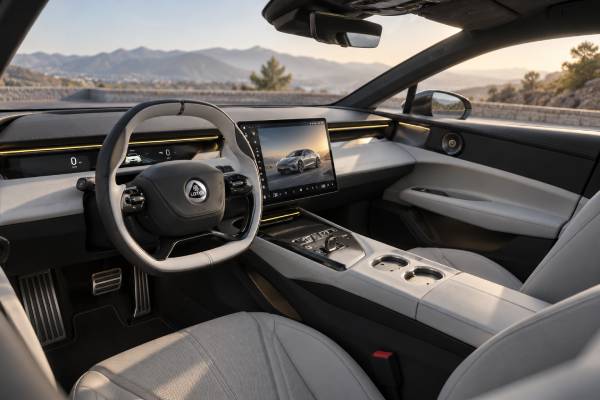
The cabin mixes conventional grand-touring priorities with a heavily software-defined interface. Functions that would once have lived on separate switches can depend on displays, driver profiles, sensors, and software. A prospective owner should therefore test more than the obvious screen animation. Pair a phone, try navigation, confirm camera views, operate seat and climate functions from both front positions, check key recognition, and make sure the car wakes and sleeps normally over repeated cycles.
Driver-assistance hardware is another area where market and equipment matter. Lotus has described the Emeya platform with extensive sensor coverage and high computing power, but feature availability can depend on local regulations, software release, and the exact option package. Do not buy an imported example because an advert promises a particular automated-driving function. Confirm what is enabled on the specific VIN in the country where the car will be registered.
The hatchback layout is useful, but the sloping rear glass changes how bulky cargo fits. Litres do not tell the whole story. A long, low suitcase load can exploit the floor area well; tall square objects may meet the roofline sooner than in an SUV. The rear seats can expand carrying capacity when passenger space is not required. Owners who need regular towing should also verify the exact market approval and fitted equipment rather than relying on a generic online figure.
Climate control matters to both comfort and efficiency. Preconditioning the cabin while connected to external power is worthwhile in very hot or cold weather. It reduces the immediate thermal load after departure and can make the first part of a journey more efficient. Heated seats and steering-wheel heating, where fitted, can also provide comfort without demanding as much cabin-air heating as an aggressively high thermostat setting.
The car’s software connection makes account transfer important when ownership changes. A used buyer should ensure the previous owner is removed from the vehicle account, digital keys are reset as required, app access transfers properly, and any subscription-dependent services are understood. A technically perfect car that remains tied to someone else’s account can create avoidable inconvenience.
Finally, think about physical access before purchase. A 2.24-metre mirror-to-mirror width can make a narrow garage much less comfortable than the nominal body width suggests. Measure the entrance, the space needed to open the doors, and the location of the charging socket relative to the wallbox. These mundane details often determine whether living with a large electric GT feels effortless or irritating.
Used-Buying and Maintenance Priorities
A used Emeya S should be assessed as a high-voltage luxury performance car, not simply as an EV with fewer service items than an engine car. The traction motors avoid oil changes and ignition-system work, but the vehicle still has cooling circuits, air suspension, brakes, tyres, steering components, cabin filtration, low-voltage electronics, software, and a complex high-voltage system that all require correct maintenance.
Start with identity. Check the VIN against Lotus documentation and the original order or build data so the car is genuinely an S of the stated model year and market. Imported cars deserve particular scrutiny because charging hardware, connected services, lighting, maps, warranty coverage, and certification can differ. The 450 kW rating alone is not enough to identify an S; several Emeya variants share that output.
Then review service and software history. A complete record should show scheduled inspections and any campaign or recall work applicable to the VIN. Ask whether software updates were installed normally or whether the vehicle has had recurring update failures, warning lights, or 12-volt battery problems. Modern EVs rely on the low-voltage system to wake contactors and control modules, so a weak 12-volt supply can produce a surprisingly broad set of symptoms even when the traction battery is healthy.
Battery condition should be evaluated with evidence rather than dashboard range alone. The displayed estimate responds to recent driving and climate use, so a low number after fast motorway running is not proof of degradation. A dealer diagnostic report or supported battery-health assessment is more useful. Check the underside for impact marks because physical battery-pack damage can be more consequential than ordinary cosmetic damage to a sill or bumper.
The cooling system deserves attention because it manages the traction battery, motors, power electronics, and charging performance. Look for coolant warnings, leaks, collision repairs near cooling components, and evidence that underbody panels have been removed or damaged. A car that repeatedly throttles charging or power due to temperature may need diagnosis rather than reassurance that “all EVs do that.”
Air suspension should raise and settle evenly without persistent compressor noise. Leave the car parked long enough to see whether one corner sinks. On the road, listen for knocks over low-speed sharp bumps and note whether ride-height or damping warnings appear. Active-aero components should cycle without scraping or sticking. Replacement costs can be substantial, so small warning signs are worth investigating before money changes hands.
Brake inspection remains necessary even if regeneration has preserved the pads. Check disc faces for heavy corrosion, scoring, or a pronounced lip, and verify smooth stopping from moderate speed. A pulsing pedal may indicate disc variation; a pull under braking can point to tyre, alignment, or brake issues. The parking brake should release cleanly after the car has been stored.
Tyres and wheels can reveal how the vehicle has been treated. Look for sidewall bubbles, cuts, mismatched brands, uneven wear, cracked or bent rims, and signs of repeated kerb impact. Because replacement performance tyres are expensive, a nearly worn set should be included in the purchase budget rather than treated as a minor cosmetic issue. Correct alignment is also important for range and stability.
Charging should be tested on both AC and DC if practical. Confirm the port door, locking mechanism, cable release, scheduled-charging function, and app controls. A DC session is especially useful for exposing communication or thermal-management faults that an overnight AC charge will not reveal. Record the starting state of charge and battery temperature context rather than judging the car solely on a momentary peak number.
Warranty terms must be checked in the market where the car is registered. Lotus has published market-specific vehicle and high-voltage component warranties, but duration and mileage limits are not universal. An imported car may not carry the same coverage as a locally supplied one. Get the answer in writing from the servicing Lotus representative using the VIN.
For ongoing ownership, use the official handbook and service information for intervals and fluid specifications. Keep software current, maintain tyre pressures, clean debris from cooling and aerodynamic openings, and do not ignore small chassis warnings simply because propulsion still feels normal. The Emeya S’s greatest ownership advantage is its breadth: it can be an exceptionally fast, quiet, long-range GT. Preserving that breadth depends on maintaining the whole vehicle, not merely watching the battery percentage.
References
- Lotus Emeya S (2024-2025) price and specifications – EV Database 2026 (Historical Model Specifications)
- Lotus Emeya – The Fully Electric Hyper-GT | Lotus Cars 2026 (Official Model Overview)
- Lotus Emeya | How it Drives | Lotus Cars 2026 (Official Engineering Overview)
- Lotus believes processing power is the new horsepower – and Emeya built on NVIDIA DRIVE is a thoroughbred 2024 (Official Technical Release)
- Emeya Handbook | Lotus Cars United Kingdom 2026 (Official Owner Information)
- Lotus Emeya S specifications | EVKX.net 2026 (Technical Reference)
Disclaimer
This guide is for informational purposes and does not replace professional diagnosis, maintenance, or repair. Specifications, torque settings, service intervals, software functions, charging limits, and procedures can differ by VIN, market, production date, and installed equipment. Confirm any work or purchasing decision against the official Lotus documentation for the exact vehicle.
If this article helped, please share it on Facebook, X/Twitter, or another platform to support our work.