
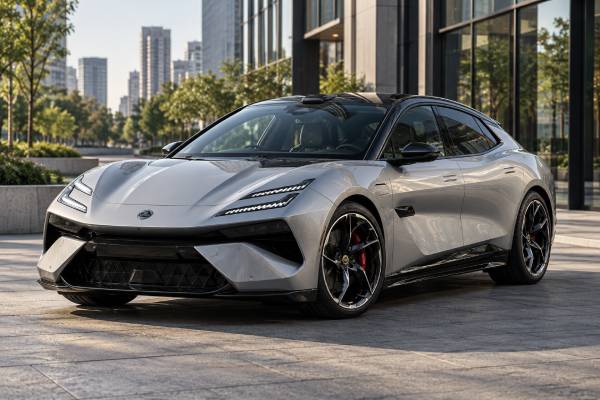
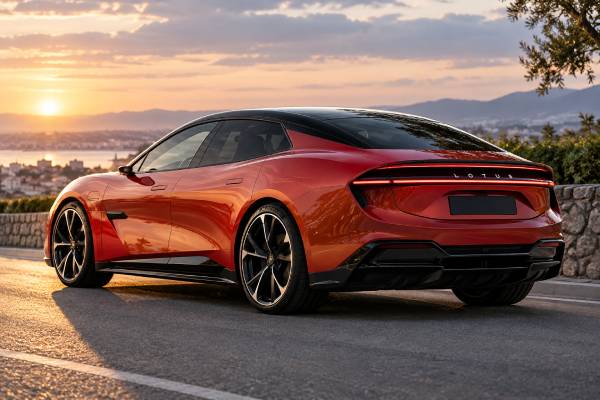
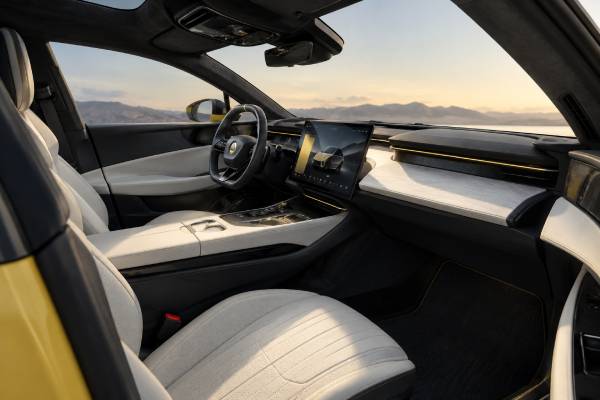
The 450 kW Lotus Emeya is the version that makes the clearest case for the car as an electric grand tourer rather than a headline-chasing super sedan. With dual-motor all-wheel drive, 710 Nm of torque, a 102 kWh battery, and a single-speed rear drive arrangement, it still delivers roughly 4.2-second 0–100 km/h performance while offering the longest official range figures in the early Emeya family. For many owners, that balance matters more than the 675 kW car’s extra acceleration. The standard-power Emeya also keeps the platform features that define the model: 800-volt electrical architecture, very rapid DC charging, active aerodynamics, electronically controlled air suspension, a long 3,069 mm wheelbase, and a technology-heavy cabin. This guide covers the 2024–2025 450 kW car as its own model, not as a detuned R. It explains what the drivetrain changes mean, how range and charging should be judged, which systems deserve maintenance attention, and what to verify before buying one used.
Table of Contents
- Why the 450 kW Emeya Makes Sense
- Standard Emeya Specifications
- Range, Efficiency, and Fast Charging
- Ride, Handling, and Active Aero
- Cabin, Cargo, and Digital Systems
- Maintenance, Wear, and EV Health
- Used Buying Guide
Why the 450 kW Emeya Makes Sense
The 450 kW Emeya is not a slow version of the car. Its 603 hp output and 710 Nm of torque are already enough to deliver effortless overtaking and sports-car acceleration, while the simpler single-speed drive layout avoids the performance model’s rear two-speed gearbox. That makes it the more natural choice for buyers who value touring range, smoothness, and lower mechanical complexity over sub-three-second launches.
Lotus positioned Emeya as a Hyper-GT: a long-distance, high-speed electric liftback with performance-car responses. The standard-power car supports that brief particularly well. It retains a motor on each axle, so traction is immediate and all-wheel drive is available without a mechanical propshaft. The power delivery is linear, and the car does not need a multi-speed transmission to stay within its intended performance envelope. With roughly 4.15–4.2 seconds to 100 km/h and a 250 km/h top speed, it is faster than most drivers will use on public roads.
The major ownership advantage is range. Early European specifications quoted up to about 610 km WLTP for the 450 kW version, depending on wheel and equipment configuration. China-market equivalents were commonly listed around 650 km CLTC. Those figures are not directly comparable because the test cycles differ, but both show the same trend: the lower-output Emeya is the efficiency-focused member of the original lineup.
That advantage does not come from a different battery. The car still uses the 102 kWh pack and 800-volt-class electrical system. Instead, the gain comes from calibration, gearing, wheel/tire choices, and the absence of the high-output rear drive unit. This is why a buyer should not assume an R’s range number applies simply because both cars share the same body and nominal battery size.
The standard car also makes sense as a used purchase. A less extreme drivetrain can mean fewer signs of repeated launch use, fewer owners choosing the largest available wheel packages, and more cars that spent their lives as fast daily transport. That does not eliminate inspection needs, but it changes the likely wear profile. Tire alignment, air suspension, brakes, charging behavior, and software matter more than evidence of repeated maximum-performance operation.
Standard Emeya Specifications
The 450 kW Emeya is a dual-motor BEV with permanent-magnet traction motors, all-wheel drive, and a 102 kWh battery. Its defining mechanical difference from the 675 kW model is the lower combined output and simpler single-speed gearing. The specification tables below concentrate on values that are useful for the 2024–2025 standard-power car rather than borrowing R-specific hardware.
| Specification | Value |
|---|---|
| Powertrain type | Battery-electric, dual-motor AWD |
| Combined peak power | 450 kW (603 hp; about 612 metric PS) |
| Combined peak torque | 710 Nm (524 lb-ft) |
| Front motor | Permanent-magnet synchronous motor, 225 kW in published European data |
| Rear motor | Permanent-magnet synchronous motor, 225 kW in published European data |
| Transmission | Single-speed reduction gearing |
| Battery capacity | 102 kWh |
| Electrical architecture | 800-volt class |
| Measure | Published figure |
|---|---|
| 0–100 km/h | About 4.15–4.2 seconds |
| Top speed | 250 km/h (155 mph) |
| WLTP range | Up to about 610 km (379 mi), configuration dependent |
| China-market CLTC context | Comparable 450 kW versions listed around 650 km CLTC |
| Drive | All-wheel drive |
| Item | Specification |
|---|---|
| DC charging architecture | 800-volt high-power system |
| Original peak DC figure | 350 kW-class |
| Quoted 10–80% DC time | About 18 minutes in suitable conditions |
| European AC connector | Type 2 |
| European DC connector | CCS |
| Battery preconditioning | Supported through the vehicle’s thermal-management/navigation functions |
| Specification | Value |
|---|---|
| Length | 5,139 mm (202.3 in) |
| Width | 2,005 mm (78.9 in), excluding mirrors |
| Width including mirrors | About 2,241 mm (88.2 in) in European data |
| Height | About 1,459 mm (57.4 in) in European specification |
| Wheelbase | 3,069 mm (120.8 in) |
| Front luggage volume | 34 L in European specification |
| Rear luggage volume | 509 L with rear seats in use |
| Rear volume with seats folded | Up to 1,388 L in corresponding five-seat specification |
| System | Configuration |
|---|---|
| Suspension | Electronically controlled air suspension |
| Damping | Adaptive electronic control |
| Aerodynamics | Active front grille, active rear aerodynamic devices, deployable rear wing |
| Weight distribution | Near-even front/rear balance in Lotus marketing material |
| Wheel/tire layout | Large staggered performance fitments depending on market and option package |
| Steering assistance | Electric power steering; rear-steer equipment depends on specification |
| Feature | Detail |
|---|---|
| Vehicle operating system | Lotus Hyper OS |
| OTA updates | Supported |
| ADAS processing | Dual NVIDIA DRIVE Orin systems cited by Lotus at launch |
| Surround sensing | 34 sensors cited for the Emeya platform |
| Head-up display | Large projected HUD |
| Premium audio availability | KEF system with immersive-audio capability |
Range, Efficiency, and Fast Charging
The standard Emeya’s strongest practical advantage is that it can use the 102 kWh pack for distance rather than maximum acceleration. Even so, a 610 km WLTP rating should be treated as a test-cycle result, not a fixed road-trip promise. Sustained high speed, winter weather, large wheels, and repeated hard acceleration can reduce range substantially.
For everyday ownership, energy consumption is more useful than a single range number. Track the car on routes you repeat and note temperature, average speed, wind, wheel setup, and climate use. If the car normally consumes one amount of energy on a familiar motorway and suddenly rises without a weather explanation, check tire pressures, alignment, brake drag, software changes, and thermal-management behavior before assuming battery degradation.
The 800-volt architecture is especially valuable on long trips because it reduces the time needed for a mid-journey stop when a compatible high-power charger is available. Lotus originally quoted about 18 minutes for a 10–80% session in ideal conditions. That result depends on arriving with a warm battery and a low enough state of charge. A cold pack can accept far less power, and a charger labeled with a large number may still be limited by voltage, current, site load, or thermal conditions.
Use route planning that allows battery preconditioning before the charging stop when the car supports it. Preconditioning is not merely cabin heating; it brings the traction battery toward the temperature range in which it can accept energy quickly. If a car repeatedly charges slowly after a proper preconditioning drive at a known capable station, that is worth investigating.
Home charging changes the ownership experience more than peak DC figures. A driver who starts most mornings with the desired state of charge rarely needs to think about public infrastructure during normal weeks. Keep the routine charge limit appropriate for your use, and reserve 100% for days when the extra range is needed. The battery management system protects the pack, but avoiding unnecessary long periods at full charge is a sensible habit.
When comparing used cars, do not judge battery condition from the displayed predicted range alone. The guess-o-meter is influenced by recent driving and weather. A better evaluation combines service diagnostics, state-of-health information when available, charging behavior, warning history, and a controlled drive that compares energy use with expected conditions.
Ride, Handling, and Active Aero
The 450 kW Emeya still depends on active chassis systems to disguise its size and weight, but its performance envelope is easier to exploit on public roads than the 675 kW model’s. The car should feel settled, precise, and quiet at speed, with strong traction and progressive responses rather than the abruptness sometimes associated with high-output EVs.
Air suspension is central to that behavior. It allows the car to manage ride height and body motion while adaptive damping reacts to road inputs. On a test drive, cycle through available drive modes and note whether the ride actually changes. A warning-free dashboard does not prove that every damper or ride-height sensor is operating correctly. If the car sits low at one corner after being parked overnight, or the compressor runs unusually long at every startup, investigate for a leak or sensor problem.
The active aero system also deserves functional checks. The front grille manages cooling air, while rear aero surfaces and the deployable wing alter the car’s aerodynamic balance. Dirt, ice, impact damage, or a failed actuator can affect operation. Listen for abnormal motor noise and check for warning messages after the car performs its self-tests. Never force a stuck aerodynamic element by hand without the correct procedure.
Tire condition can make or break the chassis. Large, wide tires react strongly to alignment and pressure. Inspect tread depth across the full width, not just the outer shoulder, because negative camber or toe errors can wear the inner edge first. Check date codes as well; low-mileage cars can still sit on hardened old tires. A mismatched pair front-to-rear or side-to-side can change wet grip and stability-control behavior even if the sizes are correct.
The brakes may see less everyday use because regenerative deceleration handles part of the workload. That makes disc corrosion possible on cars driven gently. Perform several firm but safe braking events to clean the surfaces and then assess vibration, noise, and pulling. If a wheel remains much hotter than the others afterward, a dragging caliper or bearing problem deserves attention.
The key dynamic advantage of the 450 kW car is usable speed. It has enough power to feel special without requiring the driver to reach extreme velocities before the chassis starts to communicate. That makes it the version many owners can enjoy more often.
Cabin, Cargo, and Digital Systems
The Emeya is a genuine long-distance car because the cabin and luggage layout are designed around adult passengers, not merely around front-seat performance. The five-door body, long wheelbase, 509 L rear luggage area, and small front compartment give it practical capacity that a conventional two-door Lotus never attempted.
The driver faces a wide digital environment rather than a traditional analog dashboard. The large head-up display carries speed, navigation, and assistance information into the driver’s line of sight. Before purchase, check it at night and in daylight, because alignment, brightness, windshield replacement, or calibration can affect clarity. A replacement windshield on a sensor-rich car should have the correct specification and any camera/HUD recalibration documented.
Lotus Hyper OS controls many vehicle functions and receives over-the-air updates. Software history therefore becomes part of service history. Ask whether the car is on the expected software version for its market and whether any update failed or required dealer intervention. Test profiles, smartphone connection, navigation, audio, cameras, parking functions, climate scheduling, remote app features, and charging controls rather than assuming that a responsive main screen means the whole system is healthy.
The premium KEF audio system is worth checking channel by channel. A sophisticated multi-speaker installation can hide a failed speaker because the remaining channels still create a full sound field. Use familiar material, move the balance/fader, and listen for rattles or distortion at moderate volume. Door and trim rattles can also indicate previous disassembly.
Cargo inspection should include the liftgate, load floor, underfloor areas, seals, and evidence of water entry. A panoramic or advanced glass roof should be checked for chips, edge damage, and shade/electrochromic functions where fitted. Water staining in the luggage area, unusual condensation, or damp carpets deserves investigation before purchase because electronic modules often live low in modern cars.
For families, the practical decision is seating rather than acceleration. Verify rear headroom with the seat adjusted for the actual driver, child-seat compatibility if relevant, and the folding behavior of the rear backrest. The Emeya’s performance image can distract buyers from these basic usability checks, but they determine whether the car works every day.
Maintenance, Wear, and EV Health
The standard Emeya has fewer routine powertrain service items than an ICE grand tourer, but it still needs systematic maintenance. The high-value areas are tires, brakes, suspension, cooling, low-voltage electronics, charging hardware, and software—not oil changes.
Inspect tires at least as often as you would on a heavy performance SUV. The combination of mass, torque, and wide tread can wear shoulders quickly if alignment drifts. Rotate only where the specific staggered setup permits; many performance fitments cannot be swapped front-to-rear. Keep a record of alignment measurements after tire replacement because a recurring wear pattern can reveal a chassis issue before it becomes expensive.
Brake fluid still absorbs moisture even when regenerative braking reduces pad use. Follow the market-specific service schedule rather than extending intervals based on pad thickness alone. Friction brakes should also be exercised periodically in a controlled way to remove surface corrosion. If the car has been stored, inspect discs before assuming they will clean themselves completely.
Battery and power-electronics cooling is another time-based system. The exact coolant specification and replacement procedure should come from the VIN-specific service documentation; do not substitute a generic EV coolant because color looks similar. Inspect for leaks, dried residue, damaged hoses, and repeated thermal warnings. Cabin air-conditioning performance matters too because the thermal system may share components or control logic with battery conditioning.
The 12-volt battery is easy to overlook. A weak auxiliary battery can produce confusing warnings, prevent contactors from closing, interrupt updates, or leave the car apparently dead even when the traction battery is charged. If a used car has a history of long storage, ask whether the 12-volt battery has been replaced and test it properly rather than judging only by age.
Software updates should be treated like service actions: read the release information, allow the car adequate time and charge, and verify all major functions afterward. If an update coincides with a new fault, record the timing. Good documentation helps a dealer distinguish software behavior from a failing physical component.
Finally, inspect the underside. Battery protection panels, aero covers, jacking points, and suspension links can be damaged by curbs or road debris. A dent near the high-voltage pack deserves professional evaluation even if the car drives normally.
Used Buying Guide
The best used 450 kW Emeya is the car with a coherent history, not necessarily the one with the fewest kilometers. A properly exercised car with regular charging, documented software work, even tire wear, and clean diagnostics can be safer than an almost unused example that spent months at full charge on underinflated tires.
Start by confirming the exact variant. Because Emeya naming changed across markets and later model years, use the VIN and original sales specification rather than assuming every “base” or “600” badge represents the same equipment. The 2024–2025 assignment car is the 450 kW, 710 Nm version. Check that service and registration records match that drivetrain.
Then inspect charging. Verify AC operation at the normal home/destination rate and, if practical, perform a DC session at a charger capable of exercising the 800-volt system. A single low peak is not conclusive, but repeated communication failures, overheating messages, or charge-port locking problems are meaningful. Confirm that the car can precondition and that navigation recognizes chargers in the market where you will use it.
A structured pre-purchase inspection should include:
- VIN, service history, software campaigns, and accident records.
- Diagnostic scan of high-voltage, chassis, ADAS, and body-control modules.
- Tire date codes, tread pattern, wheel condition, and alignment evidence.
- Air-suspension ride height after an overnight park and compressor behavior from cold.
- Brake-disc condition plus repeated braking for vibration or pull.
- Underbody and battery-protection inspection on a lift.
- AC and DC charging checks, including connector lock and charge-port door.
- Camera, radar, parking, HUD, audio, climate, seat, and app functions.
During the road test, begin gently so noises can be heard. Then test stronger acceleration, regenerative behavior, and braking after the car is warm. A standard Emeya should be extremely smooth. Mechanical clunks on every torque reversal, steering vibration, or a persistent drivetrain whine that changes rapidly with load should not be dismissed as “normal EV sound.”
Consider wheel size when comparing cars. The most dramatic wheel package may look best, but smaller factory wheels generally help ride comfort, tire cost, pothole resistance, and range. If your priority is long-distance use, the less aggressive setup can be the better ownership choice even if it carries less showroom impact.
Finally, compare the 450 kW car with the R on how you actually drive. The R is meaningfully faster and technically fascinating, but the standard car already reaches illegal road speeds with ease. If the purchase is for commuting, cross-country travel, and occasional fast-road use, the 450 kW version’s range and simplicity can be the more satisfying specification. Its appeal is not that it lacks the R’s hardware; it is that the platform feels complete without needing it.
Ownership costs are often easier to control on the 450 kW car when the specification is chosen for use rather than appearance. Large wheels can increase tire price, expose rims to pothole damage, and reduce the range margin that makes this version attractive in the first place. Before buying replacement tires, match the required size, load rating, speed rating, and EV suitability rather than choosing only by tread pattern. After installation, have the alignment checked if the old tires showed inner-edge wear; simply fitting new rubber can hide the cause for a few thousand kilometres.
Service documentation matters even though routine EV maintenance is lighter than on a combustion car. Keep invoices for brake-fluid work, cabin filters, air-conditioning service, alignment, tires, 12-volt battery replacement, software campaigns, and any high-voltage cooling-system intervention. A future buyer can then separate normal consumable spending from unresolved electrical faults. For a daily-driven standard Emeya, that transparent history is usually more valuable than cosmetic accessories because it shows the car has been used as intended without neglecting the systems that support charging, thermal control, suspension, and driver assistance.
References
* Lotus Emeya – The Fully Electric Hyper-GT | Lotus Cars 2026 * Lotus Emeya – Explore Models | Lotus Cars 2026 * Lotus Emeya | How it Drives | Lotus Cars 2026 * Lotus unveils Emeya, its first Hyper-GT – Lotus Cars Media Site 2023 * Lotus believes processing power is the new horsepower – and Emeya built on NVIDIA DRIVE is a thoroughbred – Lotus Cars Media Site 2023 * Lotus Emeya (07/24 – 04/25): Technische Daten, Bilder, Preise | ADAC 2026
Disclaimer
This article is for informational purposes only and is not a substitute for professional diagnosis, repair, or a VIN-specific workshop inspection. Specifications, torque values, service intervals, software functions, and procedures can vary by market, equipment, production date, and VIN; verify all technical work against official Lotus documentation for the exact vehicle. If this guide helped you, please consider sharing it on Facebook, X/Twitter, or another community you use to support our work.