
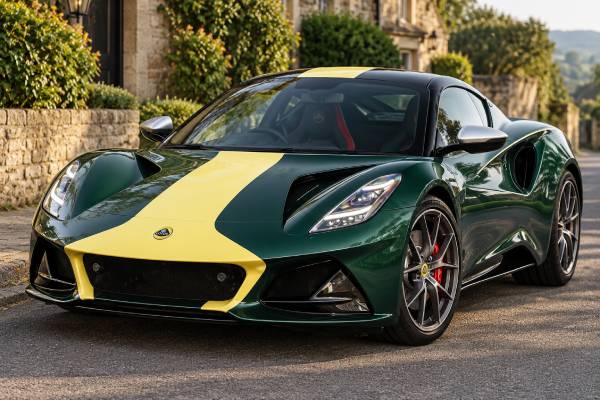
The 2025 Lotus Emira Clark Edition is a 60-car tribute to Jim Clark built around the manual 400 hp V6 Emira, not a cosmetic package applied across the whole range. Created with the Jim Clark Trust, it marks 60 years since Clark’s extraordinary 1965 season and draws its strongest visual cues from the green-and-yellow Lotus Type 38 that won the Indianapolis 500. Under the special paint, asymmetric cabin, wooden gear knob, numbered treadplates, and heritage details sits the 3.5-litre supercharged V6 Emira with a six-speed manual gearbox, limited-slip differential, hydraulic steering, Sport suspension, and the Lotus Driver’s Pack. That combination matters to collectors because the mechanical specification supports the historical theme: this is the most analogue Emira powertrain paired with one of the most elaborate factory heritage treatments. For prospective owners, authenticity is as important as mechanical condition. The car’s numbered components, bespoke trim, original accessories, paintwork, documentation, and unmodified V6 drivetrain all influence whether a Clark Edition retains the value and significance of the limited series.
Table of Contents
- Why Lotus created the Clark Edition
- Type 38-inspired exterior and cabin details
- Clark Edition specifications and technical data
- V6 manual engineering and driving character
- Rarity, provenance, and authenticity checks
- Maintenance and preservation priorities
- How to buy a Clark Edition intelligently
Why Lotus created the Clark Edition
The Clark Edition exists to commemorate Jim Clark’s 1965 season, when he won the Formula One World Championship and Indianapolis 500 among a wider set of victories and championships. Lotus limited the road car to 60 examples and developed it in collaboration with the Jim Clark Trust.
Clark’s connection to Lotus is unusually deep even by motorsport standards. He won the 1963 and 1965 Formula One World Championships for Team Lotus and became the first driver to win the Indianapolis 500 in a rear-mid-engine car when he dominated the 1965 race in the Lotus Type 38. The Jim Clark Trust records that he led 190 of the 200 laps at Indianapolis that year. He also competed successfully across Formula 2, Tasman racing, touring cars, sports cars, and other disciplines, reinforcing the image of a driver whose speed was not limited to one type of machine.
Lotus chose 2025 for the Clark Edition because it was the 60th anniversary of that season. The limited run of 60 cars reinforces the anniversary number rather than being a production target chosen for convenience. The car made its public debut around the 2025 Formula 1 Miami Grand Prix, where Lotus presented it as both a tribute and a collector-focused derivative.
Mechanically, Lotus based the car on the Emira V6 rather than the four-cylinder Turbo SE. That decision is appropriate to the theme. The 3.5-litre supercharged V6, six-speed manual gearbox, visible shift mechanism, hydraulic steering, and limited-slip differential give the car a more mechanical and interactive feel than the DCT-equipped four-cylinder. It is still a modern Type 131 Emira, but its controls align naturally with a tribute to a driver celebrated for delicacy and precision.
Lotus also made the Driver’s Pack part of the package. The company describes the Clark Edition as using Sport suspension, Track Mode, and a revised exhaust sound. This differentiates the car from a simply restyled V6 and means collectors should verify that a prospective example still carries its original chassis and exhaust specification.
The launch price also positioned it above the standard Emira V6. Lotus announced £115,000 for the UK and €140,000 for Germany. Price alone does not create collectability, but the premium is easier to justify when the production number, collaboration, bespoke trim, and mechanical configuration are all preserved.
Type 38-inspired exterior and cabin details
The Clark Edition’s identity is carried by specific factory details that are difficult to replace correctly if damaged or removed. For ownership and resale, preserving these original components is more important than adding aftermarket carbon trim, wheels, or power upgrades.
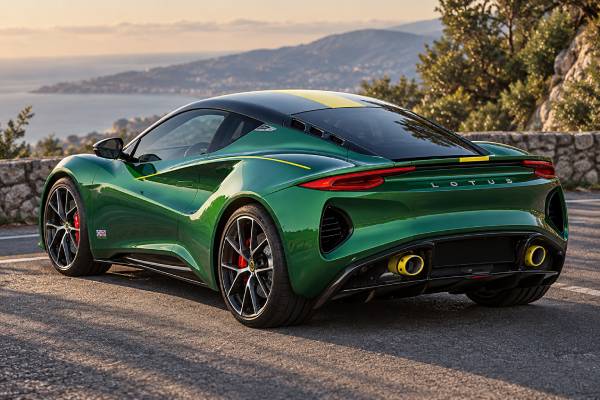
The body is finished in a special green with a contrasting black roof and a yellow stripe that flares around the nose. Lotus connects the treatment directly to Clark’s 1965 Indianapolis-winning Type 38. The car also uses silver mirror caps and a hand-painted yellow pinstripe that follows the Emira’s side contour.
Smaller details are unusually important. Lotus specified yellow exhaust tips and a machined aluminium fuel filler cap with a blue anodised centre. The doors carry Clark Edition branding inspired by the visual language used around Clark’s racing cars. None of these parts makes the car faster, but together they establish the edition’s factory authenticity.
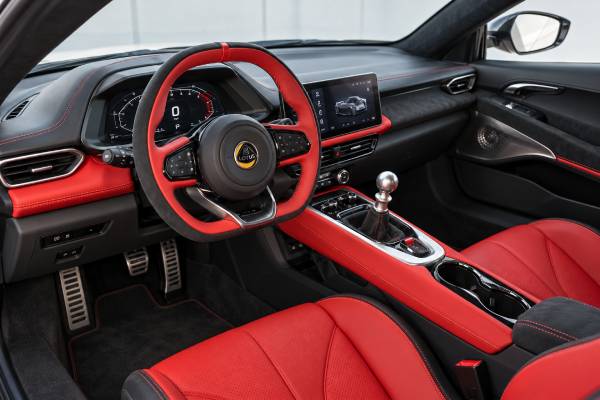
The cabin goes further than a normal special-colour package. The driver’s seat is trimmed in red leather and Alcantara, while the passenger seat uses black leather and Alcantara. The asymmetry deliberately recalls the red-trimmed cockpit environment associated with Clark’s period race cars and places the driver visually at the centre of the interior.
A sixties-style wooden gear knob is one of the most obvious heritage cues. In a normal modern sports car it might look decorative; here it is linked directly to the manual transmission and the visual character of classic Lotus competition machinery. Because it is both tactile and edition-specific, an original undamaged knob should be treated as a valuable component rather than something to swap for a modern aftermarket piece.
Lotus added a Jim Clark signature on the dashboard, Team Lotus details on the seats, special commemorative badging incorporating Clark’s personalised tartan, and numbered carbon-fibre treadplates marked as one of 60. Each customer was also to receive a bespoke hand-crafted leather holdall with Clark Edition details.
Those loose accessories matter. Limited-edition cars often reach the used market years later without presentation items, luggage, documentation folders, or spare keys. A missing holdall does not change how the Emira drives, but completeness can influence collector value. Buyers should therefore ask for every item supplied with the car, not just the vehicle itself.
Clark Edition specifications and technical data
The Clark Edition is a petrol ICE coupe using the Emira’s 3,456 cc supercharged V6, six-speed manual transmission, rear-wheel drive, and limited-slip differential. Lotus states 400 hp and bases the car on the V6 with the Driver’s Pack, making the performance hardware substantially the same as the contemporary manual V6 beneath the bespoke trim.
| Specification | Value |
|---|---|
| Engine family | Toyota 2GR-FE, Lotus installation |
| Displacement | 3,456 cc (3.5 L) |
| Configuration | Supercharged V6 petrol, mid-mounted |
| Supercharger | Edelbrock 1740 in Emira V6 technical specification |
| Maximum power | 400 hp (298 kW) |
| Maximum torque | 420 Nm (310 lb-ft) for the manual V6 specification |
| Transmission | Six-speed manual |
| Differential | Limited-slip differential |
| Drive type | Rear-wheel drive |
| Specification | Value |
|---|---|
| Chassis | Bonded and extruded aluminium Lotus Sports Car Architecture |
| Front suspension | Double wishbone |
| Rear suspension | Double wishbone |
| Dampers | High-pressure monotube |
| Steering | Electrohydraulic rack and pinion |
| Clark Edition suspension | Sport setting through Lotus Driver’s Pack |
| Drive program feature | Track Mode included with Driver’s Pack |
| Front brake discs | 370 × 32 mm |
| Rear brake discs | 350 × 32 mm |
| Calipers | AP Racing four-piston |
| Specification | Value | Notes |
|---|---|---|
| 0–100 km/h | About 4.3 seconds | Lotus V6 manual family figure |
| Top speed | About 290 km/h (180 mph) | Lotus V6 family figure |
| WLTP combined CO₂ | 258 g/km in Lotus V6 data | Market and homologation dependent |
| WLTP combined fuel consumption | 11.3 L/100 km in Lotus V6 data | Market and homologation dependent |
| Fuel tank capacity | 52.5 L (13.9 US gal) | Lotus Emira technical data |
| Specification | Value |
|---|---|
| Body style | Two-door, two-seat coupe |
| Length | 4,413 mm (173.7 in) |
| Width including mirrors | 2,092 mm (82.4 in) |
| Width with mirrors folded | 1,895 mm (74.6 in) |
| Height | 1,226 mm (48.3 in) |
| Wheelbase | 2,575 mm (101.4 in) |
| Front / rear track | 1,626 / 1,608 mm |
| Rear luggage compartment | 151 L (5.3 cu ft) |
| Cabin luggage capacity | 208 L (7.3 cu ft) |
| Feature | Clark Edition specification |
|---|---|
| Production | 60 cars for selected markets |
| Exterior | Clark Racing Green / Indy-inspired green with black roof and yellow heritage stripe |
| Mirrors | Silver caps |
| Fuel filler | Machined aluminium with blue anodised centre |
| Exhaust finish | Yellow tailpipes |
| Driver seat | Red leather and Alcantara |
| Passenger seat | Black leather and Alcantara |
| Gear knob | Sixties-style wood |
| Treadplates | Numbered carbon fibre, one of 60 |
| Customer accessory | Bespoke Clark Edition leather holdall |
Lotus did not publish a separate engine tune for the Clark Edition because its special value comes from the manual V6 package and bespoke execution rather than additional horsepower. That is useful when checking modified cars: a seller cannot justify an engine tune as necessary to make the vehicle “correct Clark spec.”
V6 manual engineering and driving character
The Clark Edition’s hardware is intentionally driver-led: supercharged response, a manual gearbox, mechanical limited-slip differential, passive Sport suspension, and hydraulic steering. Its performance is strong, but the interaction between those systems is more important than chasing a faster acceleration number.
The supercharged V6 responds differently from a turbo engine. A mechanically driven supercharger builds boost in direct relation to engine operation, so throttle response is immediate and linear. There is no waiting for a large exhaust-driven turbine to accelerate. That suits a car intended to be balanced on small throttle changes through a corner.
The six-speed manual adds physical involvement. The Emira’s exposed gearshift mechanism is already a visual feature, and the Clark Edition’s wooden knob makes it a focal point. During a test drive, the shift should feel positive rather than loose or obstructive. Clutch take-up should be progressive, with no slip under high load once the drivetrain is fully warm.
The limited-slip differential helps the rear tires share torque when one side approaches its traction limit. On a road car, the driver experiences this as cleaner power delivery exiting tighter corners rather than as a dramatic intervention. It also means rear tire condition should be matched carefully. A large tread-depth or tire-model difference across the axle can undermine the way the differential and stability systems behave.
Sport suspension is a fixed passive setup, not an adaptive electronic mode. The Clark Edition therefore has a firmer baseline than a Tour-chassis Emira. That makes tire pressure and alignment particularly influential. If the ride seems harsh or the car follows every road groove, first check geometry and tire condition before assuming the suspension is inherently unpleasant.
Hydraulic steering remains one of the Emira’s strongest differentiators. An electrically driven hydraulic pump assists the rack, allowing the system to retain fluid pressure and road feedback rather than filtering everything through an electric motor on the steering column. It asks for more effort at parking speed than some rivals, but it also communicates front-tire load more naturally.
Rarity, provenance, and authenticity checks
A Clark Edition should be bought as a numbered, documented 60-car factory series. The biggest value risk is not ordinary mileage; it is loss of provenance, replacement of unique trim, undisclosed accident repair, or a car assembled to look like the edition without complete factory documentation.
Start with the VIN and factory sales record. Confirm that the car was delivered as a Clark Edition in an eligible market and that the VIN matches all registration, service, finance, and warranty records. The numbered carbon-fibre treadplate should be present, but a number plate alone is not sufficient proof because trim can theoretically be transferred.
Photograph and record edition-specific details before purchase. Useful items include the stripe layout, silver mirror caps, Clark door graphics, fuel filler, yellow tailpipes, dashboard signature, seat embroidery, tartan-related badging, asymmetric seat trim, wooden gear knob, and numbered treadplates. Compare both sides of the car and check whether paint or decals have been repaired.
Ask for the original leather holdall and any presentation material. Also request both keys, handbook pack, invoice, order confirmation, servicing documents, and correspondence related to warranty or bodywork. Complete documentation helps future owners distinguish a carefully preserved car from one reconstructed after damage.
Paint inspection deserves specialist attention because the livery is part of the car’s identity. A normal bodyshop may produce an excellent cosmetic repair while failing to reproduce hand-painted details or factory colour breaks exactly. If there has been damage, obtain the repair invoice and photographs and confirm whether Lotus-approved parts and paint procedures were used.
Mileage should be interpreted sensibly. A car that has covered several thousand carefully documented road miles can be a better purchase than a nearly unused example stored badly on old tires with a weak battery and missed annual services. Collector quality comes from condition and originality, not odometer worship.
Maintenance and preservation priorities
Maintain the Clark Edition mechanically like the manual V6 Emira, but preserve its unique trim like a limited-production collector car. Preventive care is cheaper than trying to source bespoke cosmetic parts after damage or neglect.
For the drivetrain, use Lotus’s VIN-specific service information. Correct engine oil, coolant, brake fluid, gearbox oil requirements, and torque specifications should come from the official documentation for the market. The Toyota engine family’s broader service reputation is useful context, but it does not replace Lotus procedures for this installation.
Keep the battery healthy with an appropriate maintainer if the car is stored. Modern control modules dislike low voltage, and repeated flat-battery events can lead to warning lights, lost settings, and diagnostic confusion. During long storage, also manage tire pressure and move the car periodically or use suitable supports to reduce flat spotting.
Inspect the cooling system before and after hard use. The engine sits behind the cabin and relies on long coolant routing through the vehicle. Any recurring temperature message, loss of coolant, or smell should be investigated immediately. Likewise, let oil and coolant reach operating temperature before using full engine speed.
Brake fluid and friction materials deserve attention on cars used for track days. The Driver’s Pack and Track Mode may encourage circuit use, but consumables can age rapidly even when mileage remains low. Keep track-day records, including pads, discs, fluid changes, and alignment settings.
Cosmetic preservation should be conservative. Use paint-protection methods that do not permanently alter the hand-applied graphics. Avoid polishing aggressively over stripe edges or badges. Photograph the original condition before applying film so future owners have evidence of what lies underneath.
The wooden gear knob, red driver’s seat bolsters, carbon treadplates, and yellow exhaust tips are high-touch or high-exposure items. Protect them from rings, sharp objects, harsh cleaners, and careless footwear. Replace normal consumables when needed, but retain any removed unique factory parts if they remain serviceable.
How to buy a Clark Edition intelligently
Buy the most complete, original, documented Clark Edition available rather than the lowest-mileage car at any price. For a 60-car series, missing edition-specific parts and ambiguous history can be harder to correct than ordinary mechanical wear.
A sensible purchase inspection has three layers. First, verify identity and completeness. Second, inspect the underlying Emira V6 as a performance car. Third, evaluate collector condition separately from mechanical condition.
For identity, obtain factory documents and confirm the numbered car. For the mechanical inspection, start the engine cold, test clutch and gear selection, check for warning messages, verify steering and brake behavior, inspect tire age and wear, and examine the underside. A Lotus-experienced technician should scan the vehicle for stored faults and confirm campaign or software status.
For collector condition, look at paint, stripes, badges, seat trim, wheel finish, carbon treadplates, fuel filler, tailpipes, and the special luggage. Small flaws can be acceptable on a used car, but they should be reflected in price because replacement parts may be scarce.
Modifications deserve a strict approach. Reversible protective upgrades are one thing; ECU tunes, aftermarket wheels, suspension changes, different exhaust systems, drilled trim, or removed factory graphics can reduce the appeal of a numbered heritage edition. If modified, insist on every original part and documentation showing what was changed.
Also consider how you intend to use the car. If you want a V6 Emira to drive hard and modify freely, a standard V6 may be financially and emotionally easier to own. The Clark Edition makes most sense for someone who values the Jim Clark connection, the visual story, the 60-car production run, and the completeness of the original package while still wanting to drive it.
That does not mean the car should be sealed away. Jim Clark’s legacy is inseparable from driving, and the Emira was engineered to be used. The best ownership strategy is controlled use: warm the car properly, keep detailed service records, protect the special surfaces, avoid unnecessary irreversible changes, and document any repairs to a high standard.
The Clark Edition’s long-term desirability will depend on more than rarity. It combines a historically meaningful collaboration, recognisable Type 38 cues, and the Emira’s manual V6 drivetrain in a way that cannot be replicated simply by ordering green paint and yellow stripes. Preserve that complete relationship between story, specification, and provenance, and the car remains both a serious driver’s machine and one of the most distinctive factory Emiras of the Type 131 era.
Before purchase, make an edition-specific inventory and attach photographs to it. Record the numbered carbon-fibre treadplates, Jim Clark dashboard signature, tartan badging, asymmetric red-and-black seat treatment, wooden gear knob, exterior Clark branding, hand-painted yellow pinstripe, blue-anodised centre fuel filler, yellow exhaust finishers, and the bespoke holdall supplied with the car. That inventory creates a baseline for insurance, transport, servicing, and future resale. It also prevents an ordinary trim replacement from quietly erasing something that may be difficult to source later.
Storage history deserves its own questions. A numbered car that has covered very few miles may still need tires, fluids, a battery, or brake attention if it spent long periods stationary. Ask where it was kept, how often it was moved and brought fully to temperature, whether a battery maintainer was used, and whether paint-protection film or a cover trapped moisture against special finishes. Conversely, visible road mileage is not automatically negative when the owner can show careful warm-up, correct servicing, and sympathetic cosmetic care. For this edition, documented stewardship is more informative than odometer minimalism alone.
Transport deserves similar care. Photograph wheel and body condition before enclosed transport, specify approved tie-down points, and avoid straps or ramps that can damage the low bodywork or edition-specific finishes. Keep transport records with the provenance file when the car changes countries or storage facilities.
References
- Lotus honours racing driver Jim Clark with Emira Clark Edition 2025 (Press Release)
- Emira Clark Edition – A salute to an era and its driver | Lotus Cars 2025 (Official Model Page)
- Models | Lotus Press | Emira 2025 (Technical Data)
- Lotus reveals revised Emira line-up | Lotus Cars News 2025 (V6 Range Context)
- Lotus Grand Prix Team | The Jim Clark Trust 2026 (Jim Clark History)
- Emira Handbook | Lotus Cars United Kingdom 2026 (Owner’s Handbook Portal)
Disclaimer
This article is for informational purposes and is not a substitute for professional diagnosis, inspection, repair, or collector appraisal. Specifications, torque values, service intervals, procedures, and equipment can vary by VIN and market; verify them against official Lotus service documentation and the factory record for the specific vehicle. If this guide was helpful, please consider sharing it on Facebook, X/Twitter, or with another Lotus community to support our work.