
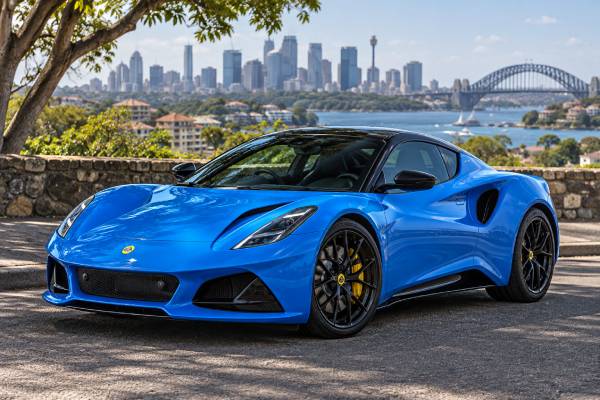
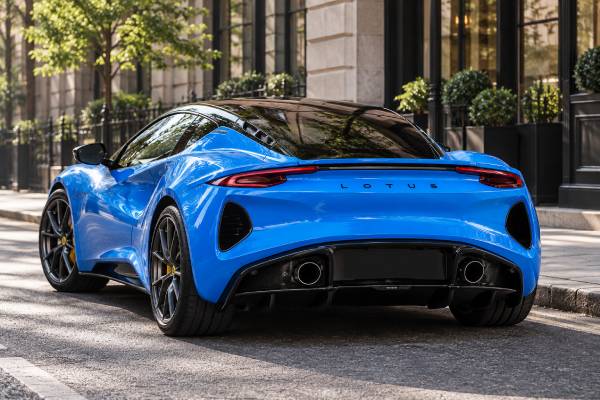
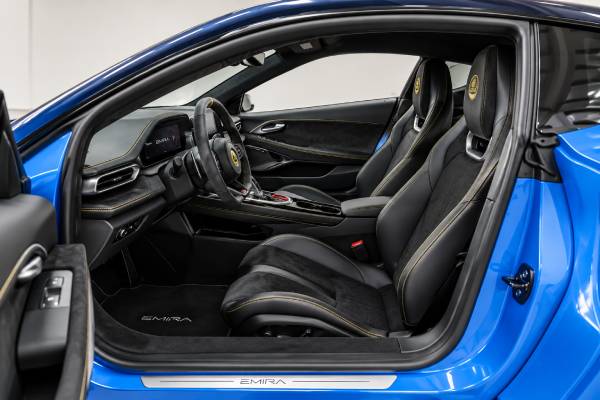
The 2.0-litre Emira First Edition is the version that brought a turbocharged AMG four-cylinder and an eight-speed dual-clutch transmission into a Lotus road car for the first time. Rated at 360 bhp and 430 Nm, it is not a cut-price V6 substitute so much as a different interpretation of the Type 131: quicker shifting, a broader torque plateau, easier stop-start driving, and slightly different mass and sound characteristics, while retaining the Emira’s bonded aluminium structure, hydraulic steering, and double-wishbone suspension. Lotus launched the four-cylinder First Edition in 2023, quoting 0–62 mph in 4.4 seconds and a 171 mph maximum speed. For a buyer today, the important details are the original 360 bhp calibration, the condition and software behavior of the DCT, the suspension and tire specification, correct servicing of a high-output turbo engine, and whether a car remains standard. This guide focuses on the 2023–2024 First Edition as built, rather than mixing its data with the later 400 bhp Turbo SE.
Table of Contents
- What makes the four-cylinder First Edition different
- How the M139-derived engine and DCT work in the Emira
- Technical specifications for the 360 bhp First Edition
- Driving character, suspension, steering, and brakes
- Cabin, luggage, and everyday use
- Service, care, and modification risks
- How to choose a good 2023–2024 example
What makes the four-cylinder First Edition different
The four-cylinder First Edition is the original 360 bhp AMG-powered Emira, sold with an eight-speed DCT and rear-wheel drive. Its identity matters because later Emira Turbo SE models raised the same broad engine architecture to 400 bhp, while the launch V6 First Edition already carried a 400 hp rating.
Lotus did not simply lift a complete Mercedes-AMG powertrain and install it unchanged. The 1,991 cc engine is derived from AMG’s M139 family, but Lotus developed a new intake and exhaust arrangement and applied a bespoke calibration to suit the Emira’s mid-engine packaging and chassis. The DCT also received Lotus-specific shift mapping. The result was a factory rating of 360 bhp at 6,600 rpm and 430 Nm from 3,000 to 5,500 rpm, with a 7,200 rpm maximum engine speed.
This powertrain changes the way an Emira covers ground. The V6 manual asks the driver to work a clutch and physical gear lever; the four-cylinder car can deliver uninterrupted torque through fast automatic shifts or allow paddle control. In urban use, the DCT removes clutch effort. On a fast road, it keeps the turbo engine close to its strongest torque range. On track, launch control and rapid shifts make the car easy to drive consistently.
That convenience does not turn the First Edition into a conventional grand tourer. It still has a low seating position, wide rear tires, hydraulic steering, and a mid-engine balance that responds clearly to throttle and brake inputs. The engine note is less dominant than the supercharged V6’s, but the four-cylinder provides a sharper, more technical powertrain character.
The First Edition badge also matters because early cars were packaged generously. Depending on market, First Edition specification bundled premium trim, larger wheels, upgraded audio, convenience equipment, and driver-focused option packs. Do not assume every country received identical content: imported cars and grey-market examples should be checked against their original order documents.
One persistent mistake is to describe the four-cylinder First Edition as a factory 400 hp model. Lotus’s 2023 launch release is explicit: 360 bhp and 430 Nm. The company later described the Turbo SE’s 400 bhp output as a 40 bhp increase, confirming that the First Edition baseline was 360 bhp. This distinction is especially important when comparing values or evaluating tuned examples.
How the M139-derived engine and DCT work in the Emira
The 2.0-litre Emira’s engineering advantage is its combination of high specific output and a fast dual-clutch gearbox. It delivers strong midrange acceleration without requiring the driver to chase revs constantly, yet Lotus retained the control feel of a traditional sports-car chassis around it.
The engine is an all-aluminium turbocharged inline-four with four valves per cylinder, variable valve timing, a single twin-scroll turbocharger, and both direct and port fuel injection. Lotus’s published technical data specifies 200-bar piezo direct injection together with port injection. Using both systems gives engineers flexibility across cold start, light load, high load, and emissions-control conditions.
A twin-scroll turbo separates exhaust pulse groups before the turbine, helping the turbo respond more quickly than a simple single-scroll layout of similar size. For the driver, the meaningful number is the broad 430 Nm torque plateau from 3,000 to 5,500 rpm. It allows the car to accelerate hard without always dropping several gears.
The eight-speed DCT uses two clutch paths so the next ratio can be prepared while the current one is engaged. During an upshift, one clutch releases as the other engages, reducing the interruption in drive that occurs with a manual gearbox. The transmission can select gears automatically or respond to steering-wheel paddles and the centre selector.
Low-speed behavior deserves realistic expectations. Dual-clutch gearboxes do not creep and slip exactly like torque-converter automatics. When maneuvering on a slope or inching into a garage, the control system must manage clutch engagement. A healthy car should be predictable, but a buyer should test parking-speed operation from cold and hot rather than judging the gearbox only during fast shifts.
Launch control is integrated into the performance strategy. Lotus designed it to maximize available rear-tire traction and coordinate engine torque with the DCT. It is useful for repeatable acceleration but, like repeated hard starts in any high-performance car, it increases thermal and mechanical load. A used car with extensive launch use is not necessarily damaged, but transmission behavior and service history become more important.
The factory’s 360 bhp calibration also creates a clear line between standard and modified cars. The M139 family has substantial tuning headroom in other applications, so aftermarket software is common. That does not mean every tune is equivalent to Lotus’s later 400 bhp Turbo SE calibration. Factory development includes thermal, emissions, gearbox, durability, and drivability validation that a peak dyno number does not capture.
Technical specifications for the 360 bhp First Edition
The 2023–2024 four-cylinder First Edition is a petrol ICE coupe with a mid-mounted 1,991 cc turbo engine, eight-speed DCT, and rear-wheel drive. Lotus published a 360 bhp output, 430 Nm torque, 4.4-second 0–100 km/h time, and 275 km/h top speed for this launch specification.
| Specification | Value |
|---|---|
| Engine family | Mercedes-AMG M139-derived, Lotus-calibrated |
| Displacement | 1,991 cc (2.0 L) |
| Layout | Turbocharged inline-four, mid-mounted transversely |
| Valvetrain | Four valves per cylinder with variable valve timing |
| Induction | Single twin-scroll turbocharger |
| Injection | 200-bar piezo direct injection plus port injection |
| Maximum power | 360 bhp (365 PS / 269 kW) at 6,600 rpm |
| Maximum torque | 430 Nm (317 lb-ft) from 3,000–5,500 rpm |
| Maximum engine speed | 7,200 rpm |
| Transmission | Eight-speed dual-clutch |
| Drive type | Rear-wheel drive |
| Specification | Value |
|---|---|
| 0–100 km/h (0–62 mph) | 4.4 seconds |
| Top speed | 275 km/h (171 mph) |
| WLTP combined CO₂ target | 208 g/km |
| Fuel tank capacity | 52.5 L (13.9 US gal) |
| Factory launch control | Yes |
| Specification | Value |
|---|---|
| Structure | Bonded and extruded aluminium Lotus Sports Car Architecture |
| Front suspension | Double wishbone, coil spring, high-pressure monotube damper |
| Rear suspension | Double wishbone, coil spring, high-pressure monotube damper |
| Steering | Electrohydraulic rack and pinion |
| Front brake discs | 370 × 32 mm |
| Rear brake discs | 350 × 32 mm |
| Calipers | AP Racing four-piston with braided hoses |
| Front tires | 245/35 R20 |
| Rear tires | 295/30 R20 |
| Specification | Value |
|---|---|
| Length | 4,413 mm (173.7 in) |
| Width including mirrors | 2,092 mm (82.4 in) |
| Width with mirrors folded | 1,895 mm (74.6 in) |
| Height | 1,226 mm (48.3 in) |
| Wheelbase | 2,575 mm (101.4 in) |
| Front / rear track | 1,626 / 1,608 mm |
| Drag coefficient | 0.37 in Lotus consolidated technical data |
| DIN weight | 1,446 kg (3,188 lb) in Lotus consolidated technical data |
| Specification | Value |
|---|---|
| Body style | Two-door coupe |
| Seats | 2 |
| Rear luggage compartment | 151 L (5.3 cu ft) |
| Cabin luggage capacity | 208 L (7.3 cu ft) |
Published Emira data has changed as Lotus revised the model range, so preserve the 275 km/h top speed and 360 bhp rating when documenting an original four-cylinder First Edition. The later Turbo SE’s 400 bhp, 480 Nm, and higher maximum speed are not retroactive specifications for 2023–2024 cars.
Driving character, suspension, steering, and brakes
The four-cylinder Emira feels light on its feet not because it is exceptionally light by historic Lotus standards, but because the steering, suspension geometry, and mid-engine balance communicate clearly. Its DCT adds speed and convenience without changing the fundamental chassis architecture shared across the Emira range.
Electrohydraulic steering is central to that character. Many modern sports cars use fully electric assistance, which saves energy and makes driver-assistance integration easier. Lotus chose hydraulic assistance driven by an electric pump, preserving a more direct sense of front-tire load. The wheel is relatively talkative over coarse surfaces, but that feedback helps the driver understand grip approaching a corner.
The Emira was offered with Tour and Sport suspension calibrations. They are passive setups, not adaptive modes. Tour gives the car more compliance on uneven roads and is often the better road choice. Sport controls body motion more tightly and can suit smooth roads or track use. Because the difference is physical, verify the factory build rather than assuming the selected drive mode changes the dampers electronically.
Tire specification has a large effect. The staggered 245/35 R20 front and 295/30 R20 rear sizes put a great deal of rubber on the road. Correct homologated or equivalent high-performance tires, matched by axle and inflated to Lotus’s specified pressure, are essential. Old or mismatched tires can make the steering feel nervous and can overwhelm electronic stability calibration in wet conditions.
The brakes are generous. AP Racing four-piston calipers act on 370 mm front and 350 mm rear discs in Lotus’s technical data. On a road car they should provide strong, progressive stopping power. Track use can heat-cycle pads and discs rapidly, so a pre-purchase inspection should measure rather than visually guess remaining life.
The DCT also changes corner-to-corner rhythm. There is no need to take a hand from the steering wheel or balance a clutch on downshifts. Drivers can use paddles and let the transmission complete shifts quickly, which is useful on a circuit. The trade-off is that some of the manual V6’s mechanical involvement disappears. That is a preference, not an objective flaw.
Cabin, luggage, and everyday use
The four-cylinder First Edition is one of the easiest traditional Lotus sports cars to use every day. It keeps the low, focused seating position but adds modern climate control, infotainment, driver displays, powered comfort features, and a transmission that can handle traffic automatically.
The cabin is wide enough for two adults without the shoulder-to-shoulder feeling of an Elise. A 10.25-inch central display and 12.3-inch driver screen handle infotainment and vehicle information, while Apple CarPlay and Android Auto were part of the Emira’s modern connectivity package. Market equipment varies, but First Edition cars were generally positioned with a rich specification rather than as stripped entry models.
The driving position has enough adjustment for a broad range of users, and the doors open conventionally. Entry is still low, so anyone with mobility concerns should try the car before buying. The wide rear haunches and low nose also require care in parking, making cameras and sensors useful rather than frivolous.
Luggage space is best understood by shape, not just litres. The 151-litre rear compartment sits behind the powertrain and is suited to soft bags. Lotus also publishes 208 litres of cabin luggage capacity. That additional figure includes storage behind the seats and within the cabin rather than a second conventional trunk. A weekend for two is realistic with flexible luggage; hard-shell cases are less accommodating.
Engine and exhaust heat can reach the rear luggage area after hard driving, so electronics, food, medicines, and other temperature-sensitive items are better kept in the cabin. Owners should also avoid packing items where they can interfere with seat travel or restraint systems.
Fuel capacity is 52.5 litres in Lotus technical data. The four-cylinder’s lower consumption compared with the V6 can make touring range more convenient, but real use varies sharply with speed and boost. A turbo engine driven gently and one repeatedly using full power can return very different numbers.
Service, care, and modification risks
The most important maintenance rule for the AMG-powered Emira is to service the car as a Lotus, not as a generic Mercedes-AMG engine installation. The engine family is shared, but cooling, intake, exhaust, software, transmission calibration, packaging, and service documentation are specific to the Emira.
Use the handbook and service schedule that correspond to the VIN and market. Lotus’s owner-support site separates model years and explicitly tells owners to verify the handbook by the 10th VIN character. That matters when a car crosses markets or has been registered later than it was built.
For ownership, prioritize:
- Correct engine oil: use the exact viscosity and approval specified by Lotus for the car. Check level at the stated procedure and interval, and shorten your inspection routine if the car is driven hard.
- Warm-up and cool-down discipline: avoid maximum boost and engine speed before oil and coolant are properly warm. After sustained track or mountain use, give the powertrain an easier period before shutdown rather than stopping immediately after a full-load session.
- Cooling-system condition: inspect for leaks, staining, damaged pipes, low coolant, or recurring temperature messages. Do not ignore a small loss simply because the car still runs normally.
- DCT operation: test low-speed clutch engagement, reverse selection, hot shifts, paddle response, and warning history. Software updates can matter, so a specialist or Lotus retailer should confirm campaign status.
- Brakes and fluid: track use can age brake fluid and friction material much faster than road mileage suggests. Document fluid changes and inspect disc surfaces and pad depth.
- Tires and alignment: wide, low-profile tires are sensitive to pressure and geometry. Uneven inner-edge wear is a reason to measure alignment, not merely replace the tires.
- 12-volt battery: maintain it during storage. Low voltage can trigger multiple warnings and make electronic diagnosis harder than necessary.
Modification deserves extra caution because the engine has obvious tuning potential. A software tune may raise boost and torque, and some owners add intakes, exhausts, or cooling changes. Ask for the exact tuner, calibration file, dyno conditions, hardware list, installation date, and service history. Confirm whether gearbox torque management was altered and whether the car can be returned to stock.
A “400 hp tune” should not be valued as though the car became a factory Turbo SE. Factory output is only one part of that later model’s engineering and homologation. A tuned First Edition remains a modified First Edition, which can affect warranty, emissions compliance, insurance, and resale.
How to choose a good 2023–2024 example
A good four-cylinder First Edition should be identified by its original 360 bhp specification, show clean DCT behavior, have even tire wear and healthy brakes, and come with documentation strong enough to explain its servicing and any modifications. Mileage is useful context, but condition and history are better predictors of ownership cost.
Begin with the paperwork. Confirm VIN, model year, first-registration date, market, original trim, and option packs. Compare the VIN on the car with the registration and service records. If the listing says 400 hp, establish immediately whether that is an error or an aftermarket claim. A seller who cannot explain the difference is not necessarily hiding a fault, but the car needs deeper verification.
Inspect from cold. The engine should start promptly without persistent warning lights or abnormal mechanical noise. Let the car idle while checking climate control, screens, windows, mirrors, seat functions, parking systems, and connectivity. Modern low-volume sports cars can accumulate small electrical issues that are easy to miss during an exciting test drive.
At parking speed, test forward and reverse engagement several times on level ground and a mild slope if safe. The DCT should be controllable rather than jerky or hesitant. Once warm, use both automatic mode and paddles under light and moderate load. Any transmission warning, repeated flare, harsh bang, or refusal to select a gear deserves diagnosis before purchase.
On an open road, the steering should be precise and centred. Listen for suspension knocks and feel for vibration through the wheel or seat. Apply the brakes progressively from different speeds; the pedal should remain consistent and the car should not pull. Check all four wheels for rim damage and all tires for matching specification, date, tread, and sidewall condition.
Underneath, look for damaged aero panels, scrape marks, incorrect jack-point use, and signs of impact. The bonded aluminium chassis makes structural repair quality particularly important. If there is any evidence of a meaningful collision, use a Lotus-experienced body specialist for inspection.
Finally, decide whether the four-cylinder First Edition fits your priorities. Choose it over the V6 if you value fast automated shifts, everyday ease, strong turbo torque, and the distinct character of the AMG-derived powertrain. Choose a later Turbo SE if a factory 400 bhp four-cylinder is important. Choose the V6 manual if clutch-and-lever involvement and supercharged sound matter more than shift speed.
The 360 bhp First Edition is most convincing when judged on its own terms. It combines a modern, high-output turbo engine and DCT with steering and chassis hardware that remain unusually tactile. A standard, well-maintained example does not need an inflated power claim to be desirable; its appeal is the way modern powertrain technology has been placed inside a sports car that still communicates like a Lotus.
One final check is whether the car still feels like a coherent factory package. The four-cylinder Emira uses a different rear subframe arrangement and powertrain installation from the V6, so unexplained fabrication, non-standard mounts, poorly routed hoses, or improvised wiring deserve attention even if the engine itself runs well. On a standard example, the best signs are mundane: factory-like fasteners and clips, no rubbed-through looms, dry connections, even tire wear, and records that make the car’s mileage and servicing easy to follow. Those details are more valuable than an aftermarket parts list when the goal is a dependable First Edition.
References
- Emira: the most powerful four-cylinder Lotus sports car ever 2023 (Press Release)
- Lotus launches new version of the critically acclaimed Emira | Lotus Cars News 2023 (First Edition Launch)
- Models | Lotus Press | Emira 2025 (Technical Data)
- Lotus Emira: the most accomplished Lotus ever made 2021 (Engineering Background)
- Lotus reveals revised Emira line-up | Lotus Cars News 2025 (Later Powertrain Comparison)
- Emira Handbook | Lotus Cars United Kingdom 2026 (Owner’s Handbook Portal)
Disclaimer
This article is for informational purposes and is not a substitute for professional diagnosis, inspection, or repair. Specifications, torque values, service intervals, fluids, software, and procedures vary by VIN, market, model year, and equipment; verify them against the official Lotus service documentation for the specific car. If you found this guide useful, please consider sharing it on Facebook, X/Twitter, or with another Lotus community to support our work.