
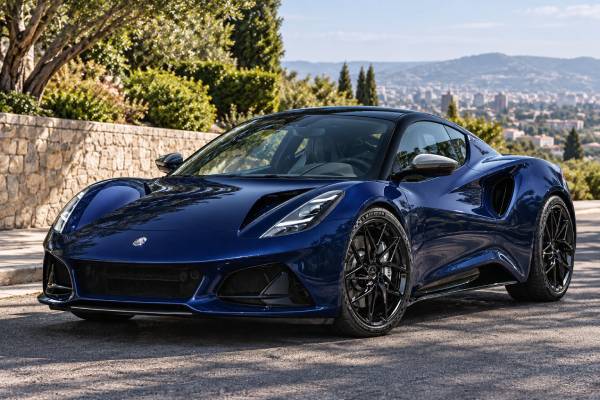
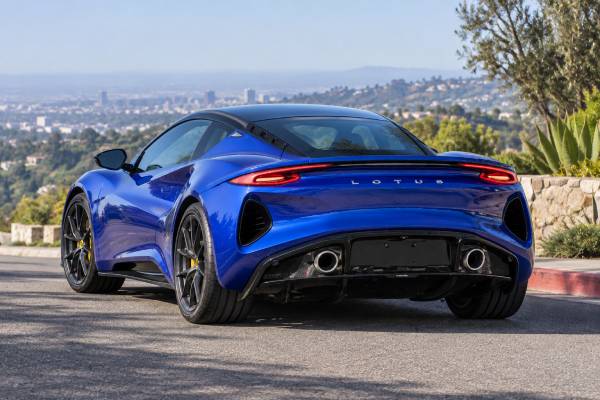
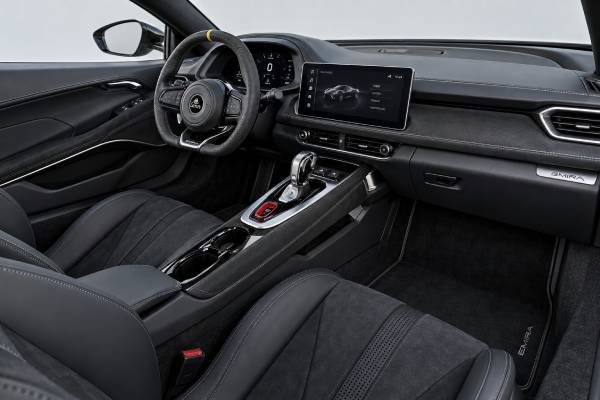
The 2025 Lotus Emira Limited is a 60-car European heritage series built from the 360 bhp four-cylinder Emira and divided into five Formula One-inspired liveries of just 12 cars each. Its mechanical foundation is the AMG-derived 1,991 cc turbo engine, eight-speed dual-clutch transmission, rear-wheel drive, double-wishbone suspension, and hydraulic steering familiar from the four-cylinder Emira, but the reason to seek a Limited is not extra horsepower. The value is in the factory-applied historical themes, tiny production allocation, market restriction, and its role in launching Lotus’s newer bespoke approach. The five designs reference the Type 25, Type 78, Type 86, Type 97T, and Type 99T, connecting the road car to different eras of Lotus innovation rather than repeating one generic racing stripe. That makes originality central to ownership. A good Limited should be evaluated as both a performance car and a numbered heritage object: drivetrain health, DCT behavior, paint and graphics, correct wheels and trim, build documentation, and evidence that its special livery has not been altered or poorly repaired all matter.
Table of Contents
- What the Emira Limited series actually is
- The five Formula One-inspired liveries
- Technical specifications for the 360 bhp Limited
- Turbo engine, DCT, and road behavior
- Originality, production rarity, and provenance
- Maintenance, storage, and livery care
- Buying the right livery and the right car
What the Emira Limited series actually is
The Emira Limited is not one single colour scheme and it is not a higher-output version of the four-cylinder Emira. It is a 60-car collection comprising five separate heritage liveries, with only 12 examples of each design.
Lotus unveiled the series on 12 December 2024 and deliberately built the number 12 into the programme. The cars were launched on the 12th day of the 12th month at 12 p.m., each livery was capped at 12 units, and the series was offered across 12 European countries. Lotus linked that repeated number to Team Lotus racing history and used the project as a bridge into its expanded bespoke work for 2025.
The participating markets were Austria, Belgium, Denmark, France, Germany, Italy, Luxembourg, Norway, Spain, Sweden, Switzerland, and the Netherlands. That geographic restriction matters when evaluating imports. A car registered elsewhere may be entirely legitimate, but a buyer should be able to trace it back to one of the original allocation countries and confirm its factory build.
Underneath the special finishes, Lotus describes the Limited as a four-cylinder Emira with an inline-four turbo engine and eight-speed DCT. For the 360 bhp assignment covered here, the correct mechanical baseline is the original 1,991 cc calibration producing 360 bhp and 430 Nm, not the later 400 bhp Turbo SE tune.
That distinction is easy to miss because the 2025 model range was changing at the same time. Lotus introduced the more powerful Turbo SE as a mainstream production derivative, while the Emira Limited remained a small heritage series focused on design and historical storytelling. A seller who advertises a Limited as “Turbo SE 400 hp” should therefore provide factory paperwork proving that exact specification rather than relying on the model year alone.
The Limited also should not be confused with the later Clark Edition. Both use a production total of 60, but their structures are different. The Limited divides 60 cars across five liveries and uses the four-cylinder DCT platform; the Clark Edition is one 60-car V6 manual theme tied specifically to Jim Clark and the Type 38.
The five Formula One-inspired liveries
Each Limited livery has its own historical reference and visual logic, so the correct buying question is not simply “Which colour do I like?” It is “Which Lotus era and design story do I want the car to represent?”
Type 25 tribute
The Type 25-inspired car reaches back to the early 1960s and Jim Clark’s first Formula One World Championship era. The original Type 25 was revolutionary because of its monocoque construction, replacing the spaceframe thinking common at the time with a structure that made the car exceptionally narrow and efficient around the driver.
Lotus translates that story to the Emira with Dark Verdant Green bodywork and a Hethel Yellow stripe, plus Team Lotus references along the body. The combination is traditional, immediately recognisable, and likely to appeal to buyers who want the most classic Lotus colour identity of the five.
Type 78 tribute
The Type 78 theme represents the ground-effect period. The 1977 Formula One car used shaped underbody tunnels to generate aerodynamic load in a way that changed race-car design. Lotus gives the Emira a darker, more dramatic treatment with grey bodywork, gold striping, and red detailing, including a red front accent that references the original car’s visual character.
The historical appeal here is technical rather than driver-specific: the Type 78 is associated with Lotus pioneering the “wing car” concept that influenced modern race-car aerodynamics.
Type 86 tribute
The Type 86-inspired Limited is the most experimental reference. The original car was a development prototype exploring a twin-chassis concept that later informed the controversial Lotus 88. Its Essex-style blue, red, and silver look is recreated on the Emira with blue bodywork, contrasting striping, silver lower details, race-number references, and period-influenced branding.
Because the Type 86 itself is less widely known than the Type 25 or Senna-era cars, this livery may appeal most strongly to serious Lotus-history enthusiasts rather than casual collectors.
Type 97T tribute
The Type 97T theme connects directly to Ayrton Senna’s first Formula One victory for Lotus in 1985. Lotus uses Shadow Grey with gold stripes, gold wheel details, red brake-caliper accents, a Union Jack element, and number 12 graphics. The combination evokes the famous black-and-gold visual language without simply copying an old race car panel for panel.
For many buyers, the Senna connection will give this version the broadest motorsport recognition. That can influence demand, but condition and provenance still matter more than popularity of the historical reference.
Type 99T tribute
The Type 99T-inspired car is vivid yellow with blue accents and references the 1987 active-suspension Lotus that gave Team Lotus its final Formula One victories. The road car carries the number 12 and visual cues associated with the original car’s yellow-and-blue scheme.
This is arguably the most visually extroverted Limited. It also represents a later technological era than the other liveries, linking the Emira to Lotus experimentation with computer-controlled active suspension rather than only lightweight structure or aerodynamics.
Across all five designs, Lotus says the liveries were applied with bespoke craftsmanship and positions each car as one of only 12. That makes damage repair unusually sensitive. A resprayed panel can be mechanically irrelevant yet materially important to collectability if the stripe placement, colour match, number graphics, or hand-finished details are not recreated to factory standard.
Technical specifications for the 360 bhp Limited
The Emira Limited covered here is a petrol ICE coupe based on the four-cylinder Emira: 1,991 cc turbocharged inline-four, eight-speed dual-clutch transmission, and rear-wheel drive. The correct output for this 360 hp assignment is 360 bhp with 430 Nm, while the underlying chassis retains the Emira’s bonded aluminium architecture and double-wishbone suspension.
| Specification | Value |
|---|---|
| Engine family | Mercedes-AMG M139-derived, Lotus-calibrated |
| Displacement | 1,991 cc (2.0 L) |
| Configuration | Turbocharged inline-four, mid-mounted transversely |
| Induction | Single twin-scroll turbocharger |
| Fuel injection | Direct injection plus port injection |
| Maximum power | 360 bhp (365 PS / 269 kW) |
| Maximum torque | 430 Nm (317 lb-ft) |
| Transmission | Eight-speed dual-clutch |
| Drive type | Rear-wheel drive |
| Specification | Value | Context |
|---|---|---|
| 0–100 km/h (0–62 mph) | 4.4 seconds | 360 bhp four-cylinder Emira baseline |
| Top speed | 275 km/h (171 mph) | 360 bhp four-cylinder Emira baseline |
| WLTP combined CO₂ | 208 g/km | Lotus four-cylinder technical data |
| Fuel tank | 52.5 L (13.9 US gal) | Lotus Emira technical data |
| Launch control | Available within the DCT performance strategy | Four-cylinder Emira architecture |
| Specification | Value |
|---|---|
| Structure | Bonded and extruded aluminium Lotus Sports Car Architecture |
| Front suspension | Double wishbone with coil spring and monotube damper |
| Rear suspension | Double wishbone with coil spring and monotube damper |
| Steering | Electrohydraulic rack and pinion |
| Front brake discs | 370 × 32 mm in Lotus Emira technical data |
| Rear brake discs | 350 × 32 mm in Lotus Emira technical data |
| Calipers | AP Racing four-piston |
| Front tire size | 245/35 R20 |
| Rear tire size | 295/30 R20 |
| Specification | Value |
|---|---|
| Length | 4,413 mm (173.7 in) |
| Width including mirrors | 2,092 mm (82.4 in) |
| Width with mirrors folded | 1,895 mm (74.6 in) |
| Height | 1,226 mm (48.3 in) |
| Wheelbase | 2,575 mm (101.4 in) |
| DIN weight | 1,446 kg (3,188 lb) in Lotus four-cylinder technical data |
| Rear luggage compartment | 151 L (5.3 cu ft) |
| Cabin luggage capacity | 208 L (7.3 cu ft) |
| Item | Factory programme |
|---|---|
| Total production | 60 cars |
| Number of liveries | 5 |
| Cars per livery | 12 |
| Original sales region | 12 specified European countries |
| Historical themes | Type 25, Type 78, Type 86, Type 97T, Type 99T |
| Programme role | Heritage series and early expression of Lotus bespoke customisation |
These tables deliberately separate mechanical specifications from the edition’s production facts. Lotus did not make the Limited special by publishing a new engine output; its distinction is the low-volume livery programme built around the established four-cylinder Emira.
Turbo engine, DCT, and road behavior
The Limited drives like a well-specified 360 bhp four-cylinder Emira, which means strong midrange turbo torque, fast DCT shifts, and a chassis that remains unusually communicative for a modern automatic sports car. The historical livery does not turn it into a delicate showpiece unless the owner chooses to treat it that way.
The 430 Nm torque plateau gives the car useful response in normal road speeds. In automatic mode, the eight-speed gearbox can keep revs low and make the Emira easy in traffic. With the paddles, the gearbox becomes a more active tool, letting the driver hold a gear through a corner and command fast upshifts without removing a hand from the steering wheel.
The steering is more distinctive than the transmission. Lotus retained electrohydraulic assistance instead of the fully electric rack used by many competitors. The result is heavier parking effort but clearer road texture and front-tire loading. On a narrow road, that information helps the driver place the car precisely despite its wide rear haunches.
Double-wishbone suspension at both ends controls wheel movement more precisely than simpler strut layouts. The Emira’s passive damping means tire pressure, alignment, and tire construction have a large effect on ride and response. A Limited that feels nervous or unusually harsh should be checked for geometry and tire issues before anyone blames the chassis design.
The automatic parking brake, cameras or sensors, climate control, infotainment, and powered cabin features make the Emira more practical than older Lotus sports cars. It can be used for touring, but luggage remains split between the rear compartment and cabin storage. Soft bags are a better choice than hard cases, and heat-sensitive items should not be left near the rear powertrain after hard driving.
Because the Limited is collectible, owners may be reluctant to drive it. That can create its own maintenance problems: old tires, stale fuel, battery discharge, brake corrosion, and seals that spend long periods unused. A carefully exercised car with documented servicing can be healthier than a nearly static example.
Originality, production rarity, and provenance
For an Emira Limited, originality is part of the specification. A mechanically perfect car with incorrect stripes, refinished wheels, missing edition badges, or undocumented body repair can be less desirable than a slightly higher-mileage example that remains complete and verifiable.
Begin with factory identity. Ask for the original order confirmation, sales invoice, market allocation, VIN documentation, service book or digital history, and any certificate or edition paperwork supplied with the car. Confirm that the livery on the vehicle matches the build record rather than an owner-applied recreation.
Then record the visual details. Photograph the complete car in neutral light, including both sides, bonnet, roof, rear deck, wheels, brake calipers, badges, race-number elements, and interior trim. Heritage graphics are easier to evaluate when you have a clear baseline rather than relying on memory at resale time.
Limited production can make accident repair disproportionately important. A replacement bumper or door is not necessarily a problem if the repair is documented and finished to factory quality. The risk is a repair that uses approximate colours or graphic placement. Ask for before-and-after photographs and invoices from a Lotus-approved or high-quality specialist bodyshop.
Wheel refinishing is another common issue. Gold, painted, or otherwise livery-specific wheel finishes should match the original specification. Powder coating a damaged wheel in a close but incorrect shade may look acceptable from a distance yet matter to a collector. Keep records of any refurbishment and, where possible, use a specialist familiar with the edition.
Modifications should be reversible. An ECU tune, aftermarket exhaust, lowering springs, non-standard wheels, or carbon add-ons may suit the current owner but weaken the connection between the car and the factory programme. If buying a modified example, insist on the original parts and confirm that no irreversible cutting, drilling, or paint removal was required.
Maintenance, storage, and livery care
Mechanically, the Limited needs the same disciplined care as any high-output four-cylinder Emira; cosmetically, it needs more cautious treatment because its paint and graphics are part of a 12-car livery subset. Both sides of that maintenance equation matter.
Use the correct Lotus handbook and service information for the VIN. Engine oil should meet the exact Lotus requirement, and the level should be checked by the specified procedure. Do not assume an AMG oil recommendation from another vehicle automatically applies, because Lotus controls the installation and service requirements.
The turbo engine benefits from proper temperature management. Avoid full boost before the engine is warm. After sustained high-load driving, reduce the load for a short period before shutting down. Inspect coolant levels and accessible connections regularly and investigate any repeated warning or loss of fluid.
The DCT should be monitored for low-speed smoothness as well as high-speed shift quality. A car stored for long periods should still be driven often enough to reach full operating temperature and exercise the transmission through its range. Confirm software and campaign status with a Lotus specialist.
Battery maintenance is essential for collector storage. Use an approved maintainer and keep the battery healthy rather than repeatedly reviving it from deep discharge. Low voltage can trigger warnings and can create false leads during diagnosis.
For the exterior, wash gently and avoid aggressive polishing across hand-applied graphics or stripe edges. If paint-protection film is installed, document the original finish first and use an installer experienced with layered graphics and unusual edges. Avoid irreversible ceramic-coating or polishing work until you understand how it may affect future repairs to the livery.
Store the car dry and ventilated. Maintain tire pressures and avoid months of weight on one tire position where possible. If the car will be static, consider periodic rolling or appropriate flat-spot prevention. Check brake discs for corrosion before the first spirited drive after storage.
Buying the right livery and the right car
Choose the livery because its history and appearance genuinely appeal to you, then buy the best documented example of that livery. With only 12 cars per design, compromising on provenance in the hope that another identical car will appear quickly can be risky—but rarity should not excuse poor condition.
Start by verifying that the car is a genuine factory Limited and that its mechanical output matches the documented build. The 360 bhp assignment covered here should not be casually described as a 400 bhp Turbo SE. If a seller claims additional power, establish whether the ECU has been modified and ask for the original calibration and hardware.
Run a normal sports-car inspection next. Start from cold, scan for stored faults, test DCT behavior at parking speed and under load, confirm straight steering, inspect suspension noises, measure brake and tire condition, and check the underside for curb or jack damage. The low body and wide wheels make cosmetic underside damage common enough to warrant a lift inspection.
Then perform the collector inspection. Compare the livery with official imagery. Verify badge placement, race numbers, pinstripes, wheel colours, caliper finish, interior details, and any model-specific plaque or documentation. Ask directly about repainting, paint-protection film removal, wheel refinishing, and replacement body panels.
The “best” livery is subjective. Type 25 offers the classic green-and-yellow Lotus image; Type 97T carries a strong Senna connection; Type 99T is vivid and unmistakable; Type 78 speaks to the ground-effect revolution; and Type 86 rewards buyers interested in Lotus’s more experimental engineering history. Future market demand may favor one, but buying solely on speculation is difficult in such a tiny series.
Use the car enough to keep it healthy. A Limited can still serve as a weekend road car, touring car, or occasional track-day machine if maintained properly. The key is to preserve reversibility: save original parts, document servicing, photograph repairs, and resist modifications that permanently erase factory details.
The Emira Limited is compelling because it combines two different kinds of Lotus history. Its chassis and hydraulic steering preserve the company’s road-car dynamic tradition, while its five liveries reach back to decades of Formula One engineering experiments. Treat the 360 bhp powertrain as the reliable mechanical baseline and the livery as irreplaceable factory history, and the car makes sense both as something to drive and something worth preserving.
Because each design was capped at 12 cars, detailed photography is unusually useful. Keep dated images of every side of the body, each wheel, the graphics at panel joins, badges, interior details, underside contact points, and the VIN-linked documents. If a stone chip or damaged stripe later needs repair, those images give a specialist a reference for placement, finish, and condition before work began. They also help a future buyer distinguish careful restoration from undocumented cosmetic alteration.
Track use should be documented rather than hidden. A circuit day does not automatically harm an Emira Limited, but it can accelerate tire, brake-fluid, pad, and alignment wear. Notes showing when consumables were replaced, which geometry settings were used, and when the car returned to road specification are far more reassuring than a low odometer paired with unexplained heat marks or heavily worn outer cosmetics.
References
- Lotus launches exclusive race-inspired Emira Limited series 2024 (Press Release)
- Emira Limited – A Tribute to Formula One Legacy | Lotus Cars 2025 (Official Model Page)
- Lotus Story | Heritage, Innovation & Performance 2026 (Official Heritage Timeline)
- Emira: the most powerful four-cylinder Lotus sports car ever 2023 (Four-Cylinder Technical Data)
- Models | Lotus Press | Emira 2025 (Emira Technical Data)
- Emira Handbook | Lotus Cars United Kingdom 2026 (Owner’s Handbook Portal)
Disclaimer
This article is for informational purposes and is not a substitute for professional diagnosis, inspection, repair, or collector appraisal. Specifications, torque values, service intervals, equipment, and procedures vary by VIN and market; always verify them against official Lotus service documentation and the build record for the specific car. If this guide helped you understand the Emira Limited, please consider sharing it on Facebook, X/Twitter, or with another Lotus community to support our work.