
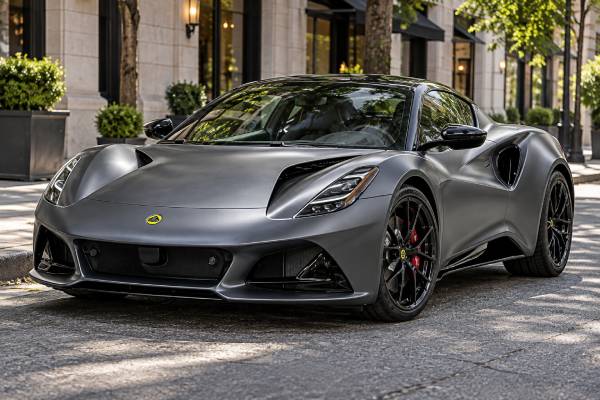
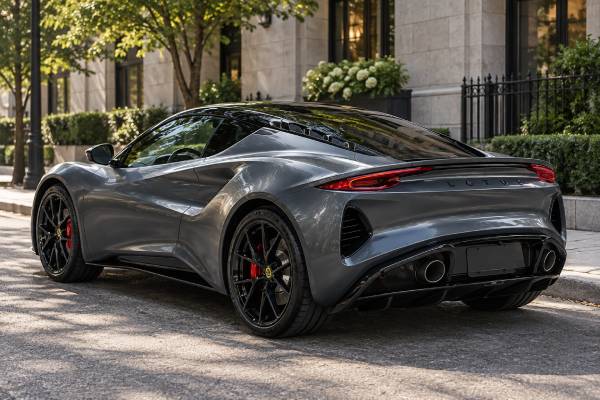
The 2026 Lotus Emira Scura is the rare, darker-edged version of the V6 Emira for drivers who want the analogue hardware turned up rather than replaced by more electronics. Built around the 3.5-litre supercharged V6, a six-speed manual gearbox and rear-wheel drive, the Scura pairs familiar Emira fundamentals with Sport suspension, Michelin Pilot Sport Cup 2 tyres, lightweight forged wheels and a deliberately restrained Satin Nebulous Grey-and-black appearance. In North America it is a limited-run car, which changes the buying equation: condition, originality and documentation matter almost as much as mileage. The important point is that the Scura is not a separate high-output engine tune. Its appeal comes from specification and feel—manual control, aggressive tyre choice, chassis calibration and a tightly defined visual package. That makes it more focused than a typical V6 SE without turning it into a stripped track special, so it can still serve as a weekend road car with modern cabin comfort.
Table of Contents
- What makes the Emira Scura different
- Scura specifications and technical data
- How the manual V6 shapes the driving experience
- Sport suspension, Cup 2 tyres, and real-world use
- Maintenance and ownership priorities
- How to inspect and buy a Scura
- Collector piece or driver’s car?
What makes the Emira Scura different
The Scura is best understood as a factory-curated V6 SE with a stronger road-and-track bias, not as a mechanically unrelated Emira. Its 400 hp supercharged V6 and six-speed manual preserve the basic V6 formula, while the standard Sport suspension, Michelin Pilot Sport Cup 2 tyres and distinctive Scura equipment make the car more specialized from delivery.
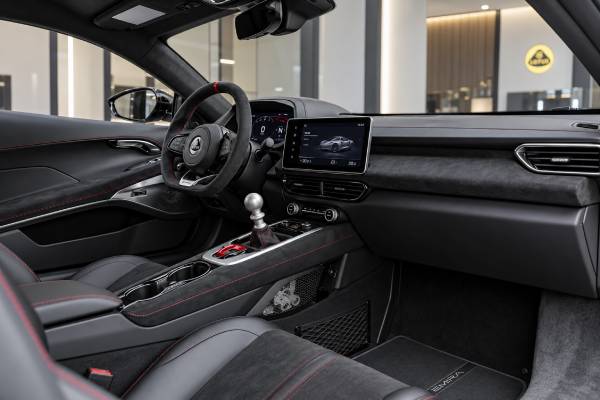
The name revives the spirit of the 2009 Exige Scura, a famously dark, lightweight limited edition. The 2026 Emira interpretation follows the same visual theme without copying the old car literally. Satin Nebulous Grey paint is paired with a Full Exterior Black Pack, gloss-black forged 20-inch V-spoke wheels, red brake callipers, black-and-silver Lotus badges and privacy glass. Inside, black Alcantara with red contrast stitching, red seat belts and a red top-dead-centre marker on the steering wheel give the cabin an intentionally motorsport-influenced look.
For the North American allocation, the Scura is a six-speed-manual car. That matters because the ordinary V6 SE can be found with either the manual or an automatic transmission in some markets. The Scura therefore removes a major decision from the order sheet: it is the version for buyers who specifically want the clutch pedal, exposed mechanical shift linkage feel and a limited-slip differential working with the rear axle.
The Driver’s Pack-style hardware is equally important. Sport suspension uses the firmer of Lotus’s two basic road calibrations, and the Cup 2 tyres trade some cold-weather and wet-road tolerance for sharper dry grip and response. The result is not merely cosmetic. Steering inputs feel more immediate, the chassis settles quickly after direction changes, and the tyre works best when it has temperature in it. Owners who drive in cool, rainy climates should understand that the Scura’s factory tyre specification asks more of the driver than a conventional all-season or wet-biased performance tyre.
Rarity adds another layer. North American cars were promoted as a 60-unit allocation, so two Scura examples with similar mileage can still differ materially in value depending on paint condition, complete factory equipment, service history and whether rare Scura-specific trim has been replaced. A buyer should resist treating the car like a generic used Emira with a paint package. The limited-edition parts and provenance are part of what is being purchased.
Scura specifications and technical data
The Emira Scura is an ICE sports car with a mid-mounted, charge-cooled supercharged 3.5-litre V6 driving the rear wheels through a six-speed manual transaxle. Its core engineering is deliberately traditional by modern standards: no hybrid system, no all-wheel drive, no active steering and no dual-clutch gearbox. Instead, the Scura leans on a bonded aluminium chassis, double-wishbone suspension and electro-hydraulic steering for feel.
| Specification | Value |
|---|---|
| Engine | 3,456 cc Toyota 2GR-FE V6 |
| Induction | Edelbrock 1740 supercharger, charge-cooled |
| Fuel | Gasoline/petrol |
| Maximum power | 400 hp (298 kW) |
| Maximum torque | 420 Nm (310 lb-ft) for the manual V6 specification |
| Engine position | Transverse mid-engine |
| Drive | Rear-wheel drive |
| Specification | Value |
|---|---|
| Transmission | 6-speed manual transaxle |
| Differential | Mechanical limited-slip differential |
| 0–60 mph | About 4.2 seconds in North American Scura listings |
| Top speed | 180 mph (290 km/h class) |
| Layout | Two-seat, mid-engine coupe |
| Specification | Value |
|---|---|
| Chassis | Bonded and extruded aluminium structure |
| Front suspension | Double wishbone, coil spring, high-pressure monotube damper |
| Rear suspension | Double wishbone, coil spring, high-pressure monotube damper |
| Scura suspension specification | Sport calibration |
| Steering | Electro-hydraulic rack and pinion |
| Front brake discs | 370 × 32 mm, AP Racing 4-piston callipers |
| Rear brake discs | 350 × 32 mm, AP Racing 4-piston callipers |
| Specification | Value |
|---|---|
| Wheel design | 20-inch V-spoke ultra-lightweight forged wheels |
| Wheel finish | Gloss black |
| Front tyre size | 245/35 R20 |
| Rear tyre size | 295/30 R20 |
| Scura tyre | Michelin Pilot Sport Cup 2 |
| Specification | Value |
|---|---|
| Length | 4,413 mm (173.7 in) |
| Width including mirrors | 2,092 mm (82.4 in) |
| Width with mirrors folded | 1,895 mm (74.6 in) |
| Height | 1,226 mm (48.3 in) |
| Wheelbase | 2,575 mm (101.4 in) |
| Fuel tank | 52.5 L (13.9 US gal) |
| Rear luggage compartment | 151 L |
| Cabin luggage space | 208 L |
| Area | Factory specification |
|---|---|
| Exterior paint | Satin Nebulous Grey |
| Exterior trim | Full Exterior Black Pack and privacy glass |
| Brake callipers | Red |
| Interior | Black Alcantara with red contrast stitching |
| Steering wheel | Black Alcantara with red top-dead-centre marker and red stitching |
| Seat belts | Red |
| Audio | KEF premium audio |
The numbers explain only part of the car. The bonded aluminium structure is stiff without relying on the mass of a large steel body, while the mid-engine layout keeps major powertrain weight close to the centre of the wheelbase. Hydraulic assistance remains in the steering system, an unusual choice in a modern performance car and one of the reasons the Emira communicates front-tyre load so clearly.
How the manual V6 shapes the driving experience
The Scura’s defining mechanical feature is not a headline power increase; it is the combination of supercharged V6 response and a manual gearbox. For a buyer comparing Emira variants, this creates a very different rhythm from the four-cylinder DCT cars even when the stopwatch numbers are close.
A supercharger is driven mechanically by the engine, so boost response does not depend on exhaust energy building in a turbocharger. In practice, the 3.5-litre V6 feels immediate when the driver squeezes the throttle at low and medium engine speeds. The response becomes stronger and more vocal as revs rise, but it does not have the same sudden torque swell as the AMG-derived turbo four. That makes the Scura easy to meter at corner exit and rewarding when the driver uses the full rev range.
The six-speed transmission reinforces that involvement. The driver chooses the gear, manages clutch take-up and can use engine braking deliberately on corner entry. The visible linkage is part of the theatre, but it is not merely decorative. Shift quality depends on careful alignment, warmed fluids and the condition of the clutch and mounts. A rushed cold shift can feel less polished than a DCT change, yet that mechanical resistance is precisely what many Scura buyers are seeking.
The limited-slip differential is equally important on the manual car. When power is applied through a bend, it helps control the speed difference between the driven rear wheels and gives the driver a more predictable path to traction. It does not eliminate wheelspin or rescue poor throttle technique, especially on cold Cup 2 tyres, but it makes the rear axle feel cooperative rather than electronically remote.
For road use, the V6’s sound and response often matter more than its outright acceleration. The engine sits close behind the occupants, the intake and supercharger are audible, and the manual requires repeated physical inputs. At legal speeds, that can make the Scura feel eventful without needing to chase extreme velocity. On track, the same qualities help a skilled driver build repeatable reference points for braking, downshifts and throttle application.
The trade-off is convenience. In stop-start traffic, the clutch and manual shift demand more effort. On a fast circuit, a DCT can change ratios more quickly and free the driver to focus on braking and steering. The Scura therefore makes the most sense for someone who values participation over minimum lap time.
Sport suspension, Cup 2 tyres, and real-world use
The Scura’s Sport suspension and Michelin Pilot Sport Cup 2 tyres are the changes that most affect how it behaves day to day. They sharpen response on a warm, dry road, but they also create conditions where tyre temperature, weather and surface quality deserve more attention.
Lotus designed the Emira around double wishbones at both ends rather than the simpler strut layouts common in many road cars. Double wishbones give engineers precise control over wheel motion and camber as the suspension compresses. In the Scura, the Sport calibration uses firmer settings than the more road-biased Tour setup. The car therefore takes a quicker set in corners and transmits more information through the seat and steering wheel.
The Cup 2 is a road-legal performance tyre with a strong track bias. In the right conditions it offers high dry grip and crisp steering. In the wrong conditions—especially low temperatures, standing water or near-freezing weather—its advantages shrink quickly. An owner who plans to drive the car through a wet winter should consider a second wheel-and-tyre set chosen for the season rather than assuming the factory tyre is ideal year-round.
Tyre pressure deserves the same discipline. Pressure rises as the tyre heats, particularly during repeated track laps. The useful target is the pressure specified for the exact car and operating condition, not a generic internet number. Start with the vehicle information and handbook, measure pressures cold for road use, and adjust track pressures only with an understanding of how the tyre is heating across the session.
Brakes also need context. The AP Racing four-piston setup and large discs provide substantial capacity, but no road-car brake system is immune to heat. Track use can accelerate pad, disc and fluid wear far beyond ordinary road driving. A sensible track routine includes inspecting pad thickness before the event, checking the discs for cracks or severe heat checking, using fresh fluid of the correct specification, and allowing a cool-down period rather than parking immediately with the brakes extremely hot.
The Scura is still a low sports car. The front splitter, wheel rims and lower bodywork are vulnerable to steep ramps, potholes and kerbs. The satin paint adds another ownership consideration because polishing a local scuff can change the sheen. Cleaning products and repair methods should be compatible with satin finishes; aggressive machine polishing can create a glossy patch that is more obvious than the original defect.
Maintenance and ownership priorities
A Scura should be maintained like a high-performance Emira first and a limited edition second. That means following the VIN-correct Lotus service schedule while adding more frequent inspections when the car sees track days, sustained high temperatures or long storage periods.
The V6 is a known Lotus powertrain, but age and use still matter. Owners should pay attention to fluid levels, coolant condition, belt condition, unusual supercharger noises, oil leaks and changes in idle or throttle response. A clean history is more valuable than a claim that the engine is “bulletproof.” The engine is mid-mounted, so some service tasks are less accessible than on a conventional front-engined car and are best handled by a technician familiar with the platform.
The manual transmission and clutch deserve sympathetic use. Avoid resting a foot on the clutch pedal, do not hold the car on inclines with clutch slip, and let the gearbox warm before forcing quick shifts. A clutch that engages very high, judders, smells after normal driving or slips under full-throttle load needs investigation. Shift quality should be consistent once warm; new resistance, graunching or difficulty selecting a gear is not something to dismiss as character.
Lotus service information has also evolved during Emira production. One manufacturer bulletin added cleaning of wheel-speed sensors and their magnetic hub rings to service schedule sheets because dirt and road debris could affect the signal and trigger warning lights. That is a useful reminder that a modern Emira combines mechanical simplicity in some areas with networked electronic control in others. Warning lamps should be diagnosed, not simply cleared.
For a car that is not driven every week, battery care matters. Use the correct maintainer when the car will sit, keep the battery terminals clean and avoid repeatedly letting the 12-volt system fall deeply discharged. Low voltage can create confusing electronic symptoms that look unrelated to the battery.
A practical owner checklist includes:
- Check engine oil, coolant and brake fluid at the intervals and procedures specified by Lotus.
- Inspect the Cup 2 tyres for pressure, tread depth, shoulder wear, cuts and age before spirited driving.
- Examine the forged wheels for inner-rim bends after pothole strikes.
- Look over the front splitter, undertray and diffuser after contact with ramps or kerbs.
- Treat any brake vibration, fluid leakage or persistent warning light as a diagnosis item rather than a normal quirk.
- Keep records of services, software updates, warranty work and replacement Scura-specific trim.
Because the model is limited, cosmetic preservation has unusual importance. Store the car clean and dry, protect the satin finish from bird droppings and harsh chemicals, and document any repainting honestly. A high-quality repair is preferable to neglected damage, but future buyers will want to know what changed.
How to inspect and buy a Scura
The best Scura purchase is the car with verifiable identity, complete factory specification and evidence of careful use—not automatically the example with the lowest odometer reading. A few thousand well-documented miles can be preferable to a nearly static car with aged tyres, weak battery history or cosmetic neglect.
Start with the VIN and build documentation. Confirm that the car is a genuine Scura allocation and that the listed equipment matches the limited-edition specification. Look for the Satin Nebulous Grey paint, black exterior pack, correct forged V-spoke wheels, red callipers, Cup 2 tyres, Scura badging, Alcantara-and-red interior details, red belts and KEF audio. Factory window stickers, order sheets and dealer invoices are useful because they establish provenance independently of the seller’s description.
Next, inspect the finish in bright, diffuse light. Satin paint can hide or exaggerate defects depending on angle. Look for inconsistent sheen, overspray, masking lines and panels that appear glossier than their neighbours. Check the gloss-black roof and trim separately because swirl marks and scratches show differently there. Examine carbon or special sill pieces for chips and lifting edges.
The wheels and tyres can reveal how the car has been used. Heavy outer-shoulder wear, rubber pickup in the arches and heat-cycled Cup 2s may indicate track use. Track driving is not automatically a negative; the Scura is equipped for it. The problem is track use without matching maintenance. Ask whether brake fluid was changed, pads were inspected, wheel alignment was checked and tyres were replaced based on condition rather than tread depth alone.
On the test drive, begin cold if possible. Listen for abnormal rattles, confirm a stable idle and verify that the clutch takes up smoothly. Shift through every gear at light load, then repeat when warm. Under acceleration, the engine should pull cleanly without warning lights or hesitation. The steering should self-centre naturally and the car should track straight on a level road. Persistent tramlining can be tyre-related, but it can also point to alignment or damage.
Brake from moderate speed with the steering lightly held. Vibration through the pedal or wheel can indicate disc deposits, uneven wear or another braking issue. Check that the parking brake operates correctly. After the drive, look underneath for fresh fluid and smell for overheated clutch or brakes.
Finally, check campaign and recall status by VIN in the market where the car is registered. A model-year search is useful background, but only a VIN check can tell you whether a specific car has an outstanding action. Ask the Lotus retailer to confirm completed software and service campaigns as well.
Collector piece or driver’s car?
The Emira Scura is most convincing when treated as a driver’s car that happens to be collectible, not a collectible that must never be driven. Its value proposition is the interaction among the manual V6, Sport suspension, Cup 2 tyres and limited-edition atmosphere; leaving it permanently under a cover misses most of what makes the specification special.
That does not mean mileage is irrelevant. Limited production tends to make originality and condition more visible in resale comparisons. A buyer who expects to preserve future value should avoid irreversible modifications, retain removed factory parts, keep detailed records and choose any upgrades that can be returned to stock. Paint protection can be worthwhile if installed correctly for a satin surface, and a second wheel set can preserve the original forged wheels during poor weather.
For the driver, the strongest case for the Scura is clarity. There is one engine, one gearbox, one focused suspension-and-tyre direction and a recognizable visual identity. It is not the fastest Emira four-cylinder in a straight line, and it does not have the newer aerodynamic and lightweight hardware of the 420 Sport. Instead, it represents the traditional V6/manual branch of the Emira family in a rare factory combination.
That distinction also helps when cross-shopping. Choose a Turbo or Turbo SE if fast DCT shifts and strong turbocharged mid-range torque are priorities. Choose a 420 Sport if the newest cooling, aero and lightweight options matter most. Choose a regular V6 SE if you want more freedom in colour, suspension or transmission. Choose the Scura when the limited manual-only specification itself is the reason you are shopping.
The practical buying rule is simple: pay for authenticity and condition, not just scarcity. A complete Scura with clean paint, healthy Cup 2s, documented service and no unresolved warning lights is the car that best preserves both sides of its character—the rare-edition appeal and the direct, mechanical driving experience Lotus intended.
References
- Lotus Emira – Reserve Now | Lotus Cars 2026
- Lotus Emira Handbook for Drivers | Lotus Cars 2026 (Owner’s Manual portal)
- Lotus introduces 2026 Emira V6 SE and Emira Turbo 2025
- Lotus Emira: the most accomplished Lotus ever made 2021
- Check for Recalls: Vehicle, Car Seat, Tire, Equipment | NHTSA 2026 (Recall Database)
- The 2026 Lotus Emira Scura Is a Dark Homage to the Exige 2026
Disclaimer
This article is for informational purposes and is not a substitute for professional diagnosis, inspection or repair. Specifications, torque values, service intervals and procedures can vary by VIN, market and equipment, so verify all work against the official Lotus service documentation for the exact vehicle.
If this guide helped you, please consider sharing it on Facebook, X/Twitter or another community where Lotus owners and buyers can use it.