
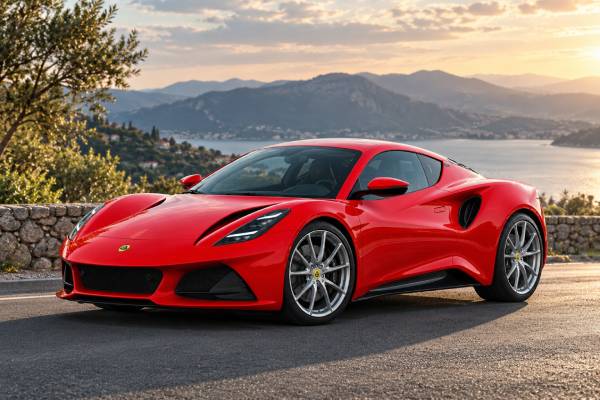
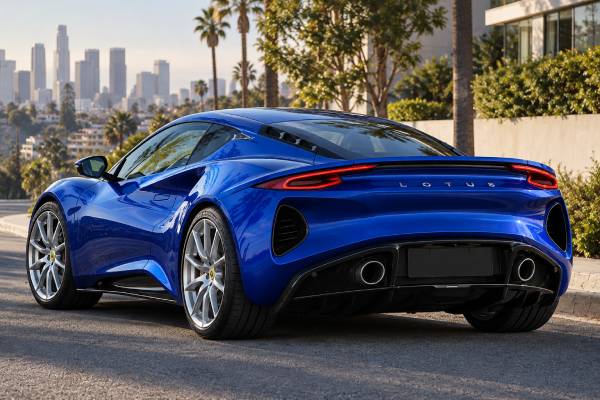
The Lotus Emira Turbo is the 360 hp, four-cylinder route into the Type 131 range, and its strongest argument is not that it imitates the V6. It uses a Lotus-calibrated version of the AMG-sourced M139 2.0-litre turbo engine, an eight-speed dual-clutch transmission and rear-wheel drive to give the Emira a different rhythm: quick shifts, strong mid-range torque and less effort in traffic, while keeping the bonded-aluminium chassis, hydraulic-assisted steering and double-wishbone suspension that define the car. For 2026, Lotus also revised cooling flow and DCT calibration across the four-cylinder range. Buyers should therefore pay attention to model-year specification rather than assuming every 360 hp car is mechanically identical in detail. This guide covers the verified performance figures, chassis and packaging data, the engineering differences that matter on the road, sensible maintenance priorities, and the checks that help separate a well-kept Turbo from one that has simply been driven hard and presented well.
Table of Contents
- Where the 360 hp Turbo fits
- M139 technical specifications
- How the four-cylinder powertrain behaves
- DCT operation and 2026 cooling revisions
- Chassis, cabin, and everyday usability
- Maintenance priorities for the Turbo
- Buying checks and trim choice
Where the 360 hp Turbo fits
The 360 hp Turbo is the least powerful current Emira, but it is not a stripped base model in the traditional sense. It keeps the mid-engined chassis layout and core steering and suspension architecture while using the M139 engine and eight-speed DCT as a more accessible, road-oriented alternative to the 400 hp Turbo SE and the manual-capable V6 SE.
That positioning matters because the four-cylinder Emira has its own character. The engine is a 1,991 cc inline-four with a single twin-scroll turbocharger, direct and port fuel injection, variable valve timing and four valves per cylinder. Lotus lists 360 bhp, or 269 kW, for the Turbo. Earlier factory technical material places peak torque at 430 Nm across a broad 3,000-5,500 rpm plateau, which is one reason the car can feel stronger in ordinary road use than the headline power gap to a 400 hp model suggests.
The transmission is also integral to the specification. Unlike the V6, the Turbo is not a manual-gearbox proposition. Its eight-speed dual-clutch transmission can shift automatically or respond to paddle inputs, and the compact turbo engine and DCT form a package Lotus tuned specifically for the Emira rather than simply installing with donor-car software.
For the 2026 model update, Lotus retained the 360 hp output but changed details around the powertrain. Coolant lines were rerouted to improve flow to the transmission oil cooler and main radiator, the air-conditioning calibration was revised, the thermostat opening temperature was moved from 65°C to 75°C, and the DCT received new calibration intended to improve shift speed and quality. Those changes do not make the earlier Turbo obsolete, but they are material when comparing cars built on different sides of the update.
It is therefore more useful to think of the Turbo as the Emira optimized around a 360 hp DCT powertrain than as a cheaper Turbo SE. The SE adds output and specific performance equipment; the V6 offers a different engine and, critically, a manual option. The Turbo sits between them as the simplest choice for a buyer who wants the Emira chassis with automatic shifting and ample road performance without paying primarily for the highest-output specification.
M139 technical specifications
The verified numbers describe a compact, high-specific-output engine in a relatively traditional lightweight sports-car chassis. The figures below are drawn from Lotus technical and press material for the 360 hp four-cylinder Emira; equipment can still vary by market and production date.
| Item | Lotus Emira Turbo |
|---|---|
| Engine family | M139 |
| Configuration | Turbocharged inline-four petrol |
| Displacement | 1,991 cc / 2.0 L |
| Valve gear | 4 valves per cylinder, variable valve timing |
| Turbocharger | Single twin-scroll |
| Fuel system | Direct injection plus port injection |
| Maximum power | 360 bhp / 269 kW at 6,600 rpm |
| Maximum torque | 430 Nm / 317 lb-ft at 3,000-5,500 rpm |
| Maximum engine speed | 7,200 rpm |
| Item | Specification |
|---|---|
| Driven wheels | Rear-wheel drive |
| Transmission | 8-speed dual-clutch transmission |
| Shift control | Automatic or steering-wheel paddles |
| 0-62 mph / 0-100 km/h | 4.4 seconds |
| Maximum speed | 171 mph / 275 km/h |
| Drive modes | Tour and Sport on current Turbo specification |
| Item | Specification |
|---|---|
| Vehicle architecture | Bonded extruded-aluminium sports-car structure |
| Front suspension | Double wishbone |
| Rear suspension | Double wishbone |
| Steering | Electro-hydraulic power assistance |
| Front brakes | 370 x 32 mm discs |
| Rear brakes | 350 x 32 mm discs |
| Brake calipers | AP Racing four-piston |
| Brake hoses | Braided |
| Measurement | Specification |
|---|---|
| Length | 4,413 mm / 173.7 in |
| Width including mirrors | 2,092 mm / 82.4 in |
| Width with mirrors folded | 1,895 mm / 74.6 in |
| Height | 1,226 mm / 48.3 in |
| Wheelbase | 2,575 mm / 101.4 in |
| Front track | 1,626 mm / 64.0 in |
| Rear track | 1,608 mm / 63.3 in |
| Position | Specification |
|---|---|
| Front wheel diameter | 20 in |
| Rear wheel diameter | 20 in |
| Front tyre size | 245/35 R20 |
| Rear tyre size | 295/30 R20 |
| Factory road-tyre family | Lotus-specific high-performance road tyre specification |
| Item | Specification |
|---|---|
| Seats | 2 |
| Doors | 2 |
| Rear luggage compartment | 151 L / 5.3 cu ft |
| Cabin luggage space | 208 L / 7.3 cu ft |
| Fuel tank | 52.5 L / 13.9 US gal |
These dimensions are useful in ownership planning because the Emira is wider than its low body initially suggests. Garage access and narrow urban parking spaces deserve a real measurement, especially if door opening room is limited. The storage figures are also more meaningful than a single quoted boot volume: luggage can be split between the compartment behind the engine bay and the space behind the seats, which works well for soft bags but requires more planning than a conventional hatchback.
How the four-cylinder powertrain behaves
The Turbo rewards using its mid-range torque rather than chasing the V6’s sound and manual interaction. With 430 Nm available across a broad band and the DCT able to select the next ratio quickly, the car can build speed with fewer dramatic events and less driver workload.
The twin-scroll turbo arrangement helps separate exhaust pulses so the turbine can respond quickly, while combined direct and port injection gives the engine control over fueling across a wide operating range. Lotus also developed its own intake, exhaust, engine calibration and transmission mapping for the application. That matters because the driving experience is not defined only by the AMG origin of the core engine; throttle response, noise, shift strategy and cooling are part of the Lotus installation.
In Tour mode, the sensible use is to let the transmission exploit torque rather than repeatedly forcing lower gears. The car has enough low- and mid-range response for overtaking without living near the 7,200 rpm ceiling. Sport mode and manual paddle control make more sense on a fast road because they keep the engine in the part of the rev range where boost response is immediate and reduce the chance of an unwanted upshift while the car is loaded through a corner.
The trade-off is emotional rather than numerical. A V6 Emira with the manual gearbox asks more of the driver and adds supercharger whine, clutch effort and the exposed shift mechanism to the experience. The Turbo is cleaner and more efficient in how it covers ground. Some owners will see that as less theatrical; others will prefer having both hands available for steering and consistent, repeatable shifts.
Heat is the engineering subject worth understanding. A turbocharged engine, its charge-air system and a DCT can all generate substantial heat when used hard. Lotus’s 2026 coolant-routing and thermostat changes should be read as factory development of thermal management, not as permission to ignore temperatures. After repeated high-load running, especially on a circuit, a cool-down lap and a short period of gentle driving are sensible. Avoid parking immediately after the hardest lap if a slower circulation period is available, and keep radiator inlets free of debris.
Fuel quality also matters on a high-output turbo engine. Use the octane grade specified in the handbook for the market and avoid tuning assumptions based on other M139 applications. Different cars using the same engine family can have different boost targets, exhaust systems, software, thermal limits and transmission torque strategies.
DCT operation and 2026 cooling revisions
A healthy Emira Turbo DCT should engage cleanly, shift consistently and avoid warning messages once fully warm. The 2026 calibration changes are significant because Lotus explicitly targeted faster shifting, better shift quality and smoother engine-transmission interaction rather than changing the gearbox concept itself.
On a test drive, assess the transmission in several conditions. Start with gentle low-speed maneuvering, because clutch-controlled gearboxes reveal poor calibration, adaptation issues or faults most clearly when creeping and reversing. There may be more mechanical sensation than in a torque-converter automatic, but engagement should not feel violently abrupt. Then test steady acceleration, a firm kickdown and manual paddle shifts. The response should remain coherent rather than alternating between hesitation and harshness.
Temperature can expose problems that a five-minute drive misses. If possible, drive long enough for engine and transmission fluids to reach normal operating temperature. Warning messages, repeated refusal to select a gear, pronounced shuddering or a sudden change in shift quality require diagnosis rather than an explanation that the car is “just a DCT.” The car’s electronics are central to gearbox operation, so battery voltage and software status also belong in the diagnostic picture.
For selected 2024 and 2025 four-cylinder Emiras, Lotus issued a service campaign involving transmission-control software. That is not the same as a safety recall, and campaign applicability is VIN-specific. A buyer should ask a Lotus retailer to check the VIN for outstanding campaigns instead of assuming that a model-year label proves the update has been completed.
The 2026 thermal changes deserve the same VIN-and-build-date approach. Lotus rerouted coolant plumbing to improve flow toward the transmission oil cooler and the main radiator, recalibrated air conditioning and raised the thermostat opening temperature. These are identifiable production refinements, but they do not justify retrofitting parts casually. If an earlier car has stable temperatures and no fault, follow the factory service information rather than copying later plumbing from photographs or forum posts.
Coolant condition should be inspected at service intervals, with the correct Lotus-specified fluid and filling procedure. Air trapped in a mid-engined cooling system can create misleading symptoms, and opening a hot pressurized system is dangerous. Persistent coolant smell, unexplained level loss or repeated high-temperature messages need a pressure test and proper diagnosis.
Chassis, cabin, and everyday usability
The Turbo remains an Emira first: its steering, seating position and double-wishbone chassis give it a sense of precision that is not dependent on having the V6. For daily road use, the four-cylinder powertrain can actually make the car easier to live with because the DCT removes clutch work and delivers quick automatic shifts in traffic.
The steering uses electro-hydraulic assistance rather than a fully electric rack. That architecture preserves a hydraulic element in the steering feel while still allowing modern packaging and assistance control. On a good car, the wheel should move naturally off center and communicate surface texture without constant kickback. Excessive steering heaviness, pump noise or an inconsistent assistance level are reasons for inspection.
Ride quality depends heavily on suspension and tyre specification. Lotus has offered Tour and Sport chassis calibrations across the Emira family, and market equipment can differ. Do not infer the dampers from wheel design or seller language alone. Check the build specification. A Tour-oriented car is often the better match for rough roads and regular touring; a firmer setup can sharpen transient response but will not compensate for old or inappropriate tyres.
Tyre condition has an outsized effect on an Emira because the front and rear sizes are wide and the car’s alignment is performance-oriented. Check manufacture dates, tread depth across the full width, sidewall damage and whether all four tyres are an appropriate matched set. Uneven inner-shoulder wear can be easy to miss with the car on the ground. If the steering wheel sits off center or the car pulls, request an alignment printout rather than accepting “they all do that.”
Brakes are powerful enough for the road, with 370 mm front and 350 mm rear discs and four-piston AP Racing calipers. Inspect disc faces and edges for heavy scoring, cracking or a pronounced wear lip. A pulse under braking can come from deposits as well as physical disc distortion, so diagnosis should include runout and pad condition rather than automatically ordering discs.
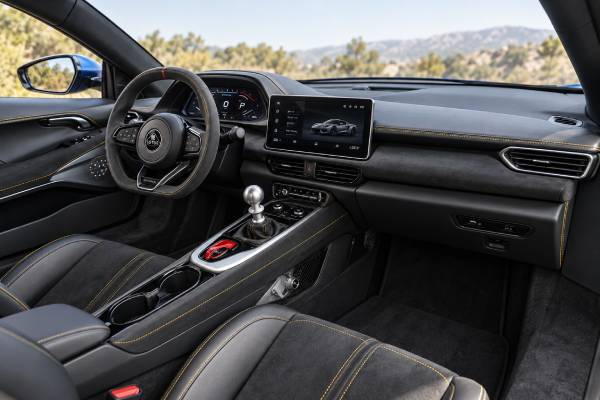
Inside, the Emira is more usable than older Lotus road cars. Current Turbo equipment can include power memory seats, smartphone integration and a conventional infotainment interface. The driving position is still low, so test ingress and egress and make sure seat motors, mirrors, climate control, cameras and phone connectivity work before purchase. Electronic inconveniences are easier to fix before delivery than after a long-distance collection trip.
The luggage layout suits weekend travel if bags are chosen around the car. Soft cases work better than rigid suitcases, and heat-sensitive items should not be placed thoughtlessly near the rear compartment after a long drive. For year-round use, remember that low ride height, wide tyres and rear-drive traction reward restraint in cold or standing-water conditions even if electronic stability systems are present.
Maintenance priorities for the Turbo
The best maintenance strategy is conservative and documentation-led: use the model-year handbook and Lotus service schedule, preserve software campaign records, and inspect tyres, brakes, fluids and cooling hardware before problems become expensive. Generic intervals taken from another M139-powered car are not an acceptable substitute for Emira-specific information.
Engine oil is the first priority on any turbocharged performance car. Use the exact grade and approval specified for the vehicle and market, change it at the required interval, and shorten the practical interval if the car sees frequent track use or repeated short journeys that do not fully warm the oil. A service invoice should identify the lubricant rather than merely say “oil service.”
Cooling-system checks should include hose joints, visible pipes, expansion-tank level and the front radiator area. The Emira’s low nose can collect leaves and road debris. Do not blast fragile heat exchangers at close range with a pressure washer. Bent fins, trapped debris and damaged underbody ducting can reduce airflow even when the coolant itself is fresh.
Transmission servicing must follow the Lotus procedure and fluid specification. A DCT is not a conventional automatic and not a manual gearbox with an easy universal oil-change rule. If there is no evidence of required transmission service, budget for inspection by a workshop familiar with the car rather than using an aftermarket “flush” service by default.
Lotus service information has also highlighted cleaning of wheel-speed sensors and their magnetic rings during routine service because contamination can affect the signal and trigger warnings. That is a useful example of why a specialist checklist matters: a warning light can come from a dirty sensing area rather than a failed major component, but guessing and clearing codes is not a repair.
Battery health is another practical concern. Performance cars that sit for weeks can develop low-voltage behavior that causes a cascade of unrelated warnings. If the car is stored, use the type of maintainer Lotus recommends and verify battery condition with a proper test. Repeatedly jump-starting a weak battery is not good preventive maintenance.
For track use, inspect the car before and after the event. Check tyre pressures cold and hot, tread condition, wheel torque using the official specification, brake-pad thickness, disc condition and fluid age. After the session, look for fluid seepage and inspect the underbody for contact. Do not invent higher wheel torque or different fluid simply because another track car uses it; the official service data remain the reference.
Buying checks and trim choice
Buy the Turbo when you specifically value the 360 hp calibration, DCT convenience and Emira chassis more than the extra output and equipment of the Turbo SE. A careful inspection should concentrate on software/campaign status, cooling and transmission behavior, tyre alignment, braking condition and evidence of accident or underbody damage.
Begin with the VIN. Confirm that the identity on the car matches registration and service documents, then have a Lotus retailer check outstanding recalls and service campaigns. Public recall databases are useful, but dealer systems can contain manufacturer campaigns that are not safety recalls. On a 2025 four-cylinder car, asking specifically about transmission-control updates is reasonable.
Next, examine the body in daylight. Panel fit on a low-volume sports car may not look identical to a mass-produced saloon, but inconsistent paint texture, overspray, fastener marks, cracked composite panels or mismatched protective film can indicate repair. Look underneath the front lip, floor and rear diffuser for impact damage from steep ramps or track kerbs.
Cold-start the engine if the seller allows it. Listen for abnormal knocking, watch for warning lights that remain on, and check for smoke beyond normal condensation. After the drive, look for fresh oil or coolant and confirm that cooling fans operate normally when required. An engine bay that has been aggressively cleaned immediately before inspection deserves more scrutiny, not less.
The choice against a Turbo SE is straightforward on paper. The SE raises output to 400 bhp and 480 Nm and adds performance-oriented equipment including Sport suspension, launch control and uprated two-piece brakes on its defining specification. If those features are important, buying the SE from the outset is usually cleaner than trying to recreate it with aftermarket parts. If they are not, the 360 hp Turbo already delivers the same fundamental platform with performance that is difficult to exploit fully on public roads.
The V6 SE is a more philosophical alternative. Its 3.5-litre supercharged V6 and available six-speed manual provide sound and driver involvement the four-cylinder cannot duplicate. The Turbo counters with a fast DCT, strong torque, a lighter-feeling rear powertrain character and less effort in daily use. Neither is simply “better”; the wrong purchase is the one made for a specification-sheet advantage the owner does not actually value.
A pre-purchase inspection by a Lotus-experienced workshop is especially worthwhile for cars with modifications, track history or incomplete paperwork. ECU tunes, non-standard exhausts, altered suspension and wheel spacers can all change thermal load, alignment and warranty implications. Ask for the original parts and the calibration history if a modified car still interests you.
Finally, compare cars on condition and provenance before options. A stock 360 hp Turbo with correct tyres, smooth DCT behavior, current software, straight alignment and complete service records is a stronger ownership prospect than a cosmetically perfect car with missing history and unresolved warnings. The model’s appeal is the combination of accessible speed and a serious chassis; preserving that combination is more important than chasing a small difference in advertised performance.
References
- Models | Lotus Press | Emira 2026
- Lotus introduces 2026 Emira V6 SE and Emira Turbo 2025
- Lotus Emira – Reserve Now | Lotus Cars 2026
- Lotus Emira: the most accomplished Lotus ever made 2021
- Lotus Emira Handbook for Drivers | Lotus Cars 2026
- Check for Recalls: Vehicle, Car Seat, Tire, Equipment | NHTSA 2026
Disclaimer
This guide is informational and does not replace professional diagnosis, inspection or repair. Specifications, torque settings, maintenance intervals and procedures may differ by VIN, production date, market and installed equipment; confirm them in the official Lotus service information for the exact car before carrying out work.
If you know an Emira owner or buyer who would find this useful, share the guide with them through your preferred social or enthusiast community.