
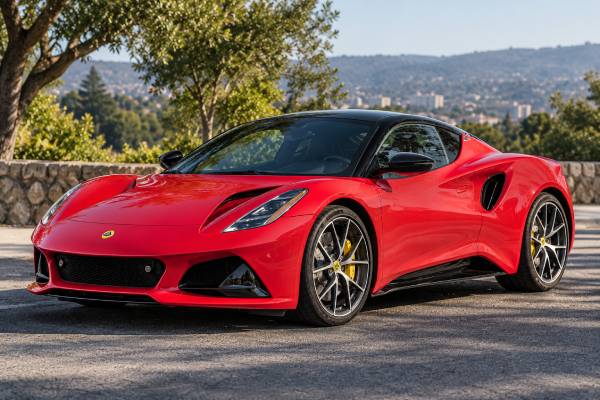
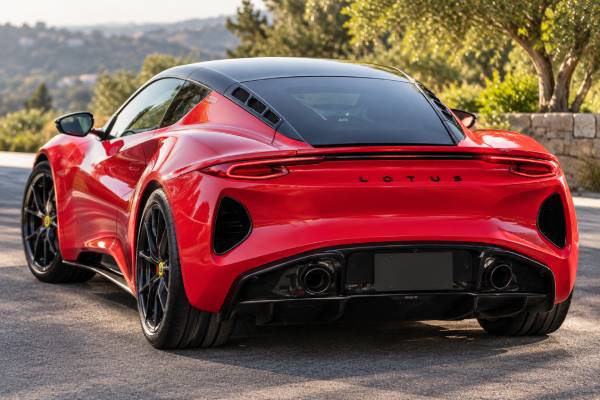
The V6 First Edition is the launch-spec Emira that most directly connects Lotus’s modern Type 131 to the company’s analogue sports-car past. Its 3.5-litre supercharged Toyota 2GR-FE makes 400 hp, sits behind the two-seat cabin, and sends power to the rear wheels through either a six-speed manual or six-speed automatic. More important than the headline output is the way the package is assembled: hydraulic steering assistance, double-wishbone suspension, a bonded aluminium chassis, large AP Racing brakes, and a manual option with an exposed shift mechanism. The First Edition also bundled much of the desirable comfort, technology, and appearance equipment that early Emira buyers otherwise would have selected individually. For 2022–2024 cars, the main buying questions are therefore less about whether the basic formula works and more about gearbox choice, suspension specification, production history, software and campaign completion, tire and brake condition, and evidence that the car has been serviced correctly. This guide focuses on those decisions while keeping factory and market-specific data clearly separated.
Table of Contents
- What defines the V6 First Edition
- Supercharged V6, manual, and automatic behavior
- V6 First Edition specifications and technical data
- Chassis tuning, steering, brakes, and road feel
- First Edition equipment and everyday usability
- Maintenance priorities and ownership checks
- Used-buying guide for 2022–2024 cars
What defines the V6 First Edition
The V6 First Edition was the original range-topping production Emira and the first customer version to pair the new Type 131 chassis with the familiar supercharged 3.5-litre V6. It is the factory 400 hp First Edition, and that distinction is useful because later four-cylinder Emiras also reached 400 bhp under different trim names.
Lotus developed the Emira as a more usable successor to the Elise, Exige, and Evora without abandoning the layout and control feel that made those cars distinctive. The body is a two-door, two-seat coupe, the engine sits transversely behind the occupants, and drive goes to the rear wheels. Under the composite body panels is the Lotus Sports Car Architecture, built around bonded aluminium extrusions rather than a conventional welded steel monocoque.
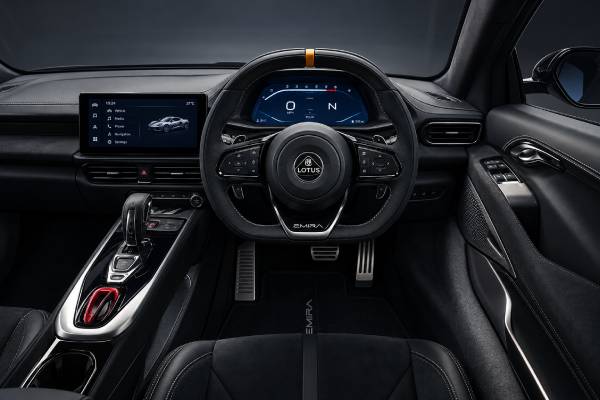
For launch customers, “First Edition” was not just a badge. Lotus packaged a broad equipment list around the V6, including 20-inch forged V-spoke wheels, two-piece brake discs, branded calipers, multiple interior trim choices, climate control, a 10.25-inch central touchscreen, a 12.3-inch driver display, smartphone integration, and a premium KEF audio system in many markets. The exact standard and optional content varies by country, so a build sheet remains more reliable than a generic brochure when checking a specific car.
The First Edition also established the Emira’s two-chassis philosophy. Tour was intended to preserve ride quality on normal roads, while the Sport setup—associated with the Lotus Drivers Pack in relevant markets—used a firmer calibration for drivers who wanted sharper body control. Both remained passive systems rather than adaptive dampers. That is important for buyers: there is no dashboard setting that electronically changes damper stiffness. If two cars feel different, first confirm which physical suspension setup each was built with.
Production timing can also create confusing advertisements. Lotus announced the Emira in 2021, planned initial customer production for 2022, and sold cars into markets on different homologation and delivery schedules. A car may therefore be described by build year, model year, or first-registration year. For parts, warranty, handbook selection, and resale documentation, use the VIN-confirmed model year and original factory specification rather than relying only on the registration date.
Supercharged V6, manual, and automatic behavior
The 2GR-FE-based V6 gives the First Edition its most traditional Emira character: linear response, a mechanical supercharger note, and no turbo lag. The gearbox choice then changes the experience substantially, so it should be treated as a primary buying decision rather than a minor option.
Lotus used the 3,456 cc Toyota V6 with an Edelbrock 1740 supercharger and its own calibration. Factory output is 400 hp (298 kW). Manual cars are rated at 420 Nm, while the automatic is rated at 430 Nm. The published maximum engine speed is 6,800 rpm. This is a durable engine family with a long history in Lotus applications, but the Emira installation, cooling system, exhaust, control software, and service requirements are specific to the car.
The six-speed manual is the emotional choice. It uses a visible mechanical linkage in the centre console and, in the V6 manual specification, a limited-slip differential. The clutch pedal and physical shift action make the driver work more than in the DCT four-cylinder Emira, which is precisely why many buyers seek this version. A good example should shift cleanly, engage gears positively, and show no clutch slip under full load. Because the exposed mechanism is part of the cabin design, looseness or awkward movement is difficult to ignore and should be investigated rather than dismissed as “Lotus character.”
The six-speed automatic is a conventional torque-converter transmission. It suits owners who use the car in traffic or want easier low-speed operation, but its performance figures and maximum speed can differ from the manual depending on market documentation. It should shift smoothly from cold and hot, respond properly to manual commands, and show no transmission warnings. Fluid or software history matters even when the factory schedule does not call for frequent intervention.
Lotus originally quoted 0–60 mph in 4.2 seconds for the launch V6 First Edition and 0–100 km/h in 4.3 seconds for the manual. Top speed was quoted at 180 mph (290 km/h). Later technical sheets sometimes list slightly different acceleration or speed numbers for specific gearbox and homologation combinations. That is not a reason to average them. A buyer should use the data corresponding to the exact model year, transmission, and market.
The supercharged engine also influences how the car should be driven and maintained. Full output is available without waiting for a large turbo to build boost, but repeated high-load running still creates substantial heat. Oil level, cooling-system condition, clean intake plumbing, and sensible warm-up are especially important on cars that see track days. The V6 may have a reputation for robustness, but a mid-engine sports-car installation can make neglect expensive.
V6 First Edition specifications and technical data
The V6 First Edition is a petrol ICE sports car with a mid-mounted supercharged V6, rear-wheel drive, and a choice of six-speed manual or six-speed automatic. Its defining numbers are 400 hp, 3,456 cc, and a 4.3-second factory 0–100 km/h figure for the manual, supported by a chassis that uses double wishbones and hydraulic steering rather than adaptive or steer-by-wire systems.
| Specification | Value |
|---|---|
| Engine code | Toyota 2GR-FE, Lotus installation |
| Configuration | 3,456 cc V6 petrol |
| Induction | Edelbrock 1740 supercharger |
| Maximum power | 400 hp (298 kW) |
| Maximum torque, manual | 420 Nm (310 lb-ft) |
| Maximum torque, automatic | 430 Nm (317 lb-ft) |
| Maximum engine speed | 6,800 rpm |
| Transmission | Six-speed manual or six-speed automatic |
| Drive type | Rear-wheel drive |
| Manual differential | Limited-slip differential |
| Specification | Value | Condition |
|---|---|---|
| 0–60 mph | 4.2 seconds | Launch V6 First Edition figure |
| 0–100 km/h | 4.3 seconds | Manual, launch specification |
| Top speed | 290 km/h (180 mph) | Launch specification |
| WLTP combined fuel consumption | 11.3 L/100 km (25.0 mpg UK) | Launch V6 First Edition figure |
| WLTP combined CO₂ | 258 g/km | Launch V6 First Edition figure |
| Fuel tank capacity | 52.5 L (13.9 US gal) | Later Lotus technical data for V6 |
| Specification | Value |
|---|---|
| Front suspension | Double wishbone, coil springs, high-pressure monotube dampers |
| Rear suspension | Double wishbone, coil springs, high-pressure monotube dampers |
| Steering | Electrohydraulic rack and pinion |
| Front brake discs | 370 × 32 mm |
| Rear brake discs | 350 × 32 mm |
| Calipers | AP Racing four-piston with braided hoses |
| Front tire size | 245/35 R20 |
| Rear tire size | 295/30 R20 |
| First Edition wheels | 20-inch forged V-spoke alloy wheels |
| Specification | Value |
|---|---|
| Body style | Two-door, two-seat coupe |
| Length | 4,413 mm (173.7 in) |
| Width including mirrors | 2,092 mm (82.4 in) |
| Width with mirrors folded | 1,895 mm (74.6 in) |
| Height | 1,226 mm (48.3 in) |
| Wheelbase | 2,575 mm (101.4 in) |
| Front / rear track | 1,626 / 1,608 mm |
| Drag coefficient | 0.349 in the original V6 First Edition launch specification |
| Specification | Value | Notes |
|---|---|---|
| DIN weight | 1,446 kg (3,188 lb) | Later Lotus V6 technical data; exact vehicle weight depends on specification |
| Rear luggage compartment | 151 L (5.3 cu ft) | Behind engine bay |
| Cabin luggage space | 208 L (7.3 cu ft) | Storage behind seats and cabin areas |
| Seating | 2 | Single row |
The differing drag-coefficient and performance values found in Lotus material across the Emira’s life are a reminder to avoid blending documents from different years. The 0.349 Cd figure belongs to the original V6 First Edition technical release; later consolidated technical sheets have used 0.37 for current Emira data. For an early car, preserve the historical specification rather than silently replacing it with the newest sheet.
Chassis tuning, steering, brakes, and road feel
The V6 First Edition’s strongest technical argument is not its 400 hp output but the way its controls communicate. Hydraulic steering assistance, passive dampers, a wide track, and double wishbones at both ends make the car feel deliberately mechanical compared with many electronically filtered rivals.
The steering is electrohydraulic: an electric pump provides hydraulic assistance to a conventional rack. That gives Lotus more freedom to tune assistance while retaining hydraulic feedback. At parking speed it is heavier than many modern electric systems, and on rough roads it sends more information through the wheel. Buyers who expect isolated grand-tourer steering may find that busy; buyers coming from an Elise, Evora, or other analogue sports car usually regard it as a major reason to choose the Emira.
Tour and Sport suspension settings are fixed hardware calibrations. Tour is the better choice for broken public roads and long-distance use because it allows more compliance. Sport tightens body control and makes most sense on smoother roads or circuits. Neither turns the Emira into a soft car, and both depend heavily on tire choice, tire pressure, alignment, and wheel condition. Before judging a used car’s ride, verify that it is on the correct 20-inch tire sizes and that pressures match the handbook.
The brakes are substantial for the car’s mass. First Edition specification included performance-oriented hardware, and Lotus’s technical data lists 370 mm front and 350 mm rear discs with four-piston AP Racing calipers. Pedal feel should be firm and repeatable. A car that has been tracked may still stop strongly while hiding heat-cycled pads, cracked or deeply lipped discs, cooked fluid, or discolored calipers. Visual inspection and service receipts are therefore more useful than one short road test.
Alignment is another high-value check. A mid-engine car with wide, low-profile tires can feel nervous or dull when toe and camber are wrong. Uneven inner-edge wear, a steering wheel that sits off-centre, or a tendency to follow road camber excessively can indicate alignment drift, curb contact, bent wheels, or suspension damage. Because the steering is naturally communicative, faults can sometimes be mistaken for “feedback.” A correct car should be alive without feeling unstable.
First Edition equipment and everyday usability
The First Edition is unusually well equipped by traditional Lotus standards, which is one reason it works as a regular-use sports car rather than only a weekend toy. The compromises are still those of a low, wide, mid-engine two-seater: access, visibility, tire cost, cargo shape, and cabin storage require realistic expectations.
The driving position is a highlight. The wheel, pedals, and seat place the driver low but not in the extreme crouch of an Elise. The digital instrument display and central touchscreen bring modern navigation and media functions, while physical controls remain available for key cabin tasks. Smartphone integration reduces the need to rely on the native interface for every function.
Cargo capacity is split rather than provided as one large trunk. Lotus publishes 151 litres for the rear luggage compartment and 208 litres of cabin luggage capacity in later technical data. Those figures do not mean the car accepts 359 litres of normal suitcases in the way a hatchback does. Soft bags work better because the storage areas are shallow and irregular. Heat near the rear compartment also makes it sensible to keep temperature-sensitive items in the cabin.
The cabin is much more refined than earlier Lotus interiors, but a used-car inspection should still test every switch and powered feature. Check seat movement and memory functions where fitted, climate control, parking sensors or cameras, window indexing, mirrors, infotainment, phone pairing, USB ports, warning lamps, and all driver-assistance functions fitted to that market. A weak 12-volt battery can cause multiple unrelated electronic warnings, so battery health should be confirmed before assuming a module failure.
Low ground clearance and a long painted nose also demand care. Inspect the front splitter, undertrays, wheel rims, and lower side surfaces for curb or ramp damage. A cosmetically perfect upper body does not guarantee the underside has been treated gently.
Maintenance priorities and ownership checks
A strong V6 First Edition ownership record is built around correct fluids, temperature management, brake and tire condition, and prompt attention to software or campaign work. The engine family is proven, but the complete Emira is a low-volume performance car whose service history should be judged more carefully than mileage alone.
Use the VIN to select the correct Lotus handbook and service information. Lotus explicitly separates Emira handbooks by model-year group. Specifications and procedures can vary by market, transmission, and production revision, so generic 2GR-FE service data from a Toyota application is not an acceptable substitute.
For routine care, focus on these areas:
- Engine oil and filter: keep to the exact Lotus specification and service interval for the VIN. Check the level regularly, especially before long high-speed trips or track events. A performance engine that has covered few miles can still need time-based servicing.
- Cooling system: inspect coolant level only as directed by the handbook, look for residue around joints and tanks, and investigate any temperature warning immediately. Mid-engine plumbing is long and air or leaks in the system can create expensive consequences.
- Supercharger drive and intake: listen for abnormal bearing or belt noises, inspect accessible hoses and clamps, and look for non-factory pulley or intake modifications. Increased boost changes the risk profile even when the car feels healthy.
- Manual clutch and linkage: check engagement point, slip under high load, shift quality when cold, and unwanted noises on overrun. A clutch job on a mid-engine car is not a trivial expense.
- Automatic transmission: confirm smooth engagement from Park, consistent shifts, no warning messages, and evidence that relevant software updates have been completed.
- Brake fluid and friction parts: time-based fluid replacement matters on cars driven hard. Measure pad thickness and disc condition instead of assuming low mileage means low wear.
- Tires: inspect date codes, sidewalls, tread across the full width, and matching axle pairs. Old high-performance tires can have deep tread yet offer poor grip.
- 12-volt battery: maintain charge when the car is stored and test a suspect battery early. Voltage instability can complicate diagnosis of otherwise minor electronic issues.
Cars used on circuit deserve a separate conversation with the owner. Ask about track frequency, session length, tire and pad changes, fluid upgrades, alignment settings, and any off-track incidents. Track use is not automatically bad—these cars are designed to be enjoyed—but undocumented track abuse should affect price and inspection depth.
Used-buying guide for 2022–2024 cars
Buy the best documented V6 First Edition you can find, then choose manual versus automatic and Tour versus Sport according to how you will actually use the car. Colour and options matter to resale, but accident history, service quality, tires, brakes, and unresolved warning issues matter more.
Start with identity. Confirm VIN, model year, transmission, factory suspension specification, original market, and First Edition equipment from primary paperwork. Compare the VIN across the windshield, registration documents, service records, and any finance or history report available in your country. Because international deliveries stretched over time, do not assume a 2024 registration makes the car mechanically different from an earlier build.
Then inspect the chassis and body. Look along panel gaps in consistent light, check paint depth if possible, and examine the underside for damage. The bonded aluminium structure should make poor collision repair a serious concern. Ask for invoices for any bodywork and, after a meaningful impact, seek a specialist inspection rather than relying on a visual check alone.
On a road test, begin from cold. Listen for unusual start-up noise, watch for warning messages, confirm steady idle, and test the climate system before the engine bay is fully heat-soaked. In a manual, work through every gear at low and moderate load, then check clutch holding power once temperatures are normal. In an automatic, test gentle and brisk shifts as well as manual requests. Steering should remain precise without clunks, brake pedal response should be consistent, and the car should track straight on a level road.
Check consumables before negotiating. A full set of correct 20-inch performance tires, large brake discs, and quality pads can represent a substantial immediate cost. The same applies to wheel damage. On a car priced near the top of the market, tired consumables should not be excused merely because the paint and interior look excellent.
Finally, consider why you want the V6 First Edition specifically. It is the most compelling early Emira for drivers who value the supercharged engine, manual gearbox, exposed shift mechanism, and launch-edition specification. Buyers who prioritize faster automated shifts and lower fuel consumption may prefer the AMG four-cylinder. Buyers mainly seeking a newer factory warranty or revised equipment should compare later V6 derivatives. The First Edition earns its premium when its original specification, condition, and history are intact—not simply because it was first.
A properly sorted example is a rare combination in the modern market: exotic proportions, a naturally responsive supercharged engine, hydraulic steering feel, and enough cabin refinement for real travel. That blend is what deserves to be protected during the buying process. Verify the car carefully, budget for performance-car consumables, and the V6 First Edition can deliver the analogue sensations enthusiasts want without demanding the compromises of Lotus’s earlier, more spartan models.
References
- Lotus confirms full specification and price of all-new Emira V6 First Edition – Lotus Cars Media Site 2021 (Press Release)
- Lotus Emira: the most accomplished Lotus ever made 2021 (Model Launch)
- Models | Lotus Press | Emira 2025 (Technical Data)
- Emira Handbook | Lotus Cars United Kingdom 2026 (Owner’s Handbook Portal)
- Emira: the most powerful four-cylinder Lotus sports car ever 2023 (Powertrain Comparison)
- Lotus introduces 2026 Emira V6 SE and Emira Turbo 2025 (Later V6 Technical Context)
Disclaimer
This article is for informational purposes and is not a substitute for professional diagnosis, inspection, or repair. Specifications, torque values, service intervals, fluids, software, and procedures vary by VIN, market, model year, transmission, and equipment; verify all work against the official Lotus service documentation for the exact vehicle. If this guide is useful, please consider sharing it on Facebook, X/Twitter, or with another Lotus community to support our work.