
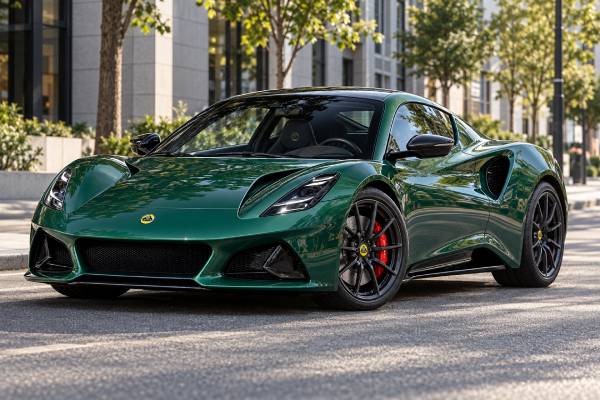
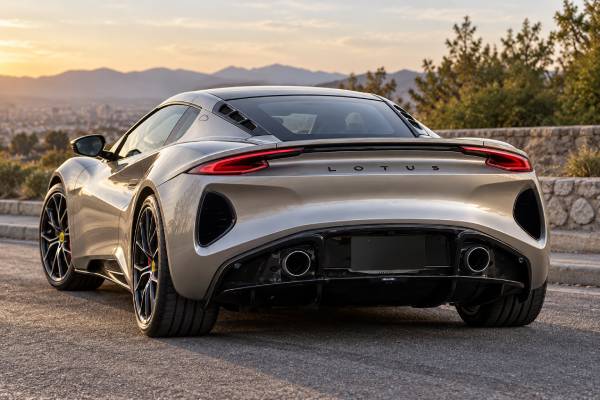
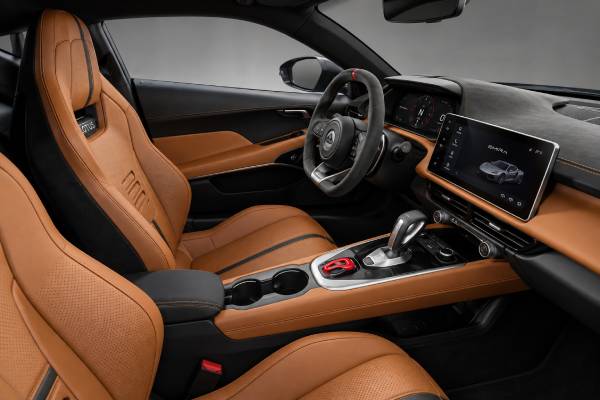
The 2025 Lotus Emira V6 is the point where the supercharged Type 131 stopped being defined mainly by its First Edition launch specification and became a regular model in the revised Emira range. It keeps the ingredients that give the V6 Emira its distinctive character: a mid-mounted 3.5-litre Toyota 2GR-FE with an Edelbrock supercharger, 400 hp, rear-wheel drive, hydraulic steering assistance, and a choice of six-speed manual or automatic transmission. For the 2025 range reset, Lotus paired the V6 with Touring suspension, Goodyear Eagle F1 SuperSport tires, cross-drilled and ventilated two-piece brakes, and a limited-slip differential on manual cars. That combination makes this version especially relevant to buyers who want the traditional V6 experience without paying primarily for a numbered or heritage-themed special edition. The important details are specification timing, gearbox choice, chassis condition, service evidence, tire age and wear, brake condition, software or campaign history, and proof that a used car actually matches the 2025 configuration advertised.
Table of Contents
- What Defines the 2025 Emira V6
- V6 Character and Gearbox Choice
- 2025 Emira V6 Technical Specifications
- Touring Chassis and Road Behavior
- Equipment and 2025 Range Positioning
- Maintenance and Long-Term Care
- Used-Buying and Inspection Priorities
What Defines the 2025 Emira V6
The key fact is simple: the 2025 Emira V6 is the regular-production successor to the V6 First Edition, not a new engine generation. Lotus announced the revised line-up in March 2025, with the Emira V6 and the more powerful four-cylinder Turbo SE replacing the previous First Editions.
That distinction matters because used listings can blur launch cars, later V6 cars, and special editions into one group. Mechanically, the 2025 V6 still uses the 3,456 cc supercharged Toyota-derived engine that established the Emira at launch. The manual remains the more mechanically interactive choice and includes a limited-slip differential in the 2025 specification. A six-speed automatic remains available for drivers who prefer two-pedal operation.
The 2025 model also has a defined road-oriented chassis specification. Lotus listed Touring suspension and Goodyear Eagle F1 SuperSport tires, rather than making the buyer choose the First Edition’s earlier Tour-versus-Sport chassis combinations. Cross-drilled and ventilated two-piece brake discs are part of the performance package. In other words, this is not a stripped entry V6. It is a deliberate road specification built around the same 400 hp engine but positioned after the initial launch-edition phase.
A buyer should therefore identify a car by its build and model-year documentation, VIN, gearbox, original equipment, and market specification rather than by a dealer’s abbreviated description. “V6,” “V6 First Edition,” “V6 SE,” and “Clark Edition” are not interchangeable names. The Clark Edition is a 60-car 2025 special based on the V6, while the V6 SE arrived as part of the subsequent 2026-model-year update. Those cars may share the basic 3.5-litre engine architecture, yet their equipment, collectability, pricing, and production context differ.
For an owner, the post-First-Edition positioning is useful. It puts attention back on the qualities that matter every time the car is driven: steering feedback, brake modulation, gearbox behavior, engine response, ride quality, tire condition, and the integrity of the bonded-aluminium sports-car platform. For a shopper, it also creates a cleaner comparison against earlier First Editions. A well-kept earlier car can still be an excellent purchase, but the 2025 V6 should be valued for its own specification rather than treated automatically as either superior or inferior because it is newer.
V6 Character and Gearbox Choice
The 3.5-litre V6 is the defining reason to choose this Emira over the four-cylinder model. It delivers 400 hp through a supercharger rather than a turbocharger, and its response, sound, transmission choices, and rear-wheel-drive layout create a different experience from the AMG-powered DCT car.
The 2GR-FE began as a Toyota engine family, but the Emira installation is a Lotus application with an Edelbrock 1740 supercharger and calibration developed for the mid-engined sports car. The engine sits behind the cabin, concentrating major powertrain mass within the wheelbase. Forced induction gives it the required output without changing the basic V6 layout, while the mechanical supercharger produces boost in a way that avoids the distinct boost-building sensation associated with many turbo engines.
The six-speed manual is the enthusiast-focused configuration. The driver works a visible linkage mechanism, and Lotus specified a limited-slip differential for the manual 2025 V6. That differential is particularly useful when power is applied out of slower corners because it can distribute drive across the rear axle mechanically rather than relying only on brake-based intervention. The combination does not mean the car should be provoked on public roads; it means the driveline has hardware intended to make rear-axle traction more predictable and engaging when the surface and conditions allow.
The six-speed automatic changes the rhythm of the car. It trades the manual’s clutch pedal and exposed shift action for easier low-speed operation and paddle-selected gears when desired. Earlier official V6 specifications listed 420 Nm for the manual and 430 Nm for the automatic, illustrating that the calibrations are not identical even though both use the same 400 hp engine family. When comparing used cars, judge the transmissions by condition and suitability, not by the assumption that one is universally “better.”
A manual inspection should include clutch take-up, shift quality from cold and hot, reverse engagement, driveline noises, and evidence of abuse. A high bite point alone is not enough to diagnose a worn clutch, but inconsistent engagement, slipping under load, or a poor service history deserves investigation. On an automatic car, check smooth take-up, clean shifts in normal and more assertive driving, correct response to paddle commands, and any warning messages. Diagnostic scanning and a specialist road test are more valuable than internet guesses about a symptom.
Inspect the engine from genuinely cold. Persistent abnormal noise, warning lamps, unstable running, visible leaks, cooling concerns, or poorly documented modifications all justify deeper diagnosis before purchase.
| Specification | Value |
|---|---|
| Engine | Toyota 2GR-FE, Lotus application |
| Configuration | 3,456 cc supercharged V6 petrol |
| Induction | Edelbrock 1740 supercharger |
| Maximum power | 400 hp (298 kW) |
| Maximum torque | 420 Nm (310 lb-ft) manual; 430 Nm (317 lb-ft) automatic, as published for the V6 powertrain |
| Transmission | 6-speed manual or optional 6-speed automatic |
| Driven wheels | Rear-wheel drive |
| Manual-car differential | Limited-slip differential |
2025 Emira V6 Technical Specifications
The 2025 V6 is an internal-combustion, mid-engine, two-seat sports car with no hybrid traction system. Its important numbers are the 3,456 cc supercharged V6, 400 hp output, six-speed transmission choices, approximately 4.3-second 0–100 km/h capability for the V6 specification, and a top speed around 290 km/h (180 mph).
Published Emira data can differ slightly by document date and market, so the safest approach is to use a 2025 vehicle’s VIN-specific documentation for final confirmation. Historical V6 First Edition specifications remain useful for the unchanged engine’s detailed output and basic performance data, while Lotus’s March 2025 announcement establishes the actual equipment and market positioning of the regular 2025 Emira V6.
| Specification | Published value or condition |
|---|---|
| 0–100 km/h (0–62 mph) | About 4.3 seconds for the V6 specification |
| Top speed | 290 km/h (180 mph) |
| Maximum engine speed | 6,800 rpm in Lotus’s published V6 First Edition specification |
| WLTP combined fuel consumption | 11.311 L/100 km (about 25.0 mpg UK) in Lotus’s March 2025 V6 data |
| WLTP combined CO2 | 258 g/km in Lotus’s March 2025 V6 data |
| Specification | 2025 V6 configuration |
|---|---|
| Chassis construction | Bonded extruded-aluminium Lotus Sports Car Architecture |
| Suspension layout | Double wishbones |
| 2025 suspension tune | Touring |
| Steering | Electro-hydraulic power assistance |
| Brake type | Cross-drilled, ventilated two-piece discs |
| Front brake discs | 370 × 32 mm |
| Rear brake discs | 350 × 32 mm |
| Calipers | AP Racing four-piston, with braided hoses in published Emira specification |
| 2025 road tire | Goodyear Eagle F1 SuperSport |
| Front tire size | 245/35 R20 |
| Rear tire size | 295/30 R20 |
| Specification | Value |
|---|---|
| Body style | 2-door, 2-seat mid-engine coupe |
| Length | 4,412–4,413 mm (173.7 in), depending on published data set |
| Width, mirrors folded | 1,895 mm (74.6 in) |
| Height | 1,225–1,226 mm (48.2 in), depending on published data set |
| Wheelbase | 2,575 mm (101.4 in) |
| Front track | 1,626 mm (64.0 in) |
| Rear track | 1,608 mm (63.3 in) |
| Specification | Value |
|---|---|
| Fuel-tank capacity | 52.5 L (13.9 US gal) |
| Rear luggage compartment | 151 L (5.3 cu ft) |
| Cabin storage behind seats | 208 L (7.3 cu ft) |
| Wheel diameter | 20 in front and rear |
| Seating | 2 occupants |
The small variations in published dimensions are a reminder not to mix specifications casually. A one-millimetre difference between documents is not meaningful to ownership, but a different gearbox, chassis tune, tire specification, brake package, or market homologation can be. For parts ordering and workshop work, use the VIN rather than assuming every 2025 Emira shares every component.
Touring Chassis and Road Behavior
The 2025 V6 is deliberately road-biased without being soft in the conventional grand-touring sense. Touring suspension, wide Goodyear tires, double wishbones, hydraulic steering assistance, and large two-piece brakes aim to preserve precision while making the car usable on normal roads.
Lotus’s bonded aluminium architecture is central to that behavior. The chassis is formed from bonded extrusions rather than a conventional stamped-steel unibody, continuing a construction philosophy Lotus has used since the Elise. The Emira itself is larger, more comfortable, and more fully equipped than an Elise, but the structural concept supports the same priority: accurate wheel control and low mass relative to the performance available.
Double-wishbone suspension is used at both ends. That gives engineers useful control over wheel geometry as the suspension moves, which is particularly important on a sports car with wide, low-profile tires. The 2025 Touring calibration is intended for road use, so buyers should not assume it is an inferior setup simply because “Sport” sounds more aggressive. On uneven public roads, compliance can help the tires maintain contact and can make the steering easier to read.
The electro-hydraulic steering is another unusual choice in a modern car. An electric motor drives the hydraulic system rather than the engine driving a conventional hydraulic pump continuously. The reason enthusiasts care is feel: the Emira retains hydraulic assistance at a time when most new sports cars use fully electric power steering. Good steering feel, however, depends on the entire front axle. Tire pressure, tire type, alignment, worn joints, wheel damage, and previous impact repairs can all alter what the driver feels.
That makes a test drive more diagnostic than a brief acceleration run. On a reasonably smooth, straight road the steering should sit naturally around center without a persistent pull. The wheel should return cleanly after a corner. Vibrations that change with road speed deserve investigation for wheel balance, tire damage, flat spotting, or bent rims. A car that tramlines excessively may have tire wear or alignment issues even if the seller describes the behavior as “normal for a Lotus.”
The brakes need similar attention. Two-piece discs can reduce unsprung mass and handle heat well, but they are performance components and can be expensive to renew. Inspect rotor surfaces, lips, cracks or abnormal heat marks, pad depth, and the condition around the bells and fasteners according to the service procedure. A light surface film after storage is different from structural damage. During a road test, the pedal should remain consistent, and the car should brake straight without steering shake.
Tires are not just consumables on this chassis; they are part of its calibration. The 2025 V6 was specified with Goodyear Eagle F1 SuperSport tires. Check all four for correct size, matching specification, manufacturing age, sidewall damage, repair history, tread depth, and uneven wear. Replacing only one tire on an axle or fitting a generic alternative may be cheaper, but it can change wet behavior, steering response, and balance. For a road-focused 2025 car, a complete, correct tire set is a meaningful sign of careful ownership.
Equipment and 2025 Range Positioning
The 2025 V6 should be understood as a range model with a defined performance specification, not as a continuation of the First Edition badge. Lotus retained the core V6 formula while simplifying how the car sat beside the four-cylinder Turbo SE.
At launch, the V6 First Edition bundled several packs and premium items. By March 2025, Lotus described the regular V6 around its mechanical specification: 400 bhp, manual or optional automatic transmission, two-piece drilled and ventilated discs, Goodyear Eagle F1 SuperSport tires, Touring suspension, and a manual-car limited-slip differential. Lotus also called out black technical fabric for the headliner, A-pillars, and cantrails, plus new model branding.
That creates an important buying trap. A used-car advertisement may compare a 2025 V6 with an earlier First Edition using only engine output and assume the cars are equipment-identical. They are not necessarily so. Market packages, trim, infotainment features, seat specification, exterior packs, wheel finish, driver-assistance content, and optional equipment should be checked car by car.
The March 2025 European list pricing also helps explain positioning. Lotus published the V6 above the Turbo SE in price even though the Turbo SE’s four-cylinder made the same headline 400 bhp and was quicker to 100 km/h on paper. The V6 proposition was therefore not based on winning a spreadsheet comparison. Its value was the six-cylinder engine, transmission choice, steering and chassis character, and the particular mechanical experience expected by traditional Lotus buyers.
That remains the right way to compare them used. Choose a Turbo SE if its DCT response, turbocharged torque, and faster quoted acceleration better fit your priorities. Choose the V6 if the engine note, manual option, clutch-and-shifter interaction, or supercharged delivery are central to why you want an Emira. Buying the V6 solely because it was the more expensive version when new misses the point.
The 2025 car also sits in a narrow historical window. Lotus announced the Clark Edition in May 2025, using the V6 as its base, and then announced the V6 SE for the 2026 model year in June. The V6 SE kept the 400 hp engine but brought further refinements, including a revised manual-gearbox compression mount and broader cooling changes across the range. Consequently, a seller calling a regular 2025 V6 a “V6 SE” because it was registered late in the year should be asked for model-year and build documentation.
For collectors, the ordinary 2025 V6 is unlikely to derive its appeal from scarcity in the same way as a numbered Clark Edition. That can be an advantage for an owner who wants to drive the car. Condition, originality, color and option desirability, manual versus automatic transmission, service history, and provenance should usually matter more than speculative claims that every V6 Emira will become a collectible.
Maintenance and Long-Term Care
A 2025 Emira V6 should be maintained from its VIN-specific Lotus schedule, not from a generic 2GR-FE service chart. The engine family has Toyota roots, but the supercharger installation, mid-engine packaging, cooling system, gearbox options, brakes, chassis hardware, electronics, and service procedures are specific to the Lotus application.
The first ownership habit is documentation. Keep invoices that identify the date, mileage, fluid specifications, filters and parts fitted, software work, warranty repairs, and any campaign actions. A simple stamped book is useful, but itemized records are stronger evidence when the car is sold. If a dealer or specialist performs work, ask that the VIN and exact odometer reading appear on the invoice.
Engine oil deserves special discipline because this is a high-performance, supercharged engine in a tightly packaged mid-engine bay. Use only the grade and specification required by the official documentation for the VIN and market. Do not choose oil solely because another Toyota 2GR-FE application uses it. Check the level using the procedure in the handbook, and investigate repeated loss rather than continuously topping up without finding the cause.
Cooling-system condition is equally important. The Emira has long coolant runs and a performance-oriented installation, so warning messages, unusual temperature behavior, coolant odor, staining, or repeated level changes should not be dismissed. Never open a pressurized hot system. If a car has had cooling work, look for proper records and evidence of correct bleeding procedures rather than assuming the absence of an immediate warning light proves the repair was successful.
Transmission care depends on configuration. A manual car adds clutch operation, shift linkage, gearbox oil requirements, and the limited-slip differential to the ownership picture. An automatic car has its own fluid and control requirements. Do not transfer intervals or fluid specifications from the other gearbox. If shift behavior changes, diagnose the cause before authorizing parts based only on symptoms described online.
Brake and tire inspections should be frequent even when annual mileage is low. Performance cars often age by time and storage conditions as much as by distance. Tires can harden or develop flat spots while retaining legal tread depth. Brake discs can corrode when a car is put away wet. Battery voltage can fall during long storage and create confusing electrical symptoms on the next start. A suitable maintenance charger can be sensible for an infrequently used car, provided it is connected exactly as the handbook directs.
Used-Buying and Inspection Priorities
The best 2025 Emira V6 is the car whose identity, history, condition, and behavior all agree. A low odometer reading cannot compensate for accident repairs, missing service records, tired tires, brake neglect, warning messages, or unclear specification.
Start before viewing the car. Ask for the VIN, registration date, build or model-year information, transmission type, original sales invoice if available, service invoices, warranty history, and a list of modifications. Confirm that the description says regular Emira V6 rather than First Edition, Clark Edition, or later V6 SE unless the documents support that name. Photographs of option labels, wheels, tires, interior trim, and the engine bay can reveal discrepancies before a trip.
At the car, inspect it cold and in good light. Panel gaps and paint finish should be consistent with the car’s construction and repair history. Look low down because the Emira’s shape makes the nose, underbody edges, wheels, and rear diffuser easy places to collect road damage. A paint-depth gauge can be useful on compatible panels, but it should support—not replace—visual inspection and repair documentation.
Inside, test every control rather than admiring the cabin for five minutes. Check both keys, windows, mirrors, seat adjustment and memories where fitted, climate control, infotainment, cameras and parking aids, instrument display, warning lamps, drive modes, lighting, USB or charging functions, and audio. Electronic faults can be intermittent, so a clean start-up after the seller has already warmed or reset the car is less informative than an undisturbed cold inspection.
Then evaluate the mechanical systems in sequence:
- Cold start: Confirm no warning lights remain unexpectedly, idle settles correctly, and no obvious leak or abnormal noise develops.
- Low-speed controls: Assess clutch, steering, brake pedal, parking brake, gearbox engagement, and driveline smoothness before driving hard.
- Normal road behavior: Check straight-line tracking, steering centering, ride quality, wheel balance, brake response, and cabin noises over different surfaces.
- Operating temperature: Reassess shift quality, cooling behavior, idle, clutch action, and warning messages once the drivetrain is warm.
- Post-drive inspection: Look and smell for fresh fluid loss, overheated brakes, coolant odor, or other changes that were absent before the drive.
On a manual car, the limited-slip differential and clutch make previous use especially relevant. Repeated track starts, clutch abuse, or inappropriate tires can impose wear even at low mileage. That does not make a tracked car automatically bad; a car used on circuit with excellent maintenance can be a better purchase than a neglected road-only example. The problem is undocumented hard use combined with deferred maintenance.
On either gearbox, request a professional pre-purchase inspection if the purchase value justifies it—and on an Emira V6 it usually does. A Lotus-experienced technician can put the car on a lift, inspect suspension and underbody areas hidden at ground level, measure brake wear, look for leaks, check diagnostic faults and readiness data where appropriate, and compare software or campaign status with the VIN. The aim is not to find a flawless car. It is to understand exactly what you are buying and budget accurately.
Price should be the final step, not the first. Adjust your offer for consumables and defects with real replacement costs: four correct tires, performance brake components, scheduled service, paint or wheel repair, missing keys, or overdue rectification can quickly outweigh a small advertised discount. Conversely, a documented car with fresh correct tires, healthy brakes, complete servicing, original parts, and no unresolved faults can justify paying more than the cheapest listing.
The 2025 V6 is particularly appealing when the objective is driving rather than collecting a launch badge. Its regular-model status, Touring chassis, road tire choice, manual-LSD option, and unchanged 400 hp supercharged engine form a coherent package. Buy on evidence, choose the gearbox that fits how you will actually use the car, and preserve the factory specification unless you have a clear reason to change it.
References
- Lotus reveals revised Emira line-up | Lotus Cars News 2025
- Lotus confirms full specification and price of all-new Emira V6 First Edition – Lotus Cars Media Site 2021
- Lotus Emira: the most accomplished Lotus ever made 2021
- Emira Handbook | Lotus Cars United Kingdom 2026 (Owner’s Handbook Portal)
- Lotus honours racing driver Jim Clark with Emira Clark Edition 2025
- Lotus introduces 2026 Emira V6 SE and Emira Turbo 2025
Disclaimer
This article is for informational purposes and is not a substitute for professional diagnosis, inspection, or repair. Specifications, torque values, service intervals, fluids, software, and procedures vary by VIN, market, model year, transmission, and equipment; verify all work against the official Lotus service documentation for the exact vehicle. If this guide is useful, please consider sharing it on Facebook, X/Twitter, or with another Lotus community to support our work.