
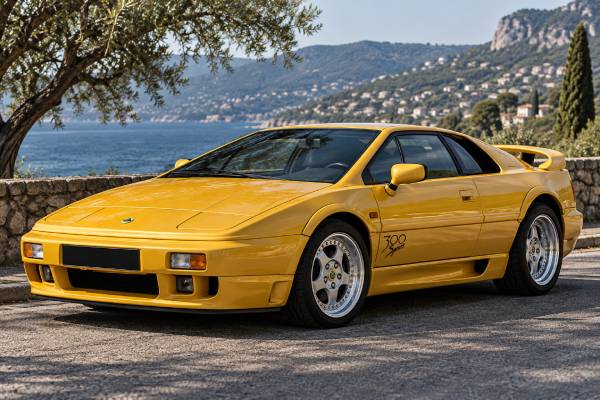
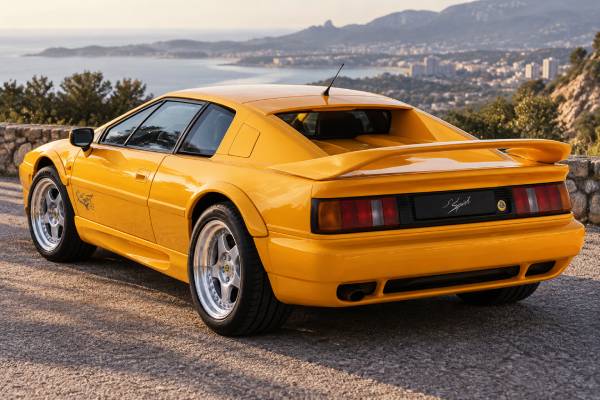
The Lotus Esprit Sport 300 is the four-cylinder Esprit at its most uncompromising: a road-legal derivative of the X180R competition programme with 300 bhp, wider tyres, serious AP Racing brakes and a chassis prepared for harder use. Lotus built only 64 examples, making specification accuracy and provenance especially important today. The model is often grouped casually with the contemporary S4, but its body, suspension, driveline hardware and cabin details were deliberately altered around a much more focused brief. This guide covers the Sport 300 as represented across the 1993–1995 assignment span, while distinguishing period production dates from later registration or market references. It explains the Type 910S engine, hybrid turbocharger, chargecooling, Renault five-speed transaxle, limited-slip differential and unusual wheel-and-tyre package, then turns those facts into practical inspection priorities. Because published weight and performance figures vary by source and test method, conflicting numbers are identified rather than blended into a false single specification.
Table of Contents
- From X180R racer to Sport 300 road car
- Lotus Esprit Sport 300 specifications
- Engine, chargecooling and driveline hardware
- Chassis, brakes and the extreme tyre package
- What makes the Sport 300 drive differently
- Inspection, authentication and costly weak points
- Ownership, parts strategy and preservation
From X180R racer to Sport 300 road car
The Sport 300 was not simply an Esprit SE with more boost and a body kit. Lotus described it as a lightweight, ultra-high-performance road derivative of the X180R racer, and much of its appeal comes from how directly that competition programme shaped the road car.
The X180R had given Lotus practical experience in North American sports-car racing, where sustained braking, tyre load, chassis stiffness and heat management mattered far more than a short road demonstration. The Sport 300 translated that experience into a usable European road car rather than reproducing a race car literally. It retained road equipment and a civilised enough cabin, but Lotus provided competition-oriented seats, mounting provisions for a roll cage and harnesses, a stronger braking package and chassis changes that made the car unusually track-ready for an early-1990s exotic.
The production story needs care because period announcements, planned quantities and retrospective records do not all use the same date conventions. Lotus now states that 64 Sport 300s were hand-built between 1992 and 1995, while enthusiast production references commonly describe the customer production run as 1993–1994. Those statements can coexist: concept, build, model-year, sale and registration dates are not necessarily identical. For this article, 1993–1995 is retained as the requested coverage, but a particular car should be dated from its VIN, factory record and registration documents rather than from a generic web listing.
The body immediately signals that this was a different proposition. Enlarged wheel housings and extensions covered the much wider wheel-and-tyre set, the nose incorporated brake-cooling ducts, and a distinct rear aerofoil completed the visual package. Underneath, Lotus reinforced the chassis and provided an engine-bay brace. The changes were functional: the car had to carry much greater tyre grip and braking capability than the regular Esprit without losing the delicacy that defined the platform.
Rarity also changes the buying equation. A modified SE or S4 can imitate part of the Sport 300 look, but visual similarity does not reproduce the model-specific chassis, brake, wheel, trim and identification details. On a car this scarce, authentication should happen before negotiation, not after purchase.
Lotus Esprit Sport 300 specifications
The core Sport 300 specification combines the 2,174 cc Type 910S four-cylinder engine with a hybrid turbocharger, electronic multi-point fuel injection and chargecooling. Period figures cluster around 300 bhp, with some road-test material quoting 302 bhp; those are presentation and test-source differences rather than evidence of a separate production engine.
| Item | Sport 300 specification |
|---|---|
| Engine | Lotus Type 910S, all-alloy inline four |
| Displacement | 2,174 cc (2.2 L) |
| Valvetrain | DOHC, 16 valves |
| Bore × stroke | 95.3 × 76.2 mm (3.75 × 3.00 in) |
| Compression ratio | 8.0:1 |
| Induction | Hybrid Garrett T3/T4 turbocharger with chargecooler |
| Fuel system | Electronic multi-point fuel injection |
| Rated output | 300 bhp at about 6,500 rpm; some period tests quote 302 bhp |
| Peak torque | 287 lb-ft (389 Nm) at about 4,400 rpm |
Lotus enlarged and reworked the engine’s breathing rather than relying on boost alone. Factory-derived specifications list larger inlet valves and ports, revised engine management, increased fuel pressure and a hybrid T3/T4 turbocharger. Extra chargecooler capacity helped control intake temperature when the engine was being used hard. That combination matters when assessing a modified car: replacing an original component with a superficially similar aftermarket part can alter boost response, fuelling or thermal margin even if peak dynamometer power looks healthy.
| Item | Specification |
|---|---|
| Layout | Mid-engine, rear-wheel drive |
| Transmission | 5-speed manual Renault transaxle |
| Final drive | 3.89:1 quoted in period road-test data |
| Differential | Lotus limited-slip differential |
| Clutch | Uprated clutch cover and flywheel specification |
| Shift hardware | Sport-oriented linkage/quick-shift specification in factory-derived descriptions |
The limited-slip differential is a defining functional item because it helps the rear tyres deploy torque under acceleration rather than leaving the chassis to manage an open differential. Its presence and behaviour should be checked during authentication and road testing. A noisy, binding or incorrectly set differential is not a charming competition trait; it is a reason for specialist investigation.
| Measure | Period figure |
|---|---|
| 0–60 mph | 4.7 seconds |
| 0–100 mph | 11.7 seconds |
| Standing quarter-mile | 13.4 seconds in the cited period Autocar test |
| Top speed | Period sources range from about 161 to 168 mph (259–270 km/h) |
| Length | About 4,391 mm (172.9 in) in the cited road test |
| Width | About 1,900 mm (74.8 in) in the cited road test |
| Height | About 1,175 mm (46.3 in) in the cited road test |
| Wheelbase | About 2,438 mm (96.0 in) in the cited road test |
Published kerb or test weights vary substantially. Lotus publicity emphasised that the body was roughly 250 lb lighter than an Esprit SE, while period and later specification sources use different complete-car figures. Rather than declare one universal weight, use the factory build specification and an actual scale measurement if vehicle mass is important for competition, transport or registration purposes. The same caution applies to top speed: gearing, test conditions and publication method explain why period figures do not all match.
Engine, chargecooling and driveline hardware
The Sport 300’s Type 910S works as a system: turbocharger, chargecooler, fuel delivery, ignition control, cooling and exhaust condition all determine whether the engine safely makes its intended output. A car that “feels fast” is not proof that those systems are healthy.
Start with the chargecooler circuit. The chargecooler lowers the temperature of compressed intake air before it reaches the engine, increasing density and reducing the tendency to detonate. On an ageing Esprit, poor pump performance, restricted coolant flow, leaks or air in the circuit can leave the chargecooler warm when it should be removing heat. The result may be reduced performance, greater knock sensitivity or an engine-management response that masks a fault by pulling back from ideal operation. A specialist familiar with four-cylinder chargecooled Esprits can check circulation and temperature behaviour instead of judging the system by appearance.
Turbo condition deserves equal attention. Listen for unusual contact noises, inspect accessible intake plumbing for excessive oil contamination and look for evidence that boost control has been altered. Historic manual boost controllers, non-standard wastegate settings and improvised hose routing are especially relevant because an apparently small increase in boost can push an old fuel or cooling system beyond its margin. Originality and mechanical safety point in the same direction here: understand what is fitted before asking the engine for full load.
Fuel pressure and injector condition matter because the Sport 300 specification used altered fuelling to support its output. Long storage can be as troublesome as high mileage. Deposits, stale fuel, perished hoses or a tired pump may not reveal themselves at idle but can become critical under sustained boost. Any smell of raw fuel, dampness around hose unions or uncertainty about the age of flexible fuel lines should be addressed before enthusiastic driving.
The engine itself benefits from the same disciplined approach. Verify oil pressure behaviour, inspect for coolant contamination or unexplained coolant loss, note smoke after overrun or boost, and establish when timing-belt-related service was last completed. Service history carries more weight than a fresh-looking engine bay. A thick file showing specialist work, parts used and recurring observations is more useful than a recent cosmetic detail.
The Renault-based five-speed transaxle was well established in later four-cylinder Esprits, but the Sport 300 asks more of it. Full-throttle shifts and aggressive launches place high loads through the clutch, shafts, mounts and differential. Test every gear from cold and warm. Synchro reluctance, a gear lever that jumps under load, rumbling that changes with throttle or a clutch that slips as boost rises are all more significant than a slightly deliberate shift feel. Correct lubricant specification and linkage condition can influence shift quality, so diagnosis should precede assumptions about an internal rebuild.
Do not use drag-style standing starts to prove a prospective purchase. The car’s rarity and driveline value make that unnecessary. A progressive road test in a safe, legal setting can reveal boost delivery, clutch holding power and gearbox behaviour without shocking the transmission.
Chassis, brakes and the extreme tyre package
The Sport 300’s chassis specification is central to the model, not decorative supporting detail. Lotus strengthened the platform, revised springs and dampers, fitted large ventilated brakes with AP Racing four-piston calipers and gave the car one of the widest rear tyre packages ever used on an Esprit.
| Item | Sport 300 specification |
|---|---|
| Front suspension | Double wishbones, coil springs and anti-roll bar; Sport 300 spring/damper tune |
| Rear suspension | Transverse links/trailing-arm arrangement with coil springs and anti-roll bar; revised tune |
| Front brakes | Ventilated discs, about 327 mm in a period road test, AP Racing 4-piston calipers |
| Rear brakes | Ventilated discs, about 280 mm in a period road test, AP Racing calipers with separate parking-brake provision |
| ABS | Reprogrammed anti-lock braking system |
| Front wheels | OZ 3-piece, 8.5 × 16 in |
| Rear wheels | OZ 3-piece, 10.5 × 17 in |
| Front tyres | 245/45 ZR16 |
| Rear tyres | 315/35 ZR17 |
That rear tyre size is a practical ownership issue in the modern world. Correct-size, correct-speed-rating tyres may not be available from every mainstream range at every moment. Before buying a car, establish what is currently fitted, the date codes, whether front and rear compounds are compatible and whether a credible replacement path exists. Old premium tyres are still old tyres; tread depth alone does not make them suitable for a 300 bhp mid-engined car.
The three-piece OZ wheels deserve careful inspection because replacements are scarce and refinishing can hide damage. Look for bends, cracks, corrosion around fasteners, air leakage and evidence of incorrect assembly. Confirm the dimensions and offsets rather than assuming that any visually similar split-rim wheel is authentic. Wheel originality contributes materially to both how the car drives and how the market values it.
Brake inspection should go beyond pad thickness. AP Racing hardware is a strength when maintained, but seized pistons, degraded seals, old fluid, scored discs or mismatched replacement components can make an expensive system perform badly. The period car used a reprogrammed ABS strategy; warning lamps, pump behaviour and stored faults should therefore be investigated rather than bypassed. A seller who dismisses an illuminated warning lamp because “old Lotus electrics do that” is not offering a diagnosis.
On the chassis, check the backbone, suspension pick-up areas, braces and body mounting points for accident evidence, corrosion where applicable and poor repair work. The glassfibre exterior will not rust, but it can crack, craze and conceal previous impact repairs. Uneven panel fit on a hand-built car is not automatically proof of a crash, yet asymmetric wheel position, disturbed fasteners, non-original welds or inconsistent underbody finish justify deeper examination.
Alignment is unusually important because the wide tyres can disguise or magnify setup problems. A car that follows cambers aggressively may simply reflect tyre width, but persistent pulling, strange steering effort, uneven wear or a nervous rear axle can also indicate geometry error, worn bushes or past damage. A four-wheel geometry report from a specialist who knows the model is valuable evidence.
What makes the Sport 300 drive differently
The Sport 300 feels more serious than a standard contemporary Esprit because its responses are built around grip, body control and braking as much as extra power. The raw numbers matter, but the relationship among them is what makes the car distinctive.
At modest engine speed, the four-cylinder layout still has the recognisable character of a boosted Type 910 rather than the instant low-rpm torque of a modern large-displacement turbo engine. As airflow and boost build, the car becomes much more urgent. The chargecooled 300 bhp output was formidable in the early 1990s, and the low seating position, narrow cabin sightlines and mechanical controls make speed feel vivid rather than filtered.
The tyres transform the way the rear of the car carries load. With 315-section rear rubber, the Sport 300 has enormous visual and mechanical rear-end authority, yet Lotus did not design it simply to understeer safely on giant tyres. The revised spring, damper and geometry package preserves the Esprit’s ability to change direction with precision. When properly set up, steering inputs should produce a coherent response rather than a delay followed by a sudden correction.
The brakes are one of the clearest departures from ordinary road-car specification. Large ventilated discs and multi-piston AP calipers give the system thermal capacity as well as initial stopping force. A healthy car should stop straight with a firm, consistent pedal. Long travel, vibration, pulling or rapidly changing pedal feel is not something to excuse as period character.
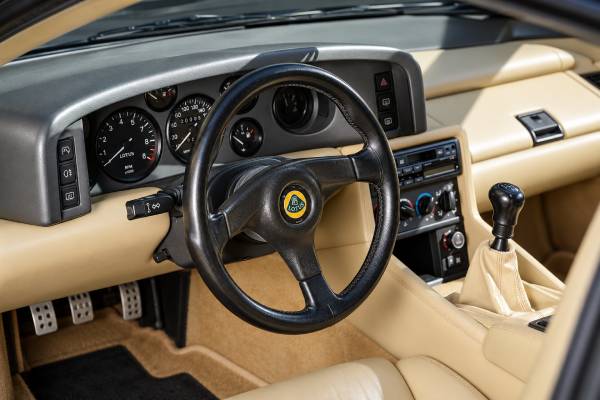
The cabin reinforces the mission. Alcantara-type trim, competition-influenced seats, a larger tachometer, electronic speedometer and anti-slip pedal details distinguish the Sport 300 from a luxury-led Esprit. Some equipment and trim details can vary with market and individual build, so the correct question is not whether a car matches an internet photograph perfectly; it is whether its current configuration matches its factory record.
Period testing also shows why a single acceleration number should not define the car. The cited Autocar test recorded 0–60 mph in 4.7 seconds and a 13.4-second standing quarter-mile, but its tested top speed figure was lower than some factory or later references. Wind, surface, gearing tolerance, engine condition and test protocol all affect those results. For an owner now, consistency of oil temperature, coolant temperature, boost response, braking and tyre behaviour is more useful than attempting to reproduce a magazine run.
On public roads, the Sport 300’s limits are far beyond what needs to be explored. Its value lies in the precision available below those limits: steering placement, stable braking, boost building through a gear and the sense that the car was developed with sustained hard use in mind. Track use can be appropriate for a properly prepared example, but age changes the risk calculation. Fluids, hoses, tyres, brakes, wheel fasteners and cooling systems should be checked to track-day standards first.
Inspection, authentication and costly weak points
A Sport 300 purchase should begin with identity and history before the mechanical road test. With only 64 cars officially recognised by Lotus, the financial gap between a genuine, correct example and a replica or heavily altered car can be substantial.
Ask for the VIN, numbered-car details where present, factory build information, early invoices, service records and photographs of major past work. Cross-check those records with a marque specialist or recognised Sport 300 register. Authentication should cover the body configuration, wheel sizes, brake hardware, interior details, engine specification, chassis reinforcements and limited-slip driveline. No single plaque or badge is sufficient proof by itself.
| Area | What to verify | Why it matters |
|---|---|---|
| Identity | VIN, factory/build record, numbered details, early history | Rare-model provenance strongly affects value |
| Engine | Cold start, oil pressure, cooling, timing-belt history, leaks, smoke | High-output 910S depends on sound maintenance |
| Boost system | Turbo condition, wastegate/control plumbing, chargecooler circulation | Altered or overheated intake systems can threaten reliability |
| Fuel system | Hoses, pump performance, injector/fuel-pressure history | Age and high-load fuelling are safety and engine-health issues |
| Transaxle | Synchros, bearings, clutch, LSD behaviour, mounts | Hard launches and poor shifting can be expensive |
| Brakes | Correct AP hardware, discs, seals, ABS operation, fluid condition | Original components are valuable and costly to restore |
| Wheels/tyres | Correct OZ dimensions, cracks, fasteners, tyre age and size | Rare hardware and unusual tyre sizes affect safety and authenticity |
| Body/chassis | Accident repairs, geometry, braces, mounting points, glassfibre condition | Past damage can undermine both handling and value |
Conduct the inspection from cold if possible. A pre-warmed engine can conceal starting behaviour, smoke and noises. Watch instruments as the car reaches operating temperature, verify radiator-fan operation and look for stable coolant behaviour. After the drive, recheck for fresh fluid traces and coolant loss. A clean floor before the test is useful; a freshly washed engine bay can be less informative.
Electrical issues range from nuisance faults to safety-related ones. Test every lamp, fan, window, mirror, instrument, warning lamp and cabin control. Pay particular attention to cooling-fan control, fuel-pump behaviour, ABS warnings and charging voltage. Do not assume a new battery proves the charging system is healthy.
Parts scarcity changes how defects should be priced. A generic service item may be straightforward to source, while a correct Sport 300 wheel, trim component, body piece or brake-specific part can require specialist networks and patience. The cheapest example can therefore become the most expensive one if it is missing rare original hardware.
Finally, assess modifications on evidence rather than prejudice. A reversible, documented improvement made by a recognised specialist may be appropriate for use. Undocumented boost increases, mismatched suspension parts, improvised wiring or cosmetic conversions that discarded original pieces are different. For a limited-production model, retain every removed original component whenever practical.
Ownership, parts strategy and preservation
Owning a Sport 300 successfully is less about frequent heroic repairs than about planned specialist maintenance and preserving hard-to-replace components. The car rewards preventive work because its highest-cost systems are interconnected.
Build a baseline immediately after purchase unless the history proves one already exists. That baseline should establish timing-belt status, engine and transaxle fluids, brake fluid, cooling-system condition, chargecooler operation, fuel-hose age, tyre age, wheel integrity, brake condition and suspension geometry. It is safer to replace an unknown-age consumable than to treat a service stamp as proof of its current condition.
Service intervals should come from the correct Lotus documentation for the individual car and market, not from a generic modern-car schedule. Time can be as important as mileage for belts, flexible hoses, brake fluid and tyres. A collector car that covers 1,000 miles a year can still age mechanically while stationary.
Storage needs thought as well. Keep the car dry, maintain the battery correctly, avoid parking indefinitely with damp brakes and move or support the car in a way that protects tyres during long periods off the road. Starting the engine briefly without bringing the whole powertrain fully to temperature is not a substitute for proper exercise. If the car will be laid up, follow a deliberate storage procedure for fuel, battery, tyres and fluids.
When parts are required, record provenance. Photograph old and new components, retain invoices and note part numbers or specialist substitutions. That documentation helps the next technician understand what is fitted and protects the car’s history if factory-original parts become unavailable. For unique Sport 300 pieces, repair by an experienced specialist can be preferable to replacement with a generic item, provided structural and safety standards are maintained.
The model’s rarity should not make it unusable. A correctly maintained Sport 300 was engineered to be driven hard, and sympathetic regular use can reveal small problems before they become major ones. The sensible approach is to separate enjoyment from abuse: warm fluids fully, avoid heavy load when cold, monitor gauges, allow the turbocharged engine an appropriate cool-down after sustained work and investigate changes in sound or feel promptly.
Preservation also means resisting historical drift. Over decades, rare cars accumulate later wheels, stereos, steering wheels, boost devices, suspension pieces and paint changes. Restoring every alteration is not mandatory for safe enjoyment, but owners should know what is original and keep enough evidence to reverse changes. A complete, traceable Sport 300 tells a far stronger story than one assembled to resemble a brochure photograph shortly before sale.
That story is ultimately what makes the model important. The Sport 300 sits at the point where Lotus took lessons from the X180R programme and applied them to a hand-built road Esprit without smoothing away the competition influence. Its 300 bhp engine is only one part of the equation. The reinforced structure, huge rear tyres, AP brakes, limited-slip differential and pared-back cabin are what make it a coherent special rather than a power upgrade. Buy on identity and condition, maintain the systems as a whole, and its rarity can remain an asset rather than a maintenance trap.
References
* Lotus Esprit – James Bond’s choice | Lotus Cars 2026 * Esprit Models 2026 * Esprit Models 2026 * Esprit Road Tests 1993 * The European X180R That Was Never Built — and the Esprit Sport 300 2026 * Lotus Esprit (1987-2004) buyer’s guide: what to pay and what to look for | Classic & Sports Car 2019
Disclaimer
This article is for informational purposes only and is not a diagnosis, repair procedure or substitute for professional inspection. Specifications, service intervals, torque settings and procedures can vary by VIN, market, equipment and production change, so verify the correct Lotus service documentation for the individual vehicle before maintenance or repair. If this guide helped, please consider sharing it with other Lotus enthusiasts on Facebook, X or your preferred owners’ community.