
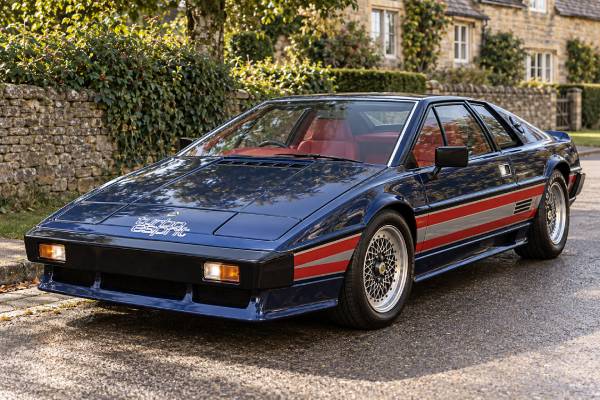
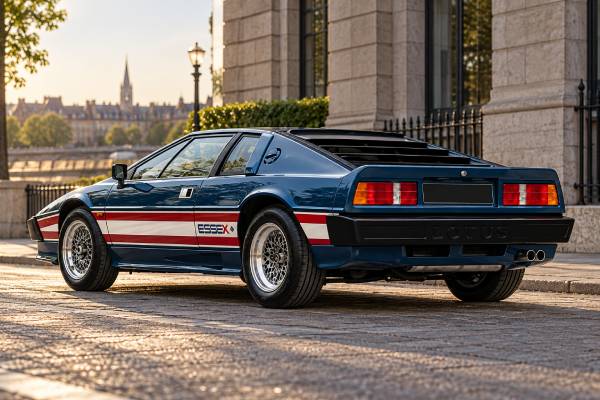
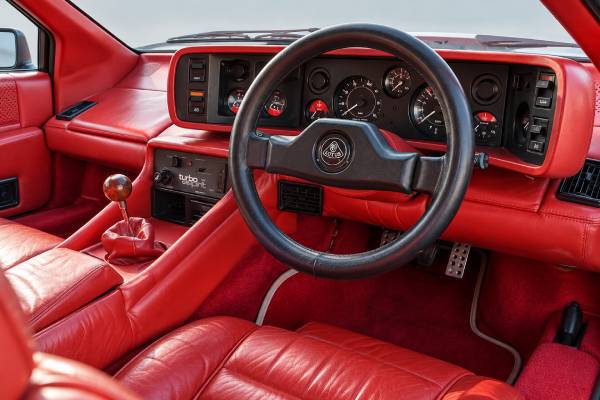
The Essex Turbo Esprit is where the Giugiaro Esprit changed from an elegant lightweight sports car into a genuine turbocharged supercar. Launched in 1980 in the blue, red and chrome colours of Team Lotus sponsor Essex Petroleum, this limited edition introduced the factory Type 910 turbo engine, a strengthened galvanised backbone chassis, revised rear suspension and a much more aggressive aerodynamic package. Its 210 bhp output is only part of the story. Early cars also used dry-sump lubrication, pressure-sealed Dellorto carburettors, distinctive split-rim Compomotive wheels and cabin details that make authenticity unusually important. Lotus currently describes the first 45 Turbo Esprits as the special Essex launch edition, although specialist records further distinguish production cars from development examples. This guide focuses on the 1980–1981 Essex specification itself: what changed mechanically, how the dry-sump system should be treated, which details identify a genuine car, and what an informed inspection should establish before purchase or recommissioning.
Table of Contents
- Why the Essex was more than a paint scheme
- Type 910 engine and vehicle specifications
- Dry-sump lubrication and blow-through carburetion
- Chassis, bodywork, wheels and cabin details
- How the first Turbo Esprit changed the driving experience
- How to authenticate and inspect an Essex Turbo
- Maintenance strategy for a rare early Turbo
Why the Essex was more than a paint scheme
The Essex was the launch specification for Lotus’s factory turbocharged Esprit, not a standard car dressed in sponsor graphics. The Type 82 programme brought a new powertrain, chassis revisions, altered rear suspension, stronger braking and functional aerodynamic changes at the same time as the memorable Essex livery.
That distinction matters because later Giugiaro Turbo Esprits look closely related and share the 2.2-litre Type 910 concept. A later car can be painted blue, red and silver; it does not thereby become an Essex. The launch cars occupy a specific place in the Esprit story: they introduced the 210 bhp production Turbo architecture that would carry the model through much of the 1980s.
Lotus’s current heritage material states that the first 45 Turbo Esprits were released as a special launch edition in Essex Team Lotus Formula One colours. Specialist registries sometimes split that total into 34 customer-production cars plus 11 development or prototype cars. Older publications also quote other totals, often because they count development cars, early non-Essex dry-sump Turbos or planned production differently. For a valuable individual car, a generic production number is therefore less useful than a chassis-specific factory record.
The launch presentation matched the car’s ambition. Lotus revealed the turbo model amid the company’s close association with Essex Overseas Petroleum Corporation, then a Team Lotus sponsor. The body retained Giorgetto Giugiaro’s wedge but gained a deeper front air dam, sill extensions with cooling ducts, enlarged bumpers, a rear lip spoiler and a prominent louvred engine cover. The visual message was substantially more aggressive than the S1 or S2.
Underneath, the change was equally significant. Turbocharging raised engine output and thermal load, while the wider tyres and higher cornering potential placed greater demands on the structure and rear suspension. Lotus responded with a galvanised backbone chassis, a revised rear arrangement with an additional upper link and plunging driveshafts, and upgraded brakes. The Essex is therefore best understood as a coordinated engineering step rather than the beginning of a styling package.
Its collectability now comes from that historical role as much as from rarity. The right car combines first-factory-Turbo significance, Formula One-era branding and a specification that was soon altered as Lotus refined the regular Turbo Esprit. Those same qualities mean incorrect restorations can erase a surprising amount of what buyers are paying for.
Type 910 engine and vehicle specifications
The Essex uses the original 2,174 cc Type 910, an all-aluminium DOHC 16-valve four-cylinder with a Garrett AiResearch T3 turbocharger and twin Dellorto carburettors. Lotus rated it at 210 bhp at 6,250 rpm and 200 lb-ft at 4,500 rpm, with a low 7.5:1 compression ratio suited to the period turbo system.
| Item | Essex Turbo specification |
|---|---|
| Engine | Lotus Type 910 inline four |
| Construction | Aluminium-alloy block and cylinder head |
| Displacement | 2,174 cc (2.2 L) |
| Bore × stroke | 95.25 × 76.20 mm (3.75 × 3.00 in) |
| Valvetrain | DOHC, 16 valves |
| Compression ratio | 7.5:1 |
| Induction | Single Garrett AiResearch T3 turbocharger, about 8 psi maximum boost |
| Fuel system | Twin Dellorto DHLA 40H sidedraught carburettors, pressure-sealed for turbo use |
| Lubrication | Dry-sump system on Essex-specification cars |
| Power | 210 bhp at 6,250 rpm |
| Torque | 200 lb-ft (271 Nm) at 4,500 rpm |
The 2.2-litre capacity came from a long-stroke evolution of Lotus’s 900-series four. Compared with the naturally aspirated engines, the Turbo required changes to compression, cooling, lubrication, exhaust-valve specification and bottom-end durability. The result was not merely a naturally aspirated engine with a turbo bolted to its exhaust manifold.
Period material commonly cites maximum boost around 8 psi, or roughly 0.55 bar. That sounds modest beside modern turbo engines, but the Essex predates knock-controlled electronic engine management and modern sequential injection. Correct carburettor sealing, fuel pressure, ignition timing, wastegate operation and cooling therefore matter greatly. Raising boost without understanding the complete calibration is particularly unwise on a rare original engine.
| Item | Specification |
|---|---|
| Layout | Longitudinal mid-engine, rear-wheel drive |
| Gearbox | 5-speed manual Citroën transaxle |
| Clutch | Hydraulically operated single-plate unit, increased capacity for Turbo use |
| Front brakes | Disc brakes, approximately 10.5 in in period specification data |
| Rear brakes | Inboard discs, approximately 9.7 in in period specification data |
| Steering | Unassisted rack and pinion |
| Chassis | Galvanised steel backbone with glassfibre body |
The five-speed transaxle was retained from the earlier Esprit family but coupled through a higher-capacity clutch and revised driveline. Correct linkage adjustment is important because a poor shift can come from external wear or adjustment rather than an internal gearbox failure. Equally, a seller’s claim that every awkward change is “just how they are” should not prevent a proper diagnosis.
| Measure | Published figure |
|---|---|
| 0–60 mph | About 5.6 seconds in period Lotus/Motor figures; some later summaries quote 6.1 seconds |
| 0–100 mph | About 14.7 seconds in factory-derived figures |
| Standing quarter-mile | About 14.4 seconds at 98 mph in factory-derived data |
| Top speed | Approximately 150–152 mph (241–245 km/h) |
The differing 0–60 mph figures are a useful reminder that old performance data should retain its source context. Launch claims, magazine tests, weather, tyre condition and test method were not standardised. An owner does not need to prove either number today; a healthy car should instead deliver progressive boost, stable temperatures and clean acceleration without detonation, misfire or clutch slip.
Dry-sump lubrication and blow-through carburetion
The dry-sump system and pressure-sealed carburetion are the two pieces of Essex engineering most likely to surprise an owner accustomed to later cars. Both demand that the correct procedure be understood before routine maintenance or fault-finding begins.
A dry-sump engine stores most of its oil in a separate tank rather than relying on a deep pan beneath the crankshaft. Scavenge pumps return oil from the engine to that tank while a pressure stage supplies the bearings. Lotus chose the arrangement to maintain oil control during the high acceleration, braking and cornering loads expected from the new Turbo. It also helped oil temperature management and allowed the engine installation to remain compact.
The consequence is that an oil-level reading depends on the system being in the correct state. Period Lotus service-note instructions reproduced by marque specialists specify checking the dry-sump tank with the oil hot and within two minutes of switching the engine off. Oil can drain back after shutdown, so checking a cold, long-stationary car as if it had a conventional wet sump can produce a misleading reading. Overfilling “to be safe” can create its own problems.
This procedure is not trivia. If a prospective owner cannot identify the oil tank, does not know how the level is checked or has records showing repeated overfilling, the lubrication system deserves close inspection. Hoses, unions, pump drive, tank condition and oil cooler plumbing should all be checked for leaks, deterioration and incorrect replacement parts. Any uncertainty about oil pressure warrants professional measurement rather than a guess based on the dashboard gauge.
The Essex also uses carburettors in a pressurised turbo system. Reliable technical descriptions identify the arrangement as blow-through: the T3 compressor feeds pressurised air through specially prepared Dellorto DHLA carburettors. Their throttle spindles and associated components require sealing, while fuel pressure has to remain correctly related to boost pressure. That is a very different operating environment from ordinary naturally aspirated sidedraught carburettors.
For diagnosis, resist the temptation to adjust multiple systems at once. A rich smell, hesitation or weak boost can arise from carburettor condition, fuel pressure, ignition, boost leaks, wastegate control or engine mechanical condition. Establish base ignition timing, compression health, fuel delivery and pressure integrity before chasing mixture screws. A specialist who understands the original pressurised Dellorto system can preserve drivability that is easily lost through piecemeal tuning.
Heat is another defining issue. The turbocharger and exhaust system create substantial thermal load in a compact rear engine bay. Correct undertrays, ducts and shields contribute to managing airflow; removing them because they make servicing easier can change temperatures. Perished fuel hoses near a hot turbo system are an obvious safety concern, so fuel-line age and routing should be treated as a priority on any newly acquired car.
Chassis, bodywork, wheels and cabin details
An Essex is identifiable through a combination of structural, exterior and interior details rather than one decal. The galvanised Type 82 backbone, revised rear suspension, Giugiaro aerodynamic package, Compomotive split-rim wheels and Essex-specific trim form a connected specification.
The rear suspension change was particularly important. Earlier Esprits used the driveshaft as part of the suspension’s lateral location. The Turbo’s revised arrangement added an upper link and used plunging constant-velocity driveshafts, reducing the structural duty placed on the shafts. That made sense as torque, grip and expected cornering loads rose.
| Area | Essex-era specification |
|---|---|
| Front suspension | Independent upper wishbones, lower transverse links, coil springs and anti-roll bar |
| Rear suspension | Independent unequal-length transverse links with radius arms and coil springs |
| Wheels | Three-piece 15-inch Compomotive split rims on Essex cars |
| Front wheel size | Approximately 7J × 15 |
| Rear wheel size | Approximately 8J × 15 |
| Typical period front tyre size | 195/60 VR15 |
| Typical period rear tyre size | 235/60 VR15 |
Later Turbo Esprits are frequently seen with BBS-style wheels, so wheel identity is a useful authentication clue. Genuine period three-piece Compomotives can be costly to repair or replace. Inspect rims, centres and fasteners for cracks, distortion, corrosion and evidence of poor assembly. If a car wears reproduction or later wheels, ask whether its originals accompany it.
The glassfibre body cannot rust, but it can suffer stress cracking, star cracks, crazing, delamination and poor old repairs. The Essex paint scheme makes restoration especially demanding because the blue base, red elements and bright silver/chrome-effect sections need to align correctly with the body’s sharp geometry. A glossy repaint may look impressive while erasing factory details or hiding previous damage. Photographs taken before and during restoration are valuable.
The galvanised chassis improved corrosion resistance dramatically, yet “galvanised” does not mean immortal. Damage, contaminated moisture traps and decades of use can still affect steel parts and suspension mounting areas. Inspect underneath with the car safely raised, looking for distorted sections, repairs, corrosion around stressed points and evidence that jacking has damaged the structure or body.
Inside, the launch car is famously theatrical. Scarlet leather, revised seats and a roof-mounted National Panasonic stereo installation contributed to the Essex identity. The dashboard included boost instrumentation, and period trim details differ from those on later regular Turbos. Original electronics are part of the car’s historical character even if modern audio equipment performs better.
Cabin originality can therefore be worth preserving rather than “upgrading.” Before replacing tired leather, stereo components or switchgear, photograph and document what is present. Correct restoration of an original item may carry more historical value than installing a cleaner later substitute.
How the first Turbo Esprit changed the driving experience
The Essex transformed the Esprit by adding strong mid-range torque without abandoning the low mass, unassisted steering and compact dimensions that made the original car engaging. Its performance felt dramatic in 1980 because the Turbo delivered both a large numerical gain and a different shape of acceleration.
The naturally aspirated early Esprit demanded revs. The Type 910 still rewards engine speed, but its 200 lb-ft torque peak gave the car much greater overtaking authority. Lotus devoted considerable development effort to reducing the lag and weak low-speed response associated with many early turbo installations. Period road impressions praised the engine’s tractability as well as its outright pace.
Modern drivers need to recalibrate expectations. Boost response is not identical to a current electronically controlled turbo engine, the unassisted steering becomes heavier at parking speeds, and the Citroën gearbox prefers a deliberate hand. Those traits are part of the period experience when the car is correctly adjusted. They should not, however, be used to rationalise severe hesitation, wandering steering, grinding shifts or unpredictable boost.
The chassis is the stronger part of the experience. Steering loads build directly, the car sits low around the driver and the revised rear suspension gives the Turbo a more appropriate foundation for its torque. Good dampers, correct bushes and tyres of the right size and quality are essential; replacing one axle’s tyres with a radically different construction or compound can change the balance of a light mid-engined car.
Brake feel also deserves period context. There is no modern brake-by-wire assistance or stability control between the driver and the car, and the rear discs are mounted inboard. The system should nevertheless feel consistent, stop straight and resist obvious pulling. Flexible hoses, caliper condition, master-cylinder health and fluid age all affect a car that may spend long stretches in storage.
Much of the Essex’s appeal comes from the sensory contrast. The livery is extroverted, but the controls are fundamentally mechanical. The turbo builds, the engine note hardens, the steering transmits road texture and the low windscreen makes 60 mph feel meaningful. That combination is why restoring an Essex to generic modern-car behaviour can be counterproductive. The goal is not to remove its period character; it is to make sure genuine faults are not mistaken for character.
How to authenticate and inspect an Essex Turbo
Authentication should precede mechanical valuation because Essex identity has a large effect on collectability. A correct chassis number, factory provenance and model-specific components carry more weight than paint colour alone.
Begin with the VIN and any numbered or provenance documentation, then compare them with factory records or a recognised marque register. Establish whether the car is recorded as a customer-production Essex, a development car or a later Turbo. Development cars can be historically important in their own right, but their identity should be represented accurately rather than treated as interchangeable with the production run.
| Area | Inspection focus | Reason |
|---|---|---|
| Identity | VIN, factory build record, historic registration and Essex provenance | Re-liveried regular Turbos exist |
| Dry-sump system | Oil tank, pump drive, hoses, scavenge function and correct level-check practice | Original system is distinctive and procedure-sensitive |
| Engine | Cold start, compression health, oil pressure, cooling, leaks and timing-belt history | Type 910 rebuild work can be expensive |
| Turbo/fuel | Wastegate, boost hoses, turbo condition, Dellorto seals, fuel pressure and hose age | Incorrect setup affects both safety and engine health |
| Transmission | Shift quality, linkage, clutch operation, driveshaft joints and mounts | Wear may be external or internal |
| Wheels | Correct Compomotive split rims, condition and accompanying originals | Rare model-specific hardware supports authenticity |
| Body | Old repairs, livery accuracy, cracks, panel alignment and aero components | Complex refinishing can hide collision history |
| Interior | Scarlet trim, roof stereo, instruments, switchgear and restoration evidence | Unique cabin parts are difficult to replace correctly |
Insist on a genuinely cold start when possible. Note cranking speed, smoke, oil-pressure rise and whether the engine settles without excessive mechanical noise. Once warm, observe coolant stability and fan operation. A turbocharged classic that idles acceptably for five minutes has not yet demonstrated that it can maintain fuel delivery, oil pressure and cooling under load.
On the road, build engine load gradually. Boost should arrive consistently and acceleration should remain clean. Back off immediately if there is detonation, severe misfire, abnormal smoke or an alarming temperature change. Listen separately on acceleration, steady throttle and overrun because gearbox bearings, driveshaft joints and differential noises can respond differently to load.
Then inspect the car again while warm. Fresh oil seepage, fuel smells, coolant traces and heat-related electrical faults can appear only after the drive. Check the radiator area and cooling fans as well as the engine bay; the Esprit’s long coolant runs mean a leak can be remote from the engine.
Paperwork should explain the car, not merely thicken a folder. Useful records identify who performed work, which parts were installed and why. An engine rebuild with measurements, invoices and photographs is far more valuable than a single line saying “engine done.” The same applies to body restoration, wheel rebuilding and carburettor work.
Maintenance strategy for a rare early Turbo
A sound Essex benefits from a preservation-first maintenance plan: learn the dry-sump procedure, control heat and fuel-system age, service the belt-driven engine correctly and keep rare original components with the car. Preventive work is usually cheaper than recovering from one neglected system.
After purchase, establish a mechanical baseline from verified records. Confirm the timing-belt service status using the correct Lotus schedule and parts, inspect auxiliary drives, renew age-sensitive fluids where history is uncertain, and have the fuel and cooling systems pressure-checked as appropriate. Do not invent service intervals from general internet advice; the applicable Lotus documentation and a specialist familiar with the exact engine configuration should govern the work.
Fuel hoses deserve a particularly conservative approach because of their age and proximity to heat. Replacement hose must be compatible with modern petrol and installed with the correct routing and fittings. Carburettor leaks or fuel vapour around a turbocharged engine are immediate safety issues, not cosmetic defects to schedule for a later restoration.
Dry-sump maintenance should become routine rather than intimidating. Owners need to know when and how to read the tank level, what normal pressure behaviour looks like and where the system’s hoses and unions run. Marking an arbitrary dipstick level after the car has stood overnight is not an acceptable substitute for the proper hot-check procedure.
Preserve removed components. If reliability or availability requires a reversible modern substitute for a pump, ignition item, stereo component or wheel hardware, label and store the original part. Keep photographs of installation details before disassembly. Small items that seemed disposable 20 years ago may now be central to a correct restoration.
The Essex also rewards regular, considerate use. Bring oil and coolant fully to operating temperature before asking for boost, avoid prolonged high load if any gauge behaves abnormally, and investigate new smells or noises promptly. After sustained fast running, give the turbocharged system a sensible period of reduced load before shutdown rather than switching off immediately from maximum effort.
Long storage creates a different set of risks: stale fuel, carburettor deposits, battery damage, corroded brake surfaces and flat-spotted tyres. A storage plan should address those issues directly. Briefly starting the engine in a garage without warming the entire drivetrain can add condensation rather than preserve the car.
Most importantly, resist the urge to make a rare launch car conform to later Turbo specifications simply because later parts are easier to find. The Essex’s dry-sump system, Compomotive wheels, sponsor livery and period cabin are not inconveniences attached to the desirable engine; they are much of the reason the car matters. A carefully documented example that still reflects its 1980 engineering tells the transition from original Esprit to Turbo more clearly than any later replica can.
References
* Lotus Esprit – James Bond’s choice | Lotus Cars 2026 (Manufacturer heritage) * Esprit Models 2026 (Essex technical reference) * Esprit Models 2026 (Turbo Esprit technical reference) * Lotus Esprit Models 2026 (Model history) * 1980-1981 Lotus Essex Turbo Esprit 2016 (Technical overview) * Buyer’s Guide to the Lotus Esprit – Sports Car Market 2026 (Buying guide)
Disclaimer
This article is for informational purposes only and is not a diagnosis, repair procedure or substitute for professional inspection. Specifications, service intervals, torque settings and procedures can vary by VIN, market, equipment and production change, so verify the correct Lotus service documentation for the individual vehicle before maintenance or repair. If this guide was useful, please consider sharing it with fellow Lotus owners on Facebook, X or your preferred enthusiast community.