
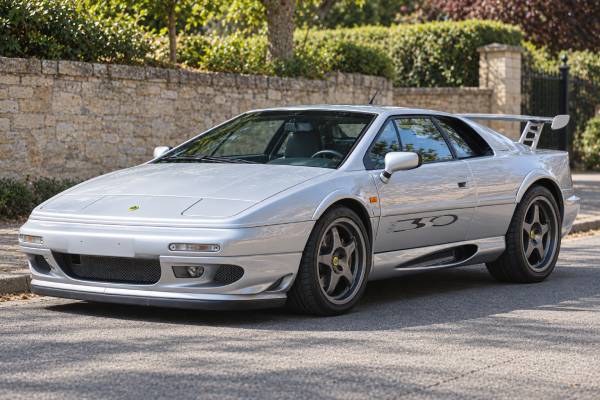
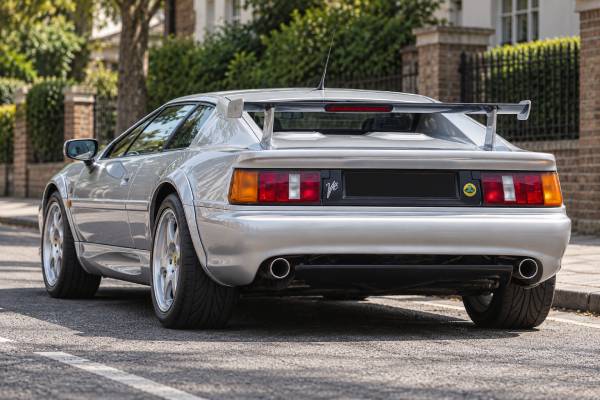
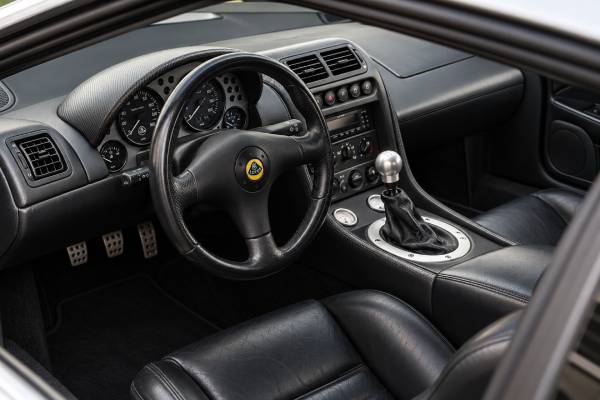
The Lotus Esprit Sport 350 is the V8 Esprit distilled around lower mass, stronger braking and sharper chassis control rather than a headline increase in engine power. Its Type 918 twin-turbo 3.5-litre V8 remains at roughly 350 bhp, but Lotus paired it with lighter body construction, OZ magnesium wheels, 320 mm AP Racing brakes, firmer suspension, extra chassis stiffness and a carbon-fibre rear wing on machined aluminium supports. That combination makes the Sport 350 much more than a numbered trim edition. It also makes authentication unusually nuanced: factory records describe 42 official European production cars, while later U.S.-spec and other factory-built Sport 350-related cars explain why totals of 50 or 54 also appear. The requested 1999–2001 span likewise extends beyond the main engine-build window, which ran from late 1998 into January 2000. This guide keeps those distinctions visible while covering the Type 918 engine, market-specific hardware, braking and wheel details, V8 failure checks, and the evidence a buyer should demand before paying a Sport 350 premium.
Table of Contents
- The Sport 350 engineering brief: less weight, same power
- Type 918 V8 specifications and performance
- AP Racing brakes, magnesium wheels and chassis tune
- Why production counts and market specifications differ
- Type 918 heat, liner sealing and timing-drive checks
- UN1 gearbox, road-test signals and condition assessment
- Authentication, preservation and long-term ownership
The Sport 350 engineering brief: less weight, same power
The Sport 350’s defining idea was to make the Esprit V8 work harder as a complete chassis without increasing its nominal peak output. Lotus reduced mass, recalibrated the engine management, stiffened the suspension and structure, and fitted brakes capable of repeated high-energy stops.
That strategy matters because the standard V8 already had more engine potential than the Renault-derived transaxle could comfortably exploit. The production Type 918 was deliberately held around 350 bhp and 400 Nm, so adding another large power increase would have worked against durability. For the Sport 350, Lotus instead improved the way the existing output could be accelerated, slowed and placed on the road.
The most visible change is the carbon-fibre rear aerofoil mounted on sculpted aluminium uprights. It was not merely a sticker-package identifier. The car also received a deeper front treatment, lightweight body construction on relevant European versions, stiffer springs, uprated anti-roll control, additional chassis tube thickness around the engine bay and dedicated interior materials. The silver-grey-and-blue launch colour scheme, blue engine detailing and large graphics made the engineering changes easy to recognise, although factory records show that a small number of cars departed from the standard colour arrangement.
Lotus quoted an approximately 80 kg reduction relative to the regular V8 reference used in contemporary material. Period road-test data put a European Sport 350 at about 1,300 kg, giving a power-to-weight figure near 268 bhp per tonne. The number is useful for context, but the more important reduction was unsprung and rotational mass at the wheels and brakes. Lighter magnesium wheels and alloy-bell brake assemblies improve the suspension’s ability to follow the road as well as helping acceleration.
The ECU was recalibrated to reshape torque delivery in the lower gears rather than to advertise a new peak-power number. That distinction is why a Sport 350 should not be judged by a dyno sheet showing substantially more than stock power. An aggressively tuned example may be faster in a single pull while increasing stress on exactly the driveline that Lotus chose not to overwhelm.
For buyers, the engineering brief gives a useful authentication principle: the value is in the package. A standard V8 wearing a carbon wing and Sport 350 graphics is missing much of what made the model special. Brake hardware, wheels, suspension, body construction, chassis details, interior specification, ECU calibration and provenance all matter.
Type 918 V8 specifications and performance
The Sport 350 uses Lotus’s all-aluminium Type 918, a 90-degree 3.5-litre V8 with four camshafts, 32 valves and two Garrett T25 turbochargers. Unlike the chargecooled four-cylinder Esprits, the production V8 does not use a chargecooler.
| Item | Sport 350 specification |
|---|---|
| Engine | Lotus Type 918, 90-degree V8 |
| Construction | Aluminium-alloy block and cylinder heads |
| Displacement | 3,506 cc (3.5 L) |
| Bore × stroke | 81.0 × 83.0 mm (3.19 × 3.27 in) |
| Valvetrain | DOHC per bank, 32 valves total |
| Compression ratio | 8.0:1 |
| Induction | Twin Garrett T25 turbochargers; no chargecooler |
| Fuel system | Electronic multi-point fuel injection with Lotus engine management |
| Power | Approximately 349–350 bhp at 6,500 rpm |
| Torque | 295 lb-ft (400 Nm) at about 4,250 rpm in Sport 350 specification data |
Peak power is therefore effectively the same as the normal Esprit V8. The Sport 350’s altered mapping changes how torque is delivered, especially in lower gears, while preserving the production engine’s established ceiling. Blue-painted cam covers became part of the European visual specification, but engine-colour details differ on U.S.-spec cars and should not be used alone to determine authenticity.
| Item | Specification |
|---|---|
| Layout | Longitudinal mid-engine, rear-wheel drive |
| Transmission | 5-speed manual Renault UN1-family transaxle |
| Final drive | 3.89:1 in period Sport 350 specification data |
| 1st gear | 3.36:1 |
| 2nd gear | 2.05:1 |
| 3rd gear | 1.38:1 |
| 4th gear | 1.09:1 |
| 5th gear | 0.76:1 |
The gear ratios show why the engine and transaxle must be considered together. The V8 produces substantial torque early enough to expose a weak clutch, worn synchro or abused input shaft quickly. Standing starts are therefore a poor method of proving performance on a collectible car.
| Measure | Published result or claim |
|---|---|
| 0–60 mph | 4.7 seconds in a cited wet-surface road test |
| 0–100 mph | 10.7 seconds in the same wet test |
| Standing quarter-mile | 13.0 seconds at about 109 mph |
| 30–70 mph through gears | 3.9 seconds |
| Claimed maximum speed | About 175 mph (282 km/h) |
| Period European kerb weight | Approximately 1,300 kg (2,866 lb) |
The wet test context is important. The raw 0–60 mph figure can look slower than some earlier V8 tests even though the Sport 350 was lighter; surface grip strongly affected the launch. Its in-gear figures better demonstrate the effect of the V8 and revised calibration. Modern owners should not attempt to reproduce period acceleration runs on public roads.
AP Racing brakes, magnesium wheels and chassis tune
The braking and unsprung-mass package is arguably the Sport 350’s most important upgrade. Lotus fitted 320 mm cross-drilled, ventilated discs at both ends, AP Racing hardware and very light OZ wheels, then recalibrated the chassis around greater braking and tyre capability.
| Component | European specification |
|---|---|
| Front wheels | OZ lightweight/magnesium construction, 8.5J × 17 |
| Rear wheels | OZ lightweight/magnesium construction, 10J × 18 |
| Front tyres | 235/40 ZR17 Pirelli P Zero |
| Rear tyres | 295/35 ZR18 Pirelli P Zero |
| Front brakes | 320 mm ventilated, cross-drilled discs with AP Racing 4-piston calipers |
| Rear brakes | 320 mm ventilated, cross-drilled discs with AP Racing hardware |
| ABS | Kelsey-Hayes electronic anti-lock system in period descriptions |
Magnesium wheels require a different ownership mindset from ordinary cast aluminium wheels. Their low mass is valuable, but age, corrosion, impact damage and inappropriate refinishing can compromise them. A specialist familiar with magnesium should inspect questionable wheels. Powder coating or aggressive stripping without understanding the material is not automatically a harmless cosmetic refresh.
Correct wheels also have high provenance value. If a Sport 350 wears later alloy wheels, determine why and whether the original set survives. Track use, pothole damage and tyre shortages can all explain a change, but missing factory magnesium wheels should be reflected in both authentication and restoration cost.
The brake system deserves the same attention. Two-piece discs, bells, calipers and pad hardware are expensive pieces of the model’s identity, not just consumables. Measure disc condition, look for heat checking and cracking around drilled holes, confirm caliper piston operation and inspect flexible lines and fluid history. Blue-painted European front calipers are visually distinctive, but U.S. cars were delivered with differences, so paint colour is not a universal pass/fail test.
Lotus also fitted firmer springs and revised anti-roll control. The result is more precise on a smooth surface than a standard V8, with a trade-off in compliance over broken roads. A Sport 350 that rides softly and rolls heavily may have been converted to regular V8 springs; a car that crashes harshly over every imperfection may have inappropriate aftermarket rates rather than “factory race suspension.” Part numbers and invoices help resolve both cases.
Chassis tube thickness around the engine bay was increased in the released specification. Underbody inspection should therefore look for accident repair, corrosion at steel components, disturbed chassis coatings and non-standard welding. The glassfibre body itself will not rust, but it can crack or conceal impact damage. The lightweight hand-laid lower body used on relevant European cars is also part of the model’s mass-saving specification and differs from U.S.-compliant construction.
Why production counts and market specifications differ
Sport 350 production cannot be described accurately with one number unless the counting method is stated. Lotus-derived factory correspondence records 42 official European Sport 350 production cars, while eight U.S.-spec cars and additional Japan-related or special-build cars are the reason totals of 50 and 54 appear in later sources.
The original proposal was for no more than 50 cars. According to factory information reproduced by Lotus Esprit World, unique parts were ordered around that ceiling, yet the European production build total was 42. Engine records show the first dedicated production engine dated November 30, 1998 and the last on January 24, 2000, with 42 production engines plus a service-stock unit.
Eight cars were later supplied in U.S.-specific form, and the factory discussion makes clear that homologation requirements changed their specification. They retained airbags and approved seats, did not use the lighter European body shell and differed in details such as spring rates, steering wheel, caliper finish, engine-cover colour and interior carbon-fibre treatment. They remain historically tied to the Sport 350 programme, but they should not be judged against a European parts checklist.
Further factory-built cars for Japan and internal or director use complicate the total again. Some production references therefore arrive at 54 Sport 350-related cars. The correct approach for a collector is to state which group is being counted: official European production, U.S.-spec numbered cars, or every factory-built Sport 350-type/hybrid car. A seller who simply claims “one of 42,” “one of 50” or “one of 54” should be able to show the build record that supports that description.
| Count | What it can refer to |
|---|---|
| 42 | Official European factory production cars in Lotus-derived records |
| 50 | Original maximum proposal or 42 European cars plus eight U.S.-spec cars, depending on source |
| 54 | Broader count including additional Japan-related factory cars in enthusiast/factory-record discussions |
The requested 1999–2001 model span should be read with the same care. The Sport 350 was launched for 1999, and dedicated engine-build records finish in early 2000. Cars can nevertheless appear with later registration, sale or market-year descriptions. For authentication, use the VIN, engine number, build record and first-registration date separately rather than forcing them into one “model year.”
Colour is similarly less absolute than the brochure image suggests. The familiar silver/grey scheme with blue graphics dominates, yet factory records mention black, white and ice-blue cars as well as internal variations. Unusual colour can be legitimate; it simply requires stronger documentary evidence.
Type 918 heat, liner sealing and timing-drive checks
The Type 918 can be durable at standard output, but cooling-system health is critical because serious overheating can contribute to cylinder-liner seal failure. On a Sport 350, that risk deserves more attention than cosmetic originality until the engine’s history is understood.
The V8 uses wet cylinder liners sealed into the crankcase. Lotus technical information reproduced by marque specialists stresses that seal failure is commonly associated with an overheating or other engine malfunction rather than inevitable failure at a particular mileage. Cars with both the earlier Loctite sealant and later Hylomar material have covered substantial mileage successfully, so a simple “pre-2000 equals bad” rule is too crude.
For the Sport 350, the build dates make this especially relevant because its dedicated engines fall inside the period before Lotus’s later sealant change. That does not condemn the engine. It means the cooling system, previous overheating history and evidence of any liner-related repair should be established. Look for unexplained coolant loss, coolant staining around the crankcase, contamination between oil and coolant, pressurisation anomalies and records of overheating. A specialist can use pressure testing, combustion-gas checks and other diagnostics where symptoms justify them.
Cooling hardware includes the front radiator system, long coolant pipes, fans, thermostat and associated plumbing. A recently rebuilt engine can still be damaged if the root cause of an old overheat was never corrected. Conversely, replacing an engine solely because of its sealant type when it has no symptoms and a sound cooling history may be unnecessary.
The timing drive is another high-consequence service area. The 918 uses belts to drive its camshafts, and service history must be verified against the correct Lotus schedule. Invoices should identify belt work, tensioning and related idler or bearing attention. The fact that a collector car has travelled only a few hundred miles since the last service does not stop elastomeric components from ageing.
Check both turbochargers and wastegate control as a pair. Heat and corrosion can affect actuators, and an overboost condition can damage the engine rapidly. Listen for abnormal turbo noise, inspect hoses and connections, and scan engine-management faults where appropriate. A modified ECU or boost controller should come with clear mapping documentation; the engine was validated at its production power and torque level, not at every aftermarket setting.
Oil leakage, exhaust heat and deteriorated hoses also deserve a methodical inspection. The compact V8 installation places many components in a hot environment. Fresh fluid traces after a road test are more useful than old staining, and a strong fuel smell should stop the drive until its source is identified.
UN1 gearbox, road-test signals and condition assessment
The Sport 350’s Renault UN1-family five-speed is the mechanical component most likely to punish aggressive standing starts or careless shifting. Lotus limited engine output partly around driveline capacity, so a “more power is always better” modification history should make a buyer more cautious, not more impressed.
A proper test begins cold. Note clutch take-up, gear selection and any shaft or bearing noise before the lubricant warms. Move through every ratio without rushing the lever. First- and second-gear synchro wear, difficult reverse selection and drivetrain noise need investigation, but external linkage or clutch problems can produce similar symptoms. Diagnosis should identify the cause before pricing a rebuild.
Once the engine and transaxle are warm, apply torque progressively in a taller gear. Engine speed that rises without a matching increase in road speed indicates clutch slip. Vibration under load may point to mounts, shafts, wheels or engine condition. Abrupt on-off-throttle movement can expose worn mounts or driveline lash that steady cruising hides.
The engine should pull with exceptional urgency from relatively low revs as the twin turbos spool. Hesitation, boost cut, severe surging or smoke are faults, not the unavoidable personality of a late V8 Esprit. Because the Sport 350 is very fast, these checks can be performed without approaching maximum speed. The objective is repeatability and mechanical smoothness.
Steering and chassis behaviour should feel unusually communicative. On a smooth road, the firmer springs and low unsprung mass let the car change direction with precision. On rough pavement the Sport 350 is busier than a regular V8, yet it should not feel loose or disconnected. Uneven tyre wear, a steering wheel that does not centre or persistent pulling call for a four-wheel alignment and chassis inspection.
Brake testing should be staged from moderate applications to one or two harder stops after the system is warm. The pedal should remain consistent and the car should stay straight. Pulsation can come from discs, wheel damage or tyre problems; a warning lamp needs an actual ABS diagnosis rather than a bulb removal or seller explanation.
End the drive with a hot restart. Heat soak can expose weak electrical connections, starter issues, marginal cooling or fuel vapour problems that a cold car conceals. Then inspect underneath and around the engine bay for fresh coolant, engine oil, gearbox oil and power-steering fluid.
Authentication, preservation and long-term ownership
A Sport 350 should be authenticated from records outward, not from graphics inward. Begin with the VIN, engine number, numbered plaque and factory build specification, then verify that the physical car matches the market for which it was built.
European cars should be checked for the lightweight body specification, correct wing and aluminium supports, OZ magnesium wheels, AP brake package, suspension/chassis changes, seats, carbon-fibre interior elements, blue detailing and the relevant numbered plaque. U.S. cars require a different checklist because airbags, seats, body construction, springs and trim were altered for homologation. Applying the European list to a U.S. car can incorrectly label original equipment as a replacement.
| Area | Evidence to seek | Why it matters |
|---|---|---|
| Identity | VIN, engine number, numbered plaque, factory build record | Production totals and market variants are frequently confused |
| Body/aero | Correct lightweight-market specification, carbon wing, alloy uprights, front treatment | Replica appearance is easier than replica engineering |
| Wheels | Original OZ magnesium set, inspection/repair history | Rare, valuable and safety-critical |
| Brakes | AP calipers, 320 mm two-piece discs, ABS operation | Central to the Sport 350 package |
| Engine | Cooling history, liner-seal evidence, timing-belt records, turbo/wastegate condition | Overheating can turn into a very expensive V8 repair |
| Transmission | Clutch history, synchro quality, correct oil and modification history | UN1 durability depends heavily on use and torque load |
| Market details | Original seats, airbags, steering wheel, spring rates and trim for destination market | USA and European cars were not identical |
Once identity is established, preservation should prioritise rare components without compromising safety. Magnesium wheels need specialist inspection; ageing tyres need replacement regardless of tread; deteriorated brake hoses or caliper seals need repair even if originality is a concern. Keep every salvageable original part, and document any modern substitute so a future owner can reverse it.
A newly purchased car deserves a baseline service unless records prove that work is current. Confirm timing belts, coolant condition, radiator and fan operation, engine and transaxle lubricants, brake fluid, fuel hoses, turbo control, tyres, wheel condition and alignment. Do not begin with ECU tuning. The factory’s decision to retain 350 bhp while improving the rest of the car is a useful ownership lesson in itself.
Storage should protect a car that may see limited annual mileage. Keep it dry, maintain the battery appropriately and avoid leaving contaminated brake surfaces or old fuel for long periods. Exercise it long enough to warm the complete drivetrain rather than repeatedly idling from cold for a few minutes. Watch the coolant system closely after any long lay-up.
Documentation adds real value because Sport 350 history is full of exceptions. Record wheel serials or markings, brake specifications, engine number, plaque, trim, paint and any factory correspondence. Save photographs before restoration or repainting. If a car is one of the unusual colours or has market-specific deviations, the paper trail can be more persuasive than a generic online checklist.
The Sport 350 is significant precisely because Lotus resisted the easiest route of chasing a larger horsepower claim. It made the existing V8 Esprit lighter, more controlled and far better braked. A correct car therefore deserves to be preserved as a system: 350 bhp, careful torque management, low-mass wheels, serious AP brakes, sharper suspension and unmistakable aero. That is what separates the factory special from a modified V8 wearing the same badge.
References
* Lotus Esprit – James Bond’s choice | Lotus Cars 2026 (Manufacturer heritage) * Esprit Models 2026 (Sport 350 technical reference) * Esprit Models 2026 (Model change specification) * Lotus Esprit V8 | PH Used Buying Guide – PistonHeads UK 2024 (Buying guide) * Lotus Esprit V8 (2008) buying guide – Lotus Esprit V8 checkpoints | evo 2008 (Buying guide) * Lotus Esprit (1987-2004) buyer’s guide: what to pay and what to look for | Classic & Sports Car 2019 (Buying guide)
Disclaimer
This article is for informational purposes only and is not a diagnosis, repair procedure or substitute for professional inspection. Specifications, service intervals, torque settings and procedures can vary by VIN, market, equipment and production change, so verify the correct Lotus service documentation for the individual vehicle before maintenance or repair. If this guide helped your research, please consider sharing it with Lotus enthusiasts on Facebook, X or a knowledgeable owners’ forum.