
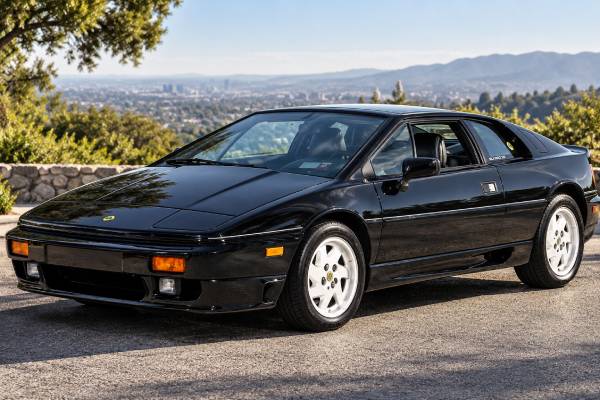
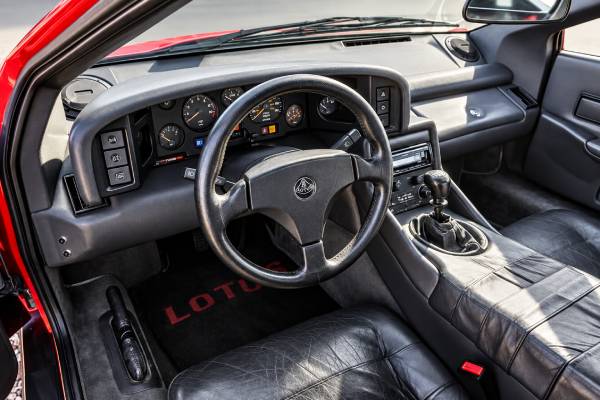
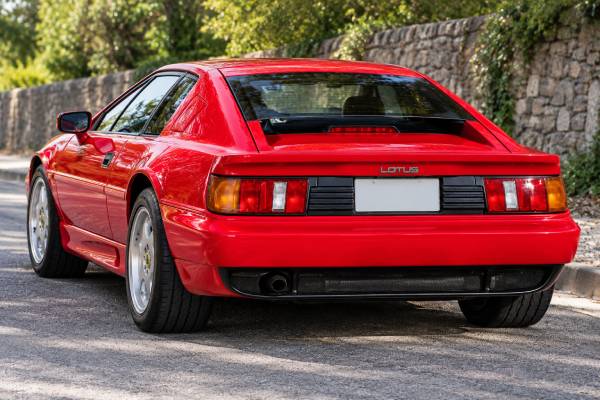
The Lotus Esprit Turbo SE made the four-cylinder Esprit genuinely modern for its time. Introduced in 1989, it combined the 2,174 cc Type 910S engine with electronic multi-point fuel injection, knock control, a water-to-air chargecooler, and 264 bhp in normal operation. The result was much stronger acceleration than the earlier carburetted Turbo, while the Peter Stevens body, Renault transaxle, galvanized backbone chassis, and outboard rear brakes made it easier to live with than the original Giugiaro generation. The SE did not stand still through 1993: ABS appeared during the run, the 1992 High Wing altered the rear body treatment, and U.S.-market 1993 and 1993½ cars gained distinctive transition features. Those changes make build date and market crucial when identifying parts or judging originality. This guide covers the 264 hp Turbo SE across the 1989–1993 assignment period, including its chargecooler system, Type 910S engineering, performance, maintenance needs, and the inspection points that matter most today.
Table of Contents
- What made the SE different
- Turbo SE specifications
- Chargecooler, injection, and overboost
- Model-year and market changes
- How the SE feels on road
- Maintenance priorities for the 910S
- Buying and road-testing an SE
What made the SE different
The SE’s defining feature is its chargecooled, electronically managed Type 910S engine. Lotus used a liquid-cooled heat exchanger to lower compressed intake-air temperature, allowing more boost and more aggressive calibration while maintaining a margin against detonation.
That engineering pushed normal output to 264 bhp at 6,500 rpm and torque to 354 Nm at 3,900 rpm. Period material also describes a temporary overboost strategy capable of greater short-duration output, often quoted around 280 bhp, but the core factory rating for this assignment is 264 bhp. A buyer should therefore be cautious when a seller advertises “280 hp stock” without explaining that distinction.
The SE arrived in May 1989 as the premium Esprit. It was more than an engine upgrade: leather trim, a burr-wood fascia, removable glass roof, air conditioning, and a large rear wing helped distinguish it. Mechanically, however, the most important changes were electronic fuel injection, distributorless ignition, knock sensing, and the separate chargecooler circuit.
The Stevens-era body also used Lotus’s Vacuum Assisted Resin Injection process and incorporated Kevlar reinforcement in the roof structure. Beneath it remained a galvanized steel backbone chassis. The Renault five-speed transaxle had replaced the older Citroën unit in most markets, which also moved the rear brakes outboard and simplified service access compared with the inboard arrangement of early Esprits.
For a collector, “Turbo SE” must be matched to market. U.S. cars have emissions equipment, catalysts, trim, safety equipment, and model-year details that differ from UK and European cars. The 1993 U.S.-market High Wing and 1993½ transition cars are particularly easy to misdescribe because they overlap visually and mechanically with later S4 developments.
Turbo SE specifications
The Turbo SE is a petrol ICE sports car with a longitudinal mid-mounted 2.2-litre turbocharged four-cylinder, water-to-air chargecooler, five-speed manual transaxle, and rear-wheel drive. Its specification represents the most sophisticated mainstream Type 910 installation before the more specialized Sport 300 and later S4s.
| Specification | Value |
|---|---|
| Engine | Lotus Type 910S inline-four |
| Location | Longitudinal, mid-mounted |
| Displacement | 2,174 cc (2.2 L) |
| Bore × stroke | 95.3 × 76.2 mm |
| Construction | Aluminium-alloy block and head |
| Valvetrain | DOHC, 16 valves, belt driven |
| Compression ratio | 8.0:1 |
| Turbocharger | Water-cooled Garrett T3 with integral wastegate |
| Maximum boost | About 0.85 bar in normal SE specification |
| Chargecooler | Liquid-to-air, separate cooling circuit with front heat exchanger |
| Fuel system | Electronic multi-point fuel injection with knock sensing and self-diagnosis |
| Maximum power | 264 bhp (197 kW) at 6,500 rpm |
| Maximum torque | 354 Nm (261 lb-ft) at 3,900 rpm |
| Minimum fuel octane | 95 RON unleaded in period specification |
| Specification | Value |
|---|---|
| Transmission | Five-speed all-synchromesh manual transaxle |
| Drive | Rear-wheel drive |
| Clutch | 234.9 mm single-plate diaphragm, hydraulic operation |
| 1st gear | 3.36:1 |
| 2nd gear | 2.05:1 |
| 3rd gear | 1.38:1 |
| 4th gear | 1.03:1 |
| 5th gear | 0.82:1 |
| Final drive | 3.889:1 |
| Measure | Value |
|---|---|
| 0–60 mph | About 4.7 seconds |
| 0–100 km/h | About 5.0 seconds |
| 0–100 mph | About 11.9 seconds |
| Top speed | About 165 mph (265 km/h) |
| Period urban consumption | 17.9 mpg UK (15.8 L/100 km) |
| Period 56 mph figure | 36.2 mpg UK (7.8 L/100 km) |
| Period 75 mph figure | 29.9 mpg UK (9.5 L/100 km) |
| Fuel capacity | 73 L (16.0 imperial gal) |
These fuel figures come from period test procedures and should not be compared directly with modern WLTP or EPA values. For an old SE, fuel economy is more useful as a consistency check than a promised ownership figure.
| Specification | Value |
|---|---|
| Body construction | Composite body produced by Vacuum Assisted Resin Injection with Kevlar roof reinforcement |
| Chassis | Galvanized steel backbone |
| Seating | Two |
| Kerb weight | About 1,305 kg |
| Steering | Unassisted rack and pinion |
| Steering ratio | 15.4:1 |
| Turns lock-to-lock | 3.0 |
| Turning circle | About 10.97 m between kerbs |
| Specification | Value |
|---|---|
| Front suspension | Upper/lower wishbones, coil springs, gas-pressurized dampers, anti-roll bar |
| Rear suspension | Upper/lower transverse links, radius arms, coil springs, gas-pressurized dampers |
| Front brakes | 259 mm ventilated discs |
| Rear brakes | 274 mm outboard discs |
| Front wheels | 7J × 15 |
| Rear wheels | 8.5J × 16 |
| Front tires | 215/50 ZR15 |
| Rear tires | 245/50 ZR16 |
Chargecooler, injection, and overboost
The chargecooler is the SE’s most important piece of engineering and one of its most important maintenance checks. If its separate coolant circuit stops circulating, the car may still run, but intake temperature rises and the engine loses the operating conditions for which its higher boost calibration was designed.
The system uses a heat exchanger near the engine to remove heat from compressed intake air, then sends that heat forward to a dedicated radiator in the nose. A pump circulates coolant through the loop. Period installations used a mechanically driven pump arrangement whose impeller can deteriorate; many cars have since been converted to reliable electric circulation pumps. The quality of that conversion matters more than whether it is strictly original.
A simple inspection begins with temperature. After driving under boost, the chargecooler should not remain heat-soaked as though no coolant is moving. A specialist can verify flow directly, check the pump, bleed the system correctly, and confirm that hoses and the front heat exchanger are clear. Loss of chargecooler function may show up as reduced performance before it creates obvious dashboard symptoms.
Electronic fuel injection is another major step forward over carburetted Turbo Esprits. The SE’s ECU can compensate within limits for operating conditions and uses knock sensing to protect the engine. That does not make the engine immune to poor fuel, vacuum leaks, weak ignition, failing sensors, or aftermarket calibration. Diagnostic fault information is valuable when available, but mechanical basics still come first.
The commonly discussed overboost feature should also be understood correctly. The 264 bhp figure is the normal maximum-power rating; under specified conditions the management system can temporarily allow more boost and output. It is not a separate permanent 280 bhp engine specification. A car that has been modified to hold overboost-level pressure continuously should be treated as tuned and evaluated accordingly.
Because the Type 910S is highly stressed for a production four-cylinder of its era, detonation control is essential. Use the fuel grade required for the exact market, keep cooling systems functional, and investigate any pinging, misfire, or boost spike immediately. Increasing boost without confirming mixture, ignition, chargecooling, exhaust backpressure, and turbo condition is poor risk management.
Model-year and market changes
The 1989–1993 SE run contains meaningful visual and equipment changes even though the basic 264 bhp engine specification remained stable. A correct car therefore has to be judged against its build date and destination market rather than one fixed photo.
ABS did not appear at the SE’s 1989 launch; it became available later, around autumn 1990. That means an early car without ABS is not necessarily missing equipment. Conversely, a later car showing an ABS warning problem needs proper diagnosis rather than having the light disabled.
The rear body evolved in 1992. High Wing cars use a taller rear aerofoil and lose the earlier glass-back treatment. These cars are uncommon and visually distinctive. Because rear decks, wings, and body panels can be swapped, verify factory specification before paying a premium for a purported High Wing.
U.S. cars complicate the picture further. The 1993 model year included a limited number of SEs with a taller wing and distinctive wheels, while 1993½ cars incorporated transition features toward the S4, including a later-style cabin, wider-opening doors, different exterior handles, and added safety equipment. Those changes are valuable identification clues but must be read together with the VIN.
Emissions equipment is also market-specific. Catalysts, exhaust back-pressure hardware, evaporative systems, oxygen sensors, and calibration can vary. An imported car may have been modified to satisfy another jurisdiction. Before diagnosing an exhaust or fueling problem, determine whether the current parts match the ECU and original market.
Wheel changes are another source of confusion. Standard SE wheels differ from later High Wing, U.S.-market, Sport 300, and S4 hardware. Period-correct larger wheels may look attractive, but tire sizes, offsets, steering feel, and suspension clearance should be confirmed rather than assumed.
The practical buying rule is simple: originality is a chain of compatible details. Wing, wheels, interior, brakes, ECU, emissions hardware, and chassis number should tell the same story. If they do not, the car may still be excellent, but its history should explain why.
How the SE feels on road
The SE’s road character is defined by a much broader performance envelope than the earlier Esprit Turbo, but it still feels like a light, unassisted-steering sports car rather than a modern grand tourer. The chargecooled engine comes alive hard in the midrange, while the chassis communicates enough information that the driver can place the car accurately before committing to boost.
At parking speed the steering is heavy, especially on wide modern replacement tires. Once moving, effort drops quickly and the rack becomes one of the car’s strengths. A healthy front end should track faithfully without a dead zone around centre. If the car follows every road seam aggressively, first inspect tire construction, age, pressure, and alignment before assuming the steering rack itself is worn.
The SE also rewards smooth throttle timing. Turbo response is quicker and more controlled than on the carburetted Giugiaro Turbo, but there is still a clear rise in thrust as the turbocharger and engine reach their effective range. On a wet or cold road, that means the driver should avoid asking for full boost while still adding steering lock. There is no modern stability-control system to sort out a careless input.
Brake feel depends on production date and equipment. Earlier non-ABS cars are mechanically straightforward, while later ABS-equipped examples add hydraulic and electronic components that must be functioning correctly. Regardless of system, the pedal should be firm and repeatable. A pulsing or wandering pedal outside an ABS event, delayed release after braking, or a warning lamp that does not complete its normal check needs investigation.
Ride quality is firmer than an ordinary coupe but should not be crashy. Worn dampers can make the car float over crests and then hit bump stops, while tired bushes allow geometry changes that make the rear feel less settled under power. Because deterioration happens slowly, a seller may describe poor behaviour as “normal for an Esprit.” Comparison with a known-good car or inspection by an experienced specialist is valuable.
Cabin experience is part of the model’s appeal and part of its inspection. The broad windscreen and low scuttle make the car feel special, but the driving position is reclined and the pedal box can feel offset. A removable glass roof increases light and headroom perception, yet worn seals can admit water and create electrical problems that appear unrelated. Check carpets and trim for damp after rain or washing.
Noise also provides diagnostic information. A healthy SE has turbo whistle, induction sound, transmission noise, and a distinctive four-cylinder exhaust note, but those sounds should be consistent with load. A sudden hiss under boost can indicate a charge-air leak; a metallic exhaust tick can suggest manifold leakage; a whine that changes with gear rather than road speed can point toward the transaxle. Learning what the car is saying is part of both the test drive and ownership.
Maintenance priorities for the 910S
A Turbo SE stays healthy when the timing belt, chargecooler, cooling system, lubrication, ignition, and transaxle receive preventive attention. Neglect in any one of those areas can create secondary damage that costs far more than the routine service that would have prevented it.
The cam belt is the first non-negotiable item. The 910S is an interference engine, and a failed belt can bend valves. Service guidance has changed over the decades as belt materials and tension procedures evolved, so use the current recommendation for the exact belt system on the car. A seller should be able to produce a dated invoice showing replacement and, ideally, tension checking rather than simply claiming it was “done recently.”
The chargecooler circuit comes next. Confirm active coolant circulation, hose condition, no unexplained loss, and a clean front heat exchanger. A replacement electric pump can be a sensible reliability upgrade if installed professionally with correct wiring and continuous or properly controlled operation.
The main cooling system is independent of the chargecooler circuit and equally important. Inspect radiator fans, relays, water pump, thermostat, hoses, front-to-rear pipes, header tank, pressure cap, and coolant condition. The mix of aluminium engine parts, steel fittings, and other metals makes correct coolant chemistry important for corrosion control.
Turbocharger and exhaust heat can loosen hardware and damage nearby components. Inspect the exhaust manifold for cracking or leaks, turbo oil-feed and drain lines, wastegate operation, heat shielding, and wiring insulation. Smoke after a long idle can point to different issues from smoke under full boost, so a specialist should observe the conditions rather than diagnose from a seller’s description.
Oil leaks are common enough that a perfectly dry engine may have been cleaned before sale. Look after the road test, not just before it. Oil near the turbo or exhaust is a safety concern; oil that contaminates the timing-belt area deserves immediate attention.
The Renault transaxle benefits from deliberate shifting and correct fluid. Check for second-gear synchro wear, bearing noise, fifth-gear concerns, and linkage play. Hard launches and rushed shifts do more damage than normal high-mileage cruising. A clutch that is heavy but consistent can be normal; slip, dragging, or an unstable bite point is not.
Electrical condition matters because the SE has more electronic systems than earlier Esprits. Low voltage, poor grounds, corroded connectors, old alarm installations, and intermittent relays can create symptoms that mimic failed control modules. Diagnose power supply and wiring integrity before replacing expensive electronics.
Buying and road-testing an SE
The best Turbo SE is the car with complete mechanical continuity: documented belt service, proven chargecooler flow, controlled temperatures, a quiet transaxle, straight composite bodywork, and electrical systems that actually work. Low mileage without that evidence is not enough.
Begin with a cold engine and inspect fluids before startup. Look for coolant staining, fresh oil around the cam towers or turbo area, cracked hoses, brittle wiring, nonstandard boost plumbing, and missing heat shields. Ask whether the car has aftermarket ECU chips, boost controllers, blow-off valves, or chargecooler changes and request records for each.
On startup, the engine should settle cleanly. A slightly busy mechanical sound is normal for a twin-cam four; heavy knocking, persistent smoke, or hunting idle is not. Let the car reach full temperature and verify radiator-fan operation before the test drive.
Use boost progressively. A healthy SE should feel extremely strong above the midrange without surging, detonation, or abrupt cut-outs. If performance seems closer to a non-chargecooled Turbo, do not assume the engine is simply tired—failed chargecooler circulation, boost leaks, ignition weakness, sensor faults, or wastegate problems can all reduce output.
Then test the chassis independently of the engine. The unassisted steering should be heavy at parking speed but precise once moving. Uneven effort, vagueness, or kickback beyond what road surface explains can indicate tires, alignment, steering joints, or accident history. Listen for suspension knocks and confirm the car does not pull under braking.
Inspect the composite body for stress cracks and old repair work, especially around headlamp pods, door apertures, bumpers, wing mountings, and wheelarches. The galvanized chassis usually survives well, but check areas damaged by jacks, accident repairs, and suspension mounts. Galvanizing is a major advantage, not a guarantee against all corrosion.
Inside, operate the air conditioning, windows, mirrors, central locking, headlamp pods, wipers, heater fan, gauges, warning lights, sunroof, and alarm. The SE was a better-equipped car than earlier Esprits, so a long list of dead accessories indicates deferred maintenance rather than charming simplicity.
A specialist inspection should include compression or leak-down testing if symptoms justify it, ECU fault retrieval where supported, boost verification, chargecooler-flow confirmation, cooling pressure testing, wheel-bearing and suspension checks, brake condition, clutch/transaxle assessment, and underbody inspection.
Finally, value modifications realistically. An electric chargecooler pump, modern tires in correct sizes, upgraded hoses, or professionally improved cooling can make a car better to use. Unknown boost chips, oversized wheels, deleted emissions hardware, and improvised wiring reduce confidence until documented. The Turbo SE’s appeal lies in how well Lotus integrated its systems; the safest example is usually the one that preserves that integration.
For many buyers, the SE is the sweet spot among four-cylinder Esprits. It has enough performance to feel genuinely exotic, electronic fuel injection that improves drivability, a mature chassis, and a cabin more usable than the early cars. Its maintenance demands are real, but they are understandable and inspectable. A well-kept SE should feel fast, composed, and mechanically coherent—not fragile, overheated, or temperamental.
References
- Esprit Models 2026 (Turbo SE technical specification)
- 1989–96 Lotus Esprit Turbo Buyer’s Guide: What You Need to Know 2013
- Lotus Esprit (1987-2004) buyer’s guide: what to pay and what to look for | Classic & Sports Car 2019
- Lotus Esprit buyer’s guide – Classics World 2022
- X180 Lotus Esprit (1988–1994) | Octane Files 2026
- Buyer’s Guide to the Lotus Esprit – Sports Car Market 2026
Disclaimer
This article is for informational purposes and is not a substitute for professional diagnosis, inspection, or repair. Specifications, torque values, service intervals, and procedures can differ by VIN, market, model year, and installed equipment; verify all work against the official Lotus service documentation for the exact car. If this article was helpful, please share it on Facebook, X/Twitter, or an appropriate enthusiast community to support our work.