
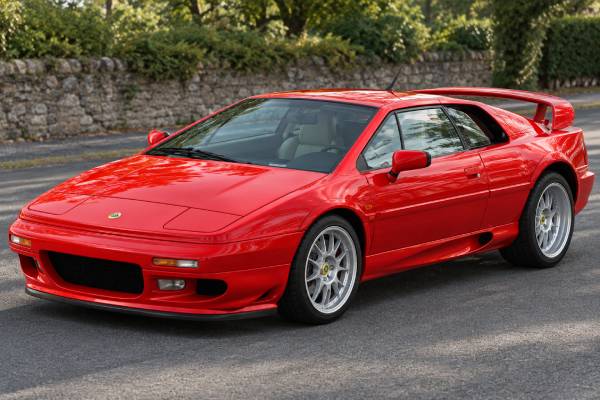
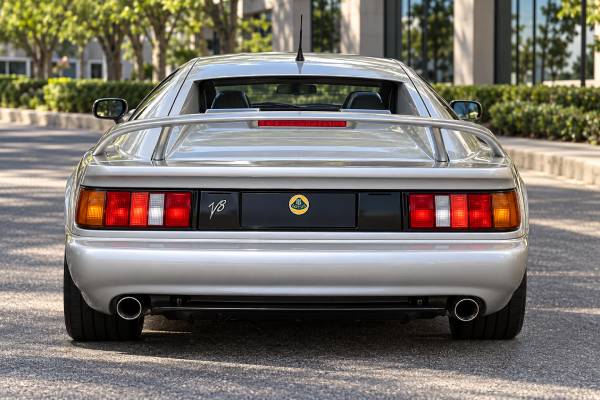
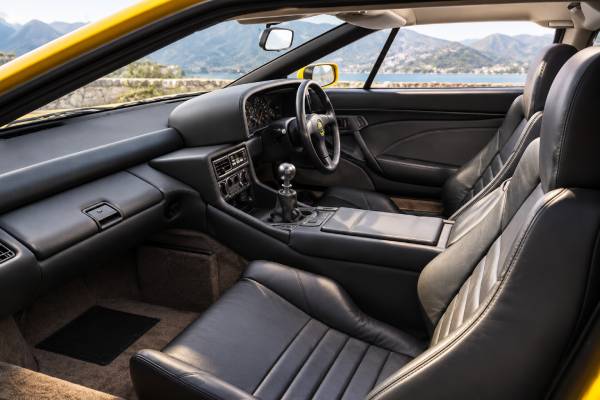
The 1996–1998 Lotus Esprit V8 is the car that finally gave the Esprit a Lotus-designed V8 without abandoning the compact backbone-chassis formula developed over the previous two decades. Its Type 918 is a 3.5-litre, all-aluminium, flat-plane-crank V8 with two turbochargers, 32 valves, 350 bhp, and 400 Nm of torque. That output turned the mature Esprit into a genuine 175 mph supercar, but it also exposed the limits of the Renault-derived five-speed transaxle and placed much more heat in an already crowded engine bay. Early V8 ownership is therefore about condition and update history as much as performance. The 1998 model year brought a substantially revised interior, while period service actions addressed timing-belt hardware, clutch, and fifth-gear concerns. This guide focuses specifically on 1996, 1997, and 1998 cars at the 350 hp rating, with special attention to Type 918 liner sealing, cooling, transmission health, maintenance evidence, and the checks that separate a good early V8 from a costly project.
Table of Contents
- The early V8 Esprit in context
- Type 918 specifications and running gear
- Why the V8 transformed the Esprit
- Early V8 engine and transmission risks
- Chassis, brakes, and driving experience
- A condition-led buying inspection
- Service history and ownership strategy
The early V8 Esprit in context
The 1996 V8 was a major mechanical change wrapped in a familiar Esprit body. Lotus retained the Type 82-based steel backbone chassis, composite body, rear-wheel drive, and five-speed transaxle, but replaced the long-serving turbo four-cylinder with its own compact twin-turbo V8.
That choice matters because the V8 is not simply a later trim level of the four-cylinder Esprit. The Type 918 was developed as a modern all-aluminium engine with four camshafts, four valves per cylinder, sequential electronic fuel injection, and two small turbochargers. Packaging remained compact enough to fit the existing Esprit architecture, and the engine with ancillaries was quoted at under roughly 220 kg.
Output was deliberately restrained. The road engine was capable of more, but the Renault UN1-based transaxle was already near its practical limit. Lotus settled on 260 kW, commonly expressed as 350 bhp or 355 PS, and 400 Nm. This is why tuned early V8s deserve more scrutiny than the power figure alone suggests: extra boost may be easy to obtain compared with the cost of making the gearbox equally strong.
The 1996–1998 period is also not visually or ergonomically uniform. Early V8s retained the previous dashboard architecture, while the revised 1998 model-year interior arrived from October 1997 production. Later in 1998 the V8 range evolved into GT and SE positioning. When comparing cars, build date and specification are more precise than registration year.
A buyer should also understand that the much-discussed cylinder-liner seal issue was not confined neatly to “1996 and 1997.” Lotus changed the liner sealant later in V8 production, around 2000. An early car may be perfectly healthy if it has never been overheated or has had documented corrective work; a later pre-change engine is not automatically immune. The correct question is what has happened to the individual engine.
Type 918 specifications and running gear
The Esprit V8 is a petrol ICE car with a longitudinal mid-mounted 3,506 cc twin-turbo V8, five-speed manual transaxle, and rear-wheel drive. The crucial numbers are 350 bhp at 6,500 rpm, 400 Nm at 4,250 rpm, a sub-five-second 0–62 mph time, and a quoted 175 mph maximum speed.
| Specification | Value |
|---|---|
| Engine | Lotus Type 918, 90-degree V8 |
| Location | Longitudinal, mid-mounted |
| Displacement | 3,506 cc (3.5 L) |
| Construction | Aluminium-alloy block and cylinder heads |
| Valvetrain | DOHC per bank, 32 valves total |
| Bore × stroke | 83.0 × 81.0 mm |
| Compression ratio | 8.0:1 |
| Turbochargers | Twin AlliedSignal/Garrett T25 units |
| Fuel system | Fully sequential electronic fuel injection |
| Maximum power | 260 kW (350 bhp / 355 PS) at 6,500 rpm |
| Maximum torque | 400 Nm (295 lb-ft) at 4,250 rpm |
| Recommended fuel | 98 RON for optimum performance; 95 RON permitted with reduced maximum performance in period documentation |
Two toothed timing belts drive the camshafts, one for each cylinder bank. That makes belt age, tension, idlers, and documented replacement critical service items rather than optional maintenance.
| Specification | Value |
|---|---|
| Transmission | Five-speed manual transaxle |
| Drive | Rear-wheel drive |
| 1st gear | 3.36:1 |
| 2nd gear | 2.06:1 |
| 3rd gear | 1.38:1 |
| 4th gear | 1.04:1 |
| 5th gear | 0.76:1 |
| Final drive | 3.89:1 |
The ratios help explain the V8’s broad performance, but the gearbox should be treated with mechanical sympathy. The slow linkage and heavy clutch are period traits; jumping out of gear, crunching shifts, or pronounced input-shaft noise are faults.
| Measure | Value |
|---|---|
| 0–60 mph | About 4.8 seconds |
| 0–100 km/h | About 4.9 seconds |
| 0–100 mph | About 10.3 seconds |
| Top speed | 175 mph (about 280 km/h) |
| Official combined consumption | 21.2 mpg UK (13.3 L/100 km) |
| Fuel tank | 70 L (15.4 imperial gal) |
Real fuel use can be substantially heavier when the turbos are worked. More important for inspection is consistency: a car that runs excessively rich, smells strongly of fuel, or has obvious misfire under boost should be diagnosed before purchase.
| Specification | Value |
|---|---|
| Body | Two-door, two-seat GRP/Kevlar composite coupe |
| Chassis | Hot-dip-galvanized steel backbone |
| Length | 4,369 mm (170.2 in) |
| Width | 1,883 mm (74.1 in), excluding mirrors |
| Height | 1,150 mm (45.3 in) |
| Wheelbase | 2,420 mm (95.3 in) |
| Ground clearance | 105 mm (4.1 in) |
| Unladen weight | About 1,380 kg (3,040 lb) |
| Specification | Value |
|---|---|
| Front suspension | Double wishbones, coil springs, telescopic dampers, anti-roll bar |
| Rear suspension | Upper/lower transverse links, radius arms, coil-over dampers |
| Steering | Power-assisted rack and pinion |
| Front brakes | 296 mm ventilated discs, Brembo four-piston calipers |
| Rear brakes | 300 mm ventilated discs, Brembo two-piston calipers |
| Front wheels | 8.5J × 17 |
| Rear wheels | 10J × 18 |
| Front tires | 235/40 ZR17 |
| Rear tires | 285/35 ZR18 |
Why the V8 transformed the Esprit
The Type 918 changed the way the Esprit accelerated more than it changed the car’s basic handling philosophy. Two small turbochargers and 3.5 litres gave the V8 a much wider torque band than the high-output four-cylinder cars, so rapid progress no longer depended as heavily on keeping one large turbo in its strongest range.
The flat-plane crankshaft keeps the engine compact and responsive, but its sound and vibration character differ from a cross-plane American V8. It is sharper and busier rather than bass-heavy. Boost is modest by tuned-car standards, and peak torque arrives at 4,250 rpm, giving strong acceleration through the middle of the rev range.
Lotus also kept the car relatively light for a 1990s supercar. At around 1.38 tonnes, the V8 had a strong power-to-weight ratio without needing 500 bhp. The 0–62 mph figure of roughly 4.9 seconds placed it firmly in contemporary Ferrari and Porsche territory, while 175 mph gave it the top-end performance its shape had always implied.
The engineering compromise sits behind the engine. The Renault transaxle had served the later four-cylinder Esprit, and the V8’s torque pushed it harder. Lotus did not exploit the engine’s full theoretical output partly because driveline durability set a practical ceiling. This makes aggressive aftermarket tuning a whole-car engineering problem rather than an ECU-only decision.
The V8 also increased thermal density. Two turbochargers, two cylinder banks, exhaust manifolds, catalysts, ignition components, and coolant plumbing all share a confined rear compartment. Heat shields, fans, radiator condition, water circulation, and clean electrical connections are therefore part of performance reliability.
For road driving, the gain is effortless speed. The car can accelerate hard in a higher gear where a four-cylinder Esprit might need a downshift, yet it still feels unmistakably analogue. The throttle is cable-operated, the gearbox is manual, the steering is hydraulic, and there is no modern stability-control layer masking the driver’s inputs.
One additional distinction is the relationship between rated power and naming. Period European literature often states 355 PS, which is the metric-horsepower expression of the same 260 kW output that is commonly rounded to 350 bhp in English-language material. Those figures should not be treated as two different factory tunes. When an advert claims a “355 hp” early V8, check whether the seller is merely repeating the PS figure or describing an actual modification.
The exhaust and catalyst layout also varies with market, and this affects heat load, emissions equipment, and replacement-part choice. A car imported between the UK, continental Europe, Japan, or North America may have been altered to satisfy local registration rules. Before ordering exhaust, ECU, oxygen-sensor, fuel-system, or evaporative-emissions parts, identify the original market and compare the current hardware against the relevant service documentation.
Because these cars are now old enough to have passed through periods of relatively low value, modification history can be more important than owner count. Aftermarket blow-off valves, boost controllers, nonstandard chips, larger turbos, bypassed emissions devices, and improvised cooling changes are not automatically harmful, but every change should have a clear engineering rationale and supporting records. A standard-looking engine bay with intact heat shielding and correctly routed hoses is often a stronger buying signal than a polished bay full of unexplained upgrades.
Early V8 engine and transmission risks
The early V8’s biggest purchase risks are loss of cylinder-liner seal integrity, overheating history, neglected timing belts, and a damaged transaxle. None automatically condemns every 1996–1998 car, but each can turn a bargain into a major repair.
The liner issue requires careful wording. The Type 918 uses wet cylinder liners sealed into the block. Earlier engines used a sealant that could lose integrity, particularly after overheating, allowing coolant contamination where it should not be. Lotus later adopted a different sealant. A healthy original engine that has always stayed within temperature limits can survive well; an overheated engine may not.
Warning signs include unexplained coolant loss, emulsified oil, pressure anomalies, coolant contamination, repeated overheating, or a history of engine removal without clear documentation. A pre-purchase inspection should include cooling-system pressure testing and whatever specialist diagnostic checks are appropriate to the symptoms. Do not rely on a clean expansion tank during a brief viewing.
Timing belts are equally critical. There are two belts, and a failure can allow piston-to-valve contact. Period service information and later specialist guidance emphasize regular tension checks and replacement. For a collector car that may cover few miles, calendar age matters. Receipts should identify the actual work performed, not merely state “major service.”
In 1998 Lotus undertook a service action on V8 cars that included revised timing-belt/idler components and other driveline work, commonly reported with clutch and fifth-gear locking updates. An early car should have documentary evidence of applicable campaigns or equivalent later work. If the record is missing, a Lotus specialist can identify hardware and advise what remains relevant.
The gearbox needs its own test. Hard launches, high-boost tuning, rushed shifts, and repeated full-throttle load in the taller gears can damage second gear, fifth gear, bearings, or input-shaft components. On the road:
- Shift from first to second at low and moderate rpm and listen for crunching.
- Apply and release load in second and fifth to check for abnormal movement or gear disengagement.
- Listen for bearing noise on drive and overrun.
- Confirm the clutch releases cleanly and does not slip under full torque.
- Check linkage condition rather than assuming every vague shift means internal failure.
A tuned engine makes the inspection more important. Ask who changed the calibration, what boost pressure is commanded, whether the fuel system was verified under load, and what gearbox upgrades accompany the extra torque. An undocumented “450 hp” claim is a liability, not a free bonus.
Chassis, brakes, and driving experience
The V8 remains a Lotus first and a power car second. Its steering, body control, and ability to communicate grip are what keep the chassis relevant even though the platform’s roots are much older than the engine.
Power steering reduces the parking effort of earlier Esprits without removing all texture. The wheel can kick over rough surfaces, and the car follows camber and tire condition more readily than a modern GT. That feedback is valuable when everything is tight, but worn lower-arm bushes, tired dampers, poor alignment, or mismatched tires can turn it into nervousness.
The Brembo braking system is strong for road use. Pedal response can feel short and firm, and ABS calibration is from an earlier generation, but a healthy system should be consistent. Inspect disc condition, caliper seals, hoses, fluid age, and ABS warning behaviour. A warning lamp that has been removed or disconnected is an obvious red flag.
Ground clearance is only about 105 mm. The front bumper and underbody are therefore vulnerable to steep ramps, bad jacking, and speed humps. Damage underneath can reveal more about a car’s use than polished paint above.
The composite body itself will not corrode like steel, but accident repairs can be hard to detect. Look for waves in reflected light, stress cracks around mounting points, mismatched panel texture, inconsistent shut lines, and repaired wheelarch areas. The galvanized chassis also deserves inspection where road damage or previous repairs may have breached its protective coating.
Tires are a major dynamic component. The 235-section front and 285-section rear fitment gives the V8 enormous mechanical grip, but old high-speed tires can look visually acceptable long after they should be replaced. Record date codes, matching model, load rating, and evidence of inner-edge wear. A car with expensive wheels but decade-old tires has not been maintained for actual high-speed use.
A condition-led buying inspection
Buy an early Esprit V8 by mechanical evidence, not mileage or cosmetics. A 50,000-mile car with regular specialist use can be safer than a 12,000-mile example that spent years stationary with old belts, stale coolant, dried seals, and untested fans.
Begin before the engine starts. It should be genuinely cold. Check coolant level and appearance, engine oil, visible hoses, turbo oil lines, exhaust shields, wiring, and evidence of recent cleaning intended to hide leaks. Look at the floor beneath the car and smell for fuel.
Start without touching the throttle unnecessarily. The engine should settle to a stable idle as management takes control. Watch warning lights complete their normal self-check, then monitor temperature as the car warms fully. Verify that radiator fans cycle correctly and that temperature remains controlled after a road drive followed by several minutes at idle.
During acceleration, use progressive throttle before asking for full boost. Misfire under load can come from ignition, fuel delivery, boost leaks, or more serious issues. Watch the mirrors for persistent smoke. A puff after extended idling has a different diagnostic meaning from continuous smoke under boost, so note exactly when it occurs.
Check hot restart behaviour. Heat-soak problems can expose tired starters, battery cables, sensors, coils, or fuel-system faults that a cold demonstration hides. Run the air conditioning, windows, mirrors, headlamp pods, cabin fans, gauges, central locking, alarm, and every switch because electrical repairs often involve access time rather than expensive parts alone.
For 1998 cars, inspect which interior is fitted and whether it is correct for build date. The revised interior is desirable to some buyers, but it should not be used to “date” the car without checking the VIN and build record. Likewise, GT and SE naming around 1998 can be confused in adverts.
A specialist pre-purchase inspection should include chassis condition, suspension play, brakes, wheel damage, engine compression/leak-down testing when indicated, cooling pressure testing, ECU fault history where accessible, boost behaviour, and a careful gearbox assessment. The cost is minor compared with one engine or transaxle rebuild.
Service history and ownership strategy
The most valuable early V8 service history is chronological and specific. You want to see what was done, when, at what mileage, by whom, and which parts were fitted—not a collection of generic stamps.
Give extra weight to invoices for timing belts and idlers, cooling-system renewal, radiator or fan work, clutch and gearbox work, turbocharger service, engine sealing, and applicable factory campaigns. Receipts for tires, brake fluid, batteries, and air-conditioning repair also show whether the car has been kept road-ready rather than merely stored.
After purchase, establish a baseline even if the history looks good. Fluids age, low-mileage cars develop electrical contact problems, and long periods of standing can be hard on fuel systems and hydraulic seals. A sensible first season prioritizes reliability before performance modification.
Usage technique also matters. Warm the engine and gearbox before heavy load. Do not lug the engine at large throttle openings in a high gear just because the V8 has enough torque to do it. Shift deliberately rather than racing the linkage, and give the car a low-load cool-down period after sustained boost. These habits reduce stress on the weakest parts without making the car tedious to drive.
Parts availability is better in some areas than the car’s rarity suggests, but specialist knowledge is uneven. Before buying, identify a workshop that actually understands the Type 918, UN1 transaxle, Lotus electrical systems, and composite body. General exotic-car experience is useful, yet it is not a substitute for knowing model-specific service procedures.
A careful owner also records battery-disconnect practices, immobilizer faults, and charging-system repairs, because repeated low voltage can create misleading electrical symptoms. Before blaming the ECU or sensors, a specialist should confirm battery condition, alternator output, grounds, and connector integrity under heat.
The early V8 is most appealing when it remains close to factory output. At 350 bhp it is already extremely quick on public roads, and the standard balance protects the transmission better than ambitious boost increases. Money spent on fresh suspension, correct tires, cooling, brakes, and accurate engine management usually produces a more satisfying car than chasing a dyno number.
A good 1996–1998 Esprit V8 therefore should not be dismissed because internet discussions focus on liners or gearboxes. Those risks are real, but they are condition-dependent and inspectable. The right car is one whose temperature history makes sense, belts and campaigns are documented, transaxle behaves correctly, electrical systems work, and owner decisions show mechanical sympathy. That evidence is what turns the Type 918 Esprit from a frightening proposition into one of the most distinctive British supercars of its era.
References
- Lotus Esprit – James Bond’s choice | Lotus Cars 2026 (Manufacturer heritage page)
- Esprit Models 2026 (V8 technical specification)
- Lotus Esprit V8 | PH Used Buying Guide – PistonHeads UK 2024
- Lotus Esprit V8 (2008) buying guide – Lotus Esprit V8 checkpoints | evo 2008
- Lotus Esprit (1987-2004) buyer’s guide: what to pay and what to look for | Classic & Sports Car 2019
- Lotus Esprit Owner’s Manual | Manualzz 1998 (Owner’s Manual)
Disclaimer
This article is for informational purposes and is not a substitute for professional diagnosis, inspection, or repair. Specifications, torque values, service intervals, and procedures vary by VIN, market, production date, and equipment; always verify them against the official Lotus service documentation for the exact car. If this guide is useful, please share it on Facebook, X/Twitter, or another enthusiast platform to support our work.