
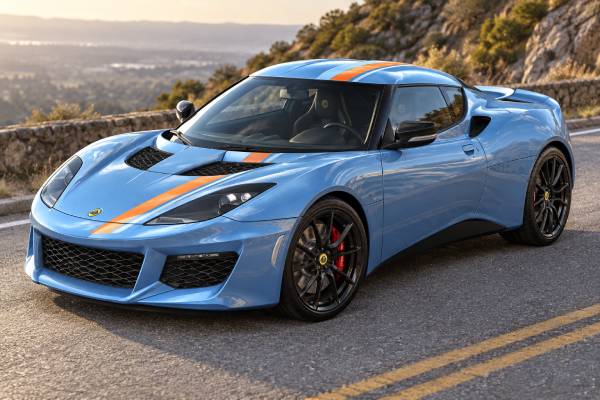
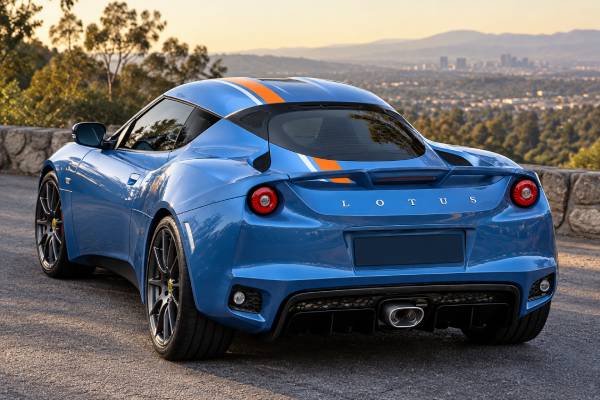
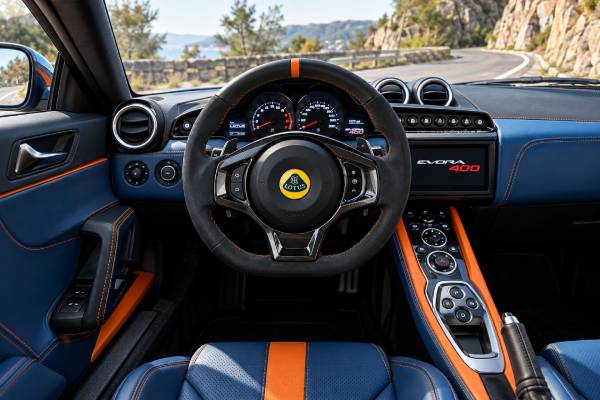
The 2016 Lotus Evora 400 Blue & Orange Edition is a ten-car special whose rarity comes from its factory-selected color scheme, not from a unique engine or chassis tune. Lotus invited enthusiasts to vote on proposed liveries through social media, then put the winning blue, orange, and white design into production through the Lotus Exclusive personalization program. Underneath, it remained an Evora 400: a supercharged 3.5-liter V6 with 400 hp, a substantially revised Type 122 chassis and cabin, AP Racing brakes, hydraulic steering, and either a six-speed manual or six-speed automatic. That distinction is important for ownership. Mechanically, the car can be serviced using the same core knowledge and parts framework as an Evora 400, while the special paint, stripes, trim, forged wheels, and documented identity deserve collector-level care. Because only ten were planned, an ordinary blue Evora 400 with added graphics is not equivalent. This guide separates edition-specific features from standard Evora 400 engineering, explains the relevant performance data, and shows what to verify before buying one.
Table of Contents
- How a Fan Vote Became a Ten-Car Factory Edition
- Blue & Orange Edition Details That Matter
- Evora 400 Engineering Beneath the Livery
- Performance and Technical Specifications
- Driving and Living With the Blue & Orange Edition
- Service, Preservation, and Cosmetic Care
- Authentication and Buying Strategy
How a Fan Vote Became a Ten-Car Factory Edition
The Blue & Orange Edition exists because Lotus turned a public design poll into an actual limited production run. In July 2016, the company announced that enthusiasts had selected a blue, orange, and white racing-inspired scheme and that only ten Evora 400s would be built in that configuration.
The project was part of the wider Lotus Exclusive program, the in-house personalization service used for unusual colors, trim combinations, graphics, and bespoke requests. Rather than simply releasing another dealer-created decal package, Lotus’s design team prepared a selection of schemes and asked fans to vote through social channels. Thousands of votes were reported, and the winning treatment recalled a blue-and-orange competition color combination associated with 1960s racing imagery. It also fit Lotus’s 2016 celebration of fifty years at Hethel.
That background gives the car a different collector story from the Hethel Edition launched earlier the same year. The Hethel Edition was conceived directly as a factory anniversary model using three heritage colors. The Blue & Orange car was a participatory Lotus Exclusive project whose final appearance was selected by fans. Its production volume was also unusually small: Lotus announced a total of ten cars.
The edition did not receive extra horsepower. Contemporary coverage and the Lotus-derived announcement were clear that the same Evora 400 powertrain sat underneath the special finish. For buyers, that means the correct mental model is “one of ten factory Blue & Orange specifications built on the Evora 400,” not “a mechanically uprated Evora 400.”
| Item | Edition detail |
|---|---|
| Model year | 2016 |
| Basis | Lotus Evora 400 |
| Planned production | 10 cars |
| Selection method | Winning design from a Lotus social-media fan poll |
| Program | Lotus Exclusive |
| Mechanical output | Standard Evora 400 specification, 400 hp |
| Theme | Blue body with orange and white racing-inspired graphics |
A ten-car announcement creates an obvious authentication issue decades later: appearance alone is weak evidence. The factory story, original invoice, VIN-specific build information, and period photographs are far more important than whether a car can be made to look correct today. Vinyl graphics, wheels, caliper color, and upholstery stitching can all be replicated. Provenance cannot.
Blue & Orange Edition Details That Matter
The edition’s defining features are visual and trim-related: blue paint, orange and white striping, black forged wheels, red brake calipers, and a black cabin with orange contrast stitching. These details are what separate an authentic car from a normal Evora 400 wearing a similar color combination.
Period descriptions show a light blue exterior with orange and white stripes running as a deliberate racing graphic rather than isolated accent pieces. Black forged wheels provide contrast, while red brake calipers add another strong color element behind the spokes. Inside, black leather upholstery is paired with orange stitching, tying the cabin back to the exterior theme without turning every surface orange.
Because Lotus Exclusive existed specifically to accommodate personalization, small specification differences are possible on individual low-volume cars. A buyer should therefore avoid the trap of treating a single press photograph as a rigid build sheet for all ten. Options such as transmission, convenience equipment, audio, seating arrangement, or market-specific equipment can differ while the car remains genuine. The non-negotiable issue is whether the vehicle can be documented as one of the factory Blue & Orange run.
| Area | Blue & Orange Edition | Underlying Evora 400 |
|---|---|---|
| Exterior | Blue with orange and white graphic treatment | Composite body on bonded aluminum structure |
| Wheels | Black forged finish reported for the edition | 19-inch front / 20-inch rear Evora 400 sizing |
| Brakes | Red calipers as a visual identifier | AP Racing four-piston system |
| Interior | Black leather with orange contrast stitching | Revised Evora 400 cabin and lower sills |
| Engine | No edition-specific power increase | Supercharged 3.5L V6, 400 hp |
| Chassis tune | No separate performance tune announced | Evora 400 suspension, steering, and DPM modes |
Preserving these details matters because the special edition’s scarcity is not hidden under the engine cover. Repainting a damaged wheel in a generic gloss black, replacing a graphic with an approximation, retrimming seats without matching the stitch color and pattern, or changing caliper finish may make little difference to performance but can reduce confidence in originality. When repairs are necessary, photograph the pre-repair condition and keep invoices, paint formulas, graphic templates, and removed original pieces whenever practical.
Evora 400 Engineering Beneath the Livery
Mechanically, the Blue & Orange Edition is an Evora 400, and that is a strength rather than a compromise. The 400 represented the largest engineering revision of the Evora up to that point, with more power, a redesigned rear body structure, improved cabin access, stronger braking, revised aerodynamics, and significant interior changes.
Its Toyota-derived 2GR-FE V6 displaces 3,456 cc and uses an Edelbrock supercharger in the Evora 400 application. Lotus rated the engine at 400 hp at 7,000 rpm and 410 Nm (302 lb-ft) at 3,500 rpm. The manual version uses a six-speed sports-ratio gearbox, a low-inertia flywheel, and a Torsen limited-slip differential. A six-speed automatic was optional and could be controlled through steering-wheel paddles.
One of the 400’s most useful changes is not visible in a specification chart: getting in and out is easier than in earlier Evoras. Lotus reduced and reshaped the sill structure and revised the cabin architecture, making the car less awkward in daily use while retaining the bonded and extruded aluminum chassis concept. That helps explain why an owner can enjoy the Blue & Orange car as a road vehicle rather than treating it only as a static collectible.
The suspension remains double wishbone front and rear, with Eibach springs and Bilstein dampers in the production specification. Steering is hydraulically assisted, a major part of the Evora’s tactile character. Lotus also fitted Dynamic Performance Management with selectable Drive, Sport, and Race settings, allowing the driver to alter throttle response and the intervention strategy of the stability system.
| System | Specification |
|---|---|
| Engine | 3,456 cc all-aluminum DOHC 24-valve V6 |
| Induction | Edelbrock supercharger |
| Power | 400 hp / 406 PS / 298 kW at 7,000 rpm |
| Torque | 410 Nm / 302 lb-ft at 3,500 rpm |
| Layout | Transverse mid-engine, rear-wheel drive |
| Manual transmission | Six-speed sports ratio, low-inertia flywheel, Torsen LSD |
| Automatic transmission | Optional six-speed automatic with paddles |
| Steering | Hydraulic power assistance, 2.86 turns lock-to-lock |
The chassis changes also increased aerodynamic stability. Lotus quoted 32 kg of downforce at 150 mph for the Evora 400, a meaningful reversal from the lift produced by the earliest Evora body. That figure does not turn the car into a track-only special, but it shows the 400’s redesign was functional rather than merely cosmetic.
Performance and Technical Specifications
The Blue & Orange Edition uses the same published performance figures as the normal 2016 Evora 400 unless VIN-specific factory documentation states otherwise. The manual is the faster car at maximum speed, while Lotus quoted the same 0–60 mph time for manual and automatic versions.
With the six-speed manual, Lotus quoted 0–60 mph in 4.1 seconds, 0–100 km/h in 4.2 seconds, and 186 mph (300 km/h). The automatic also carried a 4.1-second 0–60 mph claim and 4.2 seconds to 100 km/h, but its maximum speed was lower at 174 mph (280 km/h). Official brochure data listed an unladen weight of 1,395 kg for the manual and 1,425 kg for the automatic.
| Measure | Manual | Automatic |
|---|---|---|
| 0–60 mph | 4.1 sec | 4.1 sec |
| 0–100 km/h | 4.2 sec | 4.2 sec |
| Top speed | 300 km/h / 186 mph | 280 km/h / 174 mph |
| Unladen weight | 1,395 kg / 3,075 lb | 1,425 kg / 3,142 lb |
| Combined consumption | 9.7 L/100 km / 29.1 mpg UK | 9.7 L/100 km / 29.1 mpg UK |
| CO2 | 225 g/km | 225 g/km |
The brake package is appropriately serious for those numbers. AP Racing four-piston calipers act on two-piece cross-drilled and ventilated discs measuring 370 x 32 mm at the front and 350 x 32 mm at the rear. Standard wheel sizing is 19 inches front and 20 inches rear, with the factory brochure specifying Michelin Pilot Sport tires in 235/35 R19 front and 285/30 R20 rear sizes.
| Item | Evora 400 specification |
|---|---|
| Chassis | Bonded and extruded aluminum |
| Suspension | Independent double wishbones, Eibach springs, Bilstein dampers |
| Front brakes | AP Racing four-piston, 370 x 32 mm two-piece ventilated discs |
| Rear brakes | AP Racing four-piston, 350 x 32 mm two-piece ventilated discs |
| Front tires | 235/35 R19 |
| Rear tires | 285/30 R20 |
| Seating | 2+2 standard; 2+0 available on Evora 400 depending on specification |
| Aerodynamic load | 32 kg downforce at 150 mph |
These figures are more useful as a baseline than as a reason to chase maximum speed. On a 2016 car, tire age, alignment, brake condition, damper health, and cooling-system integrity have far more influence on how safely it performs today than its original brochure claims.
Driving and Living With the Blue & Orange Edition
The Blue & Orange Edition drives like an Evora 400: fast, communicative, and surprisingly usable for a mid-engine car, but with the extra psychological burden of knowing that cosmetic damage affects one of only ten factory examples. The ideal owner enjoys it without pretending rarity makes normal road risks disappear.
The engine’s strongest quality on the road is flexibility. Peak output arrives high in the rev range, yet 410 Nm at 3,500 rpm gives the car useful thrust without constant downshifting. Supercharger response is immediate compared with a large turbocharged engine, and the V6’s broad delivery suits both fast touring and short bursts of acceleration. A manual car adds the involvement of the sports-ratio gearbox and limited-slip differential; the automatic makes traffic and urban use easier and still allows manual selection through paddles.
Hydraulic steering is central to the experience. The wheel communicates surface texture and loading in a way many newer electrically assisted systems filter out, while the double-wishbone suspension controls the body without requiring an excessively harsh ride. On rough roads, tire condition and correct pressures matter. Old or incorrectly specified tires can make an Evora feel nervous, noisy, or less progressive near the limit.
The cabin is easier to access than earlier Evoras, but it remains a low sports car. Door clearance, front splitter height, wide rear haunches, and limited rearward visibility require attention. The reversing camera and parking aids are therefore practical equipment rather than luxuries, especially when the rear bodywork and special graphics are difficult to replace perfectly.
If the car is stored for long periods, use does not become optional. Batteries dislike inactivity, seals and air-conditioning systems benefit from operation, tires can flat-spot, brakes can corrode, and old fuel is not a preservation strategy. A low-mileage special edition with neglected fluids can be a worse ownership proposition than a carefully driven car with comprehensive annual records.
Choosing between manual and automatic matters more to the driving experience than the Blue & Orange graphics. The manual adds the Torsen limited-slip differential and asks the driver to work with the V6 directly, which suits owners who seek the classic Evora interaction. The automatic is easier in city use and on long trips, but a collector should not assume it is mechanically identical just because the brochure acceleration claim is the same. Transmission-specific service history, software behavior and road-test quality need to be judged on their own terms.
Tires are another practical dividing line between a car that merely looks correct and one that drives correctly. The Evora chassis is sensitive to tire construction and age, so a matching, recent set in factory-appropriate sizes is preferable to old rubber preserved for originality. If a previous owner changed brands, record why and check alignment after installation. On a ten-car special, preserving the wheels and body graphics is sensible; preserving unsafe tires is not.
Service, Preservation, and Cosmetic Care
Maintain the Blue & Orange Edition mechanically as an Evora 400 but preserve its cosmetics as a ten-car special. That two-track approach prevents owners from either neglecting service in the name of originality or casually replacing rare edition details with generic alternatives.
Begin with the powertrain. Records should document regular engine-oil service, correct filters, coolant condition, belt inspection, spark-plug and ignition attention when due, and investigation of any warning lights. Check the front cooling system and pipework for leaks or impact damage. The car should reach and hold normal operating temperature without unexplained coolant loss or fan behavior. Supercharger and accessory-drive noises should be assessed by a Lotus specialist rather than dismissed as “normal for a 400.”
Manual cars deserve a careful clutch and gear-change check. The clutch is a wear component whose replacement labor can be significant. Confirm that the bite point is consistent, there is no slip under high load, and all gears select cleanly. Automatic cars should engage drive and reverse promptly and shift smoothly when fully warm as well as immediately after a cold start. Transmission software or adaptation behavior can complicate diagnosis, so a specialist scan is worthwhile when anything feels abnormal.
Brake inspection should include disc thickness and condition, pad wear, caliper operation, flexible hoses, and fluid age. The large two-piece rotors are performance components, not cheap generic consumables. Suspension checks should cover ball joints, bushes, dampers, wheel bearings, and a four-wheel alignment if tire wear is uneven or the steering wheel sits off-center.
| Area | Good practice | Avoid |
|---|---|---|
| Paint and graphics | Hand wash carefully, document repairs, preserve original graphic dimensions | Aggressive polishing across decal edges or approximate replacement stripes |
| Forged wheels | Record factory finish before refurbishment | Changing color or machining profile without documentation |
| Red calipers | Use heat-resistant correct-looking restoration when needed | Unrecorded color changes |
| Interior | Protect leather and retain orange stitch pattern during repairs | Generic retrims that erase edition identity |
| Mechanical service | Follow VIN-appropriate Lotus documentation and annual inspection | Skipping maintenance because mileage is low |
| Storage | Dry environment, battery care, periodic proper operation | Long static storage on old fuel and underinflated tires |
For exterior care, photograph stripe placement, widths, terminations, and panel relationships before any body repair. If a graphic is damaged, retain a sample where possible. Paint-protection film can be sensible on high-impact areas, but installation and removal should be performed by someone comfortable working around decals, composite panels, and edges that may have been refinished.
Keep a physical and digital history file. Include invoices, MOT or inspection records, alignment sheets, tire invoices with date codes, battery replacement, photographs of paint and graphics, and any communication confirming the car’s Blue & Orange identity. On a run of ten, that archive can become almost as important as the service book.
Authentication and Buying Strategy
A Blue & Orange Edition should be authenticated through documents and VIN-specific history before price negotiation. Because a normal Evora 400 can be painted blue and striped, the special appearance is evidence to inspect, not proof by itself.
Ask the seller for the original purchase invoice or dealer order, factory build information, certificate or Lotus correspondence if available, and period photographs showing the car in its original specification. Trace previous owners and advertisements where practical. Compare the VIN across the chassis, documents, and diagnostic records. If a car has been exported between markets, make sure the identity trail remains continuous and that any market-specific lighting, emissions, or safety modifications are documented.
Inspect the exterior in strong natural light. Look for differences in paint tone between composite panels, overspray, disturbed fasteners, inconsistent stripe alignment, lifting graphic edges, and evidence that decals were applied over a later repaint. None of those automatically disqualifies the car—ten-year-old sports cars can need cosmetic work—but every repair should make sense when matched against invoices and photographs.
Then carry out a conventional Evora 400 pre-purchase inspection. Start from cold, scan the vehicle for stored fault codes, test every electrical function, operate the air conditioning, inspect the underside on a lift, check brakes and suspension, assess clutch or automatic behavior, and measure tire age as well as tread depth. Verify that wheels are straight and correctly finished and that the car tracks cleanly on a road test.
The purchase decision should reflect intended use. A perfectly original, ultra-low-mileage example may suit a collector who can preserve it in climate-controlled storage and exercise it correctly. A car with more mileage but excellent service records can be the better choice for someone who intends to tour. Cosmetic perfection without mechanical history is not a bargain.
Most importantly, pay for documented scarcity, not a story. The ten-car production claim is well supported by period coverage and Lotus-derived material, but the specific car still has to belong to that run. Once authenticity is established, the Blue & Orange Edition offers an appealing combination: the mature, thoroughly revised Evora 400 mechanical package with a colorful factory narrative that cannot be recreated simply by choosing the same shades from a paint chart.
Before agreeing a value, separate reversible wear from irreversible loss of identity. Worn tires, an aging battery or consumed brake pads are ordinary service items. Missing original wheels, an undocumented full-color repaint, deleted graphics or a completely retrimmed cabin are different because they change the features that justify the edition premium. A car with cosmetic restoration can still be excellent, but the work should be photographed, invoiced and technically accurate.
For owners who plan to drive regularly, rarity should encourage preparation rather than fear. Keep high-resolution photographs of every side of the car, record graphic dimensions, insure it for a realistic agreed value, and identify a body shop comfortable with Lotus composites before an accident forces a rushed decision. That preparation lets the car be used for what the Evora 400 does best—fast road driving and touring—without treating every mile as damage to a display object.
References
- LOTUS FANS GIVE EVORA 400 AN EXCLUSIVE ICONIC RACING COLOUR SCHEME — Lotus media information archive, 2016.
- This Blue & Orange Lotus Evora 400 is 1 of 10 (and possibly sold out) — Autoweek, 2016.
- 2016 Lotus Evora 400 Blue & Orange Edition — TopSpeed, 2016.
- Lotus Evora 400 — Lotus official brochure, 2016, archived by Lotus Drivers Guide.
- Lotus Evora – Drive without Compromise | Lotus Cars — Lotus Cars model heritage.
- Downloads – Lotus Drivers Guide — Lotus Drivers Guide brochure archive.
Disclaimer
This article is for informational purposes only and is not a substitute for professional diagnosis, inspection, maintenance, or repair. Specifications, torque values, service intervals, procedures, and fitted components can vary by VIN, market, equipment, and individual factory build; verify the exact car against official service documentation from Lotus and qualified specialist advice before ordering parts or carrying out work.
If you found this Blue & Orange Edition guide useful, please share it with another Lotus enthusiast or prospective owner.