
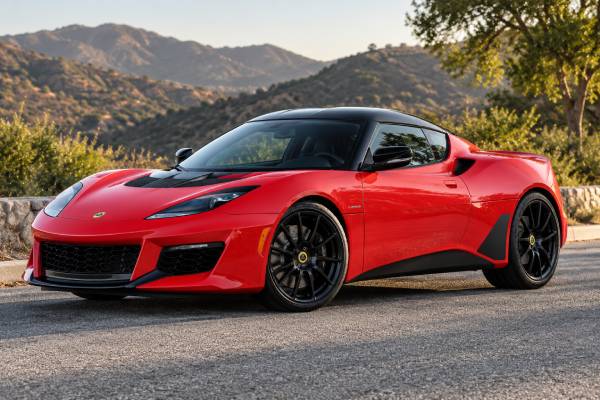
The 2020–2021 Lotus Evora GT is the North American finale of the Type 122 road car: a 416 hp, supercharged, mid-engine coupe that combines an unusually communicative chassis with enough comfort equipment to be used beyond a favorite back road. It replaced the Evora 400 and Sport 410 in the United States and Canada, gaining more power, more aerodynamic downforce, and a lower minimum weight while keeping the hydraulic steering and bonded-aluminum structure that define the Evora. Buyers could choose a six-speed manual with a Torsen limited-slip differential or a six-speed automatic with more torque, plus either two seats or a compact 2+2 layout. That flexibility makes used-car shopping more complicated than the model name suggests. Carbon-fiber options, transmission choice, software campaign history, tires, and service records all matter. This guide separates factory specification from tested performance, explains the engineering choices, and focuses on the inspections and ownership details that are most useful before buying one today.
Table of Contents
- Why the North American Evora GT Is Its Own Version
- Road Use, Cabin Packaging, and Real-World Performance
- Evora GT Technical Data and Factory Specifications
- Manual Versus Automatic: The Choice Changes the Car
- How to Inspect and Buy a Used Evora GT
- Carbon, Aerodynamics, and Chassis Hardware
- Service Campaigns and Maintenance Priorities
Why the North American Evora GT Is Its Own Version
The key point is that the 2020–2021 Evora GT is not simply a renamed European GT410 Sport. Lotus created the GT specifically for the United States and Canada, replacing the North American Evora 400 and Sport 410 with one 416 hp model that could be configured from relatively road-friendly to distinctly track-biased.
Lotus announced the GT for the 2020 model year with 422 PS, or 416 bhp, from the supercharged 3.5-liter V6. The output increase was modest in isolation, but the complete package mattered more. Revised bodywork produced up to 64 kg (141 lb) of downforce at maximum speed, double the figure Lotus quoted for the Evora 400. Selected carbon-fiber pieces were standard, while a larger optional carbon package could reduce mass further. The lightest manual configuration was quoted at 1,408 kg (3,104 lb), although a normally equipped car could be heavier.
The GT also arrived at a useful point in the Evora’s development. The Type 122 architecture had been in production for more than a decade, so Lotus had already refined the shift mechanism, cooling, cabin trim, and electronic drive modes through several earlier versions. Yet the GT still retained features that were becoming rare in new performance cars: hydraulic steering, a manual gearbox, a mechanical limited-slip differential, passive dampers, and relatively little driver-assistance hardware.
That combination explains why the model is more than a spec-sheet curiosity. It delivers modern supercar-level pace without filtering the driver’s inputs through many layers of electronic control. The steering is especially important. Its hydraulically assisted rack has 2.86 turns lock-to-lock and is mounted rigidly enough that road texture and front-tire load are easy to read. Owners often value that quality more than a faster infotainment screen or a longer equipment list.
Finally, do not confuse the North American GT with the UK-market GT410 or GT410 Sport. The names overlap in time, but the specifications, equipment packages, fuel-economy procedures, and published torque figures are not interchangeable. For this article, the scope is only the 416 hp Evora GT sold in the United States and Canada for the 2020 and 2021 model years.
Road Use, Cabin Packaging, and Real-World Performance
The Evora GT can function as a road car, but it asks its owner to accept compromises that a Porsche 911 or mainstream grand tourer largely avoids. Its reward is a level of steering feel and chassis transparency that is difficult to replicate in heavier, more insulated alternatives.
On real roads, 416 hp is more than enough because the car does not carry much mass. The V6 is flexible at ordinary engine speeds and becomes much more vocal as revs rise. Supercharger response is immediate compared with a heavily boosted turbo engine, so throttle position translates naturally into acceleration. That linearity helps the driver meter power mid-corner and makes the car feel predictable even when driven briskly.
Ride quality is another Evora strength. The fixed-rate suspension can be firm on sharp edges, especially on Cup 2 tires, yet the damping is controlled rather than brittle. The chassis does not need to be excessively stiff to create response. That makes long trips plausible, although road noise, tire noise, and cabin ergonomics remind occupants that the GT’s priorities remain performance-led.
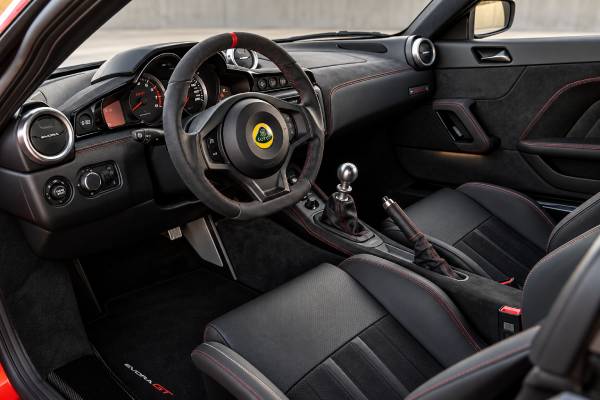
The seating configuration requires particular attention. Lotus offered both two-seat and 2+2 cars. The rear seats add flexibility for small children or soft luggage, but they should not be treated as normal adult accommodation. A two-seat car may be preferable for an owner who wants a simpler cabin and uses the rear area for storage. Conversely, a genuine 2+2 can be useful if those occasional rear positions match the buyer’s needs. Verify the actual car rather than assuming all GTs have the same layout.
Visibility is acceptable forward and to the sides, while the rear-view camera helps compensate for the body shape. Parking sensors are useful because the low nose and broad rear haunches are difficult to judge from the driver’s seat. Inspect those systems during a purchase because replacement trim, cameras, and model-specific body pieces can be disproportionately expensive on a low-volume car.
Fuel economy is secondary to most Evora GT buyers, but the manual’s EPA highway rating of 26 mpg is respectable for the performance. The automatic is rated lower on the highway at 24 mpg, with both listed at 17 mpg city. Driving style has a large effect: repeated supercharger boost, short trips, and track use can move consumption far away from those test figures.
The larger ownership point is that the GT works best when its limitations fit the buyer’s life. If easy entry, quiet cruising, abundant luggage capacity, and modern driver aids are priorities, another sports car will make fewer demands. If steering fidelity, low mass, rarity, and a manual mid-engine layout are the priorities, the Evora’s compromises become easier to justify.
Evora GT Technical Data and Factory Specifications
The Evora GT is a gasoline-only, mid-engine, rear-wheel-drive sports car. Its 3,456 cc aluminum V6 uses an Edelbrock supercharger and water-to-air charge cooling, with either a six-speed manual or six-speed automatic. The most important specification split is the transmission: power is the same, but torque, maximum speed, curb weight, highway fuel economy, and differential hardware differ.
| Specification | Evora GT |
|---|---|
| Powertrain type | Supercharged gasoline internal-combustion engine |
| Engine | 3.5-liter (3,456 cc) 24-valve aluminum V6 |
| Induction | Edelbrock supercharger with water-to-air charge cooler |
| Maximum power | 416 bhp (422 PS) at 7,000 rpm |
| Maximum torque, manual | 430 Nm (317 lb-ft) from 3,500 rpm |
| Maximum torque, automatic | 450 Nm (332 lb-ft) |
| Drive | Rear-wheel drive |
| Transmissions | 6-speed manual or 6-speed automatic with steering-wheel paddles |
| Limited-slip differential | Torsen type, manual transmission only |
| Specification | Manual | Automatic |
|---|---|---|
| 0–60 mph | 3.8 seconds | 3.8 seconds |
| Maximum speed | 303 km/h (188 mph) | 280 km/h (174 mph) |
| Wet/kerb weight | 1,440 kg (3,175 lb) | 1,451 kg (3,199 lb) |
| Lightest possible weight | 1,408 kg (3,104 lb) | 1,419 kg (3,128 lb) |
| Downforce at maximum speed | 64 kg (141 lb) | 64 kg (141 lb) |
| Specification | Factory detail |
|---|---|
| Chassis | Bonded and riveted extruded-aluminum structure |
| Front suspension | Forged-aluminum double wishbones, Eibach springs, Bilstein sports dampers |
| Rear suspension | Forged-aluminum double wishbones, Eibach springs, Bilstein sports dampers |
| Steering | Hydraulically assisted rack and pinion, 2.86 turns lock-to-lock |
| Front brakes | AP Racing 4-piston calipers; 370 × 32 mm ventilated, cross-drilled discs |
| Rear brakes | AP Racing 4-piston calipers; 350 × 32 mm ventilated, cross-drilled discs |
| Tire sizes | 245/35 ZR19 front; 295/30 ZR20 rear Michelin Pilot Sport Cup 2 |
| Specification | Value |
|---|---|
| Body style | 2-door mid-engine coupe; 2-seat or 2+2 configuration |
| Length | 4,394 mm (173.0 in) |
| Width | 1,972 mm (77.6 in), factory overall-width figure |
| Height | 1,223 mm (48.1 in) |
| Wheelbase | 2,575 mm (101.4 in) |
| Fuel-tank capacity | 55 L (14.5 US gal) |
| Transmission | City | Highway |
|---|---|---|
| 6-speed manual | 17 mpg US | 26 mpg US |
| 6-speed automatic | 17 mpg US | 24 mpg US |
| Item | Practical significance |
|---|---|
| Drive modes | Drive, Sport, Race, and Off settings alter throttle response and stability/traction intervention |
| Infotainment | 7-inch touchscreen with navigation, reversing camera, Apple CarPlay, and Android Auto |
| Carbon Pack | Additional carbon-fiber exterior panels reduce mass and contribute to the lightest configurations |
| Titanium exhaust | Factory option aimed at additional mass reduction |
These numbers are best read as configuration-specific, not as one universal curb weight. A GT with the automatic transmission, rear seats, standard body panels, and comfort options will not weigh what a two-seat manual fitted with the carbon package weighs. For a used car, the build sheet is more informative than an advertisement that simply quotes the lowest published number.
Manual Versus Automatic: The Choice Changes the Car
Choose the transmission based on how you want the GT to feel, not on the 0–60 mph number. Lotus quoted the same 3.8-second sprint for both, but the six-speed manual gets the Torsen limited-slip differential and a much higher 188 mph maximum speed, while the automatic delivers 450 Nm instead of 430 Nm and is easier in dense traffic.
The manual is the purist’s configuration for good reasons. Its aluminum shift mechanism gives deliberate mechanical feedback, and the limited-slip differential helps the driver put power down when accelerating out of a corner. Car and Driver’s manual test car reached 60 mph in 4.0 seconds and the quarter mile in 12.4 seconds at 111 mph, slightly slower than Lotus’s launch claim but still very quick. More important, the test praised the car’s steering and shift feel while noting that clutch effort is heavy.
That heavy clutch matters in a used-car decision. A ten-minute test drive on an open road may make it seem irrelevant; an hour of stop-and-go traffic may not. Check clutch take-up from cold and hot, feel for slip under full load in a high gear, and listen for abnormal noises when engaging or disengaging the pedal. The manual also uses a lightweight single-mass flywheel, so some mechanical character at low speed is part of the design, but harsh vibration, difficulty selecting gears, or obvious clutch slip is not.
The automatic is not simply the slower option. It offers paddle shifting and extra torque, and it makes the Evora easier to use for commuting or urban driving. Its lower 174 mph maximum speed has little practical relevance on public roads. What matters is whether shifts are clean and repeatable in both full automatic and manual-paddle operation, especially once the transmission is warm. Buyers should also give extra attention to software history because Lotus issued a 2020 model-year campaign covering a limited VIN range in which updated ECU and TCU programming was required. The TCU update addressed a shift/control error.
That same campaign included an ECU calibration intended to prevent a false or unnecessary P0014 variable-valve-timing diagnostic code. A car with a stored code therefore should not be diagnosed by guesswork. Confirm the VIN’s campaign status, scan the modules properly, and establish whether the correct software level is installed before replacing mechanical parts.
For resale, manuals often attract the most enthusiastic buyers, but condition remains more important than gearbox ideology. A well-serviced automatic with clean shifts, documented fluid work, and no warning lights can be a much better purchase than a neglected manual that has spent years on track tires and an abused clutch.
How to Inspect and Buy a Used Evora GT
The best Evora GT is the one with a clear identity, complete history, correct configuration, and evidence of careful use. Start with the VIN and build specification, then inspect the structure, body, consumables, and electronics before judging paint color or optional trim.
Establish exactly what the car is
Confirm model year, transmission, seating configuration, carbon options, wheel type, and any factory titanium exhaust. Compare the actual components with the seller’s description. Carbon panels are valuable, so replacement or refinished pieces deserve close inspection. A car advertised at the lightest published weight should have the equipment that made that figure possible; otherwise the claim is just brochure shorthand.
Inspect the aluminum structure and body carefully
The bonded chassis is central to the Evora’s behavior and repair economics. Look underneath for impact marks, crushed jacking areas, or signs of improper lifting. The large sills and low front bodywork are vulnerable to cosmetic damage, but structural concerns require specialist evaluation. Check panel gaps, paint texture, fasteners, and carbon surfaces for evidence of previous repairs.
Do not reject a car merely because a bumper has been refinished; low noses collect stone chips. The important question is why work was done and whether it was done correctly. Ask for repair invoices and photographs if accident work is disclosed.
Use a cold start and a full-temperature road test
Arrange to see the engine cold. Listen for abnormal accessory-belt chirping, prolonged rattles, misfire, or unstable idle. After warm-up, use the full range of normal driving conditions: low-speed maneuvering, steady cruise, firm acceleration, braking, and a few rougher road surfaces. The car should track consistently, the steering should self-center naturally, and there should be no clunks from suspension joints or loose trim that mask mechanical noise.
Manual cars should shift cleanly without clutch slip or severe graunching. Automatic cars should perform clean cold and hot shifts, including paddle commands. In either case, scan for stored and pending fault codes. A recently cleared warning light is not a repair.
Budget for condition, not just purchase price
Consumables are performance-car sized even though the vehicle itself is light. Four correct premium tires, AP Racing-compatible pads and discs, fluid service, a battery, or carbon-body repair can quickly change the economics of a seemingly inexpensive example. A pre-purchase inspection by a shop familiar with Lotus cars is therefore unusually valuable.
For a buyer deciding between two otherwise similar cars, prioritize in this order: chassis integrity, mechanical condition, service documentation, campaign status, tire/brake condition, then optional equipment. Rare paint and carbon are attractive, but none compensates for a damaged structure or a car with unexplained electronic faults.
The 2020–2021 Evora GT is compelling precisely because it sits at the end of an unusual engineering line. It offers a supercharged V6, mid-engine balance, hydraulic steering, and an available manual differential-equipped drivetrain in a package that remained light by modern standards. Buy one with a rigorous inspection and maintain it on time, and those qualities are far more likely to remain the focus than the costs of catching up neglected work.
Carbon, Aerodynamics, and Chassis Hardware
The Evora GT’s engineering priority is clear: reduce unnecessary mass, create useful high-speed stability, and preserve mechanical feedback. It does not pursue downforce with a towering rear wing or rely on adaptive suspension to cover a wide range of behaviors. Instead, Lotus integrates airflow management into the body and lets a relatively simple passive chassis do the work.
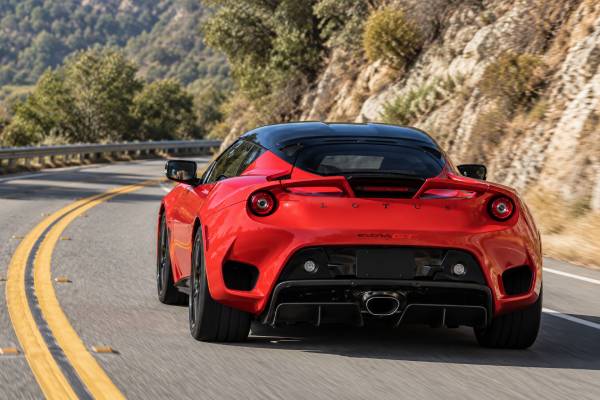
The aerodynamic changes are easy to miss if the car is viewed only from standing height. A front lip reduces airflow beneath the nose, front wheel-arch louvres manage pressure, ducts behind the rear wheels vent the arches, and a motorsport-influenced rear diffuser controls the wake beneath the tail. Together, those features produce the quoted 64 kg of downforce at maximum speed. The figure is not comparable with the extreme GT430’s much larger aero load, but it is significant for a road car that still has clean bodywork and a 188 mph manual-transmission top speed.
Carbon fiber also serves a functional rather than merely cosmetic role. Standard GT equipment already used carbon in selected areas, and the optional Carbon Pack expanded that approach with the front access panel, roof panel, and a one-piece lightweight tailgate with integrated spoiler and louvred rear window area, along with exposed-carbon rear details. On a car this light, tens of kilograms matter because they affect acceleration, braking, transient response, and tire workload at the same time.
Suspension is conventional in the best sense. Unequal-length double wishbones allow Lotus to control wheel motion precisely, while Eibach springs and Bilstein dampers avoid the complexity and cost of adaptive units. The standard Cup 2 tire package supplies very high dry grip, but tires are an important ownership variable. Age, temperature, tread depth, and alignment can change the car’s behavior dramatically. A fresh set of premium tires with a correct alignment is worth more dynamically than many aftermarket modifications.
The braking hardware is equally serious: AP Racing four-piston calipers work on large two-piece discs, 370 mm at the front and 350 mm at the rear. On a low-mass car, that combination provides a large thermal margin for fast road use. A track-driven example can still consume pads and discs, however, so visual condition alone is not enough. Check disc thickness, cracking around drilled holes, pad depth, fluid age, and evidence of heat stress.
What makes the chassis memorable is the interaction among all these choices. Hydraulic steering tells the driver what the front tires are doing; passive dampers give a consistent response; modest overall mass allows the springs and brakes to work without fighting excess inertia. The result is a car that does not need a dozen suspension settings to feel specialized.
Service Campaigns and Maintenance Priorities
A used Evora GT should be bought on documentation as much as condition. The engine has durable Toyota-family origins, but the complete Lotus installation includes a supercharger, bespoke cooling, transmission hardware, low-volume body parts, and model-specific calibration, so skipped maintenance can still become expensive.
Kelley Blue Book’s Lotus maintenance schedule for the 2020 Evora GT lists oil and filter replacement at 7,500 miles or six months under normal use, with shorter intervals for harder service. It also lists transmission fluid at 45,000 miles or six years, engine air filter and spark plugs at 30,000 miles or six years, annual brake and clutch fluid, and coolant every four years. Those are useful planning figures, but an owner should always confirm the applicable schedule against Lotus service information for the car’s VIN and market, especially if the vehicle has been tracked.
Time-based servicing matters because many Evora GTs cover modest annual mileage. A six-year-old car with 8,000 miles can still be overdue for fluids, plugs, or aged rubber. Ask for invoices rather than relying on a stamped book alone. Invoices reveal oil grade, parts used, brake-fluid dates, alignment work, tire replacements, and whether faults were investigated properly.
Two factory service campaigns deserve specific attention on the 2020–2021 GT:
- 2020 ECU/TCU software campaign 2019/13: Lotus identified a limited VIN range that left the factory without the latest software. The ECU update addressed a false or unnecessary P0014 exhaust-timing code; the TCU update corrected a shift/control error. Confirm completion by VIN rather than assuming every 2020 car needed it or that every car received it.
- 2021 auxiliary drive-belt campaign 2021/04: Lotus identified specific belt date codes made with an incorrect material specification. The defect could create a chirping sound for several minutes during warm-up and, in extreme circumstances, reduce belt service life. The bulletin covered affected 2021 Evora GT vehicles built from August 5 to November 26, 2020 and instructed inspection and, when necessary, belt replacement.
Those campaigns illustrate why diagnostic history matters on a rare car. A warning light or warm-up noise may have a known factory explanation, but it can also have an unrelated cause. Verify the VIN, read stored fault codes, and use a Lotus-capable specialist rather than assuming a bulletin automatically explains the symptom.
Brake fluid condition and pad history matter on cars that have seen track days. Cup 2 tires also reveal a lot: outer-edge wear can suggest hard cornering, inner-edge wear may point to aggressive alignment or missed inspections, and old date codes can make a low-mileage tire unsafe despite good tread depth. Because the GT depends so heavily on tire behavior, replacing aged rubber should be treated as core maintenance rather than cosmetic spending.
Battery condition is another low-mileage-car issue. Cars stored for long periods can suffer weak batteries and low-voltage electrical oddities. A proper maintainer helps, but the purchase inspection should still include charging voltage and a battery test rather than merely confirming that the engine starts.
References
- The new Lotus Evora GT for 2020 model year (North America) – Lotus Cars Media Site 2019 (Manufacturer technical release)
- 2021 Lotus Evora GT Review, Pricing, and Specs 2021 (Independent road test)
- 2020 Lotus Evora GT Service Schedules & Maintenance Pricing | Kelley Blue Book 2020 (Maintenance reference)
- Procedure to install the latest level ECU & TCU .crp programs for Evora GT 2020 model year vehicles. 2019 (TSB)
- Inspection and potential renewal of the auxiliary drive belt due to inclusion of incorrect specification material during manufacturing process. 2021 (TSB)
- Lotus Evora – Drive without Compromise | Lotus Cars 2026 (Manufacturer heritage)
Disclaimer
This article is for general informational purposes and is not a substitute for professional diagnosis, repair, or inspection. Specifications, torque values, maintenance intervals, procedures, software campaigns, and equipment can differ by VIN, market, production date, and vehicle configuration. Verify work against current official Lotus service information and the documentation for the exact car.
If this guide was useful, share it with another Evora owner or buyer who is comparing North American GT examples.