
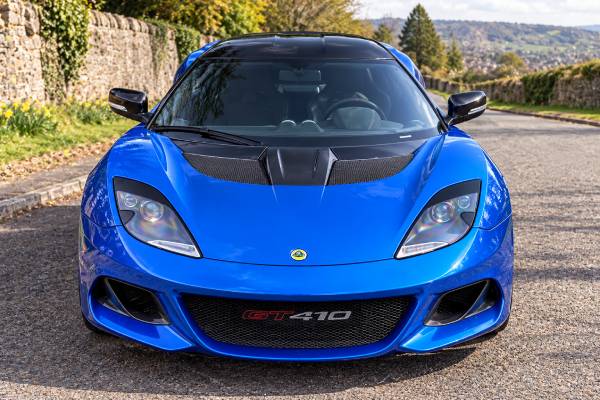
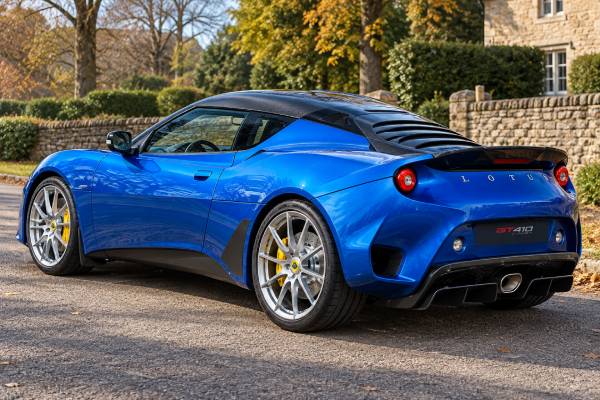
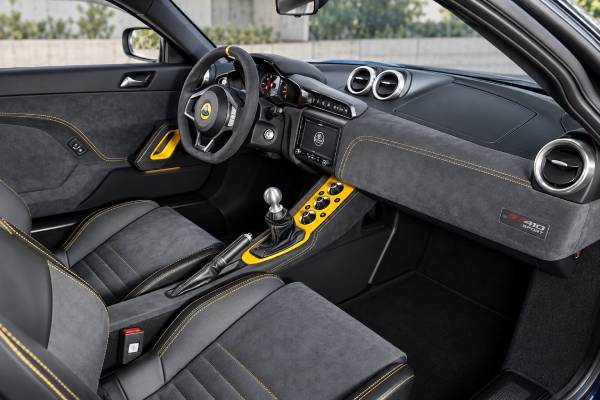
The Lotus Evora GT410 Sport is the most broadly useful of the focused late-model Evoras: it combines 410 hp, a bonded-aluminium chassis, hydraulic steering, substantial carbon-fibre bodywork, and GT430-inspired aerodynamics without the rare GT430’s adjustable Öhlins hardware or extreme rear wing. Launched in 2018 as the successor to the Sport 410, it could be ordered as a two-seater or 2+2 and with a six-speed manual or automatic. One complication for buyers is that published specifications changed as homologation methods and model-year equipment evolved. Early launch data lists a lightest dry weight of 1,256 kg and 96 kg of maximum-speed downforce, while later WLTP-era brochures quote higher unladen weights and lower downforce figures at revised top speeds. Those numbers are not safely interchangeable. The right way to understand a used GT410 Sport is to identify its market, build date, transmission, seating and options, then judge the car by its actual specification, service history, tyres, brakes, clutch, cooling system, and carbon-body condition.
Table of Contents
- Why the GT410 Sport Replaced the Sport 410
- Why Published GT410 Sport Figures Differ
- Service, Consumables, and Long-Term Care
- GT410 Sport Specifications and Technical Data
- Supercharged V6, Manual, and Automatic
- Buying and Inspecting a GT410 Sport
- Road Manners, Aero, and Chassis Balance
Why the GT410 Sport Replaced the Sport 410
The GT410 Sport moved the 410 hp Evora into the newer GT430-derived body and aerodynamic language. It kept the core Evora virtues—light weight, a supercharged mid-mounted V6, hydraulic steering, and double-wishbone suspension—but added more sophisticated airflow management and a broader range of seating and transmission choices.
The change is visible around the nose and rear wheel arches. Larger front ducts, a deeper splitter, air-management features around the front wheels, rear arch vents, and a motorsport-style diffuser reduce turbulence and generate useful downforce. Carbon fibre was used extensively, including body panels and aero elements, supporting both mass reduction and the car’s functional design.
Unlike the GT430, the GT410 Sport uses non-adjustable Bilstein dampers with Eibach springs rather than Öhlins TTX units. That reduces setup complexity and ownership cost while retaining the Evora’s forged-aluminium double-wishbone layout. For a road-focused enthusiast, this can be an advantage: there are fewer settings to get wrong, and the factory calibration is already very capable.
The GT410 Sport also retained practical flexibility. Lotus offered both 2+0 and 2+2 configurations in relevant markets. The rear seats are small, but the 2+2 layout can carry children or soft bags and may matter to buyers who want to use the car for trips rather than only weekend drives. The two-seat version prioritizes simplicity and low mass.
Production continued into the final years of the Evora line, and this is why a 2018 car and a 2021 car should not automatically be assumed to have identical published data. Emissions testing changed, standard equipment evolved, and Lotus’s own technical literature moved from launch “dry/kerb” figures to later “unladen” figures. A good article—and a good purchase decision—needs to keep those contexts separate.
Why Published GT410 Sport Figures Differ
Different GT410 Sport numbers are not necessarily errors. Lotus’s 2018 launch material and later brochures describe cars under different weight definitions, test cycles, and production contexts, so copying the lowest number from each source creates a specification that never existed as one car.
The launch claim of 1,256 kg is explicitly a “lightest possible dry weight.” Dry weight excludes fluids that later unladen or kerb definitions include, and it may assume lightweight options. A later 1,361 kg unladen figure therefore cannot be subtracted directly from 1,256 kg to claim that the car gained 105 kg in a simple model-year change.
Downforce is similarly conditional on speed. The 2018 launch figure of 96 kg was tied to the original aero claim at maximum speed. Later brochure data lists 55 kg for the manual and 48 kg for the automatic at their quoted maximum speeds. Because aerodynamic load rises strongly with speed, a lower quoted top speed or revised measurement condition can change the number without requiring the body to have been fundamentally redesigned.
Torque data also changed in published literature, from 420 Nm in early launch specifications to 410 Nm over a broader rpm range in later brochures. That may reflect calibration, homologation, or specification updates. The safest approach is to state the source context and use the documentation that matches the car’s market and production period.
For a buyer, this matters because sellers often advertise the most attractive figure regardless of the actual car. A later GT410 Sport should not automatically be described as a 1,256 kg car, and an early launch figure should not be used as proof of a particular 2020 or 2021 specification. Ask for the original brochure, build sheet, certificate, and market-specific handbook when precision matters.
Service, Consumables, and Long-Term Care
A GT410 Sport rewards preventive maintenance. The best strategy is to treat age, heat cycles, and use pattern as seriously as mileage, especially now that even 2021 cars are no longer new.
Verify regular engine-oil and filter changes and inspect for leaks around the engine and transmission. Check coolant condition and the charge-cooler circuit, including fluid level and circulation. A hot supercharged engine that cannot control intake temperature may feel strong once and then lose consistency after repeated acceleration.
Brake and clutch fluid should be renewed on a time basis appropriate to the official schedule and use. Track work or mountain driving can justify shorter intervals. Coolant also ages, and old tyres remain old even if tread depth is excellent. Date codes are therefore part of the service history.
The following items are worth documenting at purchase:
- engine oil grade, specification, and last change date;
- spark-plug and air-filter history;
- manual or automatic transmission-fluid history;
- engine coolant and charge-cooler service;
- brake and clutch fluid age;
- auxiliary belt condition;
- tyre dates, tread, and matching axle pairs;
- brake-disc thickness and pad remaining life;
- battery age and charging behavior;
- last wheel alignment and any suspension work.
The car’s low nose and aero hardware also require routine visual checks. Inspect the splitter, undertrays, diffuser, and wheel-arch liners after trips on poor roads. Missing fasteners or a cracked panel can worsen quickly if ignored.
Cars stored for long periods need battery maintenance and regular inspection for damp, sticking brakes, flat-spotted tyres, and rodent damage. A garage-kept Evora is not automatically preserved if it has sat with an empty battery and old fluid for years. Mechanical systems generally benefit from correct, regular use.
GT410 Sport Specifications and Technical Data
The GT410 Sport is a gasoline ICE sports car with a 3,456 cc supercharged V6 mounted transversely behind the cabin and driving the rear wheels. It was offered with six-speed manual and automatic transmissions. The tables below use clearly labeled launch-era or later-brochure figures rather than blending the two.
| Specification | Value |
|---|---|
| Engine | 3,456 cc all-aluminium V6, 24 valves |
| Engine family | Toyota 2GR-based V6 with Lotus calibration |
| Induction | Edelbrock supercharger with integrated charge cooling |
| Maximum power | 410 hp (416 PS) at 7,000 rpm |
| Drive type | Rear-wheel drive |
| Manual gearbox | 6-speed with Lotus precision shift mechanism |
| Automatic gearbox | 6-speed with steering-wheel paddles |
| Manual differential | Torsen-type limited-slip differential |
| Specification | Manual | Automatic |
|---|---|---|
| Maximum torque | 420 Nm | 420 Nm |
| 0–60 mph | 4.0 s | 3.9 s |
| 0–100 km/h | 4.2 s | 4.1 s |
| Maximum speed | 305 km/h (190 mph) | 275 km/h (171 mph) |
| Kerb weight | 1,320 kg | 1,331 kg |
| Dry weight | 1,279 kg | 1,292 kg |
| Lightest possible dry weight | 1,256 kg | 1,267 kg |
| Claimed downforce | 96 kg | 96 kg |
| Specification | Manual | Automatic |
|---|---|---|
| Maximum torque | 410 Nm from 3,000–7,000 rpm | 410 Nm from 3,000–7,000 rpm |
| 0–60 mph | 4.0 s | 3.9 s |
| 0–100 km/h | 4.2 s | 4.1 s |
| Maximum speed | 300 km/h (186 mph) | 280 km/h (174 mph) |
| Unladen weight | 1,361 kg | 1,368 kg |
| Power-to-weight ratio | 301 hp/tonne | 300 hp/tonne |
| Downforce at maximum speed | 55 kg | 48 kg |
| Test phase | Manual | Automatic |
|---|---|---|
| Low | 16.7 L/100 km | 18.2 L/100 km |
| Medium | 10.7 L/100 km | 11.1 L/100 km |
| High | 9.1 L/100 km | 9.4 L/100 km |
| Extra high | 9.5 L/100 km | 9.6 L/100 km |
| Combined | 10.6 L/100 km | 11.0 L/100 km |
| Combined CO₂ | 239 g/km | 248 g/km |
| Specification | Value |
|---|---|
| Chassis | Bonded and riveted extruded-aluminium structure |
| Suspension | Unequal-length forged-aluminium double wishbones front and rear |
| Springs and dampers | Eibach springs with Bilstein sports dampers |
| Steering | Hydraulically assisted rack and pinion, 2.86 turns lock-to-lock |
| Front brakes | 370 × 32 mm two-piece ventilated discs, AP Racing four-piston calipers |
| Rear brakes | 350 × 32 mm two-piece ventilated discs, AP Racing four-piston calipers |
| Driver modes | Drive / Sport / Race with reduced intervention in performance modes |
| Specification | Value |
|---|---|
| Body style | 2-door mid-engine coupe |
| Seating | 2+0 or 2+2 depending on specification |
| Drag coefficient | 0.35 in launch technical data |
| Frontal area | 1.91 m² in launch technical data |
| Wheel diameter | 19-inch front, 20-inch rear |
| Typical Cup 2 fitment | 235/35 R19 front, 285/30 R20 rear |
| Major aero features | Deep front splitter, wheel-air management, rear arch vents, and rear diffuser |
Supercharged V6, Manual, and Automatic
The 3.5-liter supercharged V6 gives the GT410 Sport immediate response and a broad usable rev range. Unlike a large turbocharged engine that may build torque abruptly, the Evora’s power delivery is linear enough to meter carefully with the throttle, which suits a rear-wheel-drive chassis.
The manual is the more traditional Lotus choice. It uses a low-inertia flywheel and a Torsen limited-slip differential, so the driver gets direct gear selection and mechanical torque biasing at the rear axle. A good manual car should shift cleanly once warm and should not crunch, resist engagement, or jump out of gear.
The automatic is quicker in the original 0–60 mph and 0–100 km/h claims because it shifts consistently and reduces driver workload. It also makes the Evora much easier in stop-start traffic. The trade is less mechanical involvement and a lower quoted top speed in early specifications. For normal road use, the choice is personal rather than objectively right or wrong.
On a manual GT410 Sport, assess the clutch as a system rather than relying on pedal feel alone. Once the drivetrain is fully warm, use a safe stretch of road to apply strong mid-range throttle and make sure engine speed rises in step with road speed. Then repeat several clean starts and shifts, listening for bearing noise and watching for a bite point that moves as temperature builds. Because clutch access involves substantial labor on the Evora, any flare, vibration, or inconsistent engagement deserves a specialist inspection before the purchase price is agreed.
For both transmissions, service history matters more than internet assumptions about “Toyota reliability.” The engine may be Toyota-based, but the supercharger, charge cooling, exhaust, ECU calibration, mid-engine installation, and Lotus transmission integration make this a specialized package. Correct fluids, cooling performance, and diagnostic attention remain essential.
Buying and Inspecting a GT410 Sport
Buy the GT410 Sport that has the clearest identity and maintenance story. Because specifications evolved and Lotus allowed substantial personalization, knowing exactly what a car is can be more important than comparing two advertisements line by line.
Start with the VIN and build documentation. Confirm market, production date, transmission, 2+0 or 2+2 layout, wheels, seats, carbon parts, exhaust, infotainment, and any Lotus Exclusive trim. If the seller quotes a particular weight, downforce, or torque figure, ask which official specification supports it.
Inspect the carbon panels and low aero surfaces in strong light. Look for impact cracks, repaired weave, lacquer damage, broken mounts, and inconsistent panel gaps. Minor cosmetic wear is common; structural damage or badly repaired mounting points are more serious. The bonded aluminium chassis should be inspected on a lift, especially around jacking points and suspension pick-ups.
Road-test the car from cold if possible. Confirm a stable start, no warning lights, effective air conditioning, proper charge-cooler behavior, clean throttle response, straight braking, and precise steering. Then repeat key checks once the car is fully warm. Heat can reveal clutch, gearbox, cooling, and electrical problems that a short cold drive hides.
Test every convenience feature. On a car that may be used for touring, faulty windows, mirrors, parking sensors, rear camera, central locking, HVAC, or infotainment become more annoying than their apparent importance suggests. Water leaks and poor seals can also damage trim and electronics over time.
For U.S.-specification 2018 vehicles, recall history deserves a VIN check. NHTSA issued campaigns affecting certain 2018 Evora vehicles, including a steering-column issue and the later 2017–2018 passenger toe-board compliance recall. Applicability depends on the individual VIN and production date, so use official recall records rather than model-name assumptions.
When choosing between the GT410 Sport and the later GT410, decide how much focus you actually want. The GT410 introduced softer damper rates, Michelin Pilot Sport 4S tyres, a glass tailgate, more sound insulation, heated seats and other comfort equipment as standard. The GT410 Sport stays closer to the harder-edged, lighter philosophy. Neither is universally better; the Sport is the choice for someone who values sharper calibration and carbon-intensive character over the later car’s daily comfort.
A well-kept GT410 Sport can therefore be a sweet spot in the Evora range. It has enough aero and carbon engineering to feel special, enough performance to remain seriously fast, and less setup complexity than a GT430. The key is resisting specification-sheet shopping. Verify the exact car, pay for a specialist inspection, budget for tyres and brakes, and prioritize documented condition over the lowest odometer reading.
The 2+2 option deserves a practical check rather than a simple yes-or-no preference. Rear space is limited, but the small seats can materially improve the car as a weekend tourer because they provide secure space for soft luggage even when no passenger sits there. Inspect the rear belts, trim, seat bases, and access mechanism, and make sure any previous owner has not removed parts to imitate a 2+0 car. Conversely, a genuine two-seat specification may appeal more to an owner who values originality and the cleaner lightweight brief.
Model-year context also affects equipment. Late cars are often advertised with features that were optional or unavailable on an early 2018 example, while early press photographs may show lightweight configurations that ordinary customer cars did not share. Build sheets and invoices resolve these questions better than online option lists. This is especially useful for forged versus cast wheels, carbon roof or tailgate details, comfort equipment, sound insulation, and infotainment. A dealer or specialist familiar with late Evoras can often identify factory hardware by part number and finish.
Track use should be evaluated by evidence rather than stigma. The GT410 Sport was designed with brakes, tyres and cooling that make occasional circuit work plausible, but Lotus still expected increased preparation and inspection for hard use. A car with documented fluid changes, fresh pads, alignment records and careful post-event checks may be a stronger buy than a supposedly road-only car with old Cup 2 tyres and no brake measurements. Ask what circuits were used, how often, and whether the car ran additional cooling or non-standard pads. The answers reveal far more than the phrase “never abused.”
Set aside a realistic first-year reserve even after a clean pre-purchase inspection. On a used GT410 Sport, tyres, brake discs, battery, air-conditioning work, alignment, a clutch, or a carbon repair can each be significant. They will not all be due on every car, but budgeting for several at once prevents deferred maintenance. The Evora is most rewarding when its steering, brakes and suspension are kept at the standard Lotus intended; postponing wear items gradually removes the qualities that make the car worth owning.
Finally, keep your own records detailed. Note fluid brands and specifications, tyre date codes, alignment settings, brake measurements, battery replacement, and any changes to wheels or exhaust. Photograph the underside and carbon panels when the car is healthy. A continuous file helps technicians diagnose later changes and gives a future buyer confidence that the car’s unusual construction and evolving factory specification were understood rather than guessed at.
A specialist road test after alignment is especially valuable because the Evora communicates small geometry errors clearly. Centered steering, even tyre temperatures, and stable braking provide useful confirmation that the chassis is working as intended.
Road Manners, Aero, and Chassis Balance
The GT410 Sport’s strongest quality is that it delivers high grip without muting the Evora’s steering and ride communication. It is serious enough for occasional circuit work yet simple enough that a driver can enjoy it without learning damper setup theory.
The Bilstein/Eibach combination is fixed, but “fixed” does not mean unsophisticated. Lotus spent considerable effort tuning spring, damper, bushing, anti-roll-bar, tyre, and steering behavior as one system. On a smooth road, body movement is tightly controlled. On broken pavement, the double-wishbone geometry and relatively low mass let the wheels move without the heavy thumping common in much larger performance cars.
Hydraulic steering remains a major attraction. The wheel communicates front-tyre loading naturally, and the rack is quick without feeling nervous when the alignment and tyres are correct. If a used car tramlines heavily, refuses to self-center, or requires constant correction, investigate tyre wear, pressures, wheel damage, alignment, and suspension joints before accepting that behavior as normal.
The aero works primarily at speed. Front and rear wheel-arch pressure management, the splitter, and the diffuser help reduce lift and improve stability, but they do not replace mechanical grip in slow corners. Tyres, alignment, and damper condition remain more important in most road driving.
Cup 2 tyres suit warm, dry conditions and fast use, but their performance changes substantially with temperature and age. For year-round road driving, many owners prefer a more versatile ultra-high-performance road tyre. That can make the car less nervous in rain and cold weather, though it changes steering response and ultimate dry grip. Use correct sizes and ratings, and avoid mixing unrelated tyre models front to rear.
The braking system has ample capacity for road use, yet two-piece discs and AP Racing calipers are not inexpensive consumables. A vibration under braking, a pronounced lip, heat cracking, pad taper, or discolored hardware deserves inspection. On cars used on track, ask which pad compound and brake fluid were used and how often the system was checked.
References
- The New Lotus Evora GT410 Sport 2018 (Launch and technical specification)
- Lotus Evora Brochure 2019.indd 2019 (Model brochure)
- Lotus Evora – Drive without Compromise | Lotus Cars 2026 (Lotus heritage comparison and successor information)
- Part 573 Safety Recall Report 2018 (NHTSA Recall 18V-781)
- LOTUS EVORA 400 2018 OWNER’S HANDBOOK MANUAL Pdf Download | ManualsLib 2018 (Owner’s Handbook)
- Part 573 Safety Recall Report 2019 (NHTSA Recall 19V-263)
Disclaimer
This article is for informational purposes only and is not a substitute for professional diagnosis, inspection, or repair. Specifications, torque values, service intervals, procedures, recall applicability, and equipment vary by VIN, market, production date, model year, and options. Verify all technical work against official Lotus service documentation for the exact vehicle.
If this guide was useful, please share it on Facebook, X/Twitter, or your preferred automotive community to support our work.