
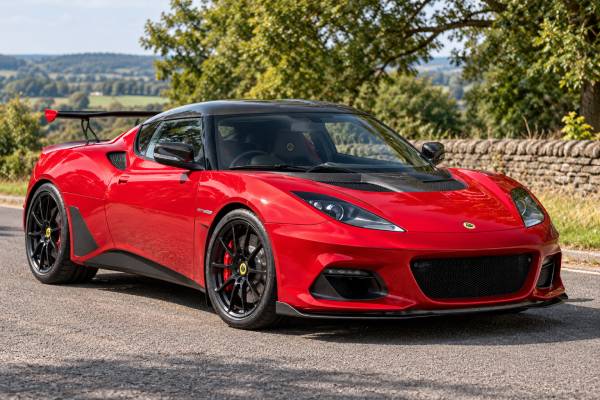
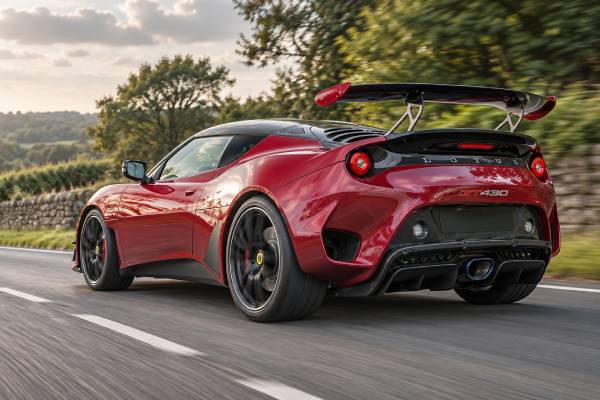
The Lotus Evora GT430 Sport is the high-speed counterpart to the winged GT430. It keeps the 430 hp supercharged V6, Öhlins TTX adjustable dampers, titanium exhaust, carbon-intensive construction, and variable traction control, but removes the large rear wing and some of the GT430’s most aggressive aero devices. That change cuts dry weight to 1,248 kg for the manual and raises its claimed maximum speed to 315 km/h, making the GT430 Sport the faster car in a straight line even though it produces much less downforce. Lotus quoted 100 kg of aerodynamic load at maximum speed, compared with 250 kg for the winged GT430. Buyers therefore need to understand the model’s deliberate compromise: lower drag and cleaner bodywork in exchange for less high-speed aero assistance. As a used car, the GT430 Sport also demands close attention to its adjustable suspension, carbon components, forged wheels, Cup 2 tyres, AP Racing brakes, clutch, and transmission because replacing neglected low-volume hardware can quickly outweigh an attractive purchase price.
Table of Contents
- What Makes the GT430 Sport Different
- Manual or Automatic: Which GT430 Sport Fits You
- GT430 Sport Specifications and Technical Data
- Maintenance and Long-Term Ownership
- Suspension Setup, Tyres, and Braking
- Used-Buying Checklist and Value Factors
- 315 km/h Versus 250 kg of Downforce
What Makes the GT430 Sport Different
The GT430 Sport is not a lesser GT430; it is a differently optimized version. Lotus retained the expensive chassis and lightweight hardware but reduced aerodynamic drag by deleting the winged car’s most extreme high-downforce elements. The result is a lighter, faster, visually subtler Evora for drivers who value top-speed efficiency and road use over maximum circuit aero.
That distinction is easiest to see at the rear. The standard GT430’s high-mounted carbon wing dominates the silhouette and contributes heavily to its 250 kg downforce figure. The Sport uses a cleaner tail treatment while retaining carbon-fibre construction, wheel-arch venting, diffuser work, and front airflow management. Lotus still claimed 100 kg of downforce at the manual car’s 315 km/h maximum speed, so this is not an aero-neutral Evora. It simply operates at a different point on the drag/downforce curve.
The powertrain remains a supercharged, charge-cooled 3.5-liter V6 with 430 hp. Manual cars were quoted at 440 Nm, while automatic cars received 450 Nm. Both transmissions were available, making the Sport broader in character than the original manual-focused GT430 launch specification. The automatic also produced the quickest official sprint numbers, while the manual achieved the highest maximum speed.
The suspension is where the Sport proves its seriousness. Öhlins TTX dampers with independent compression and rebound adjustment, Eibach springs, forged double wishbones, tubular anti-roll bars, and hydraulic steering remain part of the package. The six-position variable traction-control concept also carries over, allowing experienced drivers to select defined slip levels rather than choosing only between full intervention and none.
Because GT430 Sport production was limited and specifications could differ by market, originality matters. A car missing its titanium exhaust, lightweight battery, correct dampers, forged wheels, or carbon panels may still drive well, but it should not be valued as an intact factory example without explanation and documentation.
Manual or Automatic: Which GT430 Sport Fits You
The manual and automatic GT430 Sport deliver different strengths, so the right choice depends more on how the car will be used than on which version wins a specification-table argument. The automatic is quicker to 100 km/h; the manual is lighter, has the Torsen LSD, and reaches the higher maximum speed.
For an enthusiast who values mechanical interaction, the manual is the more distinctive package. Its low-inertia flywheel lets the engine change speed quickly, and the Torsen differential provides a purely mechanical response to rear-wheel speed differences. The driver controls every upshift and downshift, which complements the Evora’s steering feedback and adjustable chassis.
The automatic has practical advantages. Paddle shifts reduce workload in traffic and can make rapid acceleration easier to repeat. Lotus also quoted 450 Nm rather than the manual’s 440 Nm. Its 280 km/h maximum speed is lower because gearing and transmission strategy differ, but that is irrelevant for almost all road use.
Condition should decide between two used examples. A perfect automatic with documented fluid service is preferable to a manual with a slipping clutch, damaged synchros, or neglected linkage. Likewise, a crisp manual with a healthy clutch and clean shift action may be more desirable than an automatic that hesitates, flares between shifts, or shows evidence of poor maintenance.
On a manual test drive, assess clutch take-up from cold and hot, low-speed maneuvering, first-to-second shift quality, and full-load acceleration in a higher gear. On an automatic, test smooth low-speed engagement, manual paddle response, kickdown, hot shifting, and any warning messages. Transmission behavior should remain consistent after a long drive.
GT430 Sport Specifications and Technical Data
The GT430 Sport is a mid-engine, rear-wheel-drive gasoline sports car powered by a supercharged 3,456 cc V6. It was offered with six-speed manual and six-speed automatic transmissions. The manual is lighter and reaches the higher top speed; the automatic has slightly more torque and the quicker official 0–100 km/h time.
| Specification | Manual | Automatic |
|---|---|---|
| Engine | 3,456 cc all-aluminium V6, 24 valves | 3,456 cc all-aluminium V6, 24 valves |
| Induction | Edelbrock supercharger with charge cooling | Edelbrock supercharger with charge cooling |
| Maximum power | 430 hp (436 PS) at 7,000 rpm | 430 hp (436 PS) at 7,000 rpm |
| Maximum torque | 440 Nm (325 lb-ft) from 4,500 rpm | 450 Nm (332 lb-ft) from 4,500 rpm |
| Drive | Rear-wheel drive | Rear-wheel drive |
| Exhaust | Titanium system | Titanium system |
| Specification | Manual | Automatic |
|---|---|---|
| 0–60 mph | 3.7 s | 3.6 s |
| 0–100 km/h | 3.8 s | 3.7 s |
| 0–100 mph | Under 8 s | Under 8 s |
| Maximum speed | 315 km/h (196 mph) | 280 km/h (174 mph) |
| Kerb weight | 1,289 kg | 1,300 kg |
| Dry weight | 1,248 kg | 1,259 kg |
| Power-to-weight ratio | 345 hp/tonne | 342 hp/tonne |
| Downforce at maximum speed | 100 kg | 100 kg |
| Specification | Manual | Automatic |
|---|---|---|
| Transmission | 6-speed manual | 6-speed automatic |
| Shift control | Precision mechanical linkage | Steering-wheel aluminium paddles |
| Limited-slip differential | Torsen type | Transmission-specific driveline arrangement |
| Flywheel | Low-inertia single-mass | Automatic-specific |
| Gearbox cooling | Fitted | Fitted |
| Specification | Value |
|---|---|
| Chassis | Bonded and riveted extruded-aluminium structure |
| Suspension | Unequal-length forged-aluminium double wishbones |
| Dampers | Öhlins TTX two-way adjustable aluminium units |
| Damper range | 20-click compression and rebound adjustment |
| Springs | Eibach low-sideload springs |
| Steering | Lotus-tuned hydraulic rack, 2.86 turns lock-to-lock |
| ESP modes | Drive / Sport / Race with reduced or disabled intervention by mode |
| Traction control | Five preset slip levels plus off |
| Specification | Value |
|---|---|
| Front brakes | 370 × 32 mm two-piece J-hook ventilated discs, AP Racing four-piston calipers |
| Rear brakes | 350 × 32 mm two-piece J-hook ventilated discs, AP Racing four-piston calipers |
| Wheel diameter | 19-inch front, 20-inch rear forged aluminium |
| Standard front tyre | Michelin Pilot Sport Cup 2, 235/35 R19 |
| Standard rear tyre | Michelin Pilot Sport Cup 2, 285/30 R20 |
| Optional wider package | 245/35 R19 front and 295/30 R20 rear with wider rear wheels |
| Component | Factory purpose |
|---|---|
| Carbon-fibre front and rear bumpers | Mass reduction and airflow management |
| Carbon-fibre roof and access panel | Lower mass high in the body |
| Carbon-fibre tailgate | Reduces rear and upper-body mass |
| Polycarbonate rear glazing | Weight saving |
| Wheel-arch venting | Reduces pressure around rotating wheels |
| Front splitter and rear diffuser | Generate and balance aerodynamic load |
| Lightweight lithium-ion battery | Reduces vehicle mass |
Maintenance and Long-Term Ownership
The GT430 Sport’s engine architecture is proven, but the complete car is not inexpensive to run. The low-volume carbon, Öhlins dampers, forged wheels, large brakes, performance tyres, and compact mid-engine packaging create costs that do not exist on a normal Toyota-powered vehicle.
Treat service history as a sequence, not a stamp collection. Look for evidence of regular oil changes, brake and clutch fluid renewal, coolant maintenance, air-filter and spark-plug service, transmission-fluid work, belt inspection, battery care, and alignment checks. Time matters because many cars cover low annual mileage.
Cooling-system health is particularly important. Inspect the engine coolant circuit and the supercharger charge-cooler circuit for leaks, staining, low level, damaged hoses, or poor circulation. A car that feels strong on one pull but noticeably loses performance after repeated acceleration may deserve investigation of intake temperatures and charge cooling.
The titanium exhaust should be checked for impact damage, cracked brackets, poor aftermarket repairs, or substituted sections. Titanium saves meaningful mass but requires appropriate repair techniques. A non-original exhaust is not necessarily a problem, though it can alter noise, calibration assumptions, and collector value.
Öhlins dampers are serviceable rather than disposable in the conventional sense. Ask whether they have ever been rebuilt and by whom. Mileage alone does not define rebuild need; track use, road quality, heat, and storage all matter. A fresh set of professionally serviced dampers can transform a car that had gradually become imprecise.
Battery maintenance also matters because the lightweight lithium-ion unit does not tolerate every generic charger. Identify the battery chemistry and use compatible equipment. Long storage with a deeply discharged battery can create electrical frustration and an unnecessary replacement bill.
For occasional track use, add inspections before and after events. Check wheel torque, tyre condition, pad thickness, fluid level, underbody hardware, splitter and diffuser mounting, damper leaks, and wheel bearings. If the car runs sticky track tyres, suspension and bearing loads rise, so “only two track days” is not enough information without knowing pace and preparation.
Suspension Setup, Tyres, and Braking
The GT430 Sport can feel brilliant or strangely unsettled depending on how its adjustable chassis is configured. The Öhlins TTX dampers provide meaningful tuning range, and that range should be treated with discipline rather than curiosity.
Compression damping controls how readily the suspension compresses when the wheel meets a bump or when the body loads during braking and corner entry. Rebound controls how quickly the suspension extends afterward. Too much of either can reduce grip on imperfect roads. A car that feels harsh is not necessarily “set up for track”; it may simply be poorly adjusted.
Before changing clicks, record all four damper settings. Confirm left-right symmetry unless there is a documented reason for a difference. If history is unknown, ask a Lotus specialist to return the car to a known baseline and check ride height, corner balance, and alignment. This is especially important after tyre changes because a different carcass can alter steering and damping feel.
Cup 2 tyres are a central part of the factory setup. They work best in warm, dry conditions and reward careful pressure management, but their wet and cold behavior demands respect. Check date codes as well as tread depth. A tyre can have abundant tread yet be too old or heat-cycled to deliver the grip the suspension was calibrated around.
The optional wider tyre package also needs confirmation. Wider is not automatically better for road use; it changes steering effort, tramlining, breakaway character, and replacement cost. If a car wears non-standard sizes, establish whether the wheels, offsets, and alignment match the intended package.
Brakes should be inspected quantitatively. Measure disc thickness and check for cracking, scoring, heat marks, pad taper, and vibration. Two-piece J-hook discs and AP Racing calipers are serious hardware, but they are still consumables. Track-biased pads may also squeal or feel weak when cold, so identify the compound rather than assuming a noise means failure.
Used-Buying Checklist and Value Factors
A strong GT430 Sport combines documented originality with evidence that its special hardware has been used and maintained intelligently. Mileage is useful context, but service quality, setup condition, and completeness are better predictors of ownership cost.
Confirm the car’s identity first. Match VIN, build records, transmission, color, seating, wheels, carbon parts, and options. Lotus offered substantial personalization, so unusual trim does not automatically mean modification. Original invoices and factory correspondence can add meaningful provenance.
Inspect the carbon body carefully. Look for cracks around fasteners, impact damage to the splitter, repaired weave, lacquer failure, distorted panel edges, and stress around the tailgate and diffuser. Carbon replacement parts may be difficult or costly to source. A professional repair can be acceptable, but it should be disclosed and documented.
Put the car on a lift. Examine the bonded aluminium tub, jacking points, suspension pick-ups, undertrays, coolant pipes, brake lines, wheel barrels, and bottom edges of aero components. Heavy curb strikes can damage more than the visible splitter. Any repair to the aluminium structure deserves specialist verification because conventional body-shop methods are not always appropriate.
During the test drive, start with the dampers at a known road setting if possible. The steering should be precise without excessive kickback, the car should track straight, and the suspension should absorb bumps without repeated bouncing or sharp crashing. Brake vibration, steering pull, or uneven tyre wear may point to alignment, wheel, brake, or suspension issues.
Budget for a post-purchase baseline even when the car looks excellent. Fresh fluids, alignment, tyre-age verification, brake measurement, and a diagnostic scan create a reliable starting point. On a rare car, keeping that record from the beginning improves both ownership confidence and resale history.
The final comparison is philosophical. Choose the winged GT430 if you want the most visually dramatic aero package and maximum high-speed downforce. Choose the GT430 Sport if you prefer cleaner styling, lower drag, lower dry mass, and the remarkable 315 km/h manual specification while retaining the same serious adjustable chassis. The Sport is arguably the more discreet engineering statement: it gives up a headline 150 kg of maximum-speed downforce to chase efficiency and speed instead.
That makes it especially sensitive to buyer priorities. It is not simply “the one without the wing.” It is a factory-developed alternative with its own aero balance, transmission choices, tyre options, and performance targets. Buy one with complete hardware and a coherent setup, and it remains one of the most unusual combinations of low mass, manual control, hydraulic steering, and near-200-mph capability produced in the final era of the Evora.
A practical ownership plan should also account for the GT430 Sport’s age rather than assuming rare means pristine. By 2026, even the newest examples are old enough for tyre age, rubber seals, air-conditioning performance, battery condition, and cosmetic adhesives to matter. Cars stored in humid or very hot climates deserve especially careful checks around electrical connectors, window seals, interior trim, and the bonded or fastened interfaces of lightweight panels. A dry garage and regular exercise are worth more than an ultra-low odometer reading paired with years of inactivity.
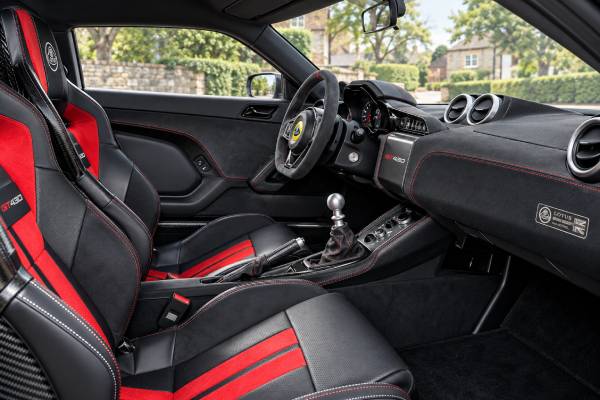
The cabin is simple enough that every function should work. Test both windows repeatedly, door latches, mirror adjustment and folding, the alarm and immobilizer, rear parking sensors, HVAC fan speeds, air-conditioning temperature, instrument illumination, and the fitted infotainment system. Intermittent faults can be more frustrating on a low-volume car than a visible mechanical defect because diagnosis may involve age-related wiring, connectors, or aftermarket equipment installed by previous owners. Any added tracker, stereo, camera, or alarm should be documented and wired cleanly rather than spliced casually into the loom.
Ownership costs are also sensitive to geography. A nearby Lotus specialist with experience in Evora 400-generation cars can make a GT430 Sport far easier to own than a nominally cheaper example located where every specialist job requires transport. Before buying, ask who can rebuild the Öhlins dampers, source two-piece brake components, align the chassis correctly, inspect bonded aluminium, and repair carbon fibre. Parts availability changes over time, so current local quotes are more useful than old forum posts.
For collectors, reversibility is a useful standard when judging modifications. Alternative tyres, a modern head unit, or a removable exhaust can be practical if the original parts stay with the car. Irreversible cutting, drilling, wiring changes, non-factory aero mounts, or undocumented ECU tuning are harder to accept because they alter a scarce specification. A modified GT430 Sport can be an excellent driver’s car, but it should be priced and inspected as the car it is rather than represented as an untouched example.
If originality is important, photograph part numbers and labels during the inspection. Dampers, wheels, seats, exhaust components, and carbon panels can sometimes be replaced with visually similar alternatives. A photographic record tied to the purchase date gives the owner a baseline for future maintenance and makes later resale discussions much clearer.
315 km/h Versus 250 kg of Downforce
The defining engineering story of the GT430 Sport is the trade between drag and downforce. Removing the large wing and associated aero burden reduces the force pushing the car into the road, but it also reduces the power required to overcome aerodynamic resistance at very high speed.
That is why the manual Sport can reach a claimed 315 km/h while the winged GT430 is rated at 305 km/h despite using the same basic engine output. At those speeds, aerodynamic drag dominates the power requirement. A small reduction in drag can therefore create a meaningful increase in maximum speed without adding horsepower.
The trade is not automatically better or worse. On a fast circuit with long corners, the winged GT430’s additional 150 kg of quoted maximum-speed downforce can increase tyre loading and stability. On a road or a circuit with long straights and fewer high-speed aero-dependent corners, the Sport’s lower drag may be more useful. Driver confidence and tyre condition can outweigh either theoretical advantage.
The GT430 Sport still manages airflow actively through fixed body design. Its front splitter, large ducts, wheel-arch relief paths, curved A-panel treatment, rear venting, and diffuser are not decorative. They reduce lift, guide wake around the wheels, and support a stable aero balance. The absence of the large wing simply shifts the emphasis.
For owners, this means body condition matters dynamically. A missing undertray, cracked diffuser, distorted splitter, or poorly repaired rear bumper can alter airflow. At ordinary road speeds the effect may be subtle, but originality and structural integrity matter on a car whose design brief includes 315 km/h operation.
Do not infer that the wingless Sport is safer for sustained top-speed running because it has less drag. Tyre speed rating, tyre age, wheel condition, alignment, brake condition, road surface, crosswind, temperature, and driver skill become critical at extreme speed. The published maximum is a technical specification, not an instruction to reproduce it on public roads.
References
- Lotus expand Evora GT430 line-up with GT430 Sport | SELOC 2017 (Lotus launch information reproduced by SELOC)
- Lotus Evora GT430 Sport – PistonHeads UK 2017 (Launch reference)
- Lotus Evora – Drive without Compromise | Lotus Cars 2026 (Manufacturer heritage)
- LOTUS EVORA SERVICE NOTES Pdf Download | ManualsLib 2009 (Service Notes)
- LOTUS EVORA 400 2018 OWNER’S HANDBOOK MANUAL Pdf Download | ManualsLib 2018 (Owner’s Handbook)
- 2017 Lotus Evora 400 Service Schedules & Maintenance Pricing | Kelley Blue Book 2026 (Maintenance reference)
Disclaimer
This article is for informational purposes only and is not a substitute for professional diagnosis, suspension setup, or repair. Specifications, torque values, intervals, procedures, tyre fitments, and equipment can vary by VIN, market, model year, transmission, and factory options. Verify all work against official Lotus service documentation for the exact vehicle.
If you found this article useful, please share it on Facebook, X/Twitter, or your preferred Lotus community to support our work.