
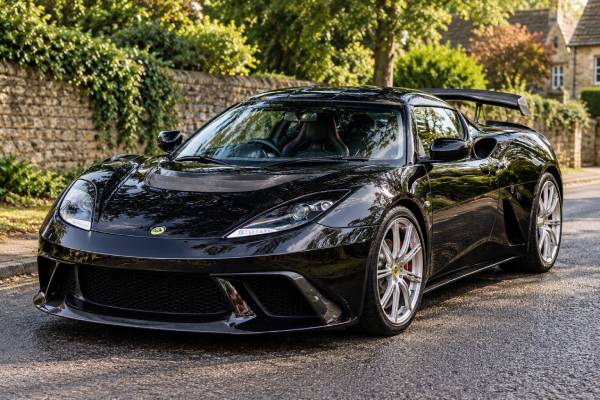
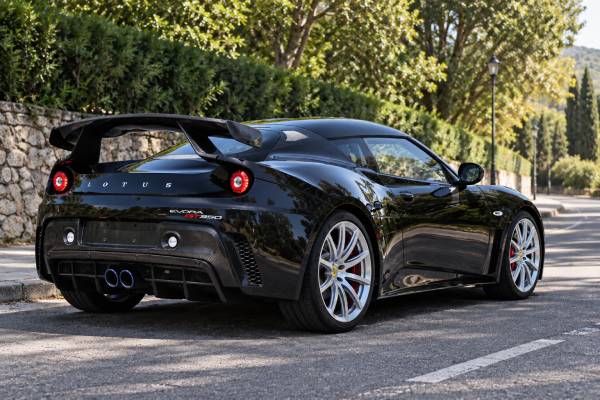
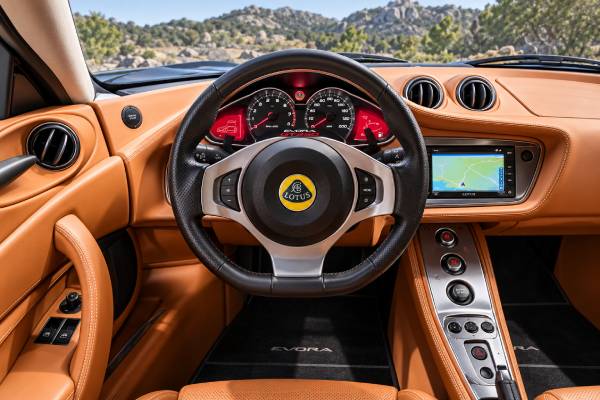
The Lotus Evora GT350 is one of the strangest road-going Type 122 variants because it did not begin as a normal production model. Lotus Motorsport created it in late 2014 and early 2015 by reworking unfinished or unsold Evora GTE road cars, replacing their more experimental 444 PS drivetrain concept with the proven supercharged Evora S powertrain and revising suspension and wheel hardware. The result kept much of the GTE’s wide, carbon-intensive bodywork and visual drama while becoming far closer mechanically to a regular 345 hp Evora S. That unusual origin is also why production totals are reported inconsistently: contemporary enthusiast records describe six right-hand-drive cars and sixteen left-hand-drive cars, yet surviving chassis lists commonly document twenty individual cars. For a buyer, condition and identity therefore matter more than repeating a single production number as unquestioned fact. This guide explains what the GT350 actually is, which specifications can be verified, where GTE and Evora S data should not be confused, and how to assess one today.
Table of Contents
- From Evora GTE Project to GT350
- What the GT350 Kept and What Lotus Changed
- GT350 Technical Data and Evora S Benchmarks
- Production Records, Configurations, and Rarity
- How the GT350 Drives and Feels
- Maintenance, Parts, and Restoration Risk
- Buying and Authenticating a GT350
From Evora GTE Project to GT350
The GT350 is best understood as a factory re-engineering program for Evora GTE road cars that never became a normal series-production model. Lotus Motorsport took those cars, made them usable with established Evora S mechanicals, and released a very small number into customer hands during 2014–2015.
The story starts with the Evora GTE road-car project shown publicly in 2011. It was intended to capitalize on Lotus’s GTE racing activity and was substantially more radical than the ordinary Evora S. Contemporary Lotus material described a road car with more than 420 bhp, a sequential-style automated manual transmission, forged center-lock wheels, and much wider bodywork. Later technical histories put the developed GTE road-car output at roughly 438 bhp or 444 PS and describe extensive carbon-fiber panels produced with Mansory involvement. In visual terms it was closer to a homologation fantasy than a trim package: broad arches, different front and rear sections, prominent aerodynamic pieces, and a much more aggressive stance transformed the Evora’s proportions.
That program did not proceed into straightforward volume production. Engineering and commercial complications left a group of GTE cars at Hethel. By late 2014, Lotus Motorsport devised a way to convert the dormant cars into saleable road cars. The key decision was to step away from the GTE’s special high-output engine and automated drivetrain and return to the regular Evora S package. The revised cars consequently used the Toyota-derived 2GR-FE 3.5-liter V6 with a Harrop supercharger in the familiar 345 hp/350 PS tune, paired with either a six-speed manual or Lotus’s six-speed IPS automatic depending on the individual car.
The name GT350 makes sense in that context. It signaled a car with approximately 350 PS rather than the GTE’s roughly 444 PS specification. More importantly, it marked a change in engineering philosophy. Instead of chasing the GTE project’s peak output, the GT350 combined exotic body construction with an established production drivetrain that Lotus dealers and specialists already understood.
The progression was therefore clear: the GTE program supplied the wide carbon-intensive body and ambitious concept, while the later GT350 rework supplied production-proven Evora S powertrain hardware, new wishbones and revised wheels. That combination—rather than a unique high-output engine—is the core of the finished GT350 identity.
This origin matters when shopping because a GT350 should not be treated as merely an Evora S with an aftermarket wide-body kit. Its value rests heavily on the factory connection to the GTE program, the specific body and suspension components fitted during the Motorsport rework, and the documented identity of the individual chassis.
What the GT350 Kept and What Lotus Changed
The GT350’s defining hardware is the combination of GTE-derived wide bodywork and GT350-specific re-engineering around the standard Evora S drivetrain. The engine is familiar; the shell, stance, and many exterior components are not.
The original GTE road car used extensive carbon fiber to cut weight and create the broader form. Technical histories describe carbon front and rear clams, wider wings, doors, rear bulkhead elements, and aerodynamic pieces made with Mansory involvement. The GT350 retained the visual identity of that program, which is why it looks dramatically different beside a normal Evora S even though the later car’s power output is the same. Large front openings, wider fenders, an imposing rear diffuser, and a high rear wing visually separate it from mainstream Type 122 models.
Lotus Motorsport did more than swap engines. Accounts of the rework specifically mention new wishbones and wheels. That point is important because the GTE chassis package had been developed around a different drivetrain and wheel concept. Bringing the cars back toward production Evora S mechanical standards required a coherent suspension and rolling-stock solution, not simply fitting an S engine and calling the job finished.
Individual GT350s were not all configured identically. Surviving chassis records show manual and IPS cars, both 2+0 and 2+2 seating, and a surprisingly broad collection of exterior and interior combinations. Some cars were finished in conventional Lotus colors, while others used dramatic two-tone or motorsport-influenced schemes. That variability is normal for such a tiny Motorsport-led run and makes documentary evidence more useful than assumptions about a single “correct” appearance.
| Area | What is known | Why it matters |
|---|---|---|
| Body | GTE-derived wide body with extensive carbon-fiber content | Replacement panels are rare and expensive |
| Suspension | Reworked by Lotus Motorsport with new wishbones | Geometry and component identity should be checked carefully |
| Wheels | GT350 rework included different wheels from the original GTE concept | Originality affects value and parts sourcing |
| Powertrain | Evora S-type supercharged 2GR-FE drivetrain | Core engine service is less exotic than the body suggests |
| Gearbox | Manual and IPS examples are documented | Driving character and service needs differ materially |
| Seating | 2+0 and 2+2 examples are documented | Do not reject a car simply because it differs from another GT350 |
A common mistake is to describe every GT350 using the GTE prototype’s 444 PS power and 1,276 kg published development figure. That is not sound. Those numbers belong to the higher-output GTE configuration, not automatically to a GT350 after Lotus Motorsport replaced the drivetrain and altered the chassis hardware. Unless a specific GT350 has factory paperwork stating its completed weight, use GTE weight claims only as historical context, not as the finished GT350’s certified curb mass.
GT350 Technical Data and Evora S Benchmarks
The safest way to specify a GT350 is to separate confirmed GT350 facts from ordinary Evora S benchmark data. Its 345 hp supercharged engine is well established, but Lotus did not publish a mainstream GT350 brochure with a complete standardized performance sheet comparable with the regular 2014 Evora range.
At the center is Toyota’s 2GR-FE, a 3,456 cc all-aluminum DOHC V6 with four valves per cylinder and variable valve timing. In Evora S tune it uses a Harrop HTV1320 supercharger incorporating Eaton TVS technology. Lotus rated the mainstream Evora S at 345 hp, equivalent to 350 PS, at 7,000 rpm, with 400 Nm of torque at 4,500 rpm. Because contemporary GT350 histories specifically state that Lotus returned the cars to the standard Evora S drivetrain, those figures are the most defensible powertrain specification for the GT350.
| Item | Specification |
|---|---|
| Engine | Toyota 2GR-FE, all-aluminum DOHC V6 |
| Displacement | 3,456 cc / 3.5L |
| Induction | Harrop HTV1320 supercharger with Eaton TVS technology, Evora S specification |
| Output | 345 hp / 350 PS at 7,000 rpm |
| Torque | 400 Nm / 295 lb-ft at 4,500 rpm |
| Drive layout | Transverse mid-engine, rear-wheel drive |
| Transmission | Six-speed manual or six-speed IPS automatic, depending on chassis |
For acceleration and top-speed context, the regular 2014 Evora S is a useful donor-drivetrain benchmark, not a guaranteed GT350 test result. Lotus quoted the manual Evora S at 0–60 mph in 4.4 seconds, 0–100 km/h in 4.6 seconds, and 178 mph (286 km/h). The IPS Evora S was quoted at 0–60 mph in 4.5 seconds, 0–100 km/h in 4.7 seconds, and 167 mph (269 km/h). The GT350’s different body, aero load, wheel package, and possible mass differences mean a specific car may not reproduce those figures exactly.
| Measure | Six-speed manual Evora S | Six-speed IPS Evora S |
|---|---|---|
| 0–60 mph | 4.4 sec | 4.5 sec |
| 0–100 km/h | 4.6 sec | 4.7 sec |
| Top speed | 286 km/h / 178 mph | 269 km/h / 167 mph |
| Combined consumption | 9.9 L/100 km | 9.7 L/100 km |
| CO2 | 229 g/km | 224 g/km |
The ordinary Evora S also used AP Racing four-piston calipers with ventilated discs, a bonded aluminum chassis, double-wishbone suspension, and hydraulic steering—fundamentals that help explain the GT350’s underlying road-car behavior. However, because the Motorsport rework involved wishbones and wheels, a buyer should inspect the actual car rather than assuming every suspension dimension or wheel offset matches the standard S brochure.
Production Records, Configurations, and Rarity
The GT350 is unquestionably rare, but the often-repeated total of 22 cars is not as tidy as it first appears. One respected Lotus model history states six right-hand-drive and sixteen left-hand-drive cars, while the commonly published chassis table attached to that history lists only twenty numbered examples; a contemporary Lotus enthusiast feature likewise described six RHD cars but said only twenty people would own one from new.
That conflict should be preserved, not “fixed” by choosing whichever number sounds more impressive. It may reflect planned versus completed cars, incomplete public chassis records, cars described as GTE rather than GT350, or simply imperfect contemporary documentation. Without factory build records for the specific chassis, the responsible conclusion is that the GT350 was a roughly twenty-car-scale rework program, with six RHD cars repeatedly documented and a wider LHD population.
The individual-car table is nevertheless useful because it demonstrates how non-standardized the run was. Among the twenty listed chassis are manual and IPS cars, 2+0 and 2+2 layouts, and numerous paint and trim combinations. That supports a practical buying lesson: authenticity is not established by matching one internet photograph. A legitimate GT350 can differ materially from another legitimate GT350.
| Record | Documented information | Interpretation |
|---|---|---|
| RHD count | Six cars repeatedly reported | Relatively consistent across contemporary enthusiast records |
| LHD statement | Sixteen cars stated in one detailed model history | Would imply 22 total if all were completed as GT350s |
| Published chassis list | Twenty numbered entries | Conflicts with the 22-car arithmetic |
| Gearboxes | Manual and IPS represented | Both can be authentic |
| Cabin layouts | 2+0 and 2+2 represented | Both can be authentic |
For collectors, this uncertainty makes provenance more valuable, not less. Original invoices, Lotus Motorsport correspondence, dealer records, historic registration documents, photographs from first delivery, and documentation linking the VIN to a known GTE/GT350 build can provide stronger evidence than a claimed serial number alone. A car with a continuous paper trail may deserve a premium even if the broader production tally remains debated.
How the GT350 Drives and Feels
A healthy GT350 should feel fundamentally like a supercharged Evora S in power delivery but more exotic in visual scale and chassis presentation. Its appeal is not that it has more engine output than an Evora S; it is that Lotus wrapped proven S mechanicals in one of the rarest and most dramatic Evora bodies.
The 345 hp engine gives strong mid-range response without the highly strung feel that the aborted GTE specification might suggest. The Harrop supercharger builds torque cleanly, and the 2GR-FE remains tractable at ordinary road speeds. In a manual car, the driver gets the directness and involvement traditionally associated with the Evora, while an IPS car trades some interaction for easier urban driving and paddle-operated control. Because the tiny run includes both, transmission choice should be based on intended use and the quality of the particular car rather than collector mythology.
The wide body changes the experience even before the car moves. Sight lines, curb awareness, and the risk of damaging expensive carbon sections all make tight roads and parking spaces more stressful than in a conventional Evora. On a fast open road, however, the low seating position, hydraulic steering, bonded aluminum chassis, and double-wishbone architecture still deliver the clarity that made the Evora special. The GT350’s real-world performance is already more than sufficient for modern roads; preserving chassis balance and steering quality is more important than modifying it for additional horsepower.
A test drive should focus on consistency. The steering should be smooth and communicative rather than notchy. The car should track cleanly without obvious pull. Brake effort should be progressive, with no heavy judder through the pedal or steering wheel. The engine should pull cleanly through the rev range without belt squeal, misfire, warning lights, or unstable coolant temperature. Manual cars should shift cleanly once warm; IPS cars should respond predictably in automatic and paddle modes without flares or harsh engagement.
Do not assume odd behavior is “because it is a GT350.” Its bespoke nature makes correct setup more important. Alignment errors, incorrect wheels or tires, repaired carbon panels, worn suspension joints, or poorly matched replacement dampers can all spoil the qualities buyers are paying to obtain.
Maintenance, Parts, and Restoration Risk
Routine engine servicing is comparatively straightforward because the GT350 uses the established Evora S powertrain, but body, chassis, and trim restoration can be far more difficult than on a normal Evora. The rare GTE-derived components are the ownership risk that deserves the most attention before purchase.
For the 2GR-FE, service records should show regular oil changes with the correct specification, coolant maintenance, drive-belt inspection, and attention to ignition components and air filtration. On supercharged cars, listen carefully for abnormal bearing or belt noises and check for evidence of coolant leaks around hoses, pipes, radiator connections, and the front cooling package. A specialist familiar with Evoras should inspect the underside because coolant lines and undertrays can hide evidence of leakage or previous damage.
Clutch condition matters on manual cars because replacement is labor-intensive in a mid-engine Evora. A high or inconsistent bite point, slip under full load, or difficulty selecting gears deserves investigation. Cable adjustment and linkage condition can affect shift quality, so a poor change is not automatically a failed gearbox—but it should never be ignored. IPS cars need smooth operation when cold and hot, clean engagement into drive and reverse, and service evidence appropriate to the transmission.
Suspension inspection is especially important. GT350 histories identify bespoke wishbone work during the factory re-engineering, so replacing worn parts with whatever fits a standard Evora can compromise originality or geometry. Photograph component markings, compare both sides for symmetry, and consult a Lotus specialist before authorizing substitutions. Check ball joints, bushes, dampers, wheel bearings, and alignment, then verify that the fitted wheels have correct dimensions and offsets for that particular car.
| Area | What to inspect | Why it matters |
|---|---|---|
| Supercharged V6 | Oil history, belts, leaks, ignition quality, cooling behavior | Core drivetrain is robust when properly maintained |
| Manual transmission | Clutch slip, bite point, cable adjustment, gear selection | Clutch work can be labor-intensive |
| IPS transmission | Cold/hot shifts, paddle response, fluid/service history | Faults can be expensive and diagnosis needs expertise |
| Suspension | Wishbones, bushes, ball joints, dampers, alignment | GT350-specific rework makes originality important |
| Carbon body | Cracks, repairs, panel fit, mounting points, paint finish | Bespoke GTE-derived parts are difficult to replace |
| Wheels and tires | Correct wheels, cracks, offsets, matched tires, age | Wrong fitment can alter handling and authenticity |
Body damage deserves specialist assessment even when cosmetic. Carbon can hide previous repair work under paint, and a panel that looks acceptable from a few feet away may have compromised mounting points or poor laminate repairs. Inspect panel gaps, the undersides of clams, wheel-arch edges, splitter and diffuser contact points, rear wing mounts, and areas near fasteners. Because a GT350’s value depends heavily on its GTE-derived form, a high-quality documented repair is preferable to an undocumented cosmetic cover-up.
Parts planning should be conservative. Mechanical service pieces shared with the Evora S are generally less intimidating than unique exterior components, but availability changes over time. Before buying a damaged or incomplete car, obtain actual quotations for the missing GT350 pieces. A “cheap” rare Lotus can become uneconomic quickly if the required panel, wheel, trim item, or Motorsport-specific suspension part cannot be sourced.
Buying and Authenticating a GT350
Buy the GT350’s history before you buy its appearance. The best example is not necessarily the lowest-mileage car; it is the one whose VIN, factory provenance, configuration, servicing, and repairs can be traced with the fewest unanswered questions.
Start with the VIN and documentary chain. Ask for the original sales invoice, dealer correspondence, Lotus Motorsport paperwork if available, historic registration records, previous advertisements, and photographs from earlier ownership. Compare the car’s color, interior, gearbox, and seating arrangement with published GT350 chassis information, while remembering that public lists may be incomplete. A mismatch should trigger investigation, not an immediate accusation, because some cars were marketed as GTEs even after the GT350 rework and the public record itself contains contradictions.
Next, verify the expensive physical identity. The wide GTE-derived body should be examined by someone who understands composite construction. Confirm that the clams, doors, arches, rear aero, diffuser, and wing are appropriate and have not been replaced by replica parts without disclosure. Check wheel identity and suspension hardware. Look for consistent fasteners, factory-quality installation, and evidence of old accident repairs. A paint-depth gauge is of limited use on carbon and composite panels, so visual inspection from both sides and documentation of previous work are more useful.
Then treat the drivetrain like an Evora S, not like an untouchable museum piece. Obtain a proper pre-purchase inspection, scan all modules for stored faults, test the air conditioning and cabin electronics, inspect brake wear, date the tires, check engine and gearbox behavior from cold, and put the car on a lift. A rare badge does not make consumables optional.
| Check | Strong evidence | Reason to pause |
|---|---|---|
| Identity | VIN tied to period GT350/GTE paperwork and known history | Seller relies only on badges or verbal claims |
| Configuration | Gearbox, seating, colors, and equipment supported by records | Major changes with no invoices or explanation |
| Body | Original or professionally documented carbon repairs | Cracks, poor panel fit, unexplained repainting, replica pieces |
| Chassis | Correct suspension hardware and clean alignment report | Mixed parts, bent components, unexplained tire wear |
| Mechanical health | Cold-start inspection, fault scan, specialist service history | Warning lights, overheating evidence, clutch or IPS symptoms |
| Ownership case | Price reflects provenance, condition, and parts completeness | Rarity used to excuse deferred maintenance |
For an owner who wants to drive rather than speculate, the GT350 has an unusual advantage: its heart is based on a known Evora S package. That gives specialists a familiar starting point for engine, clutch, gearbox, brake, and routine service work. The disadvantage is that every incident involving the unusual body or Motorsport-specific hardware can become a sourcing exercise. Comprehensive agreed-value insurance and clear documentation of the car’s special components are sensible.
The GT350 ultimately makes most sense for someone who values the story as much as the speed. A standard Evora S can deliver similar straight-line performance for far less money and far less anxiety. The GT350 justifies its place through the aborted GTE connection, the factory rescue/rework story, the broad carbon body, and the tiny number of completed cars. Preserve those qualities, resist modifications that erase provenance, and it remains one of the most fascinating Type 122 derivatives Lotus ever put into customer hands.
References
- Models – Evora – TechWiki — SELOC TechWiki, updated model history.
- Picture of the Month – January 2015 — The Lotus Forums, 2015.
- Photo Of The Day: 1 of 22 Lotus Evora GT350 — GTspirit, 2015.
- goldRush Rally Lotus Evora Wrapped in Anodized Aluminum Red — GTspirit, 2015.
- Lotus Evora GTE Road Car Concept — Caricos archive of Lotus material, 2011.
- Lotus Evora — Lotus 2014 Evora brochure, archived by Lotus Drivers Guide.
Disclaimer
This article is for informational purposes only and is not a substitute for professional diagnosis, inspection, maintenance, or repair. Specifications, torque values, service intervals, procedures, and fitted components can vary by VIN, market, equipment, and individual factory build; verify the exact car against official service documentation from Lotus and qualified specialist advice before ordering parts or carrying out work.
If this guide helped you understand the Evora GT350, please share it with another Lotus owner or prospective buyer.