
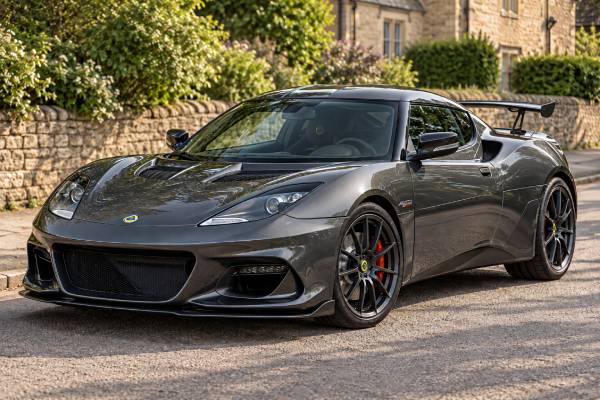
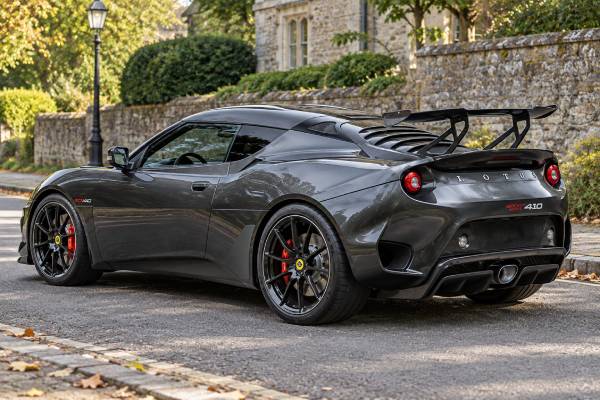
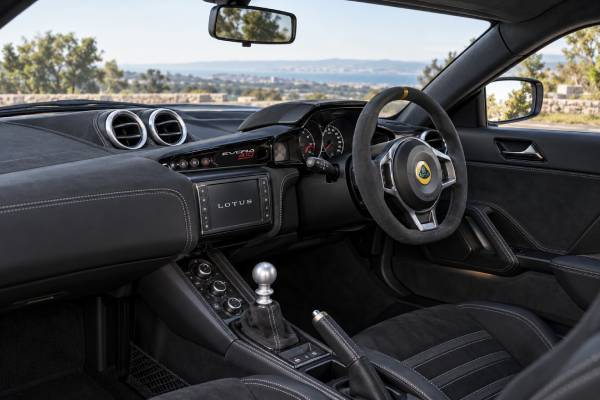
The Lotus Evora GT430 is not merely the most aggressive factory Evora with a large rear wing; it is a deeply reworked, low-volume version built around aerodynamic load, reduced mass, and chassis adjustability. Introduced in 2017, the GT430 uses Lotus’s supercharged 3.5-liter V6 at 430 hp, adds Öhlins TTX two-way adjustable dampers, a titanium exhaust, wider Cup 2 tyres, extensive carbon-fibre bodywork, and a variable traction-control system. Its defining number is 250 kg of claimed downforce at 305 km/h, far beyond what the preceding Sport 410 generated. The manual car was rated at 3.8 seconds to 100 km/h and a dry weight of 1,258 kg. Those figures make the GT430 exciting, but they also explain why used-car inspection must be unusually thorough. Aero surfaces, carbon panels, adjustable dampers, two-piece brakes, forged wheels, track-oriented tyres, and a highly stressed clutch can all turn a seemingly attractive purchase into an expensive restoration if condition is poor.
Table of Contents
- The GT430’s Purpose and Place in the Evora Range
- How the 250 kg Aero Package Works
- Service Strategy for a Low-Volume GT430
- GT430 Technical Specifications
- Öhlins Suspension, Traction Control, and Brakes
- Pre-Purchase Inspection and Collector Considerations
- Engine, Gearbox, and Real-World Performance
The GT430’s Purpose and Place in the Evora Range
The GT430 was created to move the Evora closer to a road-legal track car without abandoning the usability of the basic platform. Lotus limited production and concentrated on the areas that most directly affect lap pace: aerodynamic stability, tyre footprint, damper control, brake capability, power-to-weight ratio, and traction on corner exit.
Compared with the Sport 410, the GT430 gained far more than 20 hp. Lotus reworked both bumpers, added a prominent high-mounted rear wing, vented the front and rear wheel arches, fitted a deeper diffuser and splitter, widened the tyres, and replaced the conventional Bilstein setup with Öhlins TTX adjustable dampers. The company also fitted a titanium exhaust, lightweight rear brake components, a lithium-ion battery, and a substantial collection of carbon-fibre panels.
The result is a car whose appearance is a consequence of function. The louvres over the front wheels are there to reduce pressure in the arches. The rear ducts help evacuate high-pressure air. The splitter and diffuser manage underbody flow, while the large rear wing creates the majority of the extra high-speed load. On a road car, 250 kg of downforce at maximum speed is a remarkable figure and explains why the GT430 feels fundamentally different from an Evora whose aero is aimed mainly at lift reduction.
Lotus initially presented the GT430 around the six-speed manual gearbox. Later-period material also discussed automatic availability in the broader GT430 family, with higher quoted torque for automatic applications. Because low-volume cars can differ by market and build date, a buyer should document the exact factory configuration rather than assuming every 2017–2018 GT430 follows one brochure.
Rarity also changes the way the car should be judged. A GT430 is not the best Evora for someone who wants the lowest running costs or the softest long-distance ride. It is more valuable when its original hardware is present and correctly maintained. Missing aero pieces, substituted dampers, non-original wheels, or poorly documented engine modifications can materially affect both driving behavior and future value.
How the 250 kg Aero Package Works
The GT430’s aerodynamic system is valuable because it creates usable balance, not simply a large rear-wing number. Lotus developed front and rear devices together so that added load would support stability without overwhelming one axle.
At the front, the splitter separates the flow that travels over the body from the flow passing underneath. Enlarged ducts and air blades then manage air around the front wheels, which are major sources of drag and turbulence. Louvres above the wheel arches give pressurized air another path out, reducing lift in an area where trapped pressure would otherwise push upward on the body.
Along the sides, the GT430’s shaping tries to keep airflow attached and reduce the disturbance caused by rotating tyres. At the rear, deep wheel-arch vents perform a similar pressure-relief job. The diffuser expands and slows the underbody flow, helping create a pressure difference under the car. The rear wing then provides a direct downward force at speed.
The important practical point is that downforce increases with speed. A driver does not have 250 kg of extra load when leaving a junction. The figure is quoted at 305 km/h, and load is much lower at road speeds. Even so, Lotus stated that the GT430 reached the Sport 410’s maximum 64 kg of downforce at roughly 145 km/h, showing that the aero starts to matter well before maximum speed.
This has two ownership consequences. First, the aero hardware must be intact and correctly mounted. A cracked splitter, missing undertray fasteners, poorly repaired rear wing, or incorrectly aligned bumper is not just cosmetic. Second, suspension ride heights and damper settings should remain within sensible parameters because aerodynamic balance assumes the car is presented to the airflow as engineered.
Owners should resist the temptation to copy internet “track setups” without knowing the circuit, tyres, temperature, ride height, and driver goal behind them. The GT430 gives the owner real adjustment authority, which also means it can be adjusted badly. A neutral baseline from a Lotus specialist is usually the best starting point for a road-driven car.
Service Strategy for a Low-Volume GT430
A GT430 should be serviced as a specialist performance car even though the underlying V6 is robust. Time-based maintenance, track-use checks, damper service, and careful record keeping matter more than stretching intervals to save small amounts of money.
The sensible ownership approach is to establish a baseline immediately after purchase unless records are exceptionally complete. That baseline can include engine oil and filter, brake and clutch fluid, coolant condition, transmission-fluid history, air filter, spark plugs if due, auxiliary belt inspection, battery test, alignment, and a complete brake measurement.
Track-driven cars need additional attention. After repeated high-temperature sessions, inspect the following before assuming the road service schedule is sufficient:
- brake pad thickness and taper, disc condition, and fluid boiling history;
- tyre tread, shoulder wear, cuts, heat cycling, and pressures recorded hot and cold;
- wheel torque and evidence of wheel movement or damaged seats;
- damper leaks and adjuster function;
- suspension joints, anti-roll-bar links, and wheel bearings;
- undertrays, diffuser, splitter, wing mounts, and arch liners;
- engine-oil level and evidence of heat-related leaks;
- coolant and charge-cooler operation.
The lithium-ion battery also deserves specific care. Long storage without a compatible maintainer can damage an expensive lightweight battery. Confirm what battery is installed, how old it is, and whether the charging equipment matches its chemistry. Replacing it with a conventional battery may be sensible for some owners, but originality-focused buyers should document any change.
Do not assume that a low odometer reading means less work. A 2017 car that has spent long periods unused can have aged tyres, stale fluid, weak seals, corroded brake hardware, and a discharged battery. Regular exercise with correct warm-up is generally kinder than years of static storage.
GT430 Technical Specifications
The GT430 is an ICE, rear-wheel-drive, mid-engine coupe using the Lotus-tuned Toyota 2GR-family V6 with an Edelbrock supercharger. Published launch specification centers on the six-speed manual, with 430 hp, 440 Nm, and a dry weight of 1,258 kg. Market and later-production differences should always be checked against the individual VIN and build documentation.
| Specification | Value |
|---|---|
| Engine | 3,456 cc all-aluminium V6, 24 valves |
| Engine family | Toyota 2GR-based, Lotus calibrated |
| Induction | Edelbrock supercharger with charge cooling |
| Maximum power | 430 hp (436 PS) at 7,000 rpm |
| Maximum torque | 440 Nm (325 lb-ft) from 4,500 rpm in launch manual specification |
| Exhaust | Lightweight titanium system |
| Engine position | Transverse mid-mounted |
| Drive | Rear-wheel drive |
| Specification | Value |
|---|---|
| 0–60 mph | 3.7 seconds |
| 0–100 km/h | 3.8 seconds |
| 0–100 mph | Under 8 seconds |
| Maximum speed | 305 km/h (190 mph) |
| Kerb weight | 1,299 kg |
| Dry weight | 1,258 kg |
| Power-to-weight ratio | 342 hp per tonne based on published dry weight |
| Hethel test-track time | 1:25.8 in Lotus launch material |
| Specification | Value or function |
|---|---|
| Downforce at maximum speed | 250 kg at 305 km/h |
| Front splitter | Carbon fibre; manages and accelerates underbody airflow |
| Front wheel-arch louvres | Relieve pressure above the front wheels |
| Front air blades | Guide airflow around the front wheel area |
| Rear wheel-arch ducts | Vent high-pressure air from the rear arches |
| Rear wing | High-mounted fixed carbon-fibre aerofoil |
| Rear diffuser | Large motorsport-influenced diffuser assembly |
| Specification | Value |
|---|---|
| Suspension layout | Unequal-length forged-aluminium double wishbones front and rear |
| Dampers | Lotus-tuned Öhlins TTX aluminium two-way adjustable units |
| Damper adjustment | 20-click compression and rebound adjustment |
| Springs | Eibach low-sideload springs |
| Anti-roll bars | Eibach tubular front and rear |
| Steering | Hydraulically assisted rack and pinion, 2.86 turns lock-to-lock |
| Stability modes | Drive / Sport / Race with system-off functionality by specification |
| Variable traction control | Five preset slip targets plus off, shown through the instrument display |
| Specification | Value |
|---|---|
| Front brakes | 370 × 32 mm two-piece ventilated discs, AP Racing four-piston calipers |
| Rear brakes | 350 × 32 mm two-piece ventilated discs, AP Racing four-piston calipers |
| Wheels | Forged aluminium, 19-inch front and 20-inch rear |
| Front tyre | Michelin Pilot Sport Cup 2, 245/35 R19 |
| Rear tyre | Michelin Pilot Sport Cup 2, 295/30 R20 |
| Battery | Lightweight lithium-ion |
| Specification | Value |
|---|---|
| Primary launch transmission | 6-speed manual |
| Shift mechanism | Lotus precision aluminium linkage |
| Flywheel | Lightweight single-mass, low-inertia |
| Differential | Torsen-type limited-slip differential with manual transmission |
| Gearbox cooling | Dedicated cooler in GT430 specification |
| Oil control | Baffled sump |
Öhlins Suspension, Traction Control, and Brakes
The Öhlins TTX dampers are one of the GT430’s biggest advantages and one of its most expensive items to neglect. They allow compression and rebound changes, letting an experienced owner or engineer alter how quickly the body moves and how the tyres stay loaded over bumps.
For road use, maximum stiffness is rarely maximum performance. Excessive compression damping can make the car skip across broken surfaces, while too much rebound can prevent the suspension from extending quickly enough after a bump. The result can be less grip, not more. A well-set GT430 should still have the supple, controlled response for which the Evora chassis is known.
Before buying, confirm that all four dampers are the correct units, that adjusters move through their range, and that there are no leaks, bent shafts, damaged spring platforms, or mismatched settings. Ask when the dampers were last serviced. High-quality motorsport-style dampers are rebuildable, but their rebuild cycle depends strongly on use.
The variable traction-control system is equally distinctive. Rather than offering only a binary “on” or “off” choice, the GT430 allows several preset slip targets. That can help a skilled driver tune intervention to tyre and circuit conditions. On the road, however, the safest default remains the most protective appropriate mode. Adjustable electronics are a tool, not a reason to drive beyond visibility or tyre grip.
The AP Racing brake package is powerful and durable when properly maintained. Two-piece discs reduce unsprung mass and can manage heat effectively, but wear limits matter. Look for heat checking, deep lips, vibration, damaged bells, uneven pad deposits, seized pad hardware, and caliper dust-seal condition. A car that has consumed multiple sets of track pads may still be healthy, but it should have documentation showing disciplined inspection.
Wheel condition also deserves attention. The forged wheels are light and costly. Check the inner barrels for bends or cracks, not just the visible faces. A wheel can look perfect from outside yet be distorted by pothole or curb impacts. Because the GT430 uses wide, low-profile tyres, small alignment or wheel defects can quickly show up as uneven wear.
Pre-Purchase Inspection and Collector Considerations
The best GT430 is the one that remains mechanically coherent: correct aero, correct dampers, correct wheels, documented servicing, and modifications that can be explained. Rarity magnifies both the value of originality and the cost of replacing missing parts.
Begin with provenance. Confirm the VIN, production documentation, original invoice, market specification, transmission, color, trim, and any Lotus Exclusive options. Because the GT430 was produced in small numbers, a detailed history adds value beyond ordinary service stamps. Photographs from earlier ownership can help establish whether major body or aero components have changed.
Inspect every carbon panel under strong light. Look for impact cracks, star patterns around fasteners, lacquer lifting, repaired weave, distorted edges, and inconsistent gaps. A professional cosmetic repair is not automatically negative, but structural damage to a splitter, wing support, tailgate, or bumper should be understood before purchase.
Next, inspect the underside on a lift. The GT430 is low, and the splitter and diffuser can contact ramps, curbs, or road debris. Check the aluminium chassis, undertrays, mounting points, suspension pick-ups, brake hoses, cooling pipes, and jacking areas. Damage to bonded aluminium requires specialist evaluation; casual welding or improvised repair is a major concern.
Ask for current damper settings and alignment data. If the seller cannot explain why the adjusters are where they are, return the car to a known baseline before judging its road manners. A GT430 that tramlines, hops over bumps, or feels unstable may be badly adjusted rather than fundamentally damaged, but you should not pay collector money to diagnose that uncertainty later.
On the test drive, use enough time for the engine, gearbox, brakes, and tyres to reach normal temperature. Check cold-start behavior, air conditioning, all electrical accessories, steering assistance, clutch action, gear selection, brake straightness, and any warning messages. Listen for rattles that change with damper movement or aerodynamic load.
Finally, decide what kind of owner you intend to be. If you want regular long trips and all-weather use, a GT410 or GT410 Sport may be easier to live with. If you want the most dramatic factory aero Evora and value adjustability, rarity, and track capability, the GT430 is the more distinctive choice. Its 250 kg downforce claim, Öhlins hardware, variable traction control, and 430 hp calibration make it one of the most technically interesting Evoras built.
That technical depth is exactly why a cheap example is rarely cheap. Budget for specialist labor, premium consumables, and preventive servicing. In return, a correct GT430 offers something increasingly unusual: high-speed aerodynamic sophistication combined with hydraulic steering, a manual gearbox, low mass, and a chassis that still communicates clearly at ordinary road speeds.
A GT430 also deserves a different budgeting model from a normal used sports car. Insurance, annual registration, and routine fluids may be predictable, but the expensive events arrive in clusters: a set of Cup 2 tyres may coincide with brake-disc wear, damper servicing, and a clutch job. Keeping a reserve for those events makes ownership far more enjoyable than trying to defer each item. Because the car is rare, waiting for an obscure trim or carbon component can also create downtime that has nothing to do with mechanical reliability.
Storage quality matters as much as annual mileage. Keep the car dry, maintain battery charge with chemistry-appropriate equipment, avoid leaving tyres underinflated for long periods, and move the car often enough to keep seals, brakes, and bearings exercised. If it will sit for months, a specialist can advise on fuel stabilization, tyre pressure, ventilation, and whether the suspension should remain fully loaded. The aim is not to turn the garage into a museum; it is to prevent avoidable deterioration.
Documentation should record setup changes as well as service work. If the dampers are adjusted for a circuit, note the click positions before and after. Record alignment settings, tyre make and date codes, pad compounds, brake-fluid type, and any ECU or exhaust changes. That log gives the next technician a known starting point and helps a future buyer distinguish thoughtful development from random modification. For a limited-production Lotus, that continuity can be worth almost as much as a stamped service book because it proves the car’s unusual hardware was understood rather than merely owned.
When comparing two examples, look beyond mileage. A 30,000-km car that has been regularly serviced, driven to operating temperature, and maintained by a specialist can be a safer purchase than a 6,000-km car on decade-old tyres with no recent fluid history. Low use is attractive only when storage and maintenance support it. The GT430 was engineered to be driven hard; careful use is not the enemy. Neglect, impact damage, heat abuse, and undocumented setup changes are the real concerns.
Engine, Gearbox, and Real-World Performance
The 430 hp V6 gives the GT430 the speed to match its chassis, but the way it delivers power is more important than the peak figure. Supercharging provides immediate response, and the engine continues pulling strongly toward its 7,000 rpm power peak.
The jump from 410 to 430 hp sounds modest on paper, yet the GT430 combines that output with lower dry mass, broader tyre contact patches, more rear-axle traction, and greater high-speed stability. In practice, it can deploy its performance more confidently than a simple power increase would suggest.
The six-speed manual is a key part of the experience. A light flywheel reduces stored rotational energy, helping the engine gain and lose revs quickly. That makes throttle blips more immediate and changes the feel of low-speed maneuvering. It can also expose poor clutch technique because the driveline has less inertia to smooth an abrupt launch.
A healthy gearbox should feel positive once warm. During inspection, check first-to-second and second-to-third shifts under moderate load, then repeat after the oil is hot. Any crunching, reluctance to engage, jumping out of gear, or strong lever movement under acceleration deserves diagnosis. Also listen for abnormal differential or bearing noise on overrun.
The clutch is a significant budgeting item because access is labor-intensive. A high bite point alone does not prove imminent failure, but slip under full torque, judder, release-bearing noise, or inconsistent pedal action are warning signs. On a rare GT430, a specialist inspection before purchase is cheaper than discovering a marginal clutch immediately afterward.
Fuel economy is not the primary reason to buy this car. Expect consumption to vary widely with traffic and boost use. More important is using the correct premium fuel and maintaining the cooling and charge-cooling systems, because high intake temperature can reduce performance and increase thermal stress.
References
- PRECISION, BEAUTY AND PERFORMANCE: THE NEW LOTUS EVORA GT430 2017 (Technical launch information)
- Lotus Evora – Drive without Compromise | Lotus Cars 2026 (Manufacturer heritage)
- Lotus Evora GT430 – Un’altra iniezione di potenza per la sportiva inglese 2017 (Launch reference)
- LOTUS EVORA SERVICE NOTES Pdf Download | ManualsLib 2009 (Service Notes)
- LOTUS EVORA 400 2018 OWNER’S HANDBOOK MANUAL Pdf Download | ManualsLib 2018 (Owner’s Handbook)
- 2017 Lotus Evora 400 Service Schedules & Maintenance Pricing | Kelley Blue Book 2026 (Maintenance reference)
Disclaimer
This article is for informational purposes only and is not a substitute for professional diagnosis, inspection, chassis setup, or repair. Specifications, torque values, service intervals, procedures, damper settings, and equipment vary by VIN, market, build date, and options. Verify all technical work against official Lotus service documentation for the exact vehicle.
If this guide helped, please share it on Facebook, X/Twitter, or an enthusiast community to support our work.