
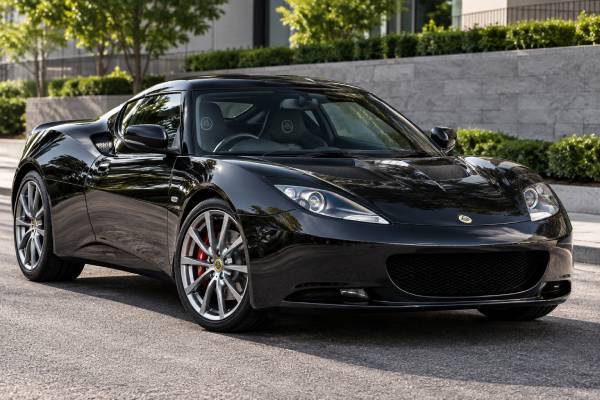
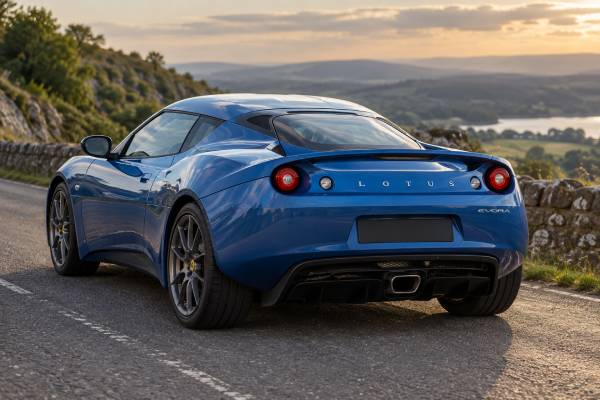
The Lotus Evora IPS is not simply a manual Evora with a convenience gearbox substituted at the end of the assembly line. Introduced for the naturally aspirated car in 2011, Intelligent Precision Shift combines the 276 hp 3.5-liter 2GR-FE V6 with Toyota’s U660E six-speed torque-converter automatic, Lotus-developed transmission control, steering-wheel paddles, shift-by-wire selection, Sport logic, and a dedicated transmission-oil cooling circuit. The result broadens the Evora’s everyday usability while preserving the bonded-aluminum chassis, hydraulic steering, double-wishbone suspension, and mid-engined balance that define the Type 122. IPS also brings its own maintenance questions: fluid capacity is complicated by external coolers, software revisions affect manual-mode behavior, and the extra mass changes performance slightly. This guide covers the naturally aspirated Evora IPS from 2011 through 2014, not the later supercharged S IPS. It separates engine data from transmission-specific facts, explains model-year revisions, and gives buyers a practical way to assess an automatic Evora on both road manners and service evidence.
Table of Contents
- IPS introduction and what Lotus changed
- 2GR-FE output, economy, and emissions
- U660E transmission, paddles, Sport mode, and cooling
- Road performance, chassis hardware, and model-year evolution
- Automatic-specific service planning and fluid data
- IPS buying checks and ownership priorities
IPS introduction and what Lotus changed
The Evora IPS arrived as Lotus’s automatic answer for customers who wanted the standard naturally aspirated Evora without a clutch pedal. Non-U.S. production was introduced in March 2011, and the system combined a conventional six-speed torque-converter transmission with Lotus-specific electronic control rather than using a dual-clutch or automated-manual design.
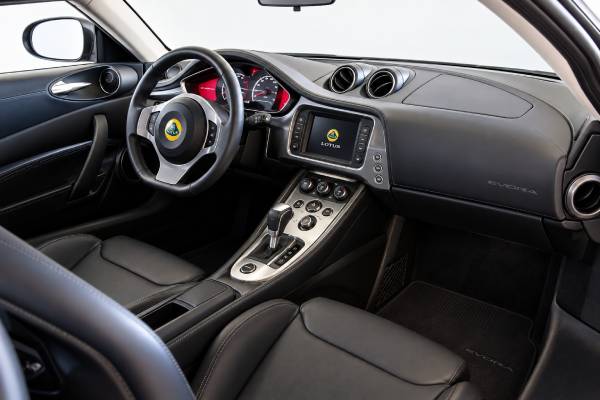
The gearbox is Toyota’s U660E. Lotus added a transmission control unit, shift-by-wire actuation, steering-wheel paddles, a PRND selector on the center console, instrument-display logic, and a Sport mode that changes shift strategy. In normal Drive the system behaves as a full automatic. Paddle inputs can request manual shifts, while Sport mode sharpens and holds the transmission’s behavior more aggressively.
That architecture is important for expectations. IPS is not meant to imitate the instant ratio changes of a modern dual-clutch gearbox. A torque converter provides smooth low-speed creep and makes traffic easier, but shift timing and response have their own character. Period road tests generally praised the added usability while noting that the mechanism did not match the fastest contemporary twin-clutch systems for immediacy.
| Item | Specification |
|---|---|
| Introduction | Non-U.S. production from March 2011; broader market availability followed |
| Transmission | Toyota U660E six-speed conventional automatic |
| Coupling | Fluid torque converter |
| Control | Lotus transmission control unit with shift-by-wire actuation |
| Driver selection | PRND console controls plus steering-wheel shift paddles |
| Manual command | Left paddle downshift; right paddle upshift |
| Sport function | Revised shift points and quicker/more pronounced shift strategy |
| Driven wheels | Rear-wheel drive |
The first IPS cars used front-mounted air/oil coolers for transmission fluid, adapting hardware related to the oil-cooling arrangement on the Evora S. For the 2012 model year, Lotus rationalized cooling across the range, using a single larger transmission-fluid cooler mounted ahead of the left-front wheel arch on IPS-equipped cars. The 2012 IPS also adopted S-type wishbones and a larger rear anti-roll bar, giving later cars a chassis specification that differs subtly from the earliest automatic Evoras.
Software is another running-change area. Later updates altered how manual control behaves in Sport mode, with enthusiast technical documentation noting revisions that allowed the car to remain in Sport Manual rather than automatically returning to Drive after a period without paddle input. A dealer or specialist can identify the software state more reliably than a road-test memory from 2011.
2GR-FE output, economy, and emissions
The naturally aspirated IPS retains the 3,456 cc 2GR-FE V6 rather than using the supercharged Evora S engine. Period IPS specifications quote 280 PS (276 hp / 206 kW) at 6,400 rpm and approximately 350 Nm (258 lb-ft) around 4,600–4,700 rpm, with calibration figures varying slightly across market literature.
The engine is an aluminum 60-degree V6 with dual overhead camshafts, four valves per cylinder, VVT-i variable valve timing, chain-driven camshafts, and electronic port fuel injection. It sits transversely behind the cabin. In the IPS application, the transmission’s torque converter and control strategy change how the power is delivered, but the basic naturally aspirated engine remains closely related to the manual Evora’s.
| Specification | Data |
|---|---|
| Engine code | 2GR-FE |
| Configuration | 60-degree V6, DOHC, 24 valves, VVT-i |
| Displacement | 3,456 cc (3.5 L / 210.9 cu in) |
| Induction | Naturally aspirated |
| Fuel delivery | Electronic multi-point / port injection |
| Maximum power | 206 kW / 280 PS / 276 hp at 6,400 rpm |
| Maximum torque | About 350 Nm / 258 lb-ft at 4,600–4,700 rpm in IPS technical data |
| 2011 combined consumption | About 8.8 L/100 km (26.7 mpg US / 32.1 mpg Imp) |
| 2011 CO2 | 208 g/km in period European IPS data |
The automatic’s early European economy was competitive with the manual despite its extra mass. Period figures list approximately 12.6 L/100 km urban, 6.6 extra-urban, and 8.8 combined, with 208 g/km CO2. Later service data shows 9.0 L/100 km combined for some configurations, illustrating why fuel and emissions figures should always be tied to the relevant model year, wheel package, and test cycle.
Driving style has a large effect. The torque converter allows relaxed low-speed operation and early upshifts in Drive, while Sport mode keeps the engine in a stronger part of the rev range and naturally increases fuel use. A healthy IPS should transition between these personalities without hesitation, flare, or harsh engagement.
Because the engine uses timing chains, there is no scheduled cam-belt replacement. That does not remove the need to inspect auxiliary drive components, cooling hoses, seals, ignition condition, and fluid levels. The best evidence of engine health remains consistent servicing, clean starts from cold, stable temperatures, and smooth power delivery under load.
U660E transmission, paddles, Sport mode, and cooling
The U660E is the defining component of the IPS model, and its condition should be evaluated as carefully as the engine. It uses six forward ratios, an open differential, electronic hydraulic control, and a torque converter, while Lotus software determines shift scheduling and the interaction with paddles and Sport mode.
Lotus service data lists the internal ratios as 3.300 first, 1.900 second, 1.420 third, 1.000 fourth, 0.713 fifth, and 0.608 sixth, with a 3.685 final drive. These ratios are fixed by the automatic transmission; unlike early manual Evoras, there is no choice between standard and sports-ratio gearsets.
| Gear | Internal ratio | Final drive |
|---|---|---|
| 1st | 3.300:1 | 3.685:1 |
| 2nd | 1.900:1 | 3.685:1 |
| 3rd | 1.420:1 | 3.685:1 |
| 4th | 1.000:1 | 3.685:1 |
| 5th | 0.713:1 | 3.685:1 |
| 6th | 0.608:1 | 3.685:1 |
| Reverse | 4.148:1 | 3.685:1 |
Sport mode does not simply command later shifts. It also changes the calibration for a more performance-oriented response, and manual paddle commands give the driver direct ratio requests within protection limits. The IPS rev limit is constrained by transmission protection, so it should not be expected to mimic the higher Sport-mode rev behavior of a manual Evora S.
There are three useful operating states to understand before judging an IPS car. In normal Drive, the calibration favors low engine speed and early upshifts. Pulling either steering-wheel paddle temporarily overrides Drive; period software returns the transmission to full automatic operation after roughly ten seconds without another paddle request. Sport changes both the automatic shift strategy and the character of downshifts, including rev-matched throttle blips. A paddle pull while Sport is active enters the more committed manual mode. Early control software could revert from Sport manual after a period without paddle use, while later dealer-installed software revisions allowed it to remain in manual operation until Drive was selected or Sport was switched off. That software difference can make two mechanically healthy cars behave differently, so a buyer should not diagnose the transmission from mode logic alone.
The selector is also part of the system rather than a direct mechanical lever. IPS uses shift-by-wire control through its transmission control unit, with a center-console PRND selector and paddles mounted behind the steering wheel. That architecture means a clean diagnostic scan matters if a car shows intermittent mode selection, gear-display, or engagement behavior. Confirm that the instrument display agrees with the commanded range and that every paddle request produces the expected gear change when conditions permit.
Cooling is integral to transmission life. Early naturally aspirated IPS cars carry additional transmission fluid in front coolers and long connecting lines. Later 2012MY hardware rationalized the system around a single larger cooler. These external circuits mean that a stated total capacity is not the amount that drains during a routine fluid service. They also create extra hose, union, and thermostat points that deserve visual inspection.
During a test drive, operate the car from cold through full temperature. Selection of Drive or Reverse should be prompt and controlled, without a long delay or violent engagement. Light-throttle shifts should be smooth. Under stronger acceleration, the engine speed should track road speed without unexplained flare. Use the paddles repeatedly, verify the gear indicator, and test Sport mode only after the transmission is warm.
Road performance, chassis hardware, and model-year evolution
IPS gives away some acceleration to the manual but preserves the Evora’s fundamental chassis behavior. Early period specifications quote 0–60 mph in about 5.3 seconds, 0–100 km/h in 5.5 seconds, and roughly 250 km/h (155 mph), while later European material lists slightly quicker 0–100 km/h and a top speed near 256 km/h depending on model-year calibration.
The automatic car is heavier than the base manual. Lotus service data lists about 1,436 kg unladen for the naturally aspirated IPS versus roughly 1,382 kg for the base manual in comparable technical data. Most of that difference sits in the driveline and cooling hardware, yet the low seating position, mid-engine balance, and hydraulic steering keep the car from feeling like a conventional automatic grand tourer.
| Item | Data |
|---|---|
| 0–60 mph | About 5.3 seconds in early IPS technical data |
| 0–100 km/h | About 5.5 seconds early; later European data may quote approximately 5.2 seconds |
| Maximum speed | About 250–256 km/h (155–159 mph), source/model-year dependent |
| Unladen mass | Approximately 1,436 kg (3,166 lb) |
| Wheelbase | 2,575 mm (101.4 in) |
| Height | 1,229 mm (48.4 in) |
| Standard tires | 225/40 ZR18 front; 255/35 ZR19 rear |
| Suspension | Independent forged-aluminum double wishbones, coil springs, dampers, anti-roll bars |
| Steering | Hydraulically assisted rack-and-pinion |
| Brakes | AP Racing four-piston calipers; 350 mm front / 332 mm rear ventilated discs |
The 2012MY chassis change is worth knowing. IPS and S IPS cars adopted the S-type wishbones and larger-diameter rear anti-roll bar, while similar revisions migrated into naturally aspirated manual production later. This does not make an early 2011 IPS undesirable; it simply means that “all base Evoras have the same suspension” is inaccurate.
The automatic changes how the car is used more than how it steers. There is no clutch work in traffic, both hands can remain on the wheel during paddle shifts, and the transmission can be left in Drive for commuting. On a clear road, the chassis still expects accurate tire pressures, healthy dampers, proper alignment, and matched tires. A poor IPS should not be excused as less precise because it is automatic.
Automatic-specific service planning and fluid data
IPS maintenance requires ordinary Evora attention plus transmission-fluid and cooler-circuit awareness. The most important service mistake is treating the total 8.6-liter figure as though that amount automatically drains and refills during routine work.
Lotus service notes identify 8.6 liters as the automatic transmission system capacity on the naturally aspirated IPS with its cooler circuit. They explain that the transmission and torque converter account for about 5.3 liters, while front coolers and hoses contain roughly another 3.3 liters, and not all of that oil can be drained during a routine change. The approved fluid listed in period service information is Toyota Genuine ATF WS or an equivalent product meeting the specified JWS 3324 requirement.
| Item | Service reference |
|---|---|
| Routine vehicle service | 15,000 km (9,000 mi) or 12 months under the period schedule |
| Automatic transmission system capacity | 8.6 L (9.1 US qt) including cooler circuit in referenced service data |
| Transmission / torque converter portion | Approximately 5.3 L |
| External cooler / hose portion | Approximately 3.3 L on the referenced naturally aspirated IPS arrangement |
| ATF type | Toyota Genuine ATF WS / fluid meeting JWS 3324 specification in period data |
| Engine oil refill including filter | About 6.1 L on naturally aspirated 2GR-FE service data, configuration dependent |
| Brake fluid | DOT 4 non-mineral hydraulic fluid |
| Fuel tank | 60 L (15.9 US gal) |
| Wheel bolt torque | 105 Nm (77 lb-ft) |
Fluid level in a modern automatic is procedure-sensitive. Temperature, vehicle level, and the correct fill/check method matter, so this is not a system to service by measuring what came out and pouring back the same amount without reference to the Lotus procedure. If the history does not show transmission-fluid work, a specialist should establish a baseline rather than perform an aggressive flush by guesswork.
The model-year cooling layout matters when parts are being ordered or a leak is being traced. The original 2011 naturally aspirated IPS installation used the front-mounted cooler arrangement that Lotus had developed around the Evora S package, but for transmission oil, with the thermostat and sandwich-plate assembly relocated to the rear bulkhead. For 2012MY, Lotus rationalized the automatic cooling circuit to one larger transmission-fluid cooler ahead of the left-front wheel arch. The change also brought revised front-duct arrangements. A car that has been repaired after front-end damage therefore deserves a check that the cooler, ducts, hoses, clips, and routing correspond to its actual build specification rather than whichever parts happened to be available.
Cooling lines should be inspected for abrasion, seepage, damaged clips, and previous repairs. A transmission that has run low on fluid or overheated can shift acceptably when cold and deteriorate as temperature rises, making a long test drive valuable. Diagnostic scanning can also reveal transmission control faults that are not obvious during a brief demonstration.
The rest of the Evora’s maintenance remains time-based: engine oil, brake fluid, coolant, auxiliary components, tires, brakes, suspension, battery, and air-conditioning all age independently of mileage. Automatic cars are often chosen for touring and urban use, so inspect cooling-system cleanliness and brake condition rather than assuming gentle use from the presence of IPS.
IPS buying checks and ownership priorities
The right IPS is the one that shifts consistently, has evidence of correct fluid and software care, and still delivers the steering and chassis precision expected of an Evora. Its torque-converter automatic can be durable, but neglect is more expensive to correct than accepting slightly higher mileage on a properly maintained car.
Begin by verifying that the car is genuinely a naturally aspirated IPS. The engine should be the 276 hp 2GR-FE specification, the center console should have PRND controls rather than a manual lever, and the steering wheel should carry the correct paddles. Later S IPS cars use the supercharged engine and are a separate model with different performance and cooling requirements.
On the service history, look for transmission-related entries rather than a lifetime of engine-oil stamps only. Ask whether software updates were performed, whether ATF has ever been renewed, whether any cooler hoses or thermostatic components were replaced, and whether stored transmission faults were investigated. Receipts that specify the fluid used are more persuasive than “gearbox serviced” written on an invoice.
Test the car in stages. From cold, verify clean selection of Reverse and Drive. At low speed, check for shudder, delayed take-up, or abrupt engagement. As the transmission warms, use both light and heavy throttle. Then select Sport and operate manual shifts with both paddles. The indicated gear should match behavior, downshifts should be controlled, and the transmission should not flare between ratios or drop into a protective mode.
Include a sustained cruise and several stop-and-go cycles before ending the test drive. The goal is to see whether shift quality remains stable after the transmission and its cooling circuit are fully warm. Recheck Reverse and Drive engagement at that point, because a fault that is hidden during the first few minutes may become clear only after heat builds.
The chassis inspection is the same standard required for any Evora. Check tire ages and inner shoulders, wheel damage, steering self-centering, brake feel, damper leakage, suspension noise, and alignment. An IPS may have spent more time in traffic than a manual, so inspect radiator cleanliness, air-conditioning performance, cooling fans, and battery health as carefully as the drivetrain.
Cabin electronics deserve a complete test because the IPS adds selector and paddle inputs to the Evora’s existing electrical systems. Confirm the PRND buttons, gear display, Sport switch, paddles, cruise control, parking aids, windows, mirrors, central locking, infotainment, and warning lamps. Intermittent faults are easier to negotiate before purchase than to explain afterward.
Finally, judge the automatic by its intended purpose. Drivers who want maximum mechanical involvement may prefer the six-speed manual, but IPS has a legitimate appeal: it removes clutch effort, adds easy urban operation, and still allows manual gear selection on a winding road. It also avoids some early manual shift-linkage complaints, though it replaces them with its own fluid, cooler, and control-system maintenance requirements.
A good Evora IPS should not feel like a compromised Lotus. It should feel like the same communicative mid-engine chassis with a smoother interface for daily driving. Buying well means confirming the correct model-year hardware, making transmission history a first-class part of the inspection, and refusing to accept hesitant or inconsistent shifts as normal. With those checks satisfied, the naturally aspirated IPS remains one of the rarer ways to combine hydraulic-steering feedback, compact 2+2 packaging, and conventional automatic usability in a genuinely lightweight-feeling sports car.
References
- Evora model history milestones – TechWiki — SELOC TechWiki, accessed 2026. [IPS introduction and model-year changes]
- 2GR-FE Gearboxes – TechWiki — SELOC TechWiki, accessed 2026. [U660E ratios, operating modes, and IPS software behavior]
- Lotus – Evora S – Workshop Manual – 2013 – 2013 — Lotus service information mirror, 2013. [Transmission ratios, capacities, chassis data]
- First Drive: Lotus Evora IPS — Car Enthusiast, 2011. [Period performance and road test]
- Lotus Evora buying checkpoints — evo, 2013. [Used-car inspection context]
- 2011 Lotus Evora S and Evora IPS Automatic — Road & Track, 2010. [Launch context and transmission description]
Disclaimer
This article is for general informational purposes and is not a substitute for professional diagnosis, inspection, repair advice, or official Lotus service information. Specifications, fluid capacities, approved products, torque settings, service intervals, software behavior, procedures, emissions figures, and equipment can vary by VIN, market, model year, and production change. Verify critical information against the correct Lotus workshop literature, owner documentation, transmission procedures, and a qualified Lotus specialist before servicing, modifying, or purchasing a vehicle. If this guide helped clarify the IPS model, please share it with another Evora owner or prospective buyer.