
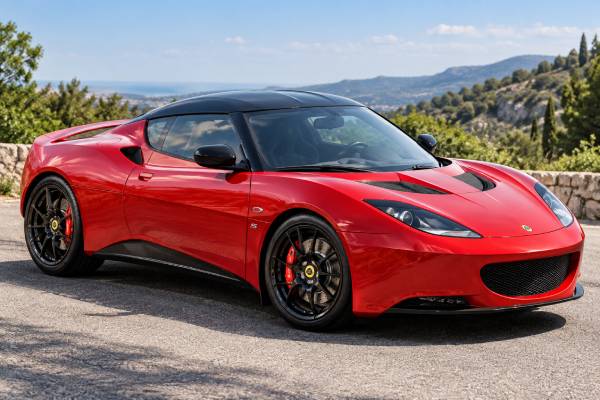
The Lotus Evora S Sports Racer is the factory-loaded, visually distinctive version of the supercharged first-generation Evora, pairing the 345 hp 3.5-litre V6 with equipment that was otherwise scattered across several option packs. Sold during the 2013–2015 period, it kept the Evora S mechanical formula—mid-mounted Toyota-based V6, rear-wheel drive, bonded aluminium chassis and either a six-speed manual or IPS automatic—while adding forged 19/20-inch wheels, Pirelli P Zero Corsa tyres, black exterior detailing, a 2+2 cabin, Sport Pack and Tech Pack as standard. That combination matters today because a genuine Sports Racer is more than a paint-and-stripe exercise: its specification is part of the model’s identity. For buyers, the biggest priorities are confirming originality, checking clutch and gearbox behaviour, inspecting the cooling and air-conditioning systems, and separating normal hand-built-car quirks from neglected maintenance. A good one remains a rare grand-touring Lotus with unusually strong steering feel, real cross-country pace and enough comfort for long trips.
Table of Contents
- What makes the S Sports Racer different
- Supercharged V6 and driving character
- Technical specifications and factory data
- Chassis, brakes, wheels and cabin equipment
- Maintenance priorities and common faults
- Used-car inspection and authenticity checks
- Who should buy one and what ownership is like
What makes the S Sports Racer different
The S Sports Racer is best understood as a high-specification Evora S with a coordinated factory appearance package, not as a separate engine or chassis derivative. Its appeal comes from the way Lotus bundled desirable options with a recognisable exterior and interior treatment, making the car easier to identify and, when new, better value than building a similarly equipped Evora S from the options list.
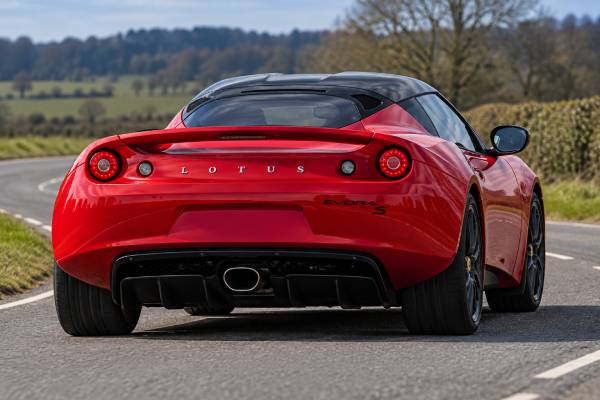
Lotus offered the Sports Racer in both naturally aspirated and supercharged forms. The car covered here is the supercharged S, rated at 345 hp (350 PS) and 400 Nm. Factory literature identified four Sports Racer colours: Aspen White, Carbon Grey, Nightfall Blue and Ardent Red. Against those colours, Lotus applied black treatment to the roof, mirror pods, front splitter, side sills, rear diffuser, light bezels and model badges. A small Union Jack side badge added another model-specific cue.
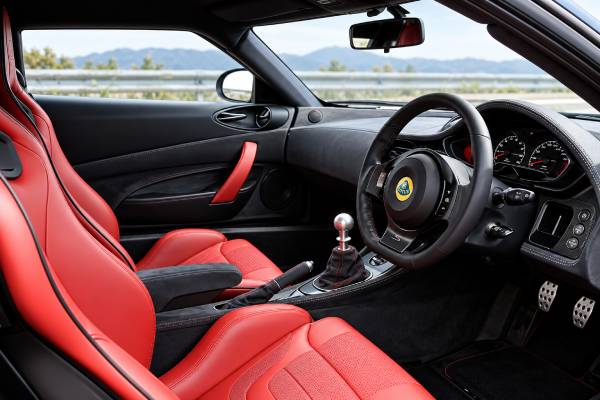
The package also included gloss-black forged Design wheels, 19 inches at the front and 20 at the rear, fitted with Pirelli P Zero Corsa tyres. Inside, buyers received Premium Sport seats, contrasting piping and stitching, SuedeTex trim across major cabin surfaces, gunmetal dashboard details and a 2+2 seating layout. The Sport Pack and Tech Pack were standard, as were power-fold mirrors and a reversing camera.
That equipment list is significant when assessing a used example. Over the years, wheels are refinished, tyres are substituted, roofs may be wrapped, seats can be retrimmed and badges disappear. A car can still be a genuine Sports Racer after sensible replacement work, but the closer its equipment is to factory specification—and the better the paperwork explaining any deviation—the easier it is to value and authenticate.
The Sports Racer was also part of the closing chapter of the original Evora before the heavily revised Evora 400 arrived. It therefore combines the earlier car’s softer, more delicate visual shape and cabin architecture with the most useful factory options of the period. For some enthusiasts that is the sweet spot: the steering and chassis retain the early Evora’s supple road manners, while the supercharged engine supplies noticeably stronger mid-range acceleration than the naturally aspirated model.
A prospective buyer should not assume that every black-roof Evora S is a Sports Racer. Check the VIN and factory/dealer documentation, then compare the original build specification with the car in front of you. Colour and trim details are evidence, but paperwork is stronger evidence.
Supercharged V6 and driving character
The central reason to choose the S Sports Racer over the naturally aspirated version is its broader, harder acceleration rather than a radically different chassis. Lotus added a Harrop HTV 1320 supercharger using Eaton TVS technology to the 3,456 cc Toyota 2GR-FE V6, lifting output to 345 hp at 7,000 rpm and torque to 400 Nm at 4,500 rpm.
In the manual car, Lotus quoted 0–60 mph in 4.4 seconds, 0–100 km/h in 4.6 seconds and a 178 mph (286 km/h) maximum. The optional IPS automatic was only slightly slower to 60 mph but had a lower top speed. The important real-world difference is the shape of the power delivery: the supercharger gives the Evora S stronger response from the middle of the rev range and reduces the need to chase the upper revs during overtaking.
The six-speed manual is the enthusiast’s choice because it combines a low, mechanical driving position with a conventional clutch and close engagement with the engine. It is not a modern, effortless shift when neglected or poorly adjusted, so a test drive should include cold and hot operation, repeated 1–2 and 2–3 changes, and a check for clutch slip in a high gear under load. A high or inconsistent bite point can be a warning rather than merely a characteristic.
IPS—Intelligent Precision Shift—is a six-speed torque-converter automatic. In Drive it suits the Evora’s grand-touring side, while steering-wheel paddles allow manual control. It is not a dual-clutch transmission, and expectations should be set accordingly. A healthy unit should engage cleanly and shift without flaring, harsh bangs or persistent warning messages. Service history and correct fluid care are more important than internet arguments about which transmission is “better.”
The Sport Pack changes the car’s temperament more than its name suggests. Sport mode sharpens throttle response, alters Dynamic Performance Management thresholds and controls the exhaust bypass valve, giving the driver more room before electronic intervention. On the road, that means the S can feel relaxed in ordinary driving and much more alert when asked.
What defines the experience, however, is still the Evora chassis. The steering is hydraulically assisted and unusually communicative. The car rides on double wishbones at all four corners, with Eibach springs and Bilstein dampers. Instead of using very stiff springs to create “sportiness,” Lotus relied on geometry, low mass and excellent damping. The result is a car that can absorb broken pavement while remaining composed through fast direction changes.
Technical specifications and factory data
The Evora S Sports Racer is a conventional petrol ICE sports car: a transverse, mid-mounted, supercharged V6 drives the rear wheels through a six-speed manual or six-speed IPS automatic. The Sports Racer package did not create a separate engine calibration, so its core drivetrain and performance figures follow the contemporary Evora S specification; the factory-specific wheels, tyres and equipment distinguish the edition.
| Specification | Value |
|---|---|
| Engine family | Toyota 2GR-FE, Lotus calibration |
| Configuration | 60-degree V6, DOHC, 24 valves |
| Displacement | 3,456 cc (3.5 L) |
| Construction | All-aluminium block and cylinder heads |
| Induction | Harrop HTV 1320 supercharger using Eaton TVS technology |
| Fuel system | Multi-point sequential fuel injection |
| Maximum power | 345 hp (350 PS / 258 kW) at 7,000 rpm |
| Maximum torque | 400 Nm (295 lb-ft) at 4,500 rpm |
| Engine position | Transverse mid-engine |
| Specification | Manual | IPS automatic |
|---|---|---|
| 0–60 mph | 4.4 s | 4.5 s |
| 0–100 km/h | 4.6 s | 4.7 s |
| Maximum speed | 286 km/h (178 mph) | 269 km/h (167 mph) |
| Combined fuel consumption | 9.9 L/100 km (28.7 mpg UK) | 9.7 L/100 km (29.3 mpg UK) |
| CO₂ emissions | 229 g/km | 224 g/km |
| Fuel tank | 60 L | 60 L |
| Specification | Value |
|---|---|
| Drive | Rear-wheel drive |
| Manual gearbox | 6-speed, sports ratios |
| Automatic option | 6-speed Intelligent Precision Shift (IPS) |
| Manual control on IPS | Steering-wheel-mounted paddles |
| Electronic traction aid | Bosch electronic differential lock function within stability system |
| Drive modes | Normal and selectable Sport calibration through Lotus DPM |
| Specification | Value |
|---|---|
| Chassis | Bonded extruded-aluminium structure |
| Suspension | Forged-aluminium double wishbones, front and rear |
| Springs and dampers | Eibach springs, Bilstein dampers |
| Front brakes | 350 mm ventilated discs, AP Racing 4-piston calipers |
| Rear brakes | 332 mm ventilated discs, AP Racing 4-piston calipers |
| Sports Racer wheels | Forged gloss-black Design wheels, 19 in front / 20 in rear |
| Front tyres | 235/35 ZR19 Pirelli P Zero Corsa |
| Rear tyres | 275/35 ZR20 Pirelli P Zero Corsa |
| Specification | Value |
|---|---|
| Length | 4,361 mm (171.7 in) |
| Width including mirrors | 2,047 mm (80.6 in) |
| Height | 1,229 mm (48.4 in) |
| Wheelbase | 2,575 mm (101.4 in) |
| Unladen mass, manual Evora S | 1,437 kg (3,168 lb) |
| Unladen mass, IPS Evora S | 1,442 kg (3,179 lb) |
| Drag coefficient | 0.33 |
| Area | Factory specification |
|---|---|
| Exterior colours | Aspen White, Carbon Grey, Nightfall Blue, Ardent Red |
| Black accents | Roof, mirror pods, splitter, sills, diffuser, light bezels and badges |
| Heritage detail | Union Jack side-marker badge |
| Seating | 2+2 configuration |
| Interior | Premium Sport leather seats with contrast piping/stitching; SuedeTex trim |
| Included packs | Sport Pack and Tech Pack |
| Convenience | Power-fold mirrors and reversing camera |
Chassis, brakes, wheels and cabin equipment
The Sports Racer’s best engineering feature is not the supercharger but the way its aluminium structure, suspension and steering work together. The bonded chassis is exceptionally stiff for its mass, allowing Lotus to use relatively compliant spring and damper settings without sacrificing wheel control. That is why an Evora can ride poor B-roads with surprising calm while still feeling precise at the steering wheel.
AP Racing four-piston calipers act on large ventilated discs at both axles. With the Sport Pack, the discs are cross-drilled. Brake feel should be firm and progressive; pulsing, steering shake or a pronounced lip on the disc edge points to wear or heat history. Replacement costs are not exotic-supercar territory, but quality parts and correct installation matter. Cars that have done repeated track work can consume discs, pads and tyres much more quickly than road-only examples.
The 19/20-inch Sports Racer wheel package looks dramatic and was a genuine factory feature, but it also deserves close inspection. Check the inner rims for cracks or bends and look for evidence of repeated cosmetic repair. Pirelli P Zero Corsa tyres were original equipment; many owners now use modern alternatives for better wet performance or availability. Matching premium tyres with correct load and speed ratings are more important than preserving an obsolete tyre model for appearance alone.
The cabin is an interesting mixture of sports-car intimacy and grand-tourer equipment. The driving position is low, the windscreen base is far ahead, and the pedals and steering are aligned for committed driving. The rear seats are small and are best viewed as occasional child seats or luggage space, but their presence is useful in a car that can genuinely cover distance. ISOFIX mountings were part of the Evora’s 2+2 practicality.
Sports Racer trim matters to authenticity. Factory combinations used black leather with red contrast details or Venom Red leather with black contrast details, plus Slate Grey SuedeTex on the dashboard, doors and centre console. Wear on seat bolsters is common, but mismatched retrimming, missing contrast details or a completely different dashboard finish should prompt questions. Restoration is not automatically negative; undocumented attempts to mimic Sports Racer trim are.
Electrically, check every item rather than assuming a minor fault is harmless. Test air conditioning, windows, central locking, power-fold mirrors, the reverse camera, parking functions, headlamps, audio/navigation and all warning lamps. Early Evora electronics are not exceptionally complex, but access and diagnosis can turn a cheap-looking fault into labour expense.
Maintenance priorities and common faults
A well-maintained Evora S is robust by specialist sports-car standards, but deferred maintenance can be expensive because several jobs are labour-intensive. The Toyota-derived V6 is generally durable; most ownership risk lies in the systems around it, the clutch and gearbox, age-related cooling components, trim and the cumulative effect of hard use.
Start with service history. Evidence should show regular engine-oil and filter changes, brake-fluid service, attention to coolant condition and age, and spark-plug replacement at appropriate intervals. A stamped book is helpful, but detailed invoices from a knowledgeable Lotus specialist are better because they reveal what was actually inspected and replaced.
On a cold start, listen for abnormal knocking, persistent belt noise or supercharger-related mechanical sounds beyond the normal whir. The idle should settle cleanly. Watch the coolant temperature as the car warms and confirm the radiator fans operate when required. Inspect the front radiator area for damage and debris; stone impact and corrosion can shorten radiator or air-conditioning condenser life.
Clutch replacement is one of the large-cost jobs on a manual Evora because access is time-consuming. During the test drive, check for slip under full load, judder when moving away, difficulty selecting gears and a bite point that changes when hot. A recently replaced clutch supported by a credible invoice can be a positive value point.
The manual shift mechanism can suffer from wear or adjustment problems in cables and linkages. Not every reluctant shift means an internal gearbox failure, but it should be diagnosed rather than accepted. IPS cars require a different assessment: shifts should be consistent in automatic and paddle modes, engagement should not be delayed, and there should be no transmission warning lights.
Suspension wear usually announces itself through knocks, vague wheel control or uneven tyre wear. Inspect dampers for leaks, bushes and ball joints for play, and alignment for evidence of kerb strikes. The Evora’s excellent geometry depends on everything being tight and accurately set; a tired car can feel merely ordinary, which is not how a healthy Evora drives.
Other age-related checks include door seals and water ingress, boot and cabin dampness, headlamp condition, door handles and latches, window operation, seat runners, dashboard trim and the condition of the engine-bay heat shielding. Air-conditioning should produce genuinely cold air. A seller who says it “just needs a regas” should be expected to prove that, because a leaking condenser or pipe is a different repair.
Used-car inspection and authenticity checks
The smartest way to buy an S Sports Racer is to verify identity first, condition second and cosmetic perfection third. A factory-correct but neglected example is not automatically a better purchase than a carefully maintained car with reversible upgrades.
Begin with the VIN, registration history and original sales documentation. Ask a Lotus dealer or marque specialist to confirm the build specification where possible. Then compare the car with the Sports Racer equipment: one of the four original colours, coordinated black accents, Union Jack side badge, gloss-black forged Design wheels, Premium Sport interior treatment, 2+2 seating, Sport Pack and Tech Pack. A missing badge is trivial; a completely different original specification is not.
Inspect the bonded aluminium chassis carefully. It is not repaired like a conventional steel monocoque. Look underneath for impact damage, crushed jacking areas, distorted panels or suspicious fresh coatings. The composite body can be repaired after minor damage, but poor accident work may show as waviness, mismatched paint, cracking around fixings or inconsistent panel gaps.
A pre-purchase inspection by a Lotus specialist is particularly valuable because the car’s appearance can hide expensive mechanical issues. Ask for diagnostic scanning, clutch assessment, suspension inspection, brake measurement, tyre-age check and a review of coolant and air-conditioning condition. The specialist should also check for oil leaks, exhaust condition, engine mounts and evidence of track use.
During the drive, the car should track straight, steer with immediate but natural response and ride firmly without crashing over bumps. There should be no persistent steering vibration at motorway speed. Full-throttle acceleration should be smooth and forceful, with no hesitation or warning lights. Braking from speed should be straight and free of pulsation.
Do not reject tasteful upgrades automatically. A modern head unit, improved tyres, upgraded dampers or a quality exhaust may make the car more usable. What matters is workmanship, documentation and whether original parts accompany the car when collectability is a priority. Conversely, loud cosmetic modifications can conceal a lack of routine spending.
Finally, evaluate the seller as part of the car. An owner who can explain tyre choices, alignment settings, service work, battery care and known imperfections is usually more reassuring than a freshly detailed car with no history. Sports Racers are uncommon enough that patience is preferable to buying the first one available.
Who should buy one and what ownership is like
The Evora S Sports Racer suits a driver who wants first-generation Evora delicacy with stronger performance and a factory specification that already includes most of the desirable equipment. It is not the cheapest Evora to run, and it is not as modern inside as the later Evora 400, but it offers a distinctive blend of steering feel, road compliance and usable speed.
Compared with the naturally aspirated Sports Racer, the S has a clear advantage when accelerating from medium speeds or carrying a passenger and luggage on fast roads. The trade-off is slightly higher mechanical complexity, somewhat greater fuel use and more temptation for previous owners to have driven it hard. Those are manageable concerns if the car has been maintained correctly.
Compared with the Evora 400, the early S feels more like the original Evora concept. The cabin entry is tighter, the infotainment and switchgear date it, and outright performance is lower, yet many drivers value the earlier car’s styling and supple chassis. Buying on specification sheets alone misses the point; the Sports Racer is compelling because the whole car communicates clearly at ordinary road speeds.
Transmission choice can also shape long-term satisfaction more than a small difference in purchase price. A manual S Sports Racer rewards a driver who wants to manage the engine’s torque and chassis balance directly, but clutch condition must be priced realistically because replacement labor is substantial. IPS suits owners who spend more time in congestion or want an easier touring car, provided it shifts cleanly when hot and has a convincing service record. Neither version is automatically the better collector car; provenance, originality and mechanical health are more defensible value indicators than gearbox preference alone.
Running costs should be budgeted like a low-volume performance car, not a Toyota with a Lotus badge. The engine’s origin helps with durability and parts knowledge, but clutch labour, AP Racing brake hardware, large performance tyres, composite-body repair and Lotus-specific trim can still be costly. A maintenance reserve is more useful than trying to find the lowest advertised purchase price.
For occasional touring, the 2+2 configuration and rear luggage area are genuinely useful. The ride makes long journeys less tiring than the car’s appearance suggests, and the V6 is relaxed at cruising speed. Visibility to the rear is limited, which is why the factory reversing camera is worth having in working order.
The model also has a credible collectability argument because its identity is easy to understand: a limited-period, high-specification factory package built around the supercharged first-generation Evora. Collectability, however, should not override condition. The most rewarding cars are those with documented history, original identity, sensible upkeep and regular use.
If those fundamentals are present, the S Sports Racer remains one of the more complete ways to experience the original Evora. It can commute, tour and entertain on a demanding road without needing track-car stiffness or supercar theatre. That breadth is the real reason the model has aged well.
References
- The Lotus Range 2013 (Sales Brochure)
- Lotus Evora 2014 (Sales Brochure)
- Lotus • Heritage Timeline 2026 (Heritage Timeline)
- Lotus Evora – Drive without Compromise | Lotus Cars 2026 (Manufacturer Heritage)
- Lotus – Evora – Sales Brochure – (2013)2 2013 (Sales Brochure)
- Models – Evora – TechWiki 2023 (Model Reference)
Disclaimer
This article is for informational purposes only and is not a substitute for professional diagnosis, repair or inspection. Specifications, torque values, maintenance intervals and procedures can vary by VIN, market and equipment; verify every service decision against the official service documentation for the specific vehicle.
If this guide helped you, please consider sharing it on Facebook, X/Twitter or your preferred enthusiast community to support our work.