
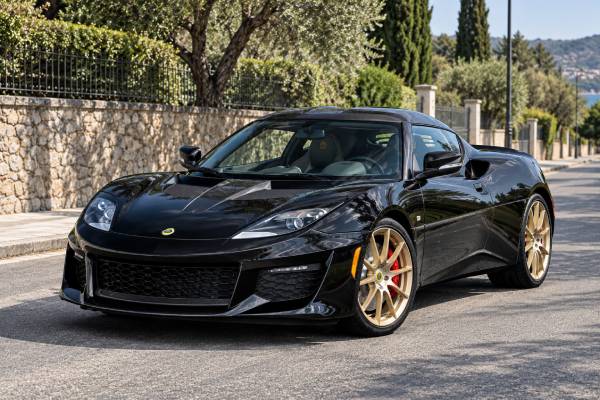
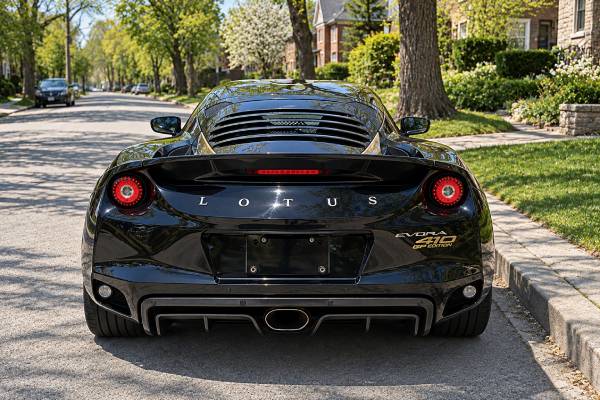
The 2017 Lotus Evora Sport 410 GP Edition is a black-and-gold Lotus Exclusive specification created around the North American launch of the lighter, more focused Sport 410. Lotus announced five GP-liveried cars for the United States and Canada, using colors inspired by famous Team Lotus Formula 1 machinery. The underlying Sport 410 was more than an appearance package: it used extensive carbon fiber, forged wheels, a lithium-ion battery, revised aerodynamics, and a 3.5-liter supercharged V6 developed beyond the Evora 400. One complication is power terminology. European Sport 410 literature quotes 410 hp, while Lotus’s Federal North American launch material quoted 400 hp for the U.S./Canada car; the assignment’s 410 hp label reflects the model name and wider Sport 410 specification, not a reason to erase the Federal rating. Production evidence also needs care: the 2017 North American announcement specifies five GP cars, while later model-history material records a GP specification of up to twenty units. This guide keeps those records distinct and focuses on what a buyer can verify on an individual car.
Table of Contents
- The GP Livery and North American Launch
- Five Announced Cars and the Broader GP Record
- Sport 410 Lightweight Engineering
- Sport 410 Performance and Technical Data
- Federal Versus Rest-of-World Specification
- Maintenance for a Carbon-Intensive Evora
- Buying and Authenticating a GP Edition
The GP Livery and North American Launch
The GP Edition was the visual flagship for Lotus’s 2017 Sport 410 arrival in North America. Lotus Exclusive applied a Motorsport Black base with gold graphics and wheels that deliberately recalled the black-and-gold era of Team Lotus Formula 1 cars.
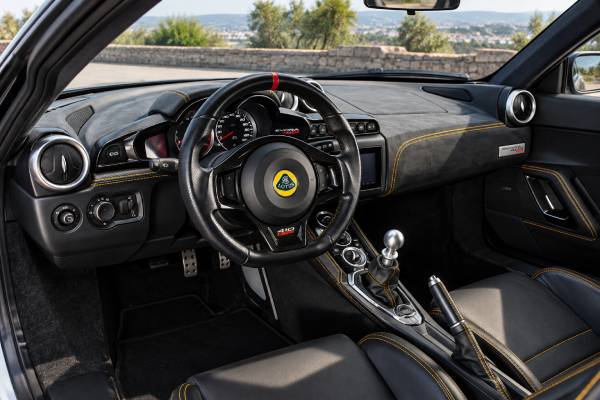
The scheme is instantly recognizable because it echoes racing Lotuses from the 1970s and 1980s, including the visual language associated with cars such as the Type 72 and Type 79. On the road car, the historical reference was translated rather than copied literally: gloss-gold graphic elements, gold-finished lightweight wheels, dark bodywork, and detail badges created a cohesive factory specification. Inside, period descriptions identify Alcantara or leather trim with gold stitching, continuing the theme without making the cabin theatrical.
For North America, Lotus used the GP Edition to draw attention to the arrival of the Sport 410 alongside the Evora 400. The company announced that just five cars would be offered in the GP color scheme for U.S. and Canadian customers. Contemporary pricing put the standard North American Sport 410 at $104,200 before taxes and the GP Edition at $110,000.
| Item | Launch information |
|---|---|
| Market | United States and Canada |
| Announced GP allocation | 5 cars |
| Base model | Evora Sport 410 |
| Program | Lotus Exclusive |
| Exterior theme | Motorsport Black with gold racing-inspired graphics |
| North American MSRP | $110,000 for GP Edition at launch |
| Standard Sport 410 MSRP | $104,200 at launch |
The important collecting point is that the GP name refers to this factory-created specification, not simply any Sport 410 repainted black and gold. Wheels, graphics, trim, badges, original sales paperwork, VIN history, and market delivery records should all support the claim.
Five Announced Cars and the Broader GP Record
“Only five” is accurate for the North American GP launch announcement, but later Lotus model-history records complicate any claim that exactly five GP-spec cars existed worldwide. Those later records describe a Sport 410 GP Edition specification of up to twenty units.
The safest interpretation is to keep the statements attached to their sources. In April 2017, Lotus’s North American communication said five GP-liveried Sport 410s would be produced for U.S. and Canadian customers. Contemporary press reports repeated that five-car allocation. Separately, later model-history documentation records “up to 20 units” associated with the GP Edition specification and even notes differences between Federal and non-Federal cars.
Those records do not necessarily describe the same market pool or production stage. “Up to 20” can refer to a broader specification authorization, planned worldwide availability, or later builds beyond the initial five North American announcement. Dealer anecdotes sometimes claim additional cars were made after demand exceeded the original plan, but such claims should be corroborated with factory records before being used to authenticate a specific chassis.
The source hierarchy matters when describing rarity. Lotus’s 2017 North American launch is the strongest evidence for the five-car U.S./Canada allocation; contemporary media corroborates that announcement. The later “up to 20 units” record is best treated as evidence of a broader GP specification rather than proof that twenty customer cars were completed. Dealer or owner recollections can help identify additional chassis, but they should be tied to VIN-level paperwork before being used in a sales description.
For a buyer, the lesson is practical. Do not pay a premium because a seller says “one of five in the world” unless the evidence supports that exact wording. A North American car can still accurately be one of the five cars in the initial U.S./Canada GP allocation, which is rare enough without inflating the claim.
Sport 410 Lightweight Engineering
The GP Edition’s real performance substance comes from the Sport 410 platform, which reduced mass and increased aerodynamic load compared with the Evora 400. Carbon-fiber body components, lighter hardware, forged wheels, and a lithium-ion battery were central to the package.
Lotus used carbon fiber for the front access panel, roof panel, one-piece tailgate, rear quarter elements, splitter, and rear diffuser in the Sport 410 program. The lighter tailgate incorporated a louvered section and worked with revised aero elements to increase high-speed stability. Weight reduction also came from lightweight forged wheels, a lithium-ion battery, simplified interior equipment in the most focused specifications, and other detail changes.
The underlying structure remained Lotus’s bonded and extruded aluminum chassis with double-wishbone suspension. Sport 410 calibration was aimed at sharper road and track response, while hydraulic steering retained the feedback that had long distinguished the Evora. The car used Michelin Pilot Sport Cup 2 tires in 235/35 R19 front and 285/30 R20 rear sizes in European technical literature, a more track-oriented choice than the regular Evora 400’s road-biased fitment.
| Area | Sport 410 feature |
|---|---|
| Structure | Bonded and extruded aluminum chassis |
| Carbon components | Roof, tailgate, front access panel, rear quarters, splitter, rear diffuser |
| Battery | Lightweight lithium-ion unit in published Sport 410 specification |
| Wheels | Lightweight forged 19-inch front / 20-inch rear |
| Suspension | Independent double wishbones |
| Steering | Hydraulic assistance, 2.86 turns lock-to-lock |
| European tire fitment | Michelin Pilot Sport Cup 2, 235/35 R19 front and 285/30 R20 rear |
The GP treatment layered collectability onto that engineering rather than replacing it. A correct GP should therefore be judged first as a Sport 410: its carbon panels, lightweight equipment, chassis setup, and brakes are integral to what the car is. Cosmetic authenticity without correct Sport 410 hardware is not enough.
Weight-saving measures have practical consequences for inspection. A carbon roof cannot be assessed like a conventional steel panel after a suspected impact, and lightweight forged wheels deserve crack and runout checks if they have struck potholes. The one-piece tailgate is both an aerodynamic and visual component, so latch alignment, hinge condition and evidence of repair should be checked carefully. Replacing these items with ordinary Evora 400 parts may keep a damaged car usable, but it changes the substance of the Sport 410 package and should be disclosed.
The suspension setup also depends on the whole wheel-and-tire system. European cars were engineered around Cup 2 rubber, while Federal cars could have different factory tire content. Owners sometimes fit a more road-oriented tire for wet-weather confidence or longer life. That can be a reasonable choice, but all four tires should be a coherent matched set, and alignment should suit the fitted hardware. An exotic livery does not make mismatched old tires acceptable.
Sport 410 Performance and Technical Data
In European specification, the Sport 410 was rated at 410 hp and 420 Nm, with a manual top speed of 190 mph. Automatic cars were slightly quicker in the quoted sprint to 60 mph but had a lower maximum speed.
The engine remains the supercharged Toyota-derived 2GR-FE V6, enlarged in capability through Lotus calibration and induction/exhaust changes rather than increased displacement. Published UK figures list 410 hp (416 PS / 306 kW) at 7,000 rpm and 420 Nm (310 lb-ft) at 3,500 rpm. The six-speed manual retained a limited-slip differential; a six-speed automatic was also offered.
| Measure | Manual | Automatic |
|---|---|---|
| Engine | 3,456 cc supercharged V6 | 3,456 cc supercharged V6 |
| Power | 410 hp / 416 PS / 306 kW at 7,000 rpm | 410 hp / 416 PS / 306 kW at 7,000 rpm |
| Torque | 420 Nm / 310 lb-ft at 3,500 rpm | 420 Nm / 310 lb-ft at 3,500 rpm |
| 0–60 mph | 4.0 sec | 3.9 sec |
| 0–100 km/h | 4.2 sec | 4.1 sec |
| Top speed | 305 km/h / 190 mph | 285 km/h / 177 mph |
| Kerb weight | 1,325 kg / 2,921 lb | 1,336 kg / 2,945 lb |
| Dry weight | 1,280 kg / 2,822 lb | 1,291 kg / 2,846 lb |
Lotus also quoted substantially more aerodynamic load than on the Evora 400. Published maximum downforce figures were 64 kg for the manual and 60 kg for the automatic in the UK technical specification. Braking hardware remained AP Racing four-piston calipers with two-piece ventilated rotors measuring 370 x 32 mm front and 350 x 32 mm rear.
| Item | Manual | Automatic |
|---|---|---|
| Front brakes | 370 x 32 mm two-piece ventilated discs, AP Racing four-piston calipers | 370 x 32 mm two-piece ventilated discs, AP Racing four-piston calipers |
| Rear brakes | 350 x 32 mm two-piece ventilated discs, AP Racing four-piston calipers | 350 x 32 mm two-piece ventilated discs, AP Racing four-piston calipers |
| Combined consumption | 9.7 L/100 km | 9.7 L/100 km |
| CO2 | 225 g/km | 230 g/km |
| Maximum quoted downforce | 64 kg | 60 kg |
These UK/European figures are useful for understanding the Sport 410 engineering package, but they should not automatically be pasted onto a Federal GP Edition without qualification. Certification, equipment, tires, and rated output differed by market.
Federal Versus Rest-of-World Specification
A North American GP Edition is not simply a European Sport 410 with U.S. lamps. Lotus’s own Federal launch material quoted 400 hp and 301 lb-ft of torque, while European documentation quoted 410 hp and 420 Nm; Federal cars also carried market-specific equipment and a higher road-ready weight.
This is the most important specification nuance in the model. The “410” name remained, and auction descriptions sometimes call a North American GP a 410-hp car, but the contemporaneous Lotus USA communication reproduced by multiple outlets states 400 hp for the Federal version. That difference may reflect certification, calibration, measurement convention, or a market-specific tune, but the safe practice is to report the figures Lotus gave for the relevant market rather than force one global number.
The Federal Sport 410 was also described as about 60 kg lighter than the Federal Evora 400 and capable of 0–60 mph in 3.9 seconds with a 190 mph maximum speed in launch material. Later Lotus model-history notes indicate Federal GP cars used Evora 400-style door trims, Sparco seats, and Evora 400-spec tires rather than matching every lightweight detail of non-Federal cars.
| Item | UK/European Sport 410 literature | North American launch material |
|---|---|---|
| Named model | Evora Sport 410 | Evora Sport 410 |
| Quoted power | 410 hp / 416 PS | 400 hp |
| Quoted torque | 420 Nm / 310 lb-ft | 301 lb-ft in reproduced Lotus USA material |
| 0–60 mph | 4.0 sec manual / 3.9 sec automatic | 3.9 sec quoted for North American launch car |
| Top speed | 190 mph manual | 190 mph quoted at launch |
| GP allocation | Not defined by the five-car U.S./Canada launch | Five cars announced in GP livery |
When buying, record the market the car was built for and use that market’s documentation. This prevents problems when ordering tires, emissions components, lighting, seats, restraint-system parts, or software. It also stops an innocent specification difference from being misread as evidence that a car is fake.
The same discipline applies to weight. UK literature quotes 1,325 kg kerb and 1,280 kg dry for a manual Sport 410, but a Federal car carries market-specific safety and convenience equipment. Auction catalogs, dealer advertisements and owner discussions may use different definitions of curb, wet, dry or unladen mass. Compare like with like before claiming that an individual GP is unusually light or heavy. If originality is important, weigh the car only as a supporting data point after documenting its actual equipment.
Interior differences deserve equal care. Lightweight Sport 410 specifications could delete or simplify equipment, yet North American cars were made more usable and had Federal-specific trim. Air conditioning, audio, cruise control and seating content can therefore vary by build. A rare car does not become more authentic simply because comfort features have been removed later; factory order records should decide what belongs.
Maintenance for a Carbon-Intensive Evora
A GP Edition needs normal supercharged Evora mechanical care plus unusually careful inspection of its carbon-fiber and lightweight components. The expensive risks are often not inside the engine; they are in damaged composite panels, wheels, aero pieces, or poorly substituted lightweight hardware.
Service the 2GR-FE according to the VIN-appropriate Lotus schedule and keep records of oil, filters, coolant, plugs, belts, and brake fluid. Watch for coolant loss, accessory-drive noises, misfires, and stored fault codes. A specialist should inspect the cooling pack and underbody because the car’s low front end and splitter are vulnerable to road impacts.
Manual transmission cars should be checked for clutch slip, judder, bite-point inconsistency, and shift-cable condition. Automatic cars need smooth cold and hot engagement and correct paddle response. Because some GP cars spend long periods stored, age-related deterioration can be more significant than mileage. Old fluid, weak batteries, hardened tires, corroded brake surfaces, and sticky air-conditioning systems are common consequences of preservation by inactivity.
Carbon components require a different eye from painted metal. Look along the roof and tailgate for cracking, distortion, repairs, cloudy clear coat, or mismatched weave where visible. Inspect mounting points, hinges, latch areas, splitter edges, diffuser fasteners, and the front access panel. A professionally repaired original component may be preferable to an undocumented replacement of uncertain origin, but the repair should be disclosed and photographed.
The lithium-ion battery deserves correct charging practice. Do not connect an unsuitable conventional charger simply because the car will crank. Use equipment approved for the battery chemistry fitted to the specific car, and verify whether a previous owner replaced the original lightweight battery with a different type. Such a change can be sensible for usability, but it should be documented if originality matters.
| Area | Inspection focus | Risk if neglected |
|---|---|---|
| Engine/cooling | Fluid history, belts, leaks, fault scan, stable temperatures | Heat-related or drive-system failures |
| Transmission | Clutch/shift quality or automatic engagement and paddle operation | High labor or component cost |
| Carbon body | Cracks, repairs, mounting points, clear-coat condition | Very expensive cosmetic and structural restoration |
| Forged wheels | Cracks, bends, gold finish, correct dimensions | Handling issues and loss of GP identity |
| Battery | Correct lithium-compatible charging and battery type | Battery damage or starting problems |
| Tires | Correct market fitment, age, matching set, pressures | Loss of grip and altered steering balance |
If the car sees track use, shorten inspection intervals rather than merely changing oil more often. Check brake pads and rotors, tire shoulders, wheel torque, fluid condition, suspension joints, and underbody contact points after events. Track use is not inherently harmful when the car is prepared and serviced correctly; undocumented overheating or repeated curb damage is the real concern.
Preserving the GP finish requires a similarly technical approach. Photograph graphic placement before paintwork, keep records of gold wheel refinishing, and avoid polishing aggressively across decal edges. If paint-protection film is fitted, make sure an installer understands composite panels and aged graphics; pulling old film carelessly can damage clear coat or lift decals. Inside, gold contrast stitching and Alcantara should be cleaned with products suited to the material rather than generic leather conditioners.
Insurance should reflect replacement difficulty, not just book value. A minor front-end incident can damage a carbon access panel or splitter whose replacement cost and availability are disproportionate to ordinary Evora parts. An agreed-value policy, detailed current photographs and an inventory of GP-specific components can make a future claim much easier to resolve.
Buying and Authenticating a GP Edition
Authenticate a GP Edition with VIN history and factory/dealer records before relying on the black-and-gold appearance. The livery is easy to imitate compared with the paper trail of a genuine Lotus Exclusive build.
Start by establishing market. A North American car should have documentation consistent with the U.S./Canada Sport 410 launch and its Federal equipment. Ask for the original window sticker or invoice, build information, Lotus or dealer correspondence, and photographs from delivery. Confirm that the VIN has a continuous ownership trail and that the seller’s production claim is worded accurately—especially if “one of five” is being used to justify a large premium.
Then inspect the GP-specific finish. Motorsport Black paint, gold graphics, gold wheel treatment, Union Jack or other edition details, and gold interior stitching should agree with the known specification and the individual car’s records. Look for repaired wheels, replacement decals, repainted panels, or retrimmed seats. None automatically disqualifies the car, but each should be documented and reflected in price.
Next confirm Sport 410 hardware. Examine the carbon roof, one-piece tailgate, access panel, aero pieces, brakes, seats, wheels, and lightweight equipment. Because Federal and non-Federal content differs, compare the car to the correct market specification rather than a European brochure photograph. A seller who calls normal Federal equipment “missing lightweight parts” may simply be using the wrong reference.
Finally, buy on mechanical condition. Arrange a specialist cold-start inspection, full diagnostic scan, lift examination, brake measurement, suspension check, tire-age review, and road test. Confirm clutch or automatic health, cooling-system stability, steering precision, and air-conditioning operation. On a rare car, deferred maintenance can hide behind very low mileage.
The GP Edition’s appeal comes from three layers that should all remain intact: the Sport 410’s genuinely lighter and more focused engineering, the historically resonant factory livery, and the tiny initial North American allocation. If one layer is missing—wrong hardware, undocumented repaint, or dubious provenance—the price should change accordingly. A properly documented example, by contrast, is one of the clearest intersections of modern Evora performance and Lotus’s racing visual heritage.
Driving history should be interpreted rather than feared. A Sport 410 that has attended occasional track days may be healthier than a static collector car if fluids, brakes, tires and alignment were maintained after each event. Look for invoices and inspection notes that show the owner understood the additional heat and wear. Conversely, a low-mileage GP with blue heat marks on rotors, damaged splitter edges and no service detail deserves a larger contingency budget.
The same principle applies to modifications. Reversible exhaust, wheel or infotainment changes are easier to accept when the factory parts remain with the car. ECU tunes, pulley changes, non-standard suspension geometry or replacement carbon panels require stronger evidence because they affect both engineering and provenance. The model is already fast and rare in standard form, so a buyer should demand a clear technical reason for changes rather than assuming extra power or stiffness automatically improves it.
References
- Lotus Evora Sport 410 GP Edition (US-Spec) | 2017MY — Caricos archive of Lotus USA media information, 2017.
- Lotus Evora Sport 410 GP Edition – only five units — paultan.org, 2017.
- 2017 Lotus Evora Sport 410 GP Edition — RM Sotheby’s vehicle history and catalog entry.
- Lotus Evora Sport 410 — Lotus UK brochure, 2017, archived by Lotus Drivers Guide.
- Models – Evora – TechWiki — SELOC TechWiki model history, including GP specification notes.
- Downloads – Lotus Drivers Guide — Lotus Drivers Guide brochure archive.
Disclaimer
This article is for informational purposes only and is not a substitute for professional diagnosis, inspection, maintenance, or repair. Specifications, torque values, service intervals, procedures, and fitted components can vary by VIN, market, equipment, and individual factory build; verify the exact car against official service documentation from Lotus and qualified specialist advice before ordering parts or carrying out work.
If this Sport 410 GP Edition guide helped clarify the model, please share it with another Lotus owner, collector, or prospective buyer.