
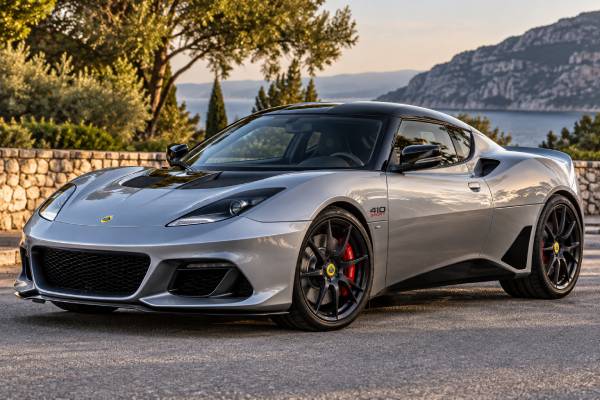
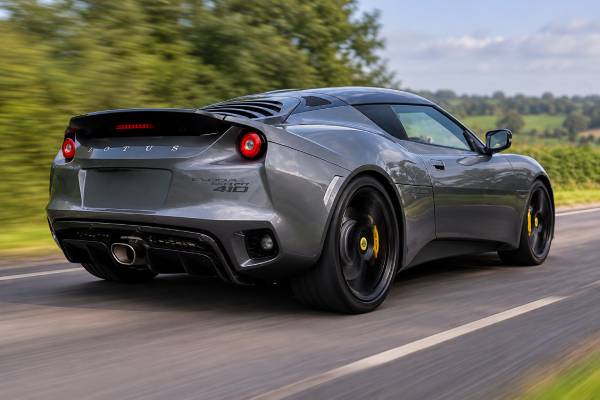
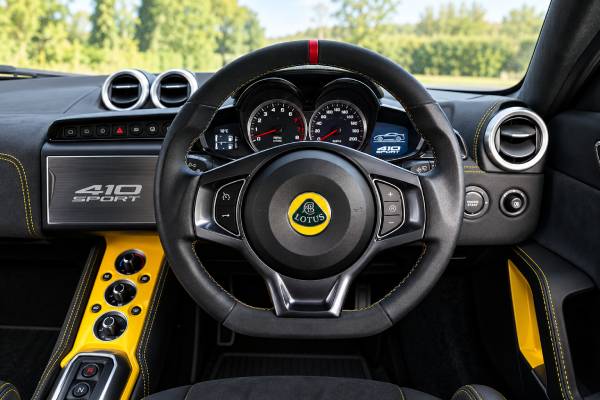
The Lotus Evora Sport 410 is the lighter, sharper bridge between the Evora 400 and the later GT-series cars. Built from 2016 through 2018, it keeps the Evora’s bonded-aluminium chassis and supercharged 3.5-liter V6 but strips mass with carbon-fibre body parts, carbon seats, forged wheels, and a lighter cabin specification. The result is a genuinely fast road car that still feels unusually communicative at legal speeds. Lotus rated the manual at 410 hp, 420 Nm, 0–100 km/h in 4.2 seconds, and as much as 305 km/h depending on market specification. Those numbers matter, but the Sport 410’s appeal is more about steering clarity, chassis balance, and the way reduced weight changes every control response. For a buyer today, condition matters more than odometer reading alone: tyres, clutch behavior, brake wear, cooling-system health, service history, accident repairs, and the condition of its costly carbon parts deserve close inspection.
Table of Contents
- What Defines the Evora Sport 410
- Evora Sport 410 Specifications and Technical Data
- Why the Lightweight Engineering Matters
- How It Drives on Road and Track
- Maintenance Priorities for a Used Sport 410
- Inspection Points and Common Problem Areas
- How to Buy the Right Evora Sport 410
What Defines the Evora Sport 410
The Sport 410 is best understood as a weight-focused Evora rather than simply an Evora 400 with ten more horsepower. Lotus removed roughly 70 kg relative to the Evora 400 specification used as its reference point, lowered the suspension, fitted more carbon fibre, and gave the car a more focused tyre and chassis package.
That distinction changes the ownership proposition. An Evora 400 was conceived as the broader-use model, while the Sport 410 deliberately trades some convenience for a more immediate feel. Many cars were supplied as two-seaters, and comfort equipment could be optional depending on market. Carbon-fibre sports seats, a carbon roof panel, carbon rear quarter panels, carbon access panel, carbon front splitter, and a lightweight carbon tailgate were central to the car’s identity rather than decorative add-ons.
The engine remained Toyota-derived but Lotus-calibrated. Its 3,456 cc 2GR-family V6 uses an Edelbrock supercharger and charge cooling, with the engine mounted transversely behind the cabin. Output is sent only to the rear wheels. A six-speed manual was the enthusiast choice and includes a low-inertia flywheel and Torsen-type limited-slip differential. A six-speed automatic with steering-wheel paddles was also offered.
The manual and automatic should not be treated as interchangeable versions of the same experience. The automatic is slightly quicker in the official 0–100 km/h sprint, but the manual offers the mechanical shift action, LSD, and direct driveline feel that fit the Sport 410’s lightweight brief. Conversely, a well-kept automatic can make sense for traffic-heavy use or for an owner who prefers the Evora’s chassis without dealing with clutch effort.
The Sport 410 also sits at an interesting point in Evora history. It arrived before the aerodynamically more elaborate GT430 and before the later GT410 Sport adopted the newer GT body treatment. That gives the 410 a cleaner look and a relatively simple specification while retaining the major Evora 400-era chassis and cabin improvements.
Evora Sport 410 Specifications and Technical Data
The Sport 410 is a conventional gasoline ICE sports car with a mid-mounted, supercharged V6, rear-wheel drive, and either a six-speed manual or six-speed automatic. The manual is the lighter configuration and the one most closely aligned with the model’s original engineering intent. Figures below reflect published Lotus Sport 410 data and can differ slightly by market, homologation cycle, options, and model year.
| Specification | Value |
|---|---|
| Engine | 3,456 cc all-aluminium V6, 24 valves |
| Engine family | Toyota 2GR-based V6, Lotus-calibrated |
| Induction | Edelbrock supercharger with charge cooling |
| Maximum power | 410 hp (416 PS / 306 kW) at 7,000 rpm |
| Maximum torque | 420 Nm (310 lb-ft) at 3,500 rpm in Lotus brochure specification |
| Engine position | Transverse mid-mounted |
| Drive type | Rear-wheel drive |
| Fuel | Premium unleaded gasoline |
| Specification | Manual | Automatic |
|---|---|---|
| Transmission | 6-speed manual | 6-speed automatic with paddles |
| Limited-slip differential | Torsen type | Not the manual Torsen arrangement |
| Flywheel | Low-inertia single-mass type | Automatic-specific driveline |
| Gearbox cooling | Market/specification dependent | Automatic-specific cooling provision |
| Driver modes | Drive / Sport / Race | Drive / Sport / Race |
| Specification | Manual | Automatic |
|---|---|---|
| 0–60 mph | 4.0 s | 3.9 s |
| 0–100 km/h | 4.2 s | 4.1 s |
| Top speed | Up to 305 km/h (190 mph) in Lotus brochure specification | Up to 285 km/h (177 mph) in Lotus brochure specification |
| Kerb weight | 1,325 kg (2,921 lb) | 1,336 kg (2,945 lb) |
| Dry weight | 1,280 kg (2,822 lb) | 1,291 kg (2,846 lb) |
| Downforce at maximum speed | 64 kg | 60 kg |
| Specification | Manual | Automatic |
|---|---|---|
| Urban consumption | 13.6 L/100 km | 14.1 L/100 km |
| Extra-urban consumption | 7.3 L/100 km | 7.1 L/100 km |
| Combined consumption | 9.7 L/100 km | 9.7 L/100 km |
| CO₂ emissions | 225 g/km | 230 g/km |
| Fuel-economy procedure | Period European laboratory cycle | Period European laboratory cycle |
| Specification | Value |
|---|---|
| Chassis | Bonded and extruded aluminium structure |
| Front suspension | Forged aluminium double wishbones, Eibach springs, Bilstein dampers |
| Rear suspension | Forged aluminium double wishbones, Eibach springs, Bilstein dampers |
| Steering | Lotus-tuned hydraulic rack and pinion, 2.86 turns lock-to-lock |
| Front brakes | 370 × 32 mm two-piece ventilated discs, AP Racing four-piston calipers |
| Rear brakes | 350 × 32 mm two-piece ventilated discs, AP Racing four-piston calipers |
| Wheels | 19-inch front, 20-inch rear forged aluminium |
| Tyres | Michelin Pilot Sport Cup 2, 235/35 R19 front and 285/30 R20 rear |
| Specification | Value |
|---|---|
| Body style | 2-door mid-engine coupe |
| Typical seating configuration | 2+0 for Sport 410 lightweight specification |
| Length | 4,394 mm (173.0 in) |
| Wheelbase | 2,575 mm (101.4 in) |
| Width without mirrors | About 1,845 mm (72.6 in) |
| Major lightweight body parts | Carbon roof, access panel, splitter, rear quarters, diffuser elements, and tailgate depending on specification |
The apparently conflicting 300/305 km/h figures found in period material are a useful reminder to identify the exact market brochure for a particular car. Early launch coverage often quoted 300 km/h for the manual, while later Lotus technical literature listed 305 km/h. For buying purposes, the difference has no practical meaning; matching the VIN, market, and original specification is more important.
Those period fuel figures are most useful for comparing factory specifications, not predicting what a present-day owner will see. The Sport 410 invites frequent use of the supercharger, while short trips, cold starts, traffic, tyre pressure, and driving style can move real consumption substantially. Unusually good or poor trip-computer numbers are therefore weak evidence of mechanical health. Service history, a clean diagnostic scan, stable temperatures, smooth full-load running, and a thorough road test say much more about the condition of a particular car.
Why the Lightweight Engineering Matters
The Sport 410’s defining engineering change is not its ten-horsepower gain; it is the reduction of mass in places that affect how the car reacts. Removing weight from the roof, tailgate, seats, wheels, and other components reduces inertia, while forged wheels also reduce unsprung and rotational mass.
A lighter roof and upper body reduce the amount of mass the suspension must control in a direction that works against cornering stability. Lighter wheels respond more readily to bumps and require less energy to accelerate or decelerate. Removing weight behind the rear axle, particularly with an optional titanium exhaust, is especially valuable because it reduces the pendulum effect of mass located far from the car’s center.
The carbon-fibre tailgate is a good example of Lotus thinking. It combines several functions into one large lightweight component and changes both total mass and where that mass sits. That is more meaningful to the driving experience than replacing an interior trim panel purely for appearance.
The Sport 410 also sits 5 mm lower than the Evora 400 reference setup and was calibrated around sticky Cup 2 tyres. Those tyres can generate high dry grip, but they are a consumable part of the suspension system in practical terms. Old, hardened, heat-cycled, or mismatched tyres can make a sound Sport 410 feel nervous or dull. A buyer should therefore regard tyre date codes and matching axle pairs as chassis-inspection items, not merely running-cost details.
Hydraulic steering is another central part of the package. Modern electric racks can be accurate, but the Evora’s hydraulically assisted rack transmits small changes in front-tyre load with unusual clarity. Because the car is not extremely heavy and the front tyres are modest by modern supercar standards, steering effort builds progressively rather than feeling artificially weighted.
The brakes are equally serious. AP Racing four-piston calipers clamp large two-piece discs at both ends. This arrangement gives good heat capacity for fast road use, but replacement parts are not economy-car items. A pre-purchase inspection should measure disc condition rather than judging only by visible pad thickness.
How It Drives on Road and Track
The Sport 410 rewards smooth inputs more than dramatic ones. Its strongest trait is the continuity between steering, brake pedal, chassis roll, and rear-axle traction; the driver can sense small changes before electronic intervention becomes necessary.
On a fast road, the supercharged V6 delivers immediate torque without the waiting period associated with a large turbocharger. The engine becomes more urgent as revs rise, so the car still encourages use of the upper half of the tachometer. The soundtrack is mechanical and induction-heavy, and cars with the titanium exhaust are louder and lighter at the rear.
The manual transmission contributes substantially to the character. The exposed-style precision shift mechanism used in this Evora generation gives a more positive action than earlier Evoras, but condition and adjustment matter. A healthy car should select gears cleanly when fully warm. Resistance, crunching, an indistinct gate, or a clutch that bites at the very top of its travel deserves investigation rather than being dismissed as “Lotus character.”
The automatic changes the car’s rhythm. It can deliver the slightly better official standing-start time because it removes a manual shift from the driver’s workload, yet it does not provide the same involvement on a quiet road. Buyers who intend to commute frequently may nevertheless prefer it, especially if they value the Evora’s steering and ride more than the gearbox interaction.
Cup 2 tyres provide exceptional dry-road grip when warm and healthy, but they are not an all-weather magic trick. In cold rain, standing water, or near-freezing conditions, the driver needs larger safety margins. Many owners who use the car year-round choose a more road-biased performance tyre, accepting a small reduction in ultimate dry grip for better wet behavior and temperature tolerance. Any tyre change should preserve appropriate load ratings, sizes, and axle balance.
For track use, the car’s brakes, cooling systems, wheel bearings, tyres, and fluid condition become much more important than the headline power figure. Lotus itself warned that competitive or closed-circuit use requires additional inspection and servicing. A car advertised as having done “only a few track days” should therefore be examined more carefully, not automatically rejected. Properly maintained track use can be less worrying than neglected road use, but evidence matters.
Maintenance Priorities for a Used Sport 410
A Sport 410 does not require exotic maintenance simply because its engine began life as a Toyota design, but the Evora installation is compact and many jobs are more labor-intensive than they would be in a front-engine sedan. The right maintenance mindset is preventive: keep fluids fresh, watch heat-sensitive components, and address small driveline or suspension changes before they become expensive.
Period Evora service documentation uses time as well as mileage. Low annual mileage does not justify leaving engine oil, brake fluid, coolant, or other age-sensitive items indefinitely. A car that has covered 2,000 km a year for six years can still need substantial service work because seals, fluids, batteries, tyres, and rubber parts age while parked.
Key items to verify include:
- Engine oil and filter: confirm regular changes with oil meeting the correct Lotus specification for the car and climate. Cars used hard or on track deserve shorter intervals.
- Brake and clutch fluid: moisture-contaminated fluid reduces boiling margin. A fresh-fluid record is especially important on cars driven quickly.
- Engine coolant and charge-cooler circuit: inspect levels, condition, hoses, connections, and evidence that the supercharger charge-cooling system is circulating correctly.
- Spark plugs and air filter: these are age- and mileage-dependent service items. Missing records are a reason to budget for baseline service.
- Transmission fluid: verify that the correct fluid and interval were used for the manual or automatic transmission fitted.
- Auxiliary belt and tensioner area: inspect for cracking, contamination, noise, or poor alignment.
- Battery condition: lightweight batteries save mass but generally tolerate neglect less well than a large conventional battery. A maintainer is sensible for an intermittently used car.
Clutch replacement on a manual Evora can be labor-intensive, so clutch health deserves more attention than it does on an ordinary used car. Test it from cold and warm. Look for slip under heavy load in a high gear, judder when moving away, noise with the pedal depressed, or a changing bite point. None of those symptoms proves a single fault, but each justifies specialist diagnosis before purchase.
Suspension inspection should go beyond checking whether a damper leaks. Look for play in ball joints and bushes, uneven tyre wear, wheel damage, cracked springs, loose anti-roll-bar links, and alignment that leaves the steering wheel off center. Because the car communicates so clearly, poor geometry is often obvious on the road, but a proper alignment printout is better evidence than a seller’s reassurance.
Inspection Points and Common Problem Areas
The biggest financial risk in a Sport 410 is often not the 2GR engine itself but accumulated neglect around the chassis, carbon bodywork, cooling system, clutch, brakes, and trim. A specialist pre-purchase inspection is therefore worth more than choosing the lowest-mileage example.
Start with the body. The bonded aluminium tub does not rust like a steel monocoque, but accident repair quality matters enormously. Inspect panel gaps, paint texture, undertray fasteners, jacking points, wheel-arch liners, and the underside for evidence of curb or track damage. Carbon parts can be expensive, and cracks around mounting points need proper assessment. Cosmetic lacquer damage is different from structural delamination; a knowledgeable composite repairer can tell the difference.
Examine the front splitter and underside carefully. The Evora is low and its nose is easy to scrape. Light wear is normal, but broken mounts, distorted undertrays, or repeated heavy impact marks may signal careless use. Check the carbon tailgate operation and alignment, and make sure louvres, seals, hinges, and latch mechanisms work without being forced.
On the engine side, insist on a cold start if possible. Listen for abnormal mechanical noise after initial oil pressure builds, watch for warning lights, and confirm a stable idle. After a long test drive, inspect again for coolant odor, fresh leaks, or unusual heat-related behavior. The supercharged engine should pull cleanly through the rev range without hesitation or reduced-power symptoms.
The cabin can reveal use history. Check every switch, window, mirror, central-locking function, air-conditioning mode, parking sensor, infotainment function, and instrument display. A lightweight Lotus may have a simple interior, but that does not make failed electrical accessories acceptable. Air conditioning matters because the cabin and glass area can make summer use unpleasant without it.
For U.S.-specification 2017 and 2018 Evoras, verify recall completion by VIN. NHTSA campaign 19V-263 covered certain 2017–2018 Evora vehicles for a passenger toe-board compliance issue, and another 2018 campaign concerned certain steering columns. Do not assume a recall is complete just because the car has changed hands; use the VIN and official records.
A road test should include low-speed full-lock maneuvers, rough pavement, steady highway speed, hard but safe braking, and several clean gear changes once the car is warm. Listen for bearing hum, suspension knocks, brake vibration, steering pull, driveline clunks, and wind or water-seal noise. Each symptom is easier to price before purchase than after delivery.
How to Buy the Right Evora Sport 410
Buy the best-documented Sport 410 you can find, not necessarily the one with the fewest kilometers. A car with consistent specialist servicing, recent tyres and brakes, documented clutch condition, clean carbon panels, and sensible use history is usually the stronger prospect than a long-stored garage queen with old consumables.
First, establish authenticity and original specification. Confirm the VIN, market, transmission, factory options, seating layout, wheels, and carbon components. Because Lotus offered extensive personalization, two Sport 410s can look very different without either being incorrect. Original invoices, build information, and old photographs can help explain changes.
Second, decide whether you really want the manual. For many enthusiasts the answer is yes, because the Torsen LSD, low-inertia flywheel, and manual shift are fundamental to the Sport 410 experience. But do not buy a tired manual simply because the gearbox type is fashionable. An excellent automatic is a better car than a neglected manual, and it may suit urban use more comfortably.
Third, price the consumables before negotiating. A set of quality 19/20-inch tyres, two-piece brake discs, clutch work, damaged forged wheels, tired dampers, or carbon repair can erase the apparent saving on a cheap example. Ask a Lotus specialist for current parts and labor estimates in your region rather than relying on old forum numbers.
Fourth, distinguish reversible modifications from structural or calibration changes. A quality exhaust, modern head unit, or alternative road tyre can be sensible. Poorly documented engine tuning, altered pulley ratios, improvised suspension settings, cut wiring, or questionable aero changes create more risk. Modified cars are not automatically bad, but the work should have a clear parts list, installer, calibration source, and service history.
Finally, compare the Sport 410 with the cars around it in the Evora family. The Evora 400 is the more relaxed value choice. The later GT410 Sport has newer aero and, in later specifications, a somewhat more road-friendly presentation. The GT430 adds serious downforce and adjustable Öhlins hardware, while the GT430 Sport removes the large wing and chases maximum speed. The Sport 410 remains compelling because it captures much of that later intensity in a relatively clean, light package.
For the right owner, that is the point: the Sport 410 is fast enough to feel special, light enough to make modest road speeds engaging, and rare enough that preserving originality has real value. Treat the purchase like a specialist sports car rather than a Toyota-powered bargain, and it can be one of the most satisfying Evoras to own.
References
- THE NEW LOTUS EVORA SPORT 410 – PURE SUPERCAR 2016 (Lotus technical brochure)
- 2017 Lotus Evora 400 Service Schedules & Maintenance Pricing | Kelley Blue Book 2026 (Maintenance reference)
- LOTUS EVORA 400 2018 OWNER’S HANDBOOK MANUAL Pdf Download | ManualsLib 2018 (Owner’s Handbook)
- LOTUS EVORA SERVICE NOTES Pdf Download | ManualsLib 2009 (Service Notes)
- Part 573 Safety Recall Report 2019 (NHTSA Recall 19V-263)
- Part 573 Safety Recall Report 2018 (NHTSA Recall 18V-781)
Disclaimer
This article is for informational purposes only and is not a substitute for professional diagnosis, inspection, or repair. Specifications, torque values, service intervals, procedures, and recall applicability can vary by VIN, market, production date, transmission, and equipment. Verify all work against the official Lotus service documentation for the exact vehicle.
If this guide was useful, please consider sharing it on Facebook, X/Twitter, or your preferred enthusiast community to support our work.