
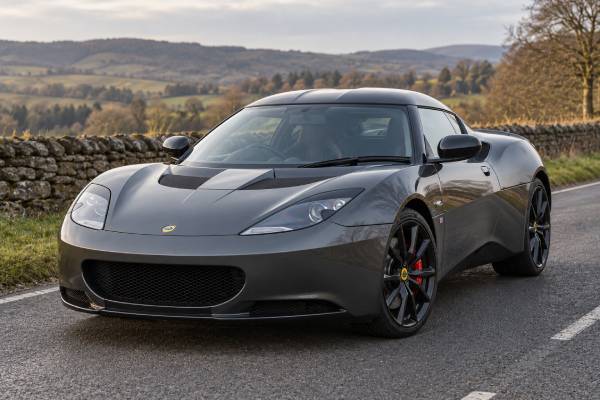
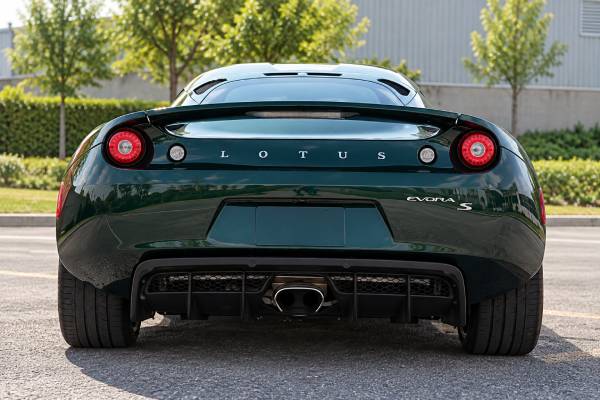
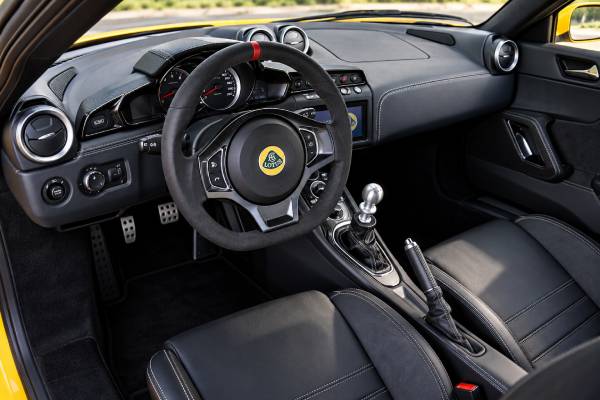
The naturally aspirated Lotus Evora Sports Racer is the version for drivers who want the first-generation Evora’s balance and response without the extra thrust or complexity of the supercharged S. Introduced as a generously equipped factory package for the 2013 model year, it combined the 276 hp 3.5-litre V6 with the Sports Racer’s black exterior accents, forged 19/20-inch wheels, Pirelli P Zero Corsa tyres, 2+2 cabin, Sport Pack, Tech Pack and distinctive leather/SuedeTex trim. Its performance is modest by later Evora standards—Lotus quoted 0–60 mph in 4.8 seconds for the manual—but the appeal is broader than a single acceleration figure. The unboosted 2GR-FE responds cleanly, the hydraulic steering is exceptionally informative, and the chassis can carry speed over imperfect roads without becoming harsh. As a used purchase, condition and provenance matter more than rarity claims. Buyers should verify the factory specification, test the clutch or IPS gearbox carefully, inspect the cooling and air-conditioning systems, and prioritise documented specialist servicing over cosmetic perfection.
Table of Contents
- Why Lotus created the Sports Racer package
- Naturally aspirated Sports Racer specifications
- Engine response, manual gearbox and IPS
- Road manners, cabin and everyday practicality
- Age-related maintenance and known trouble spots
- Originality, modifications and value
- How to choose the right example
Why Lotus created the Sports Racer package
The naturally aspirated Sports Racer was essentially Lotus’s answer to a simple problem: many Evora buyers wanted the desirable option packs and visual upgrades, but specifying them individually made the car expensive and complicated. The Sports Racer gathered them into one coherent version and gave the car a more assertive look without changing the basic engine output.
That distinction is important. The 276 hp Sports Racer is not a detuned Evora S and it is not a mechanically special homologation model. It uses the standard naturally aspirated 3,456 cc V6, with the Sports Racer identity coming from equipment, trim and appearance. The factory offered Aspen White, Carbon Grey, Nightfall Blue and Ardent Red, each paired with black treatment for the roof, mirror pods, front splitter, side sills, rear diffuser, light surrounds and badging. A Union Jack badge on the side panel completed the theme.
The package was unusually comprehensive for Lotus at the time. Gloss-black forged 19-inch front and 20-inch rear wheels were standard, as were the Sport Pack and Tech Pack, power-fold mirrors, reversing camera and 2+2 seating. The interior used Premium Sport seats and contrasting colour details, with Slate Grey SuedeTex across the dashboard, door trim and centre console. In other words, the Sports Racer’s appeal was not merely that it looked different; it was that it arrived with the features most owners were likely to choose anyway.
For today’s buyer, that creates two separate questions. First, is the car genuinely a Sports Racer? Second, how much of the original Sports Racer equipment remains? The first should be answered by VIN-linked documentation, build records or dealer confirmation. The second can be judged against the factory equipment list. Missing wheels or retrimmed seats do not change the identity of a genuine car, but they can affect desirability and price.
The naturally aspirated version has another advantage in the used market: it represents the original Evora concept in a mature, well-equipped form. With no supercharger, output builds in a more progressive way and the car rewards momentum. That makes it less dramatic in a straight line than the S Sports Racer, but it also puts more emphasis on steering, braking and carrying speed through a corner—exactly the areas in which the Evora remains unusually strong.
Naturally aspirated Sports Racer specifications
This Sports Racer is a petrol-only ICE model with a transverse mid-mounted Toyota 2GR-FE V6 driving the rear wheels. It could be ordered with a six-speed manual or Lotus’s six-speed IPS automatic. The Sports Racer did not receive a separate engine tune, so factory Evora figures apply to its drivetrain while its wheels, tyres, trim and equipment follow the Sports Racer package.
| Specification | Value |
|---|---|
| Engine | Toyota 2GR-FE V6, Lotus calibration |
| Displacement | 3,456 cc (3.5 L) |
| Valvetrain | DOHC, 24 valves, variable valve timing |
| Induction | Naturally aspirated |
| Fuel delivery | Multi-point sequential injection |
| Maximum power | 276 hp (280 PS / 206 kW) at 6,400 rpm |
| Maximum torque | 350 Nm (258 lb-ft) at 4,600 rpm |
| Layout | Transverse mid-engine, rear-wheel drive |
| Specification | Manual | IPS automatic |
|---|---|---|
| 0–60 mph | 4.8 s | 5.0 s |
| 0–100 km/h | 5.0 s | 5.2 s |
| Maximum speed | 262 km/h (163 mph) | 256 km/h (159 mph) |
| Combined consumption | 9.3 L/100 km (30.3 mpg UK) | 9.0 L/100 km (31.4 mpg UK) |
| CO₂ emissions | 217 g/km | 210 g/km |
| Fuel tank capacity | 60 L | 60 L |
| Specification | Value |
|---|---|
| Manual | 6-speed sports-ratio gearbox |
| Automatic | 6-speed Intelligent Precision Shift (IPS) |
| IPS manual control | Steering-wheel paddles |
| Stability system | Lotus Dynamic Performance Management |
| Sport Pack function | Revised throttle, stability and exhaust-valve behaviour |
| Steering | Hydraulically assisted rack and pinion |
| Specification | Value |
|---|---|
| Structure | Bonded extruded-aluminium chassis |
| Front suspension | Forged-aluminium double wishbones |
| Rear suspension | Forged-aluminium double wishbones |
| Spring/damper suppliers | Eibach springs and Bilstein dampers |
| Front brakes | 350 mm ventilated discs, AP Racing 4-piston calipers |
| Rear brakes | 332 mm ventilated discs, AP Racing 4-piston calipers |
| Wheels | Gloss-black forged Design wheels, 19 in front / 20 in rear |
| Tyres | 235/35 ZR19 front; 275/35 ZR20 rear Pirelli P Zero Corsa |
| Specification | Manual | IPS automatic |
|---|---|---|
| Length | 4,350 mm | 4,350 mm |
| Width including mirrors | 2,047 mm | 2,047 mm |
| Height | 1,229 mm | 1,229 mm |
| Wheelbase | 2,575 mm | 2,575 mm |
| Unladen mass | 1,383 kg | 1,436 kg |
| Drag coefficient | 0.33 | 0.33 |
| Area | Factory detail |
|---|---|
| Paint choices | Aspen White, Carbon Grey, Nightfall Blue, Ardent Red |
| Exterior contrast | Black roof, mirrors, splitter, sills, diffuser, light bezels and badging |
| Side detail | Union Jack badge |
| Seats | Premium Sport leather with contrasting piping and stitching |
| Cabin surfaces | Slate Grey SuedeTex with red contrast stitching |
| Standard packs | Sport Pack and Tech Pack |
| Seat layout | 2+2 |
Engine response, manual gearbox and IPS
The naturally aspirated Evora asks the driver to use revs and momentum, and that is a feature rather than a deficiency. Its 350 Nm torque peak arrives at 4,600 rpm, so the engine feels smooth and flexible in normal use but becomes more energetic as the tachometer rises. There is no sudden boost step and no need to manage a large torque surge at corner exit.
That character suits the manual gearbox. When the cables, linkage and clutch are in good condition, the six-speed transmission encourages deliberate shifts and makes the driver work with the engine. Because maximum power arrives at 6,400 rpm, a fast road drive involves choosing gears rather than relying on a broad supercharged torque plateau. The reward is that speeds remain more accessible than in later 400-plus-horsepower Evoras.
The manual’s main ownership concern is clutch replacement. The clutch itself is not exotic, but labour can be substantial because of the packaging. A car with a heavy pedal, inconsistent bite, slipping under load or difficulty engaging gears when hot deserves investigation. Do not assume every shift-quality issue is the clutch, either; worn or maladjusted shift cables can create their own symptoms.
IPS changes the personality. It uses a conventional automatic transmission, not a dual-clutch unit. In automatic mode it makes urban and touring use easier, and the paddles give the driver control on a winding road. It also adds mass: factory data show a notably higher unladen figure for the naturally aspirated IPS car. The automatic is slightly slower and its responses are less immediate than a modern performance DCT, but it can be the better ownership choice for drivers who face regular traffic or who simply prefer two-pedal driving.
For either transmission, test the car from cold. A seller who has fully warmed the vehicle before you arrive may be hiding a cold-start noise or shift issue. Let the engine idle, watch for warning lights, check that the idle stabilises and then drive gently until temperatures are normal. Only after that should you use full load.
The Sport Pack deserves mention because it alters more than the exhaust note. The selectable Sport setting adjusts throttle response and stability-control thresholds, allowing more slip before intervention. This makes the naturally aspirated car feel more alert without changing its fundamental balance.
Road manners, cabin and everyday practicality
The naturally aspirated Sports Racer makes its strongest case on real roads, where low mass, steering accuracy and suspension compliance matter more than headline horsepower. It is a car that can flow quickly without needing the road to be perfectly smooth.
Lotus used double wishbones front and rear, with Eibach springs and Bilstein dampers. That architecture gives engineers unusually precise control over wheel movement and camber. More importantly, the company did not rely on excessive stiffness to create sharp handling. The Evora can breathe with a bumpy surface, keeping the tyres in contact while the body remains well controlled. The result is confidence rather than nervousness.
Hydraulic steering is one of the car’s defining features. Effort builds naturally with cornering load and small surface changes reach the driver’s hands without becoming kickback. Alignment matters greatly, so a car with vague steering, uneven self-centring or rapid inner-edge tyre wear may simply need geometry work—or may have worn components or prior impact damage.
The AP Racing brakes are powerful and easy to modulate when healthy. The Sports Racer’s large wheel and tyre package provides substantial grip, though the original P Zero Corsa is a performance-oriented tyre that demands respect in cold or wet conditions. Many owners now use newer tyre designs that trade some dry-road purity for broader weather ability. A matched set from a premium manufacturer is preferable to chasing originality with old or mismatched rubber.
The interior is more usable than the low roofline suggests. Front occupants have supportive seats and a strong sense of being positioned within the chassis rather than on top of it. Rear seats are small; children or luggage are the realistic use cases. The rear luggage area can handle soft bags and touring gear, making the Evora far easier to live with than an Elise or Exige.
The Sports Racer’s standard reversing camera is especially useful because rearward visibility is limited. Power-fold mirrors help in narrow garages. The Tech Pack’s convenience features were valuable when new and remain useful today, although original navigation and audio hardware now feels dated. A discreet modern head unit can be a sensible improvement if installed without damaging the trim or wiring.
Age-related maintenance and known trouble spots
Age matters as much as mileage on a 2013–2015 Sports Racer. A low-mileage example that has sat unused can need more recommissioning than a regularly driven car with a thorough service record.
The Toyota-based V6 has a strong reputation, but the Evora’s installation adds heat, packaging and Lotus-specific ancillaries. Check for coolant leaks, ageing hoses, radiator condition and evidence that the cooling fans operate correctly. The front of the car is vulnerable to road debris, so radiators and air-conditioning condensers deserve visual inspection. A/C that is merely cool rather than cold should not be dismissed as “just gas.”
Routine oil changes are essential. Ask what oil was used, when it was changed and whether the filter history is documented. Spark plugs, brake fluid and coolant all have time as well as mileage considerations. Cars used on track need shorter service intervals and closer inspection of brakes, tyres and fluids.
Suspension components wear gradually. Ball joints and bushes can introduce noise or looseness, while tired dampers reduce the chassis’s polish. Because the Evora normally rides so well, harshness is a useful warning. Uneven tyre wear should trigger an alignment check and an inspection for bent wheels or damaged suspension parts.
Water ingress is another practical area to examine. Lift mats, check the footwells and rear luggage area, and look for condensation or staining. Door seals, window alignment and drainage should be assessed. Persistent damp can lead to electrical nuisance faults and interior deterioration.
Electrical checks should be systematic: battery voltage, charging behaviour, windows, central locking, alarm, mirrors, camera, parking aids, lights, blower speeds, audio and every dashboard warning lamp. A healthy battery is particularly important in a low-use sports car; repeated deep discharge can create confusing faults.
Bodywork is composite over an aluminium structure. Cosmetic cracking or chips can be repaired, but inspect the chassis underneath for impact. Bonded aluminium is not repaired like conventional steel. Any sign of major structural work should be supported by specialist documentation.
Originality, modifications and value
Sports Racer value depends on proof and condition more than on a claim that the car is “rare.” The edition’s specific visual and trim package makes authenticity relatively easy to investigate, and buyers should use that advantage.
The most convincing car will have original invoices, build documentation, service records and a specification that matches factory Sports Racer details. The four correct exterior colours and black accent scheme are obvious starting points. Then look at wheels, seats, SuedeTex, contrast stitching, Union Jack badge, 2+2 arrangement and evidence of the Sport and Tech equipment.
Repainted panels are not necessarily a problem. Composite sports cars collect stone chips, and a high-quality front-end refinish may be preferable to heavily damaged original paint. What matters is why the work was done and whether panel fit and substrate condition are sound. A paint-depth gauge is less decisive on composite panels than on steel, so visual inspection and invoices matter.
Mechanical upgrades can add or subtract value depending on the buyer. Quality dampers, a stainless exhaust, improved gear cables or a modern head unit can make the car better to own. Aggressive lowering, unknown engine tuning, cheap tyres or wiring modifications are more concerning. Ask whether the original parts are included.
Mileage should be read alongside use. A 60,000-mile car with annual specialist care, recent clutch, fresh dampers and good tyres may be a safer purchase than a 15,000-mile garage queen on old fluids and decade-old rubber. The Evora responds well to regular exercise; seals, batteries and air-conditioning systems do not benefit from long inactivity.
Because the naturally aspirated Sports Racer is slower than the S on paper, it can sometimes be overlooked. That can be an advantage for a buyer who values steering and chassis over acceleration. The absence of a supercharger also means fewer induction components, though it does not eliminate the major Evora costs associated with clutch labour, suspension, brakes or body repair.
The character difference is most obvious when the road opens up. The naturally aspirated engine asks for revs and rewards accurate gear selection, so speed builds in a more progressive way than in the supercharged S. That makes the manual especially appealing on flowing roads where the driver can use the upper half of the rev range without immediately arriving at very high speeds. The IPS changes that rhythm: it keeps the car relaxed in traffic and can select gears through the paddles, but its responses and gearing make it feel less mechanical. A buyer should drive both rather than assuming the manual is mandatory because enthusiasts usually prefer it.
The Sports Racer package also deserves to be preserved as a complete specification. The black roof and exterior accents, forged Design wheels, Union Jack side marker, Premium Sport cabin treatment, reversing camera, Tech Pack and Sport Pack were part of the model’s appeal because they bundled equipment that could otherwise make ordinary Evoras vary widely. Missing or altered items do not make a car unusable, but they change what you are buying. A replacement head unit is easy to understand; a repainted roof, incorrect wheel design or retrimmed interior needs documentation if the seller is charging a premium for originality.
For long-distance use, the naturally aspirated car has another advantage that rarely appears in headline comparisons: its performance is accessible without relying on supercharger torque. It cruises comfortably, uses the same fundamentally practical 2+2 packaging, and retains the supple ride that helped distinguish the early Evora from stiffer rivals. Owners who tour should still inspect rear luggage-area heat, hatch sealing, air-conditioning performance and the age of the battery, because those everyday details determine whether the car is enjoyable between the interesting roads.
How to choose the right example
Choose a naturally aspirated Sports Racer when you want the most complete factory version of the original 276 hp Evora rather than the quickest first-generation car. The right example should feel coherent, light on its feet and mechanically honest; a tired one will lose exactly the qualities that make the model worthwhile.
Arrange a specialist pre-purchase inspection before money changes hands. Ask for a scan of stored fault codes, brake and tyre measurements, suspension inspection, chassis check, coolant-system review, clutch or IPS assessment and confirmation of the build specification. A Lotus specialist can often spot model-specific issues in minutes that a general workshop may miss.
On the road, insist on a cold start and a route that includes urban manoeuvring, rough surfaces, open corners and motorway speed. The steering should remain calm around centre yet communicate clearly as load builds. There should be no clunks over small bumps, no steering shake under braking and no drivetrain vibration at steady speed.
A manual should select every gear cleanly when hot. Test for clutch slip by using strong throttle in a higher gear at low-to-medium rpm; engine speed should not rise independently of road speed. An IPS car should move from rest promptly, shift consistently and accept paddle commands without flaring or warning messages.
Budget after purchase for baseline service unless the history proves it has just been done. Fresh fluids, a geometry check and known-age tyres provide a reliable starting point. If the car is on old or mixed tyres, replace them before judging the chassis.
The naturally aspirated Sports Racer will not win a numbers comparison with the later Evora 400 or Sport 410. That is not its job. It offers a more measured, progressive power delivery wrapped in one of the best-equipped versions of the original Evora. For drivers who enjoy using an engine’s rev range and preserving momentum, that can be more engaging than simply having more torque.
Buy on documentation, mechanical condition and driving feel, then treat originality as a bonus rather than an excuse to overlook neglect. A good Sports Racer is an unusually practical Lotus that still communicates at ordinary speeds, which is precisely why it remains relevant long after its performance figures stopped being headline material.
One final check is whether the car still behaves like a coherent factory package. Steering effort, brake response, throttle progression and ride quality should feel naturally matched rather than modified in isolation. If oversized wheels, extreme alignment, very stiff dampers or an aggressive exhaust dominate the experience, price the cost of returning the car to a balanced road specification. The naturally aspirated Sports Racer was valuable because Lotus combined equipment without sacrificing the original Evora’s fluidity; preserving that balance is more important than maximizing any one performance number.
References
- The Lotus Range 2013 (Sales Brochure)
- Lotus Evora 2014 (Sales Brochure)
- Lotus • Heritage Timeline 2026 (Heritage Timeline)
- Lotus Evora – Drive without Compromise | Lotus Cars 2026 (Manufacturer Heritage)
- Lotus – Evora – Sales Brochure – (2013)2 2013 (Sales Brochure)
- Models – Evora – TechWiki 2023 (Model Reference)
Disclaimer
This article is for informational purposes only and does not replace professional diagnosis, repair or inspection. Specifications, torque values, service intervals and procedures may differ by VIN, market and equipment, so verify all work against the official service documentation for the individual vehicle.
If you found this guide useful, please share it on Facebook, X/Twitter or another enthusiast community to help support our work.