
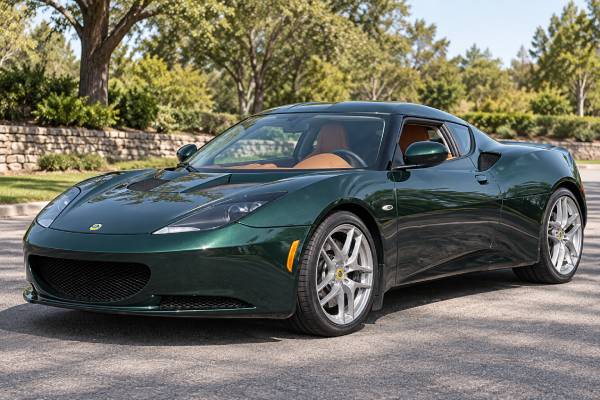
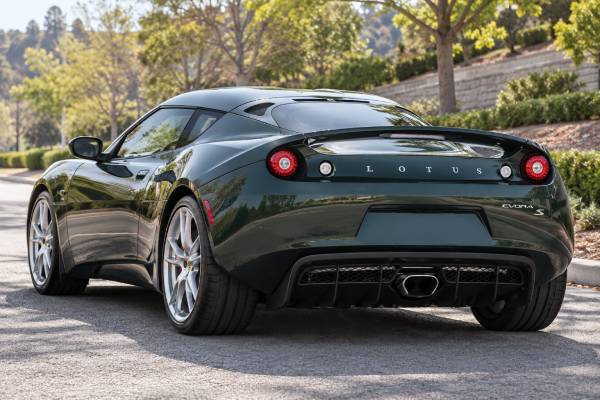
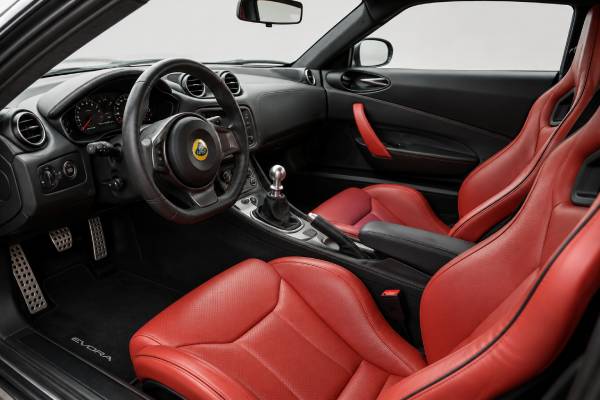
The naturally aspirated Lotus Evora is the original Type 122 formula in its clearest form: a 276 hp Toyota-derived 3.5-liter V6, a six-speed manual gearbox, rear-wheel drive, hydraulic steering, and a bonded-aluminum chassis tuned for road use rather than headline power. Sold from 2009 through the first-generation Evora’s mid-2010s run, it evolved more than its unchanged 2GR-FE output suggests. Early buyers could choose standard or closer sports ratios, while the 2012 model year made the sports-ratio manual standard and brought numerous trim, exhaust, chassis, and equipment revisions. The car was also offered as either a 2+0 or compact 2+2 in many markets, making specification unusually important when comparing used examples. This guide focuses on the 276 hp manual Evora rather than the separately covered IPS automatic, Launch Edition, or supercharged S. It explains the engine, gearing, chassis, service requirements, model-year changes, common inspection points, and the details that matter most when choosing one today.
Table of Contents
- Model years, configurations, and running changes
- Naturally aspirated 2GR-FE engine specifications
- Manual gearbox choices, performance, and economy
- Chassis engineering, brakes, wheels, and packaging
- Service schedule, fluids, and maintenance planning
- Inspection priorities and age-related issues
- How to choose a 2009–2014 Evora
Model years, configurations, and running changes
The 276 hp Evora remained mechanically recognizable throughout 2009–2014, but the specification around that engine changed enough that model year and option history matter. The earliest cars established the basic 2+0/2+2 architecture and option packs; 2012 brought the most important mechanical normalization by making the sports-ratio six-speed standard on naturally aspirated manual cars.
European customer deliveries began in 2009 after a rapid development program, and Lotus positioned the Evora as a more usable companion to the Elise and Exige. The first production phase included the highly equipped Launch Edition, but subsequent normal-production cars could be ordered more selectively. A buyer might find a simple 2+0 with relatively few options, a 2+2 with Tech and Premium packs, or a Sport Pack car with cross-drilled brakes and additional performance equipment.
The 2010 Federal introduction added market-specific airbags, seats, bumper protection, side markers, and stability-control hardware. That means a U.S.-market car should not be expected to match a contemporary UK or European car in every detail. VIN decoding, market documentation, and factory option information are more reliable than assumptions based on registration year alone.
For the 2012 model year, Lotus revised the range more substantially. The standard-ratio manual was deleted for naturally aspirated cars and the sports-ratio gearbox became standard. Exhaust hardware changed, interior colors and trim choices were revised, infotainment equipment changed in some markets, and suspension updates used on other Evora derivatives began migrating across the range as running changes. Later cars can therefore feel and look meaningfully different even though the engine remains rated at 276 hp.
| Item | Specification / change |
|---|---|
| Platform code | Type 122 |
| Production focus here | Naturally aspirated 3.5-liter Evora with six-speed manual |
| First customer deliveries | 2009 in Europe; Federal-market introduction followed in 2010 |
| Seating formats | 2+0 or compact 2+2, depending on market and order specification |
| Early manual gearbox | Standard ratios; sports-ratio six-speed optional |
| 2012MY manual change | Sports-ratio six-speed became standard on naturally aspirated cars |
| Power throughout this version | 206 kW / 280 PS / 276 hp |
| Drive layout | Transverse mid-engine, rear-wheel drive |
Equipment packs also shape ownership. The original Sport Pack added a selectable sport mode, altered throttle and traction-control behavior, a sports diffuser, titanium-look exhaust finisher, cross-drilled brake discs, black calipers, and an engine-oil cooler in early specification. Tech Pack and Premium Pack content concentrated on navigation/audio, parking assistance, cruise control, cabin materials, and convenience features. Because many used cars have been modified or retrofitted, the original invoice or build record is the safest way to determine what a specific car left Hethel with.
Naturally aspirated 2GR-FE engine specifications
The base Evora uses Lotus’s naturally aspirated calibration of Toyota’s 2GR-FE V6, producing 206 kW (280 PS / 276 hp) and 342 Nm (252 lb-ft). It is an all-aluminum, chain-driven, dual-overhead-cam 3,456 cc engine mounted transversely behind the passenger compartment and fed by electronic port injection.
This engine is a major reason the early Evora works as an everyday exotic. The core architecture was produced in high volume by Toyota, but Lotus changed the installation, intake and exhaust environment, engine management, cooling integration, and driveline application. The result is not a Toyota sedan drivetrain dropped unchanged into a sports-car shell; it is a durable base engine integrated into a Lotus-specific chassis and calibration.
Power delivery is progressive rather than explosive. Peak torque arrives higher in the rev range than in the supercharged Evora S, and the naturally aspirated car rewards carrying speed and choosing gears well. The soundtrack and response build with rpm, so the standard 276 hp figure can feel more involving than its paper comparison with later Evoras suggests. On public roads, the combination of response, moderate mass, and close chassis control is often more important than outright acceleration.
| Specification | Data |
|---|---|
| Engine code | 2GR-FE |
| Construction | Aluminum 60-degree V6, DOHC, 24 valves |
| Displacement | 3,456 cc (3.5 L / 210.9 cu in) |
| Induction | Naturally aspirated |
| Fuel system | Electronic port fuel injection |
| Variable valve timing | VVT-i |
| Maximum power | 206 kW / 280 PS / 276 hp |
| Maximum torque | 342 Nm / 252 lb-ft |
| Camshaft drive | Timing chains |
| Layout | Transverse mid-mounted engine, rear-wheel drive |
A timing chain means there is no routine cambelt replacement interval, but age still affects auxiliary belts, seals, hoses, ignition parts, fluids, and cooling components. A smooth cold start is useful evidence: listen for abnormal mechanical noise, check for warning lamps, and observe whether idle settles cleanly. On the road, the engine should pull evenly through the rev range without hesitation or misfire.
The naturally aspirated car also avoids the supercharger and extensive front engine-oil-cooler circuit fitted to the Evora S, although some early option packages included an engine oil cooler. This distinction matters when reading workshop capacities or recall discussions. Service information must be matched to the actual configuration rather than copied from an S or IPS data sheet.
Manual gearbox choices, performance, and economy
The six-speed manual was standard, but not every 2009–2011 car has the same ratios. Early Evoras used a more relaxed standard set unless the optional sports-ratio transmission was specified; from the 2012 model year, naturally aspirated manual cars received the sports-ratio set as standard.
The gearbox is Toyota-derived EA60 hardware adapted for the Evora. The key difference between ratio sets is concentrated in the upper gears. Lotus service data lists shared first and second ratios, while the sports set shortens third through sixth. That keeps the V6 nearer its stronger rpm range during acceleration and makes the car feel more urgent, at the cost of higher engine speed during some cruising conditions.
| Item | Data |
|---|---|
| Transmission | Six-speed EA60 manual |
| Differential | Open bevel-gear differential; electronic brake-based differential function used in vehicle controls |
| Early standard 6th gear | 0.64:1 with 3.24 final drive for 5th/6th in Lotus service data |
| Sports-ratio 6th gear | 0.86:1 with 3.24 final drive |
| 0–60 mph | About 4.8–4.9 seconds in later manufacturer/market specifications |
| 0–100 km/h | Approximately 5 seconds, specification dependent |
| Top speed | About 260 km/h (162 mph) |
| 2009 EU combined, standard ratios | 8.7 L/100 km (27.0 mpg US / 32.5 mpg Imp) |
| 2009 EU CO2, standard ratios | 205 g/km |
The original European figures show how much gearing affected homologation. Standard-ratio cars were rated at 12.4 L/100 km urban, 6.5 extra-urban, and 8.7 combined under the then-current European test. Lotus service data lists higher consumption for the optional close-ratio setup. Later model-year certification values can differ, so a 2013 or 2014 car should not be assigned 2009 emissions numbers simply because engine output is unchanged.
When test-driving, concentrate on shift quality at operating temperature. The linkage should select gears positively and the clutch should take up consistently. A notchy cold change can be different from persistent baulking once warm. Check reverse engagement, full-throttle clutch holding ability, and any noise that changes with clutch pedal position. Gearbox and clutch work is labor-intensive enough that “they all do that” is not a useful diagnosis.
The sports-ratio gearbox is often desirable for drivers who want the V6 to stay on cam, but the earlier long-legged transmission has its own appeal for sustained touring. There is no universally superior choice; the important point is knowing which one is fitted and whether it suits how the car will be used.
Chassis engineering, brakes, wheels, and packaging
The Evora’s defining engineering feature is its bonded aluminum safety structure combined with forged-aluminum double-wishbone suspension at all four corners. That architecture allows precise wheel control without resorting to an excessively stiff ride, which is why the original Evora can be both communicative on a demanding road and surprisingly comfortable over broken surfaces.
Hydraulic rack-and-pinion power steering is equally central to the experience. There is no need to romanticize every hydraulic system, but this one is notable for its linear effort and information at the rim. If a used Evora feels vague, wanders, or pulls, suspect tire condition, alignment, damaged wheels, worn joints, or previous repair before assuming that is normal behavior.
Braking hardware is substantial for a 276 hp car. AP Racing four-piston fixed aluminum calipers work on 350 mm front and 332 mm rear ventilated discs. Early base cars had plain ventilated discs as standard, with cross-drilled discs included in Sport Pack specification. Later option combinations and replacements vary, so disc style alone is not a definitive identifier of an original Sport Pack car.
| Specification | Data |
|---|---|
| Structure | Bonded aluminum safety tub with composite body panels and deformable structures |
| Suspension | Forged-aluminum unequal-length double wishbones, coil springs, Bilstein dampers, anti-roll bars |
| Steering | Hydraulically assisted rack-and-pinion |
| Brakes | AP Racing four-piston fixed aluminum calipers |
| Brake discs | 350 x 32 mm front; 332 x 26 mm rear |
| Standard wheel size | 18 x 8.0 in front; 19 x 9.5 in rear |
| Standard tire size | 225/40 ZR18 front; 255/35 ZR19 rear |
| Length | About 4,350 mm (171.3 in) in base-Evora service data |
| Width excluding mirrors | 1,848 mm (72.8 in) |
| Height | 1,229 mm (48.4 in) |
| Wheelbase | 2,575 mm (101.4 in) |
| Unladen weight | 1,382 kg (3,047 lb) in Lotus service data for base Evora |
| Fuel tank | 60 L (15.9 US gal) |
Packaging is unusual for a mid-engined sports car. The 2+2’s rear seats are small and best regarded as occasional seats for children or short journeys, but their existence changes how the cabin can be used. The 2+0 substitutes additional luggage space behind the front seats. Both retain a rear luggage compartment, although heat from the nearby drivetrain makes it unsuitable for items that dislike elevated temperatures.
The body panels are largely composite rather than steel. That resists conventional rust but does not make accident history irrelevant. The aluminum structure is bonded and requires correct repair techniques; poor lifting, crash damage, or improvised structural work can be much more significant than a cosmetic scratch in a composite panel.
Service schedule, fluids, and maintenance planning
Lotus specified routine service at 15,000 km (9,000 miles) or 12 months, whichever came first, for normal non-U.S. use in the referenced service schedule. A low-mileage car still needs annual attention because brake fluid, coolant, oil, seals, batteries, and rubber parts age even while the odometer barely moves.
The early service schedule calls for more frequent oil and filter changes under severe conditions such as repeated high-rpm use, frequent short trips, dusty driving, or other demanding operation. The same logic should guide present-day ownership. An Evora that spends occasional weekends on track or repeatedly runs short cold journeys should not be serviced as though it spends its life on steady motorway trips.
| Item | Lotus service reference |
|---|---|
| Routine service | 15,000 km (9,000 mi) or 12 months |
| Engine oil refill including filter | 6.1 L (6.4 US qt) in early base-Evora service data |
| Engine dry capacity | 6.8 L without heat exchanger; 7.1 L with heat exchanger |
| Manual transmission oil | 2.3 L (2.4 US qt) |
| Manual transmission oil grade | SAE 75W-80, API GL-4 in period Lotus service information |
| Brake / clutch fluid | DOT 4 non-mineral hydraulic fluid |
| Brake / clutch fluid interval | 24 months in the early maintenance data |
| Coolant | Ethylene-glycol OAT coolant at specified concentration |
| Coolant interval | 4 years in the period service notes |
| Wheel bolt torque | 105 Nm (77 lb-ft) |
Oil viscosity and branded fluid recommendations were revised in later Lotus documentation, so current servicing should use the specification appropriate to the exact VIN, climate, and latest applicable factory information. Capacity is not a substitute for level checking: fill procedures, whether an oil cooler is installed, and what actually drains from the car all affect the amount required.
A useful ownership plan goes beyond fluids. Clean debris from radiator and condenser paths, inspect the auxiliary belt, monitor cooling-system joints, check suspension joints and dampers, keep the hydraulic steering system dry, and inspect brakes at every wheel. Tire age matters even when tread depth looks generous, especially on lightly used cars that may still wear visually good but hardened rubber.
Service history should show work, not merely stamps. Invoices reveal whether coolant was actually changed, whether the gearbox oil has ever been renewed, what brake fluid was used, and whether recurrent faults were diagnosed or simply cleared. On a 10- to 15-year-old sports car, the quality of maintenance is often more predictive than a small mileage difference.
Inspection priorities and age-related issues
There is no single universal failure that defines every naturally aspirated Evora, so inspection should be systematic rather than driven by forum folklore. The strongest purchase candidate is the car whose mechanical behavior, service evidence, body condition, and option history all tell the same story.
Start with the clutch and shift mechanism. The Evora’s mid-engine layout puts the transmission at the back of the car and uses remote cables, so worn or maladjusted linkage can affect feel. Clutch replacement is not a trivial job. Test from cold and hot, use every gear, and apply enough load in a high gear to reveal slip without abusing the car.
Next inspect the cooling and lubrication systems. Look for seepage around the engine and transmission, evidence of coolant loss, damaged undertrays, and staining around hose connections. Cars equipped with an engine-oil cooler deserve extra scrutiny of the cooler and hose routing. Recall campaigns associated with early Evora oil lines were configuration- and market-specific, with prominent U.S. actions focused on certain 2011 cars; use a VIN-level recall lookup rather than assuming inclusion or exclusion from the model name alone.
Cabin and body faults can be less dramatic but expensive in aggregate. Test air conditioning, windows, central locking, mirrors, audio/navigation, parking sensors or reversing camera if fitted, seat mechanisms, lighting, and tailgate release. Water ingress can damage trim and electrical connectors, so check carpets, luggage areas, door seals, and the condition of weatherstripping.
Suspension inspection should include ball joints, bushes, wheel bearings, dampers, springs, and anti-roll-bar hardware. Uneven tire wear is a clue, not a diagnosis. A car can have healthy suspension parts but poor geometry after a curb strike; conversely, repeated alignments will not cure a worn joint. The steering should self-center naturally and remain calm under braking.
Brake condition deserves more than measuring pad thickness. Examine disc faces, cracks around drilled holes on Sport Pack or replacement rotors, corrosion on cars stored for long periods, and caliper condition. Brake fluid that has been ignored can absorb moisture and lower boiling performance even if the car is rarely driven hard.
Finally, inspect the chassis and composite body with someone familiar with Lotus construction. Look underneath for jack damage, distorted mounting points, impact marks, and evidence that panels or structural pieces were repaired without the correct process. Paint-meter readings are less straightforward on composite panels than on steel-bodied cars, so repair quality and documentation matter more than a simplistic number.
How to choose a 2009–2014 Evora
The best naturally aspirated Evora is not automatically the newest or lowest-mileage one; it is the example whose gearbox, seating configuration, options, maintenance, and condition match the buyer’s intended use. Early cars can be lighter in specification and more distinctive, while later cars benefit from accumulated production changes and standard sports-ratio gearing.
For long-distance use, an early standard-ratio car can be attractive because of its relaxed upper gears. Drivers who regularly use challenging roads may prefer the closer sports ratios, whether factory-optioned on an early car or standard on a 2012-on example. Do not assume a gearbox from registration year alone: confirm the actual build specification or compare ratios through a specialist.
The 2+0 versus 2+2 decision is equally personal. The rear seats are not adult grand-tourer seats, but they can be useful for children, bags, or occasional short-distance flexibility. The 2+0 provides a cleaner luggage solution behind the front occupants. Resale preferences vary by market, so buy the layout that will actually be useful rather than the one an online discussion labels “best.”
Option packs should be valued according to function and originality. Sport Pack changes the driving interface and brake specification; Tech Pack adds useful convenience but includes aging infotainment that may no longer feel modern; Premium Pack improves cabin materials. A well-executed modern head-unit upgrade can make a driver car more usable, while collectors may prefer the original components retained with the vehicle.
Before purchase, ask for evidence of the following:
- annual or mileage-based servicing with dates and invoices;
- coolant and brake-fluid renewal rather than oil-only maintenance;
- clutch and gearbox behavior documented if major work has been performed;
- tire ages, not just remaining tread;
- suspension or alignment work and the reason it was needed;
- recall/campaign status checked against the VIN and market;
- accident and body-repair history, including underside damage;
- original seating, pack, wheel, and gearbox specification.
A specialist pre-purchase inspection is particularly valuable because several expensive conditions can hide behind a car that looks immaculate in photographs. A worn clutch, bent forged wheel, failing air-conditioning component, neglected cooling system, damaged undertray, and aging tires can turn a seemingly inexpensive Evora into a costly first year of ownership.
When the fundamentals are right, the 276 hp Evora remains compelling precisely because it does not rely on overwhelming power. The naturally aspirated V6 asks the driver to use the gearbox, the hydraulic steering communicates load clearly, and the chassis carries speed with little drama. Its Toyota-based engine makes the car less intimidating to own than its rarity suggests, but the rest of the vehicle is still a low-volume Lotus and rewards specialist maintenance. Buy on evidence, choose the ratio and cabin layout deliberately, and preserve the alignment, tires, fluids, and structural integrity that allow the original Type 122 concept to work as intended.
References
- The 2010 Model Year Lotus Evora Range Specification and Pricing (EU and Switzerland) — Lotus Cars, 2009. [Factory specification and pricing]
- Evora model history milestones – TechWiki — SELOC TechWiki, accessed 2026. [Production and model-year changes]
- Lotus – Evora – Workshop Manual – (2009) — Lotus service information mirror, 2009. [Technical data and service specifications]
- Lotus Evora Service Notes — Manualzz, period Lotus service information. [Maintenance schedule and fluids]
- Used 2014 Lotus Evora 2+0 Specs & Features — Edmunds, 2014. [Later-model dimensions and performance reference]
- Recalls — National Highway Traffic Safety Administration. [VIN-level U.S. recall verification]
Disclaimer
This article is for general informational purposes and is not a substitute for professional diagnosis, inspection, repair advice, or official Lotus service information. Specifications, fluids, torque settings, service intervals, procedures, emissions data, recall applicability, and equipment can vary by VIN, market, model year, option package, and production change. Verify critical information using the correct Lotus workshop literature, owner documentation, official recall records, and a qualified Lotus specialist before servicing, modifying, or purchasing a vehicle. If you found this guide useful, please share it with another Evora owner or shopper.