
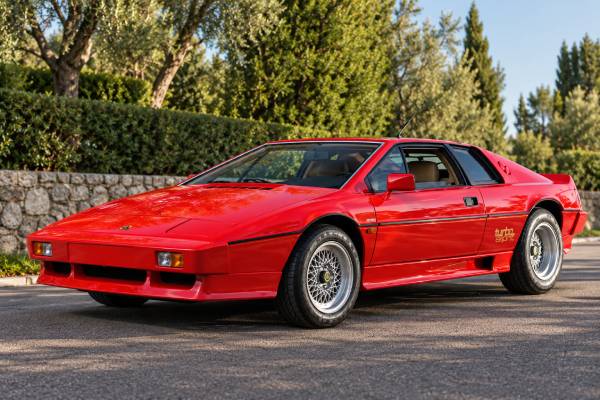
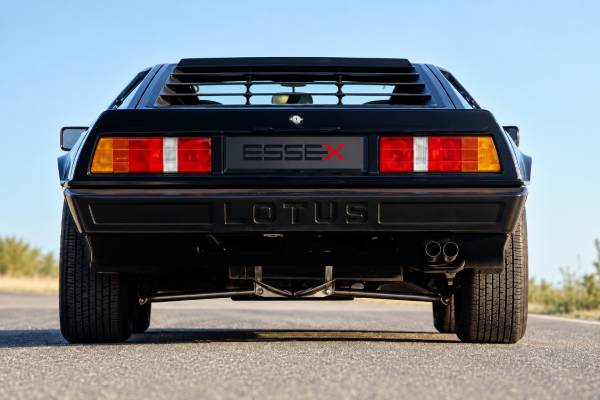
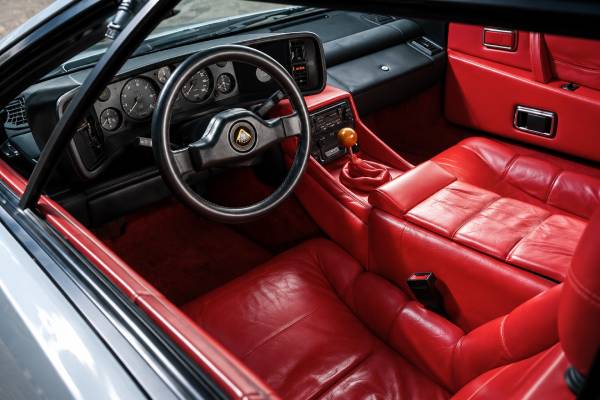
By 1981 the Lotus Esprit finally had the power to match its supercar profile. The regular-production Turbo Esprit took the expensive Essex launch car’s basic formula—Type 910 turbocharged 2.2-litre engine, stronger galvanized backbone chassis, revised suspension, bigger cooling package, and dramatic Giugiaro aero treatment—and turned it into a series-production flagship. In the specification covered here, output is 210 bhp and 200 lb-ft, enough for a period 0–60 mph time around 5.6 seconds and a claimed 150 mph top speed. The model evolved during its 1981–1986 run, however: early cars retained dry-sump details related to the Essex, most later cars used wet-sump lubrication, wheel and trim details changed, and the 1986 High Compression Turbo became a distinct 215 bhp development. For that reason, this guide concentrates on the 210 bhp Type 910 Turbo Esprit rather than treating every 1986–1987 Turbo as mechanically identical.
Table of Contents
- What the 210 bhp Turbo Esprit is
- Type 82 technical specifications
- Turbo engine and driveline behaviour
- Changes across the 1981–1986 run
- Preventive maintenance and heat management
- Pre-purchase inspection priorities
- Living with a Giugiaro Turbo
What the 210 bhp Turbo Esprit is
The 1981–1986 Turbo Esprit is the regular-production development of the 1980 Essex Turbo, using the 2,174 cc Type 910 engine at 210 bhp in a galvanized Type 82 chassis. It is not simply an S1 or S2 with a turbocharger bolted on; Lotus reworked the structure, suspension, cooling, body aerodynamics, brakes, drivetrain mounting, and cabin to cope with the added performance.
That distinction matters when buying parts and judging originality. The Turbo’s deep front spoiler, sill ducts, rear-quarter intake treatment, wraparound bumpers, and raised tail section were functional changes as well as styling. The chassis gained wider front structure, revised mounting points, a stronger rear engine/transmission frame, and galvanizing. The rear suspension no longer used the driveshaft as a suspension link in the same way as the earliest Esprits, reducing driveline loads and improving wheel control.
The production Turbo launched in April 1981 with a more restrained equipment specification than the limited Essex. Most examples encountered today are wet-sump cars, while some very early production cars continued dry-sump lubrication. That detail should be established from the individual car rather than assumed from registration year alone. Dry-sump hardware is more specialized and deserves owner knowledge because correct oil-level procedure and system condition matter.
The end of the assignment period also needs a clear boundary. In 1986 Lotus introduced the Turbo HC, or High Compression, with an 8.0:1 compression ratio, 215 bhp, and more torque. Some markets also received fuel-injected HCi derivatives. Those are closely related Type 82 cars but they are not the 210 bhp specification named here. A seller advertising a “1986 Turbo” therefore needs to show whether the car is the earlier 210 bhp version or the later HC/HCi.
Production totals also differ depending on whether a source counts the standard 210 bhp Turbo, Essex cars, and HC cars together. A commonly cited figure for the 1981–1986 standard Turbo is 1,845 cars, while broader Turbo-family totals are higher. For a collector purchase, chassis and build documentation are more useful than a single aggregate number.
Type 82 technical specifications
This Turbo Esprit is a rear-wheel-drive petrol ICE car with a longitudinal mid-mounted, carburetted, turbocharged four-cylinder engine and a five-speed manual transaxle. Its key engineering jump over the naturally aspirated Esprit is not only the 210 bhp output, but the much stronger 200 lb-ft torque figure and the chassis, cooling, and suspension changes required to exploit it.
| Specification | Value |
|---|---|
| Engine | Lotus Type 910 inline-four |
| Location | Longitudinal, mid-mounted |
| Displacement | 2,174 cc (2.2 L) |
| Construction | Aluminium-alloy block and cylinder head |
| Valvetrain | DOHC, 16 valves |
| Bore × stroke | 95.25 × 76.2 mm |
| Compression ratio | 7.5:1 |
| Turbocharger | Garrett AiResearch T3 |
| Maximum boost | About 8 psi (0.55 bar) in the quoted early specification |
| Fuel system | Twin Dell’Orto DHLA sidedraught carburettors |
| Maximum power | 210 bhp (157 kW) at 6,250 rpm |
| Maximum torque | 271 Nm (200 lb-ft) at 4,500 rpm |
The low compression ratio reflects the period approach to controlling detonation under boost. Unlike the later SE, this engine has no chargecooler between compressor and intake, so intake temperature, mixture strength, ignition setup, fuel quality, and cooling condition are especially important.
| Specification | Value |
|---|---|
| Transmission | Five-speed manual transaxle |
| Drive | Rear-wheel drive |
| Clutch | 9.5 in diaphragm spring, hydraulic operation |
| Driveshafts | Plunging constant-velocity-jointed layout |
| Lubrication | Early cars may be dry sump; most later 1981–1986 production cars are wet sump |
The long linkage to the rear transaxle gives a heavier, slower shift than a modern sports car. That is normal; worn synchros, repeated crunching, or a gear that disengages under load is not.
| Measure | Value | Notes |
|---|---|---|
| 0–60 mph | About 5.6 seconds | Period/factory figure commonly quoted |
| Top speed | About 150 mph (241 km/h) | Quoted Turbo Esprit figure |
| Fuel consumption | About 23 mpg UK in period specification | Driving style has a major effect |
| Fuel tank | 15 imperial gallons (about 68 L) | Period specification |
A carburetted turbocharged car can move far outside its period fuel-consumption figure when driven hard or when the carburettors are out of tune. Fuel economy is therefore also a rough diagnostic clue: severe richness, fuel smell, or unusually poor range deserves investigation.
| Specification | Value |
|---|---|
| Body | Two-door, two-seat glassfibre coupe |
| Chassis | Zinc-galvanized steel backbone |
| Length | About 4,293 mm (169 in) |
| Width | About 1,854 mm (73 in) |
| Height | About 1,168 mm (46 in) |
| Wheelbase | 2,438 mm (96 in) |
| Kerb weight | About 1,148 kg (2,531 lb) |
| Specification | Value |
|---|---|
| Front suspension | Upper wishbones, lower transverse links, coil springs, dampers, anti-roll bar |
| Rear suspension | Unequal-length transverse links, radius arms, coil springs, dampers |
| Steering | Unassisted rack and pinion |
| Front brakes | 267 mm (10.5 in) discs |
| Rear brakes | 246 mm (9.7 in) inboard discs |
| Front wheels | 7J × 15 |
| Rear wheels | 8J × 15 |
| Original tire sizes | 195/60 VR15 front, 235/60 VR15 rear |
| Later Lotus-approved rear alternative | 225/60 VR15, following Lotus tire evaluation |
The rear 235/60 VR15 size became difficult to obtain, and Lotus later evaluated alternatives. When replacing tires today, preserve axle balance, load and speed capability, and rolling diameter rather than mixing whatever period-looking products happen to be available.
Turbo engine and driveline behaviour
A properly sorted 210 bhp Turbo Esprit should feel flexible below boost and then build a strong, progressive surge through the midrange. It is an early turbo system by modern standards, but the extra 2.2-litre displacement gives useful off-boost torque and makes the transition less abrupt than the “nothing, then everything” stereotype suggests.
The T3 turbocharger operates with carburettors rather than the later electronic fuel injection used on newer Esprits. That means mechanical condition and calibration are fundamental. Float levels, jets, throttle synchronization, ignition timing, wastegate control, and fuel delivery all interact. A car that hesitates badly, detonates, blows black smoke, or surges unpredictably needs diagnosis; those symptoms should not be excused as inevitable turbo lag.
Heat is the central engineering challenge. The turbocharger, exhaust manifold, oil system, and engine all occupy a compact bay behind the cabin. Lotus enlarged the radiator and added an oil cooler, while the body gained ducts and vents to manage air flow. Owners should preserve that system rather than defeating it with blocked grilles, tired fans, missing ducting, or improvised exhaust insulation.
The Type 910’s boost transforms overtaking performance compared with a naturally aspirated S3, but the gearbox still prefers a deliberate hand. Forcing fast shifts, especially when cold, is poor technique. Let the clutch fully disengage, guide the lever rather than ramming it, and allow the synchros to work. Driveline longevity in an old transaxle is strongly influenced by how the car has been driven.
Turbo care is similarly dependent on habits. Avoid heavy boost before the oil is warm. After sustained hard running, give the engine a period of low-load driving before shutdown so temperatures can stabilize. A modern owner does not need ritualistic minutes of idling after every trip, but repeatedly switching off immediately after a high-load run is unkind to old oil, bearings, and seals.
The 210 bhp engine is also mechanically different from the 1986 HC. The later engine raises compression and torque, and some HCi cars use fuel injection. When ordering pistons, ignition or fuel-system parts, turbo components, or service information, “1986 Turbo Esprit” is not specific enough.
Changes across the 1981–1986 run
The standard Turbo Esprit evolved quietly, so production date and physical equipment matter more than a simplistic year-by-year chart. The biggest mechanical distinction within the 210 bhp period is the move away from the early dry-sump arrangement to a conventional wet sump.
The Essex had used dry-sump lubrication, with separate scavenge and pressure functions appropriate to the launch car’s competition-inspired positioning. Early regular Turbos continued elements of that system, but Lotus moved to wet-sump lubrication during production. A dry-sump car is not automatically better; it is rarer and requires correct knowledge, while a well-maintained wet-sump car is simpler to own.
Wheel specification changed as well. The expensive multi-piece Compomotive wheels associated with Essex and early cars gave way to BBS wheels on much of the series. Because many Esprits have been modified over four decades, wheel type should be matched against build period and supporting documentation rather than used alone to date a car.
Front suspension geometry and components were revised during the Giugiaro Turbo era, and interior trim, switchgear, mirrors, and equipment also evolved. Market regulations created further differences. U.S. cars in particular can differ in bumpers, lighting, emissions equipment, carburetion or injection, and performance.
At the end of 1986, High Compression versions arrived. The HC increased compression from 7.5:1 to 8.0:1 and raised output to about 215 bhp with stronger torque. In emissions-sensitive markets, HCi versions used Bosch injection. Those cars are desirable in their own right, but a buyer seeking the 210 bhp assignment specification should confirm that the car has not simply been grouped under the broader “1980–1987 Turbo Esprit” label.
The practical lesson is to buy by chassis number, build information, and actual hardware. A 1985 car with early wheels, a late fuel system, and undocumented engine swap may still be fun, but it should be valued as a modified car rather than represented as untouched factory specification.
A further complication is that market specification can change the apparent identity of a car. Lighting, bumpers, emissions hardware, carburettor calibration, air-conditioning equipment, speedometer scale, and some engine controls were altered for local regulations. Cars also migrated between countries when values were low, so the specification in front of you may no longer match the market shown on its current registration document. The safest way to order parts is to start from the chassis number and engine number, then compare the installed hardware with the relevant Lotus parts list.
Period modifications deserve similar caution. Higher boost, nonstandard wastegate springs, freer-flowing exhausts, altered carburettor jets, and later ignition systems can make a healthy engine faster, but they also change combustion temperature and the margin against detonation. Without dyno or air-fuel-ratio evidence, a claimed “stage” upgrade tells a buyer very little. Returning an unknown car to a verified baseline before pursuing more power is generally wiser than assuming old tuning work was engineered correctly.
Preventive maintenance and heat management
The Turbo Esprit rewards preventive work, especially on the cam belt, cooling system, turbo lubrication, fuel system, and exhaust. Waiting for a clear failure signal is the expensive way to own one.
Cam-belt history comes first. The Type 910 is an interference engine, so belt failure can bend valves and trigger a major rebuild. The belt also lives in a hot, cramped environment. Service intervals quoted by specialists have varied as belt materials and procedures evolved; the safe approach is to follow current Lotus-specialist guidance for the exact belt and tensioning method fitted, with dated records rather than mileage alone.
Cooling should be treated as a system. Check radiator core condition, all three fan functions where applicable, fan switches and relays, coolant hoses, front-to-rear pipes, pressure cap, water pump, thermostat, header tank, and evidence of air trapping or previous overheating. Narrow or corroded cooling tubes and neglected coolant chemistry can produce internal corrosion as well as temperature problems.
The turbo and exhaust live under severe thermal load. Inspect for:
- Oil seepage at the turbo feed and drain connections.
- Excessive shaft play or smoke suggesting worn turbo seals.
- A sticking or corroded wastegate mechanism.
- Exhaust manifold cracks, loose fasteners, and heat-damaged nearby wiring.
- Missing shields, deteriorated hoses, or insulation added in a way that traps heat.
- Signs of overboost, detonation, or previous piston damage.
Fuel hoses deserve the same attention because the engine uses carburettors in a hot rear compartment. Ethanol-compatible replacement hose is sensible where approved, but routing, clamps, pressure, and fittings still need to follow a safe specification. Persistent fuel smell after shutdown is a reason to stop and investigate.
Dry-sump cars need an owner who understands their oil-level procedure and plumbing. Checking them like a conventional wet-sump engine can give a misleading reading. On wet-sump cars, oil level is more straightforward but still needs frequent attention because turbo engines can consume or leak oil.
Electrical reliability improves dramatically when grounds, connectors, relays, fan circuits, and charging-system connections are cleaned and repaired properly rather than bypassed. Headlamp lifts, windows, cabin fans, and old alarm installations are common places to find accumulated modifications.
Finally, do not overlook suspension. Bushes and dampers degrade gradually, so an owner can become used to a car that no longer drives as Lotus intended. Restoring correct ride height, damping, ball joints, steering joints, and alignment often improves the car more than an engine modification.
Pre-purchase inspection priorities
A strong Turbo Esprit purchase is built on evidence of heat management and disciplined servicing. The most worrying car is not necessarily the one with the highest mileage; it is the one with gaps in history, signs of overheating, improvised wiring, and performance modifications without documentation.
Inspect the body in bright light. Glassfibre does not rust, but it can crack, craze, blister, and hide old collision repairs. Look around wheelarches, spoiler mountings, door apertures, headlamp pods, and the rear body. Poor panel fit is common on old hand-built cars, but major asymmetry or thick filler can indicate accident damage.
The galvanized chassis is a major durability improvement over the S1’s ungalvanized frame, yet “galvanized” does not mean immortal. Inspect suspension mounting points, areas damaged by jacking, repaired sections, fastener interfaces, and places where the zinc coating may have been compromised. Evidence of a straight, original chassis is valuable.
Require a true cold start. Listen for mechanical noise, observe smoke, and watch oil pressure and temperature. During warm-up, check for leaks and verify that the cooling fans operate. On the road, apply boost progressively. The engine should pull cleanly without misfire, detonation, or erratic boost.
Check the transaxle in every gear. A slow, mechanical shift feel is expected; grinding into second, jumping out of gear, or strong bearing whine is not. Test the clutch under load for slip and inspect the hydraulic system. A heavy pedal may be characteristic, but an inconsistent bite point or incomplete release needs work.
Examine the braking system, remembering that the rear discs are inboard and less convenient to inspect. Confirm that the car tracks straight, the pedal stays firm, and no caliper drags after a drive. Steering should be heavy at parking speed but communicative and stable once moving.
The cabin reveals neglect quickly. Check windows, mirrors, lights, gauges, heater and ventilation controls, air conditioning if fitted, headlamp pods, wipers, and every switch. A few old electrical faults are manageable; a dashboard full of nonfunctional systems often signals years of deferred maintenance.
Paperwork should answer the expensive questions: when was the cam belt changed, what cooling work has been done, was the turbo rebuilt, what is the clutch and gearbox history, and has the car ever overheated? For an early dry-sump example, records should also show that previous owners understood the lubrication system rather than treating it as a curiosity.
Living with a Giugiaro Turbo
The 210 bhp Turbo Esprit makes sense for an owner who wants the sharp-edged Giugiaro appearance with genuine period-supercar speed. It is faster and more usable than the S1, but it asks more from its maintenance budget because turbo heat, specialized parts, and a tightly packed engine bay add complexity.
Its best quality is the combination of speed and feedback. The unassisted steering is heavy in town but vivid on an open road. The turbo engine has enough torque to make passing effortless by 1980s standards, yet the chassis still encourages momentum and careful lines. There is no traction control, stability control, or electronic throttle to rescue a clumsy power application on a wet road.
Comfort is better than the earliest Esprit but still highly personal. The seating position is reclined, the sill is broad, the cabin is low, and rearward visibility is restricted. Ventilation and air conditioning condition matter far more in ownership than they do during a five-minute viewing. A prospective buyer should spend enough time in the car to discover whether pedal offset, headroom, and cabin heat are acceptable.
Originality is also becoming more valuable. Correct BBS or early Compomotive wheels, intact decals, period interior, original turbo bodywork, and unmodified engine management can add desirability. Reversible reliability improvements are not necessarily harmful, but heavily modified boost control, oversized wheels, or improvised fuel systems should be priced with caution.
If two cars cost similar money, choose the one with a recently proven cooling system, clear belt history, good transaxle, correct chassis, and documented specialist work even if the paint is less perfect. Cosmetic improvement is expensive, but correcting a damaged engine, transaxle, and poorly repaired chassis simultaneously can overwhelm the value of the car.
For owners prepared to maintain it properly, the 1981–1986 210 bhp Turbo is one of the most charismatic Esprits. It retains the original folded-paper design while delivering the acceleration the shape always promised, and its engineering marks the point where the Esprit moved decisively from exotic sports car to credible supercar.
References
- Lotus Esprit – James Bond’s choice | Lotus Cars 2026 (Manufacturer heritage page)
- Esprit Models 2026 (Turbo Esprit technical reference)
- 1980 Lotus Esprit Turbo 2016
- Buying an Esprit 2018
- Lotus Esprit buyer’s guide – Classics World 2022
- Lotus Esprit: History, Generations, Specifications 2020
Disclaimer
This article is for informational purposes and is not a substitute for professional diagnosis, inspection, or repair. Specifications, torque values, service intervals, and procedures can vary by VIN, production date, market, and equipment; verify all work against the official Lotus service documentation for the exact car. If you found this guide useful, please share it on Facebook, X/Twitter, or a relevant enthusiast community to support our work.