
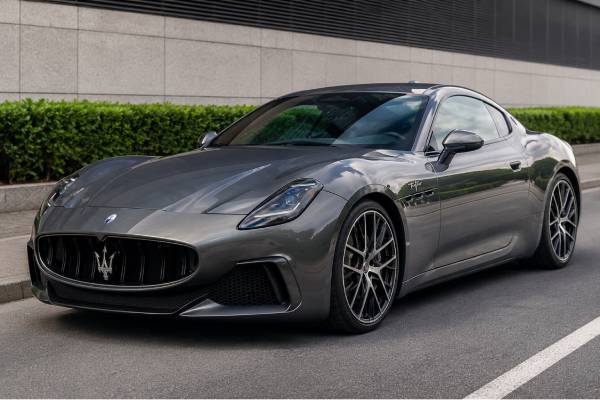
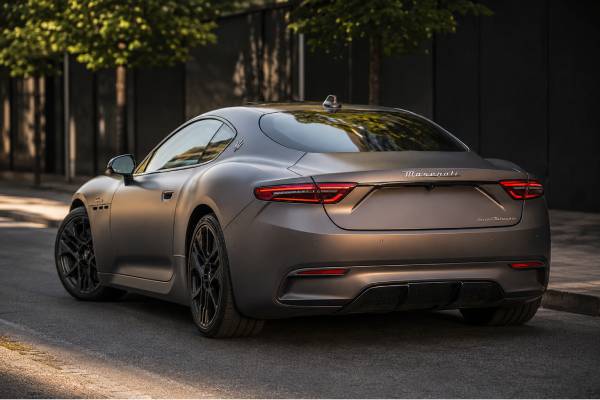
The Maserati GranTurismo Folgore is the first battery-electric production car in the brand’s history and one of the few electric grand tourers built around a low, four-seat coupe rather than an adapted sedan or SUV. Its 800-volt system combines a 92.5 kWh gross battery, three permanent-magnet motors, all-wheel drive, and up to roughly 560 kW—about 760 hp—delivered to the wheels. Maserati quotes about 2.7 seconds from 0–100 km/h and a top speed near 325 km/h for the launch specification, making it quicker than the Nettuno Trofeo while retaining the same 1,353 mm roof height and genuine rear seating. The engineering solution is a T-bone battery pack arranged through the center tunnel and behind the occupants instead of beneath every seat. That protects the low seating position but creates its own service, crash-inspection, thermal, and packaging priorities. Ownership differs sharply from an internal-combustion GranTurismo: battery health, high-voltage cooling, charging performance, software, 12-volt stability, tire wear, underbody condition, and warranty terms matter more than oil leaks or clutch life. This guide explains the Folgore’s architecture, production changes, driving character, charging reality, maintenance needs, and the checks required before buying a used example.
Table of Contents
- Maserati’s First Electric Grand Tourer
- 800 Volts, Three Motors, and T-Bone Battery
- Launch Editions, Options, and Evolving Range
- Low-Slung EV Packaging With Four Seats
- Instant Performance With GT Road Manners
- Battery, Charging, Software, and Chassis Care
- Buying a Folgore With Confidence
Maserati’s First Electric Grand Tourer
The Folgore is not an electric derivative added after the M189 was finished; the platform was engineered from the beginning to accommodate both combustion and battery power. That decision lets it share the GranTurismo’s proportions, seating, and visual identity instead of becoming a taller, heavier-looking EV.
Maserati introduced the second-generation GranTurismo in 2022 for the 2023 launch period. Modena and Trofeo used the Nettuno V6, while Folgore—Italian for lightning—opened the brand’s electric program. All three were designed within the same body envelope and built around the same four-seat grand-touring purpose.
The Folgore’s headline output is 760 hp delivered through one front and two rear motors. Each motor is capable of up to 300 kW, but battery discharge and system management limit combined continuous delivery; the three individual ratings should not simply be added into a 900 kW claim. Torque can be varied rapidly across axles and between the rear wheels, giving the control system more freedom than a mechanical differential and transfer case.
At launch, the car offered a gross battery capacity of 92.5 kWh, about 83 kWh usable, 270 kW peak DC charging on suitable 800-volt infrastructure, and a claimed WLTP range around the mid-400-kilometer region depending on specification. Later development introduced efficiency improvements and market-specific range changes. Current listings should therefore be checked against build date and homologation rather than one universal figure.
The Folgore carries symbolic importance because Maserati’s historical identity is tied closely to engine sound. Engineers created a distinctive electric sound using the actual behavior of the motors and power electronics as a basis, then shaped it for feedback and brand character. Buyers may like or dislike the result, but it is integrated with the drive modes rather than being an unrelated novelty.
The model’s significance does not remove practical EV questions. Public fast-charging availability, home electrical capacity, winter range, long-distance route planning, battery warranty, and repair access vary strongly by country. A Folgore can be an exceptional grand tourer where 800-volt chargers and trained service support exist, but ownership may be less convenient in regions with sparse infrastructure.
As a used car, it should be assessed as a high-voltage performance vehicle and a limited-volume luxury coupe. The battery and power electronics are expensive; the 21-inch rear tires wear quickly; the mixed-material body and underfloor protection need specialist repair; and software history can affect charging, range, and control-system behavior.
800 Volts, Three Motors, and T-Bone Battery
The Folgore’s architecture uses 800 volts for efficient high-power operation, a T-shaped battery to preserve seating height, and three motors for precise all-wheel-drive control. Its numbers are impressive, but thermal state and software determine how much performance or charging power is available at a given moment.
| Item | Specification |
|---|---|
| Battery | 92.5 kWh gross, approximately 83 kWh usable |
| Electrical architecture | 800 volts with silicon-carbide inverter technology |
| Motors | Three permanent-magnet motors; one front, two rear |
| Motor capability | Up to 300 kW per motor, system limited by battery and control strategy |
| Maximum delivered power | Approximately 560 kW, about 760 hp |
| Drive | All-wheel drive with independent rear torque control |
| DC fast charging | Up to 270 kW on compatible 800-volt equipment |
| AC charging | Up to 22 kW in supported markets and installations |
| Suspension | Air springs with adaptive dampers |
| Wheels | 20-inch front and 21-inch rear |
| Length | 4,959 mm |
| Width | 1,957 mm excluding mirrors |
| Height | 1,353 mm |
| Wheelbase | 2,929 mm |
| 0–100 km/h | Approximately 2.7 seconds |
| Top speed | Approximately 325 km/h |
The T-bone battery places modules along the central tunnel and across the rear portion of the floor. A conventional flat skateboard pack would raise the seats and roof or reduce headroom. Maserati’s arrangement keeps occupants low and preserves the GranTurismo silhouette, while concentrating mass near the centerline.
That packaging also creates inspection priorities. The central underbody and rear battery enclosure must be checked after road impacts, incorrect lifting, or curb strikes. Protective panels, cooling connections, seals, and isolation monitoring are safety-critical. Any deformation should be evaluated by a high-voltage-qualified facility, not dismissed because the car still drives.
The front motor can add traction, while two rear motors vary torque independently. This permits torque vectoring without a conventional rear differential. In fast corners, software can increase or reduce each rear motor’s contribution to support rotation and stability. The system responds in milliseconds but remains limited by tire grip, temperature, and battery state.
At an appropriate DC charger with a warm, conditioned battery, peak power can reach 270 kW. Maserati described roughly 100 km of range added in about five minutes and a 20–80 percent session around 18 minutes under ideal conditions. Actual results depend on charger capability, battery temperature, starting state of charge, shared-station limits, and the charging curve after the peak.
AC capability can be a major advantage where 22 kW three-phase service is common. In homes limited to single-phase power, charging will be slower. The cable, wall box, supply protection, earthing, tariff, and local electrical code must match the installation.
Launch Editions, Options, and Evolving Range
The first Folgores included PrimaSerie 75th Anniversary cars, followed by regular production with broader personalization. Build date matters because software, homologated range, standard equipment, and efficiency hardware can evolve without changing the Folgore name.
PrimaSerie production included 75 cars in Rame Folgore and 75 in Blu Inchiostro, forming half of the 300-unit launch-edition program. Dedicated 75th Anniversary logos, embroidery, badges, wheel-center details, and contrasting accents distinguish them. Regular Folgores can be ordered in many colors and through Fuoriserie, but they are not PrimaSerie without the factory record.
Rame Folgore, an iridescent copper shade, became the signature launch color. It reflects warm and cool tones under different light and connects with copper accents used in the cabin. Complex finishes require expert matching after damage, and partial repainting may be visible even when technically sound.
Common option areas include:
- alternative 20/21-inch wheel designs and finishes;
- carbon-fiber exterior and interior trim;
- multiple leather, Econyl, technical-fabric, and stitching combinations;
- head-up display and driver-assistance packages;
- 14-speaker or 19-speaker Sonus faber audio;
- comfort, heated, ventilated, and market-specific seat equipment;
- Fuoriserie paint, graphics, and personalized details;
- charging cables and accessories suited to the delivery country.
The original range figure varies with test cycle, wheels, climate, and software. Later Maserati material describes improved range through measures such as front-axle wheel-end disconnect in newer specifications, allowing the car to reduce drag when full AWD is unnecessary. That feature should not be assumed on an early car. Confirm hardware and software by VIN.
Charging equipment also varies by market. A car imported from another region may have a different inlet standard, cable, onboard AC rating, connected-service compatibility, navigation database, or warranty status. Conversions can be impractical or unsupported. Verify before purchase, not after delivery.
The provenance file should include factory build data, warranty start, battery warranty terms, charging cables, portable equipment, keys, manuals, app transfer information, service invoices, update history, campaign completion, and records of any underbody or high-voltage work. For PrimaSerie, add the edition-specific materials and confirmation of the correct 75-car configuration.
Low-Slung EV Packaging With Four Seats
The Folgore’s design proves that an EV does not need a tall floor or crossover shape. Its battery layout, mixed-material body, and compact motors preserve the same low roof and seating concept as the combustion GranTurismo.
The body retains a long hood even though it does not contain a V6. That choice preserves brand proportions and provides space for power electronics, cooling, crash structure, and the front motor system. The closed or differently detailed grille, aero wheels, copper accents, and Folgore badges identify the electric model without changing the basic form.
A multi-material shell uses extensive aluminum, magnesium in selected parts, and high-strength steel where loads demand it. The approach controls mass but requires approved repair methods. High-voltage isolation, battery clearance, sensor calibration, adhesives, rivets, and corrosion prevention all complicate collision work.
Underbody aero is particularly important for an EV because drag affects range and battery cooling. Panels smooth airflow and protect high-voltage components. Missing fasteners, cracked trays, damaged cooling ducts, or incorrect jacking can create noise, reduce efficiency, and expose costly parts.
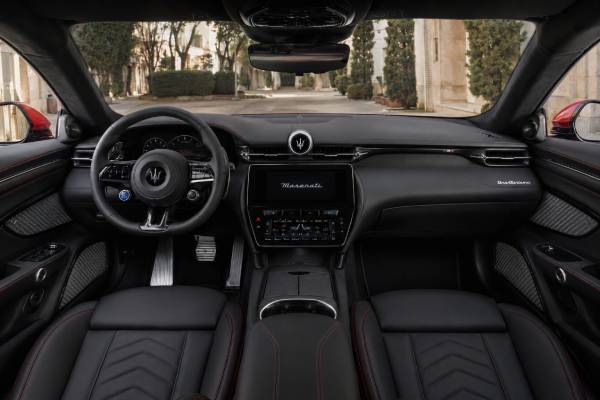
The cabin is familiar from Nettuno cars: digital instruments, Maserati Intelligent Assistant, a lower comfort display, a digital clock, optional head-up display, and physical paddles that control regeneration rather than gear changes. Materials and graphics use copper and technical themes to distinguish Folgore.
Four full-size seats remain usable because battery modules do not sit directly under each occupant. Rear passengers still face coupe access and a sloping roof, but the accommodation is meaningful. The trunk is suitable for touring luggage, though cable storage should be planned so charging gear does not dominate the space.
Regeneration paddles let the driver adjust deceleration. The strongest setting can reduce brake-pedal use, but it does not eliminate friction braking or replace attention to brake condition. Lower regeneration supports coasting on open roads. The preferred setting depends on traffic, gradient, grip, and efficiency strategy.
Maserati’s synthesized sound uses motor and inverter behavior as an input. It changes with power demand and mode, providing speed feedback that a nearly silent 760 hp car would otherwise lack. Cabin sound settings should be tested because software or speaker faults can alter the intended experience.
Instant Performance With GT Road Manners
The Folgore combines extraordinary initial acceleration with calmer, more controllable touring behavior than its output suggests. Instant motor response and precise torque allocation make it easy to go quickly, which increases the need for judgment.
In GT mode, power delivery is smooth, suspension compliant, and regeneration selectable. The car moves quietly through traffic and requires no gear shifts. A heavy battery is always present, but its low, central location keeps body movement controlled. Low-speed ride still reflects the short tire sidewalls.
Sport increases accelerator response, damping control, and torque delivery. Corsa makes the car more immediate and reduces electronic restraint for suitable conditions. Max Range limits performance and climate demand to extend travel. Mode availability and behavior can change through updates, so owners should consult the car’s current manual.
The 2.7-second 0–100 km/h claim is possible because all three motors respond immediately and AWD controls slip. Repeated full-power launches heat the battery, inverters, motors, and tires. Performance may reduce when state of charge is low or temperatures leave the optimal window. That protection is normal, not necessarily a fault.
At speed, the Folgore remains forceful beyond the initial launch, and its 325 km/h maximum is unusual for an EV. Energy consumption rises dramatically at high speed. A short unrestricted-road run and a long-distance range calculation should never be treated as the same use case.
Steering is accurate and the front motor can help pull the car through an exit, while independent rear motors influence yaw. The car can feel smaller than its mass, but tires still carry substantial load. Entering too fast overwhelms the front contact patches; smooth braking and patient turn-in remain essential.
Regenerative braking can be tuned with paddles. Transition to friction brakes should feel consistent. A change in pedal feel, vibration, pulling, or unusual noise needs inspection. Because regeneration reduces routine friction-brake use, discs can corrode if the car is driven gently in wet climates. Occasional appropriate friction braking helps keep surfaces clean.
Air suspension allows comfortable highway travel and stable body control. One-corner sag, compressor noise, harshness, or warnings are not normal. The car’s width and low nose require care in cities. Cameras and sensors help, but expensive wheels and battery protection remain close to curbs and road obstacles.
Range planning is part of the experience. Cabin heating, cold weather, high speed, elevation, rain, wheel choice, and tire pressure can change consumption markedly. Precondition the battery while connected when possible, set realistic charger backups, and arrive with enough reserve to handle a failed or occupied station.
Battery, Charging, Software, and Chassis Care
The Folgore needs less routine mechanical service than a Nettuno car, but its expensive systems require specialized inspection. Battery health, cooling, isolation, charging performance, software, air suspension, tires, brakes, and the 12-volt system should be documented rather than assumed.
Battery degradation is best assessed through diagnostic state-of-health data, usable energy testing, charging history where available, cell-balance information, fault logs, and real-world consumption under known conditions. Dashboard range alone is not a health test because it changes with recent driving and climate use.
Inspect the high-voltage cooling loops, reservoirs, pumps, hoses, chiller interfaces, and underbody for leaks or impact. The battery must manage temperature during fast charging and repeated acceleration. Reduced charging speed may result from cold temperature, charger limits, high state of charge, or a genuine thermal problem; a controlled session helps distinguish them.
Test both AC and DC charging. Confirm the inlet locks, cable releases, charge scheduling, app functions, navigation preconditioning, and expected power ramp. Bring the cables supplied with the car and verify their current and connector ratings. Look for heat discoloration or damaged pins.
Software updates can change charging behavior, range estimation, driver assistance, infotainment, and control calibration. Confirm all campaigns by VIN and preserve invoices or digital records. A failed update can require stable 12-volt support and dealer intervention.
The 12-volt battery wakes contactors and powers modules. If it weakens, the high-voltage pack may be unable to bring the car online even when fully charged. Load-test it, verify DC-to-DC charging behavior, and investigate sleep-current issues. Use approved storage procedures.
Air suspension and adaptive dampers need the same attention as on Trofeo. Check overnight height, compressor run time, struts, lines, valves, sensors, and alignment. The Folgore’s greater mass increases tire and suspension loads. Inspect 20/21-inch wheels internally and use matched, homologated tires with minimal circumference variation.
Friction brakes can suffer corrosion through underuse. Measure discs and pads, assess inner faces, test the parking brake, and replace fluid at the prescribed interval. Heavy track use can overheat tires and brakes even when regeneration contributes.
High-voltage warranty terms are crucial. Confirm duration, mileage, degradation threshold, exclusions, transfer requirements, and whether imported cars retain coverage. Repairs and towing must follow EV safety procedures. Never allow an unqualified workshop to drill, weld, lift, or disconnect components near the battery.
Buying a Folgore With Confidence
The safest used Folgore has a verified battery warranty, complete campaign history, normal diagnostic state of health, undamaged battery protection, reliable charging on AC and DC, current software, matched tires, and local high-voltage service support.
Begin with VIN and market identity. Confirm build date, PrimaSerie or regular status, paint, interior, wheels, options, charging inlet, onboard AC rating, supplied cables, connected services, and warranty eligibility. An attractive imported car can become inconvenient if its connector or telematics are unsupported.
Use a Maserati EV-qualified facility for the pre-purchase inspection. It should include:
- Full high- and low-voltage diagnostic scan.
- Battery health, cell-balance, isolation, and thermal-system review.
- AC and DC charging test with power-curve observation.
- Underbody, battery enclosure, cooling, and impact inspection.
- Air-suspension, wheel, tire, brake, and alignment assessment.
- Software, campaign, app, key, and connected-service verification.
- Mixed-material body and sensor-calibration review.
| Area | Good evidence | Warning sign |
|---|---|---|
| Battery | Healthy diagnostics, balanced cells, valid transferable warranty | Isolation faults, unexplained capacity loss, damaged enclosure |
| Charging | Normal AC and DC sessions, complete correct cables | Interrupted charging, hot pins, low power without explanation |
| Software | Current updates and closed campaigns | Recurring warnings, failed updates, unavailable connected services |
| Chassis | Level suspension, straight wheels, matched fresh tires | Sag, compressor overrun, impact marks, uneven wear |
| Body and provenance | Qualified repairs and factory-correct trim | Underbody strike, poor aluminum repair, false PrimaSerie claims |
Road-test from a useful state of charge and at normal temperature. Check smooth power delivery, full regenerative range, friction-brake blending, mode changes, ride-height adjustment, steering alignment, camera and assistance systems, climate performance, and any power limitation messages.
Plan charging before purchase. Confirm home supply capacity, wall-box compatibility, electricity tariff, public 800-volt coverage, winter route needs, and insurer requirements. Owners without reliable home or workplace charging may find a high-performance EV less convenient than its acceleration suggests.
Budget for tires, wheels, brakes, insurance, dealer diagnostics, suspension parts, and out-of-warranty high-voltage risk. Energy cost can be low at home and high at premium public chargers. A remaining factory or approved extended warranty may justify paying more for a later or better-documented car.
Avoid examples with battery-enclosure damage, unresolved isolation or charging faults, missing cables, unsupported imports, air-suspension sag, mismatched tires, poor collision repair, or a seller unwilling to permit an EV diagnostic report. Do not use dashboard range as the only evidence of battery health.
A correctly supported Folgore is more than a fast electric novelty. It preserves Maserati’s low-slung four-seat GT concept while introducing genuine 800-volt engineering and advanced torque control. Maintain the battery and software with the same seriousness an older owner gives an engine and gearbox, and it can deliver silent daily ease, dramatic performance, and credible long-distance ability.
For long-term storage, avoid leaving the battery at either extreme of charge unless the official procedure requires it. Use the vehicle’s storage target, maintain the 12-volt system correctly, and check tire pressure and cabin humidity. The exact recommendation can change with software and market documentation, so the current owner manual should govern rather than a generic EV rule.
References
- New Maserati GranTurismo 2022
- The new Maserati GranTurismo 2022
- Maserati GranTurismo Folgore – 2027 Electric Sports Car 2026
- Maserati GranTurismo Folgore named as Best Electric GT 2024
- Maserati Guides & Documentation 2026 (Owner Documentation)
Disclaimer
This article is for informational purposes and is not a substitute for professional diagnosis, high-voltage service, repair, or inspection. Specifications, charging rates, range, torque values, intervals, and procedures vary by VIN, market, software, equipment, and conditions; verify all critical details in official Maserati documentation.
Please share this guide on Facebook, X/Twitter, or an EV and Maserati community if it helped you understand the GranTurismo Folgore.