
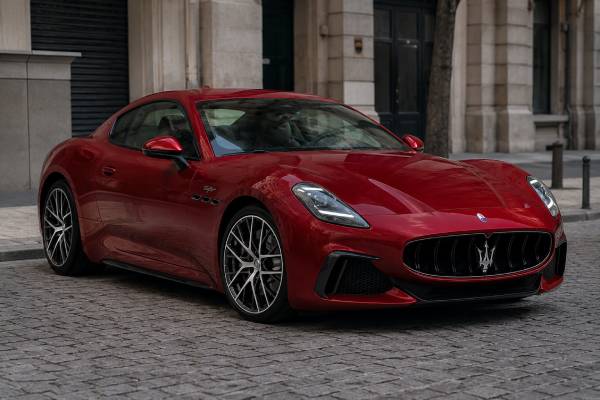
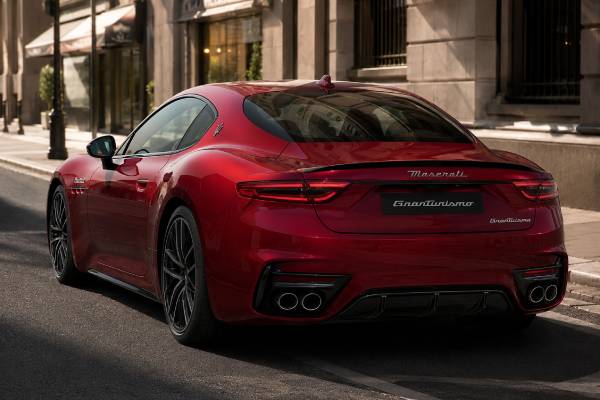
The 550 hp Maserati GranTurismo Trofeo is the high-performance combustion version of the second-generation M189 coupe launched for 2023. It replaces the old naturally aspirated V8 formula with a twin-turbo 3.0-liter Nettuno V6, eight-speed automatic, rear-biased all-wheel drive, air suspension, and a deeply integrated electronic dynamics system. The result is substantially quicker than any standard M145 GranTurismo: Maserati quotes about 3.5 seconds from 0–100 km/h and a top speed near 320 km/h, while preserving four adult seats and long-distance comfort. The 2023–2026 description needs a date clarification. The original Trofeo specification produces 550 metric horsepower; Maserati announced a refreshed 590 PS version in June 2026, so late listings may use the same model name for materially different power and design packages. Buyers must confirm build date, output, front-end design, differential, exhaust, software, and market specification by VIN. Early M189 ownership is less about old-car wear and more about warranty coverage, campaigns, 12-volt battery stability, air suspension, expensive staggered tires, software integration, and evidence of careful high-performance use. This guide covers the 550 hp car’s engineering, options, road character, maintenance needs, and purchase checks.
Table of Contents
- The Combustion Flagship of the New GranTurismo
- 550 hp Nettuno, AWD, and Active Chassis
- Launch Years, Options, and the 2026 Transition
- Mixed-Material Body and Digital Grand Touring
- Supercar Pace With Four-Seat Range
- Warranty, Software, and Performance-Car Care
- How to Buy the Correct 550 hp Trofeo
The Combustion Flagship of the New GranTurismo
The 550 hp Trofeo is the fastest original-launch combustion M189 and the direct performance counterpart to the 490 hp Modena. It uses the same core Nettuno architecture but adds output, sharper calibration, distinct trim, and a Corsa-oriented personality.
Maserati developed the M189 as a clean-sheet platform after M145 production ended in 2019. It had to support both a twin-turbo V6 and the tri-motor Folgore battery system without changing the basic roofline, seating position, or four-seat mission. That requirement drove the extensive use of aluminum, magnesium, high-strength steel, networked control systems, and powertrain-specific packaging.
The Trofeo’s 550 hp and 650 Nm make the comparison with the old 460 hp V8 simple in numbers but complicated in character. The V6 delivers maximum torque much earlier, and all-wheel drive turns that torque into acceleration with little drama. The old engine built excitement through sound and revs; Nettuno adds speed through boost, combustion efficiency, and electronic coordination.
The Trofeo is not a stripped MC Stradale replacement. It retains air suspension, a rich digital cabin, driver assistance, premium audio, rear seats, and touring refinement. Its performance advantage appears through engine output, drive modes, launch control, braking, tires, cooling, and dynamics calibration rather than deleted comfort equipment.
The model launched alongside Modena and Folgore, with PrimaSerie 75th Anniversary versions introducing the range. Regular Trofeo cars offer a wider color and trim choice through standard and Fuoriserie programs. This makes exact specification more important than a simple trim badge; two cars can differ greatly in paint, carbon, audio, seats, driver aids, and wheel finish.
In June 2026, Maserati announced a significant refreshed GranTurismo family with up to 590 PS, a new front design, standard Sportivo exhaust on Trofeo, and updated hardware. That creates a boundary within the 2026 calendar year. A 550 hp car may be registered in 2026 without being the new 590 hp version. Only the VIN, build data, engine output, and visible update details resolve the identity.
The 550 hp Trofeo remains important as the launch-era combustion flagship and the purest expression of the original M189 design. It offers extreme road pace without sacrificing the central GranTurismo promise: four occupants, luggage, and enough comfort to make distance enjoyable.
550 hp Nettuno, AWD, and Active Chassis
The Trofeo’s performance comes from a 2,992 cc twin-turbo V6, eight-speed automatic, all-wheel drive, air springs, adaptive dampers, and coordinated vehicle software. Every system must be healthy because the car reaches its figures through integration rather than one oversized component.
| Item | Specification |
|---|---|
| Engine | 2,992 cc 90-degree twin-turbo V6 Nettuno |
| Combustion | Pre-chamber Maserati Twin Combustion plus conventional spark ignition |
| Output | 550 hp at 6,500 rpm |
| Torque | 650 Nm from approximately 3,000 rpm |
| Transmission | Eight-speed torque-converter automatic |
| Drive | Electronically controlled all-wheel drive, rear biased |
| Suspension | Double wishbone front, multi-link rear, air springs, adaptive dampers |
| Wheels | 20-inch front and 21-inch rear |
| Tires | Approximately 265/30 ZR20 front and 295/30 ZR21 rear |
| Length | 4,959 mm |
| Width | 1,957 mm excluding mirrors |
| Height | 1,353 mm |
| Wheelbase | 2,929 mm |
| 0–100 km/h | Approximately 3.5 seconds |
| Top speed | Approximately 320 km/h |
Nettuno uses a small pre-chamber above each cylinder’s main chamber. A spark initiates combustion in the pre-chamber, and burning jets pass through small openings to ignite the main mixture rapidly. A second spark plug supports conventional operation when appropriate. This allows high specific output and stable combustion but increases the importance of correct plugs, fuel quality, oil, cooling, and software.
Twin turbochargers provide broad torque. The engine does not need 5,000 rpm to feel urgent, yet it continues toward a 6,500-rpm power peak. Turbo plumbing, charge-air cooling, exhaust heat shields, vacuum or electronic controls, and oil supply all belong in a serious inspection.
The eight-speed automatic shifts smoothly in GT use and quickly in Sport or Corsa. Paddles give direct manual control, while launch control coordinates engine torque, clutch packs, AWD, brakes, and stability systems. Repeated launches add thermal and mechanical load even when the computer prevents an obviously poor start.
All-wheel drive sends torque forward when conditions demand it. The car still feels rear-led because normal calibration and chassis balance favor the rear axle. Tire circumference must remain within approved limits. Mismatched brands, large tread-depth differences, or incorrect sizes can upset traction logic and increase driveline stress.
Air springs adjust ride height and support multiple modes. Adaptive dampers alter body control rapidly, and the vehicle dynamics controller blends steering, torque distribution, braking, and stability intervention. The benefits are wide capability; the cost is that a fault in one sensor or module can affect several apparent systems.
Launch Years, Options, and the 2026 Transition
The original 550 hp Trofeo spans launch production through the point at which the refreshed 590 PS model appeared. Buyers should separate model year, build date, registration date, and market launch timing rather than treating “2026 Trofeo” as one specification.
Early cars include PrimaSerie launch editions and regular production. PrimaSerie has fixed 75-car color groups and dedicated anniversary details. A normal Trofeo can be highly personalized through Fuoriserie but should not be represented as PrimaSerie without factory confirmation.
Regular option areas include:
- solid, metallic, three-layer, or Fuoriserie paint;
- multiple leather, perforation, stitching, and technical-fabric combinations;
- carbon-fiber exterior and cabin elements;
- 20/21-inch wheel designs and finishes;
- brake-caliper colors;
- head-up display and driver-assistance packages;
- 14-speaker or 19-speaker Sonus faber audio;
- comfort, heated, ventilated, or market-specific seat features;
- privacy, convenience, and connectivity packages.
The factory build sheet is essential because configurator names and bundles vary by country. A carbon part added after delivery may look convincing but differ in weave, UV stability, fit, or crash behavior. Retain original parts when modifications are reversible.
The refreshed car announced in June 2026 introduces a more horizontal and aggressive nose influenced by MCXtrema, GT2 Stradale, and MCPURA. Trofeo output rises to 590 PS and torque remains 650 Nm. A redesigned standard Sportivo exhaust, revised interior details, and updated dynamics content distinguish it. The 550 hp article does not apply to that powertrain even when registration papers simply say GranTurismo Trofeo.
A seller should provide the original order, invoice, VIN specification, warranty start date, software history, service invoices, keys, manuals, emergency equipment, and records for tires, wheels, glass, or paint. Imported cars need documentation for homologation, lighting, emissions, connected services, radio functions, maps, and local warranty support.
Color and personalization can influence resale, but mechanical and electronic condition remains more important. A restrained factory specification with complete care often finds a broader market than a dramatic personalized car whose materials are difficult to repair. Rare does not automatically mean desirable.
Mixed-Material Body and Digital Grand Touring
The M189 is designed around low mass, a low seating position, and four-seat packaging despite its AWD hardware. Extensive aluminum, selected magnesium components, and high-strength steel let the body meet stiffness and safety targets without becoming as heavy as its equipment suggests.
The design keeps the long hood and four-fender form associated with Maserati GTs. Vertical headlamps place the car in the MC20 family, while the oval grille and Trident retain brand identity. The roof flows into the rear pillars without making the back seats purely decorative.
The body’s mixed materials require correct repair methods. Aluminum and steel cannot be joined or refinished casually without corrosion control, approved adhesives, rivets, welding procedures, and calibration of surrounding sensors. After an accident, invoices and photographs from a qualified facility are valuable.
Cooling openings, active or shaped ducts, undertrays, and wheel-arch liners manage heat and aero. A low-speed curb strike can damage more than paint. Inspect the underside for cracked panels, missing fasteners, bent heat exchangers, oil or coolant residue, and disturbed radar or parking sensors.
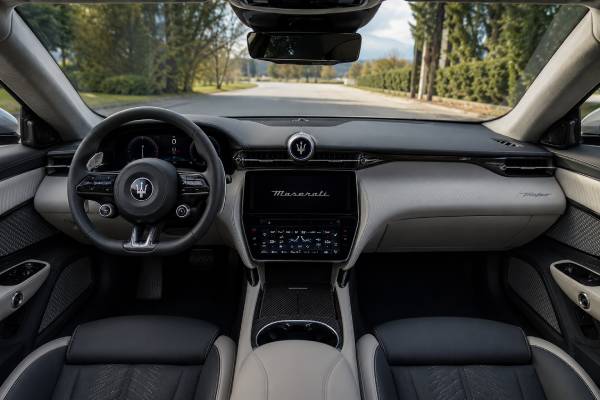
Inside, the driver faces a digital instrument display and a large Maserati Intelligent Assistant screen. A lower comfort display controls climate and related functions. The traditional clock becomes a configurable digital device. Physical paddles and the steering-wheel mode control preserve direct driving interactions.
The interface is powerful but network dependent. A black screen, slow boot, lost phone pairing, camera delay, or unavailable assistance feature may trace to software, battery voltage, module communication, or hardware. Test the car after sleep, during a drive, and after a hot restart rather than only in accessory mode.
Four seats remain central. Adults can occupy the rear for meaningful journeys, though access and headroom depend on size. The trunk supports touring luggage. Front seats should move and return smoothly to preserve rear access; memory and easy-entry faults can be expensive annoyances.
Nettuno’s exhaust note is amplified by valves and cabin acoustics but remains mechanically generated. It is more compact and forceful than the former V8’s sweeping note. Owners should avoid assuming that a louder aftermarket exhaust improves the experience; drone, heat, emissions faults, or warranty disputes may follow.
Supercar Pace With Four-Seat Range
The Trofeo’s defining skill is delivering near-supercar acceleration with the ride, visibility, and seating needed for long trips. It is faster and more secure than the M145, though some steering texture and naturally aspirated theater are traded for control and torque.
In Comfort or GT mode, throttle response is measured, the transmission shifts early, exhaust volume falls, and the air suspension absorbs broad road movements. Low-profile tires still transmit sharp edges. The car is quiet enough for conversation and stable at motorway speed.
Sport mode brings earlier boost response, quicker shifts, heavier damping, and more exhaust presence. Corsa reduces intervention and prepares the car for harder use. Tire temperature and surface condition matter; Corsa is not a styling setting for wet or congested roads.
Launch control delivers the quoted 3.5-second sprint only under suitable conditions. The process is repeatable because computers coordinate the systems, but it is not free of wear. Warm fluids, sufficient fuel, correct tire pressure, a straight dry surface, and appropriate cool-down are basic requirements.
Mid-range acceleration is the larger real-world advantage. Passing requires less planning than in the old V8. The gearbox can drop several ratios quickly, and 650 Nm moves the car without waiting for the top of the tachometer. Manual paddles are useful on descending or winding roads.
Electric steering is precise and quick. It provides consistent effort but less fine texture than the hydraulic M145. The front axle helps pull the car out of corners, while rear-biased calibration allows controlled rotation. Entering too fast still produces understeer as the front tires reach their load limit.
Air suspension keeps the body flat without making normal roads punishing. A healthy car should not float, bounce repeatedly, or crash over small impacts. Those symptoms can indicate pressure, damper, tire, wheel, or sensor problems.
Braking performance is strong and conventional in feel. The system must stop a fast, heavy coupe repeatedly, so pad thickness, rotor condition, fluid age, cooling, and tire grip matter. Track use should be followed by inspection rather than waiting for a warning.
City compromises include width, low bodywork, expensive wheels, limited rear-quarter visibility, and a wide turning circle. Cameras and sensors reduce risk but do not replace attention. On a long route, the rear seats, luggage room, audio, climate control, and effortless power justify the GranTurismo name.
Warranty, Software, and Performance-Car Care
A 550 hp Trofeo is young enough that warranty and official campaign history should influence the purchase heavily. Modern faults can involve software or low voltage rather than broken hard parts, but diagnosis still requires current Maserati equipment and trained technicians.
Service the Nettuno by the exact time and mileage schedule. Use approved oil, filters, spark plugs, coolant, and fuel. Inspect turbo oil and coolant connections, charge-air plumbing, heat shields, reservoirs, exhaust joints, and undertrays. Misfire, smoke, boost loss, coolant odor, or repeated warnings need immediate investigation.
The transmission and AWD system should engage cleanly and remain quiet. Check for shudder, delayed selection, harsh shifts, fluid leakage, or drivetrain warnings. Software revisions can change shift quality, so invoice and campaign records matter. Fluids should be serviced only with the applicable official procedure and specification.
Air suspension must sit level after overnight parking and change height without excessive compressor run time. Scan ride-height sensors, dampers, valves, and compressor. Impact damage or incorrect lifting can affect air lines and calibration. Alignment should be performed by a workshop that understands ride-height conditions.
The 12-volt battery supports many control modules even though the car is not a hybrid. Low voltage can trigger faults across infotainment, driver assistance, suspension, keyless entry, and powertrain networks. Load-test the battery, verify charging behavior, and use approved support during software programming.
Check VIN-specific recalls, service actions, and updates. Test adaptive cruise where fitted, lane and blind-spot systems, cameras, parking sensors, emergency braking status, all screens, the digital clock, head-up display, phone integration, audio, seats, windows, climate, keys, lighting, and alarm.
Inspect tires for correct homologation, age, cuts, heat damage, and wear across the full tread. Check wheels from the inner barrel. A cosmetic repair may hide a bend or crack. Measure brakes and inspect for track-related heat. Ask whether launch control or circuit events were frequent and compare the answer with tires and fluid history.
Body repairs require mixed-material knowledge and sensor calibration. Paint protection film can preserve vulnerable areas but inspect edges for trapped moisture, cuts, or concealed chips. Fuoriserie finishes may need specialist color matching.
An extended warranty or service plan can be worthwhile when transferable and valid in the car’s market. Read exclusions, required dealer intervals, modification restrictions, and claim procedures. A warranty is not a substitute for inspection, but it changes the risk of a complex module or air-suspension failure.
How to Buy the Correct 550 hp Trofeo
The first buying task is identification: confirm that the car is the original 550 hp specification rather than the refreshed 590 PS model, and determine whether it is a regular Trofeo or PrimaSerie. After that, prioritize software status, warranty, chassis condition, and complete documentation.
Decode the VIN and obtain the factory build sheet. Match engine output, build date, paint, interior, wheels, carbon, driver aids, audio, and market. Compare the front design and exhaust specification with the production phase. Do not rely on registration year or seller-generated option lists.
Use a Maserati specialist or dealer for a pre-purchase inspection that includes:
- Cold start, full warm-up, dynamic test, and hot restart.
- Complete module scan, software-level review, and campaign check.
- Air-suspension height, compressor, damper, and leak-down assessment.
- Turbo, cooling, oil, transmission, AWD, and underbody inspection.
- Wheel, tire, brake, alignment, and evidence-of-track-use review.
- Mixed-material body and paint assessment.
- Operation of every screen, assistance feature, and comfort system.
| Area | Good evidence | Reason to pause |
|---|---|---|
| Identity | VIN confirms original 550 hp build and exact trim | 2026 listing with unclear 550/590 specification |
| Warranty and software | Current updates, closed campaigns, transferable coverage | Recurring warnings or missing digital service history |
| Engine and driveline | Clean boost, stable temperature, smooth shifts and AWD | Misfire, smoke, leaks, shudder, overheating |
| Air chassis | Level stance, quiet compressor, even tire wear | Overnight sag, harsh ride, warning messages |
| Body and electronics | Qualified repair records and every feature functional | Poor aluminum repair, sensor faults, water entry |
Drive all appropriate modes. Check low-speed smoothness, boost delivery, paddle response, straight braking, ride changes, camera operation, and assistance availability. A brief drive may not reveal heat-related problems or an air leak after shutdown.
Calculate ownership costs before choosing options. Staggered premium tires, large brakes, insurance, dealer diagnostics, scheduled maintenance, wheel repair, and air suspension are significant. Remaining warranty may justify a higher price. An unusually cheap car with an unresolved warning can consume the saving quickly.
Avoid undocumented collision repair, mismatched tires, air-suspension sag, recurring drivetrain messages, unexplained coolant loss, noncompliant modifications, or an import with unsupported connected services. Heavy use is acceptable only when maintenance evidence matches it.
The best 550 hp Trofeo is not simply the lowest-mileage example. It is the car whose identity is clear, software current, battery healthy, tires and brakes matched, suspension level, and service history continuous. In that condition, it remains a compelling launch-era M189: extremely fast, distinctly Italian, and genuinely capable of carrying four people across a country.
A 550 hp Trofeo can also be evaluated through its use profile. A motorway-driven car may show high mileage with little brake or launch stress, while a low-mileage demonstrator can have repeated full-throttle starts, short cold journeys, and extensive stationary screen use. Ask where and how the mileage accumulated, then compare the answer with tire shoulders, brake surfaces, wheel condition, fuel records, and diagnostic history. No single clue proves abuse, but a consistent pattern gives a better picture than the odometer alone.
When negotiating a 2026 car, write the power version into the sales agreement. The contract should identify 550 hp, build date, trim, and major equipment rather than only “GranTurismo Trofeo.” That simple wording prevents disagreement if registration databases or dealer advertisements use images and specifications from the newer 590 hp model.
For cars kept near the sea or used through winter, inspect fasteners, brake hats, underbody seams, and electrical connectors for early corrosion. Prompt cleaning and documented protection are preferable to cosmetic coating applied over existing oxidation.
References
- The new Maserati GranTurismo 2022
- New Maserati GranTurismo 2022
- New Maserati GranTurismo, GranCabrio and Grecale 2026
- Maserati Guides & Documentation 2026 (Owner Documentation)
- Maserati TechInfo 2026 (Technical Information)
Disclaimer
This article is for informational purposes and is not a substitute for professional diagnosis, repair, or inspection. Specifications, torque values, service intervals, software procedures, and equipment vary by VIN, market, and production phase; verify all critical details in official Maserati documentation for the individual vehicle.
Please share this guide on Facebook, X/Twitter, or a Maserati group if it helped you identify and evaluate the 550 hp GranTurismo Trofeo.