
The 2026 Maserati GranTurismo Trofeo with 590 hp is the first major performance and design evolution of the M189 coupe. Announced on June 18, 2026, it raises Nettuno output by 40 hp over the launch Trofeo, delivers 650 Nm from just 2,500 rpm, adds an electronically controlled rear limited-slip differential, adopts a redesigned Sportivo exhaust, and introduces a sharper front end influenced by the MCXtrema, GT2 Stradale, and MCPURA. It retains the features that make the GranTurismo a true GT rather than a two-seat supercar: all-wheel drive, an eight-speed automatic, air suspension, four full-size seats, and a richly equipped digital cabin. Corsa mode lowers the body by 17 mm, applies the hardest damping and race transmission mapping, while a low-speed lifter can raise the car by 25 mm. Because the model is newly introduced, long-term failure patterns do not yet exist. Buying and ownership decisions must focus on correct 590 hp identity, current software, warranty and campaign coverage, air-suspension operation, e-LSD behavior, tire and brake condition, body-repair quality, and evidence of careful early use. This guide separates the 590 hp car from the earlier 550 hp Trofeo and explains its engineering, performance, service needs, and purchase checks.
Table of Contents
- The First Major M189 Trofeo Evolution
- 590 hp Nettuno, e-LSD, and Active Hardware
- New-Range Design, Options, and Model Identity
- Functional Aero, Sport Exhaust, and New Cabin
- Greater Response With Four-Seat Composure
- Early Ownership, Warranty, and Service Strategy
- Buying the 590 hp Car, Not a Mislabelled 550
The First Major M189 Trofeo Evolution
The 590 hp Trofeo is more than a software increase. Maserati revised powertrain calibration, exhaust hardware, rear torque management, aerodynamics, controls, materials, and visual identity to create a clearer separation from the 490 hp touring model.
The M189 GranTurismo arrived globally for the 2023 launch period with 490 hp Modena, 550 hp Trofeo, and 760 hp Folgore specifications. Its clean-sheet architecture supported combustion and electric systems within the same low body and four-seat package. The original Trofeo established the Nettuno model’s 3.5-second-class acceleration and 320 km/h capability.
For the update announced in June 2026, the Trofeo gained 40 hp while retaining 650 Nm. More important for everyday response, peak torque becomes available from 2,500 rpm. The new e-LSD actively varies torque between the rear wheels, and revised engine and transmission calibration makes the car more immediate across the rev range.
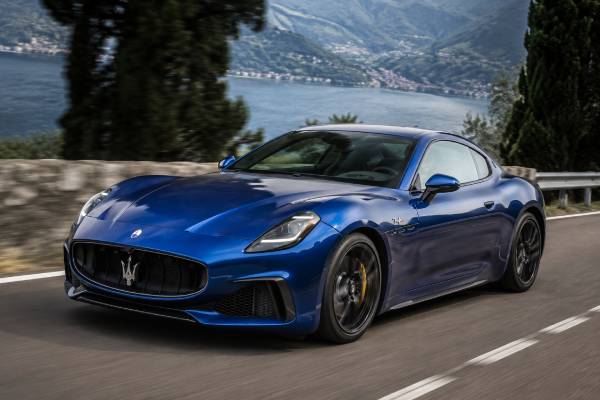
Maserati also gave the new range a more horizontal face. The design language began with the MCXtrema track car, moved to the road through GT2 Stradale and MCPURA, and now reaches the GranTurismo. The aim is not simply aggression: revised intakes, boundary-layer slots, air curtains, and splitter geometry change front airflow and downforce.
The model is described as a 2026 introduction and appears in model-year-2027 product material in some markets. That creates predictable confusion. A late 2026 registration may still be the previous 550 hp body, while an early 590 hp car may be sold as a 2027 model. The VIN, factory build data, front fascia, exhaust, e-LSD, mode menus, and power rating determine identity.
The Trofeo remains a luxury GT rather than a GT2 Stradale substitute. It has air springs, broad comfort, driver assistance, digital interfaces, premium audio, and four genuine seats. Its sharper hardware expands the dynamic range instead of deleting the equipment needed for travel.
As a new model, it should be bought with realistic expectations. Early software updates, revised parts, campaign work, and market-specific equipment changes are normal in a fresh production phase. Complete dealer records and warranty support are therefore more valuable than speculative claims about future collectability.
590 hp Nettuno, e-LSD, and Active Hardware
The updated Trofeo combines a 590 hp twin-turbo Nettuno V6 with an eight-speed automatic, AWD, an active rear e-LSD, air suspension, and mode-linked exhaust and damping. Its performance advantage comes from how these systems coordinate.
| Item | Specification |
|---|---|
| Engine | 2,992 cc 90-degree twin-turbo V6 Nettuno |
| Combustion | Patented pre-chamber Maserati Twin Combustion with conventional spark support |
| Output | 590 hp |
| Torque | 650 Nm from approximately 2,500 rpm |
| Transmission | Eight-speed torque-converter automatic with revised calibration |
| Drive | All-wheel drive with active electronic rear limited-slip differential |
| Suspension | Double wishbone front, multi-link rear, air springs, adaptive dampers |
| Ride-height range | Low-speed lifter +25 mm; Corsa position -17 mm |
| Drive modes | GT, Sport, and Trofeo-exclusive Corsa, plus low-speed lifter function |
| Wheels | 20-inch front and 21-inch rear; optional widened-track designs |
| Length | Approximately 4,959 mm, market specification dependent |
| Width | Approximately 1,957 mm excluding mirrors |
| Height | Approximately 1,353 mm at standard position |
| Wheelbase | 2,929 mm |
| Top speed | More than 320 km/h |
Nettuno’s pre-chamber system ignites a small mixture above the main chamber, sending flame jets through calibrated holes to accelerate combustion. A second plug allows conventional ignition as conditions change. The design supports high specific output from three liters, but it depends on approved oil, correct spark plugs, fuel quality, stable cooling, and current control software.
The 590 hp calibration increases output without changing displacement. Peak torque arriving 500 rpm earlier than the launch car should improve response before full boost and reduce the need for abrupt downshifts. The revised transmission mapping supports that broader delivery and changes character between GT, Sport, and Corsa.
The e-LSD is a major chassis upgrade. Instead of relying only on brake intervention or a passive differential, it can vary rear-wheel locking in response to steering, throttle, yaw, wheel speed, and mode. It helps the car turn into a corner, controls inside-wheel slip, and deploys power on exit. Fluid condition, actuator health, calibration, and diagnostic faults become new ownership priorities.
AWD remains standard. The front differential aligns with the engine to help lower the center of gravity, while the system preserves rear-led behavior. Correct staggered tires are essential because AWD and e-LSD calculations depend on wheel speed and rolling circumference.
Air suspension offers standard ride height, a +25 mm low-speed lifter for ramps, and a -17 mm Corsa position for aerodynamic efficiency and body control. Adaptive damping changes from GT comfort to Sport and the hardest Corsa setting. A ride-height fault can affect alignment, aero, and differential behavior as well as comfort.
New-Range Design, Options, and Model Identity
The easiest visual identifier is the redesigned front end, but a genuine 590 hp Trofeo should be confirmed through VIN data, engine rating, e-LSD equipment, exhaust specification, and updated cabin controls. Appearance parts alone can be retrofitted.
The new fascia is wider and more horizontal. Lateral intakes incorporate boundary-layer aspiration slots, an external air curtain was developed through computational fluid dynamics, and the central splitter is optimized to increase front downforce. Clear-lens rear lamps create a cleaner signature.
Optional glossy-black Tridente wheels draw inspiration from MCPURA and can widen track by 10 mm. A wider track can sharpen stability and stance, but buyers should verify whether the offset and related alignment are factory correct. Replicas or spacers may imitate the appearance without equivalent engineering.
Fuoriserie adds new colors such as Green Jupiter Matte, Blu Denim, Bronzo finishes, Grigio Mistero, Rosso Velluto, and Oro Lirico, along with coordinated badges and trim. Paint code and build sheet are essential because complex matte, metallic, and custom finishes can be expensive to repair.
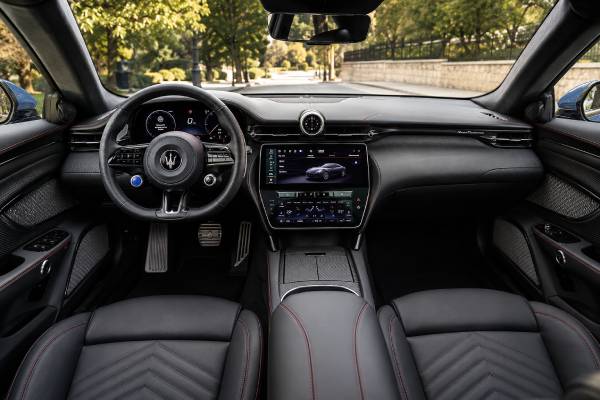
Inside, the update introduces a racing-influenced steering wheel with flat upper and lower sections, dark satin aluminum spokes, and Alcantara inserts in the Sport version. Trofeo receives Alcantara headlining, carbon lower fascias and side skirts, and performance-oriented upholstery choices. Exact market equipment may vary.
The digital clock has a metal bezel, octagonal form, revised graphics, and a mode pop-up. A new three-dimensional metal PRND selector and updated paddle functions change the control feel. The 12.3-inch center display, 8.8-inch comfort display, 12.2-inch instrument cluster, and head-up display use redesigned graphics. Driver distraction and fatigue monitoring joins the assistance suite.
To confirm a car, check:
- VIN and factory build sheet showing 590 hp Trofeo specification;
- new front and clear-lens rear treatment;
- active e-LSD identification and diagnostic presence;
- standard Sportivo exhaust hardware;
- updated steering wheel, clock, selector, and screen graphics;
- Corsa mode with the proper suspension and transmission strategy;
- correct wheels, carbon, upholstery, and market options;
- warranty start, campaigns, software versions, keys, and manuals.
A 550 hp car with the new bumper is not equivalent. Nor should an early car with an aftermarket exhaust be valued as the 590 hp version. Registration databases may not list power accurately, so factory data is the deciding evidence.
Functional Aero, Sport Exhaust, and New Cabin
The 590 hp car’s design changes are tied to airflow, sound, and driver interaction. They make the Trofeo feel more distinct without changing the M189’s core four-seat silhouette.
The new splitter and side openings control pressure around the front wheels and increase downforce. Air curtains guide flow across the outer body. These low components are vulnerable to curbs and steep ramps even with the lifter, so inspect from below for cracks, missing fasteners, damaged ducts, and displaced sensors.
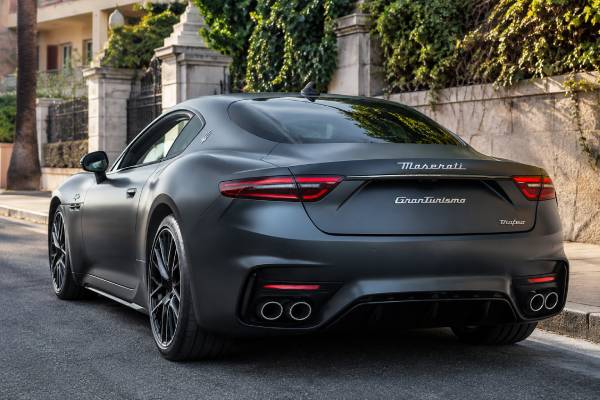
The Sportivo exhaust is a hardware revision rather than only a louder software setting. New central pipes, a redesigned resonator, changed internal geometry, and additional perforation alter gas flow. Active valves open fully in Sport and Corsa. The system should produce a more layered note through acceleration while remaining manageable in GT.
Aftermarket exhaust changes can disrupt the intended balance, generate drone, alter heat near the bumper, or trigger emissions and valve faults. Verify factory part numbers and inspect the tips, hangers, actuators, wiring, and shields. A permanently open valve is not the same as correct mode operation.
The body still uses extensive aluminum with magnesium and high-strength steel. Mixed-material repair requires approved adhesives, rivets, welding methods, corrosion isolation, and sensor calibration. A new front-end repair is especially sensitive because aero pieces, cameras, radar, and cooling all occupy the same region.
Inside, the flat-section wheel provides a clearer performance cue. Alcantara improves grip but wears and oils more quickly than leather. Inspect high-contact areas, stitching, and cleaning history. The revised digital clock and PRND controls should operate smoothly and show no loose trim or delayed response.
The four-seat package remains a defining engineering feature. Front seats must move reliably for rear access, and rear climate or comfort functions should be tested. The roof is low, but the T-shaped occupant space and wheelbase make the rear useful for real trips rather than emergencies.
Three major displays centralize vehicle controls. Screen response, brightness, phone integration, camera feeds, head-up display, audio, climate, and mode graphics all depend on software and module communication. Test after the car wakes from sleep, while driving, and after a hot restart.
Sonus faber audio remains available in premium configurations. Sound-system operation should not be assumed from a functioning center screen; test each speaker, source, microphone, and surround setting. Low-voltage events can create symptoms across unrelated systems.
Greater Response With Four-Seat Composure
The 590 hp Trofeo should feel more immediate than the launch 550 hp car, especially in the mid-range and on corner exit. The e-LSD and revised calibrations aim to make the extra output usable rather than merely increasing a peak number.
GT mode remains the long-distance setting. Throttle and gearbox behavior are progressive, damping is compliant, and the exhaust is controlled. Despite 20/21-inch wheels, a healthy car should absorb broad bumps without repeated motion. Tire noise varies with surface and option.
Sport opens the exhaust valves, tightens dampers, sharpens response, and allows launch control. The earlier torque peak gives strong acceleration without waiting for high revs. Paddle shifts become more assertive, and the e-LSD actively supports traction.
Corsa is Trofeo exclusive. Race traction control, hard damping, race gearbox mapping, full exhaust opening, launch control, and the 17 mm lower ride height create the most focused setup. It is intended for suitable roads or a circuit with warm tires and known surface conditions, not wet commuting.
The e-LSD should make turn-in and exit more precise. Under braking and initial steering, controlled locking can support stability; under power, it can send torque where grip is available. The driver still must respect front-tire load. Arriving too fast produces understeer regardless of electronics.
Electric steering provides quick, consistent response. It will not reproduce every texture of the old M145’s hydraulic rack, but the chassis is more accurate and better controlled. The optional wider track can add stability, though correct wheel specification and alignment are crucial.
Maserati states a top speed above 320 km/h. Acceleration varies by market certification and test condition, so the correct model-specific figure should be taken from the individual car’s homologation documents. In real use, the earlier torque delivery and launch coordination matter more than a tenth of a second.
Large brakes must manage repeated high-speed stops. Pedal response should be firm and straight. Track use requires fresh fluid, adequate pads, cooling laps, and inspection afterward. Tire pressure rises substantially with heat, and the car’s modes cannot compensate for old or damaged rubber.
The low-speed lifter raises the body by 25 mm to clear ramps. It does not shorten the wheelbase or protect wheels from curbs. Confirm automatic lowering behavior and any speed limits in the manual. A failed height sensor can leave the car at an incorrect level.
For touring, the car retains supportive seats, rear accommodation, luggage capacity, climate control, modern assistance, and strong audio. Its core achievement is offering significantly greater response while remaining civilized enough to cross countries with three passengers.
Early Ownership, Warranty, and Service Strategy
Because the 590 hp Trofeo is new, preventive dealer-level care and complete records matter more than internet lists of supposed common faults. Establish a clean software, battery, fluid, tire, brake, and suspension baseline while warranty coverage is active.
Follow the exact maintenance schedule for oil, filters, spark plugs, coolant, brake fluid, and driveline service. Nettuno’s turbochargers and pre-chamber system depend on approved oil and correct ignition components. Short journeys, repeated launches, and track use may justify more frequent inspection even when the official interval has not arrived.
Inspect turbo oil and coolant lines, charge-air plumbing, reservoirs, heat exchangers, exhaust joints, and undertrays. The engine should start cleanly, idle evenly, build boost without hesitation, and hold stable temperature. Smoke, coolant odor, misfire, boost loss, or recurring warnings require prompt diagnosis.
The revised eight-speed transmission should engage smoothly in every temperature range. Ask whether calibration updates were applied. Check for harsh selection, flare, shudder, fluid leaks, or drivetrain messages. AWD and the front differential should remain quiet.
The e-LSD adds an actuator, control logic, sensors, and fluid requirements. Scan it for stored faults, confirm smooth operation at parking speeds and under load, and follow the specified lubricant and calibration procedures. Chatter, binding, unexpected intervention, or warning messages should not be dismissed as a performance characteristic.
Air suspension should remain level overnight. Test +25 mm lifter, standard height, and automatic -17 mm Corsa position where conditions allow. Listen for excessive compressor cycling and inspect struts, lines, valves, height sensors, and dampers. Alignment must be set at the specified ride-height state.
A strong 12-volt battery is essential. Low voltage can trigger faults in powertrain, differential, suspension, infotainment, driver assistance, and key systems. Load-test the battery, verify charging, and use approved support during programming. Confirm software, recall, and campaign status by VIN.
Test all cameras, radar-assisted features, fatigue monitoring, displays, digital clock, head-up display, audio, phone pairing, climate functions, seats, windows, mirrors, keys, alarm, and lighting. Document intermittent symptoms before warranty expiry.
Inspect tires across the full width and verify factory sizes, homologation, age, and similar rolling circumference. Check optional wheels for correct offset and inner-barrel damage. Measure brakes and look for track heat or pad transfer. A low-mileage demonstrator may have consumed more tires and brakes than its odometer suggests.
Body work should be performed by a mixed-material-qualified repairer with calibration capability. Keep invoices, paint codes, geometry data, and before-and-after photographs. Warranty and service plans should be reviewed for territory, transfer, modification, and track-use exclusions.
Buying the 590 hp Car, Not a Mislabelled 550
Identity is the first purchase test. Confirm 590 hp through factory data and hardware before evaluating color, mileage, or price. The transition year makes inaccurate listings likely even without deliberate misrepresentation.
Obtain the VIN build sheet, original order, invoice, warranty start, and market homologation. Verify output, e-LSD, Sportivo exhaust, updated body, steering wheel, digital controls, wheels, trim, driver aids, and software. Compare registration dates with actual production dates.
A pre-purchase inspection should include:
- Cold start, full warm-up, boost test, and hot restart.
- Full module scan with engine, transmission, AWD, e-LSD, suspension, and assistance systems.
- Software-version and campaign verification.
- Ride-height and compressor testing at all permitted positions.
- Turbo, cooling, exhaust, underbody, wheel, tire, brake, and alignment inspection.
- Mixed-material body, aero, sensor, and paint assessment.
- Operation of every digital and comfort feature.
| Area | Good evidence | Warning sign |
|---|---|---|
| Model identity | VIN confirms 590 hp, e-LSD, new exhaust, and updated body | Power claim based only on registration year or tune |
| Powertrain | Clean boost, stable temperature, smooth transmission and AWD | Misfire, smoke, coolant loss, shudder, warning history |
| e-LSD and chassis | No faults, level air suspension, even matched tires | Binding, sag, compressor overrun, incorrect wheel setup |
| Software and warranty | Current versions, closed campaigns, transferable coverage | Recurring messages, unsupported import, missed service |
| Body and cabin | Qualified repairs, intact aero, all displays and sensors working | Poor mixed-metal repair, damaged splitter, dead modules |
Drive in GT and Sport, and use Corsa only where safe and permitted. Check low-speed refinement, torque response, paddle shifts, exhaust valves, braking, steering, ride-height transitions, e-LSD behavior, and camera functions. Let the car sit after driving to observe air-suspension level.
Price should reflect warranty, specification, and condition rather than early scarcity alone. New-model depreciation can be significant. Fuoriserie paint and rare trim add replacement cost but not always equal resale value. A well-specified standard car with full support may be easier to own.
Budget for premium staggered tires, large brakes, wheel repair, insurance, official diagnostics, scheduled service, and possible air-suspension or electronic work after warranty. Confirm access to a dealer trained on the updated model.
Avoid cars with uncertain 550/590 identity, non-factory tuning, unresolved e-LSD or suspension faults, mismatched tires, damaged aero, poor accident repair, missed software actions, or modifications that threaten warranty. A nearly new vehicle should not require excuses for dashboard warnings.
The best 590 hp Trofeo is a correctly identified, current, and fully supported car rather than the first or cheapest one available. Its combination of earlier torque, active rear differential, revised sound, functional aero, and four-seat comfort makes it the most developed combustion GranTurismo of the M189 era so far. Preserve its warranty history and maintain every connected system as carefully as the engine, and it can deliver both high-speed intensity and genuine grand-touring range.
References
- New Maserati GranTurismo, GranCabrio and Grecale 2026
- Maserati GranTurismo Trofeo – 2027 Performance Coupé 2026
- Maserati lights up the Goodwood Festival of Speed 2026 2026
- Maserati Guides & Documentation 2026 (Owner Documentation)
- Maserati TechInfo 2026 (Technical Information)
Disclaimer
This article is for informational purposes and is not a substitute for professional diagnosis, repair, or inspection. Specifications, torque values, service intervals, software procedures, and equipment vary by VIN, market, and production phase; verify every critical detail in official Maserati documentation for the individual vehicle.
Please share this guide on Facebook, X/Twitter, or a Maserati community if it helped you identify and evaluate the 590 hp GranTurismo Trofeo.