
The 2017–2019 Maserati GranTurismo MC is the aggressive late-production road trim created for markets where the MC Stradale’s single-clutch transaxle and carbon-ceramic setup were not the normal offering. It combines the 460 hp naturally aspirated 4.7-liter V8 with a six-speed ZF automatic, rear-wheel drive, a carbon-fiber hood, functional cooling and aerodynamic details, firm MC suspension tuning, and four-seat grand-touring usability. For model year 2018, it also gained the larger Alfieri-inspired grille, revised rear treatment, and modernized 8.4-inch infotainment system. The name can cause confusion: an MC is not automatically an MC Stradale. The late MC usually has a front-mounted torque-converter automatic, conventional high-performance iron brakes, and a road-focused cabin rather than the Stradale’s Race Shift transaxle and ceramic hardware. That distinction affects driving feel, maintenance, and value. A good MC is easier to use in traffic than a Stradale while retaining the V8 sound and visual presence enthusiasts want. A poor one can hide expensive damper, brake, cooling, mount, electrical, carbon, and interior problems. This guide identifies the correct specification, explains its model-year changes, and provides a disciplined inspection plan for buyers.
Table of Contents
- The Late M145’s Road-Going MC Formula
- Automatic V8 Performance and Chassis Specification
- Model-Year 2018 Changes, Options, and Identity
- Carbon Hood, Aero, and Four-Seat Function
- MC Drama With Automatic Ease
- Maintaining the Final Automatic V8 MC
- Buying Without Confusing It for a Stradale
The Late M145’s Road-Going MC Formula
The late GranTurismo MC blends the look and attitude of Maserati Corse development with the smooth automatic drivetrain preferred in North America and several other markets. It is the sharper alternative to the Sport, but it remains a four-seat road car rather than a stripped competition derivative.
By 2017, the M145 had been in production for a decade. Maserati’s range had evolved from the 405 hp 4.2-liter launch model through 440 hp S versions, the original 450 hp MC Stradale, and the 460 hp Sport and four-seat Stradale. The MC trim brought many of the visual and chassis cues associated with the most focused cars into a package that owners could drive daily without managing a dry clutch.
The 4.7-liter F136 Y V8 produces 460 hp and 520 Nm. In North American measurements, published output may appear as 454 hp because of the conversion from metric horsepower. That does not indicate a different engine. The car sends power through a ZF six-speed torque-converter automatic to the rear wheels. It uses paddle control and an MC-calibrated Sport strategy, but its gearbox is fundamentally different from MC Race Shift.
This matters because advertisements often collapse all “MC” names into one. A seller may call the automatic an “MC Shift,” referring loosely to paddle operation, or claim that its carbon hood proves Stradale identity. The correct late MC is desirable in its own right. Mislabeling becomes a problem when a buyer pays for carbon-ceramic brakes, a rear transaxle, or rarity the car does not have.
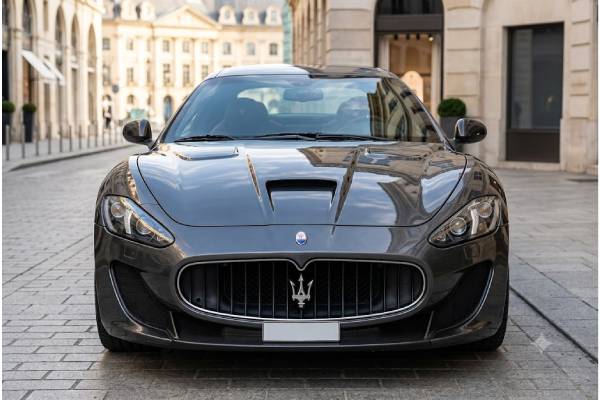
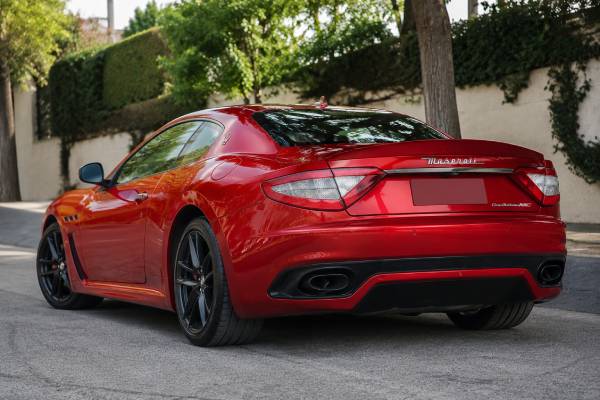
The 2018 update gave the aging platform a more current face and cabin interface. Maserati replaced the former oval grille theme with a wider hexagonal form inspired by the Alfieri concept, revised the lower air intakes, and reworked the rear bumper. The touchscreen finally added smartphone integration, improving navigation and media use without changing the engine’s analog character.
The MC’s current appeal is straightforward. It offers the last naturally aspirated Maserati V8 coupe in an extroverted factory configuration, with easier low-speed behavior than a Stradale and more visual drama than a Sport. It is still large, fuel-hungry, and expensive to restore. The purchase price should be treated as entry to a complex hand-finished GT, not as evidence that its running costs have depreciated too.
Automatic V8 Performance and Chassis Specification
The GranTurismo MC’s central formula is a high-revving 4.7-liter V8, front-mounted ZF automatic, rear limited-slip differential, double-wishbone suspension, and powerful Brembo iron brakes. It trades the Stradale’s ultimate hardware for smoother, more predictable road use.
| Item | Specification |
|---|---|
| Engine | F136 Y 4,691 cc naturally aspirated 90-degree V8 |
| Output | 460 hp at 7,000 rpm |
| Torque | 520 Nm at 4,750 rpm |
| Transmission | Six-speed ZF MC Auto Shift torque-converter automatic |
| Drive | Rear-wheel drive with limited-slip differential |
| Suspension | Double wishbones with MC-specific fixed-rate tuning in key markets |
| Brakes | Brembo ventilated iron discs with multi-piston calipers |
| Wheels | 20-inch forged-design MC wheels |
| Wheelbase | 2,942 mm |
| Length | Approximately 4,910 mm for the late MC body treatment |
| Fuel capacity | 86 liters |
| 0–100 km/h | Approximately 4.8 seconds |
| Top speed | Approximately 298 km/h |
The aluminum V8 uses dual overhead camshafts, four valves per cylinder, variable valve timing, port fuel injection, and wet-sump lubrication. It reaches peak torque well above the low-rpm range where a modern turbo engine feels strongest. The reward is immediate throttle response and a power curve that continues building to 7,000 rpm instead of flattening early.
The ZF automatic attaches to the engine rather than sitting at the rear. Its torque converter allows natural creep, smooth hill starts, and low-speed maneuvering without a consumable dry clutch. Normal mode favors early upshifts. Sport holds gears, responds more quickly to paddles, opens the exhaust valves more readily, and keeps the engine closer to its useful range.
MC suspension specification varies by market, but the late trim generally uses a firmer, lower road calibration than the adaptive Sport. Verify whether the individual car has fixed dampers or electronically controlled Skyhook rather than relying on a generic listing. Fixed dampers reduce electronic complexity; adaptive units offer a broader comfort range but are costly when leaking or weak.
Brembo iron brakes suit repeated fast road use and cost less to replace than carbon ceramics. They are still model-specific performance parts. Rotor dimensions, pad compound, cooling, and caliper condition should be verified. A common upgrade or substitution is not automatically correct for the MC’s mass and speed.
Twenty-inch wheels carry wide, staggered tires. Their age and construction strongly affect steering feel and braking. A set with deep tread but hardened six- or seven-year-old rubber is unsuitable for exploiting the car’s performance. Bent inner barrels can also create vibration that balancing alone will not cure.
Model-Year 2018 Changes, Options, and Identity
The clearest production division is between the 2017 body and the refreshed 2018–2019 cars. The drivetrain remained fundamentally unchanged, but styling, infotainment, and trim details affect usability and collector preference.
A 2017 MC retains the earlier GranTurismo grille and center-stack architecture. It may appeal to buyers who prefer the original Pininfarina face, especially when combined with the MC hood and splitter. The 2018 update adopts the large hexagonal grille with vertical bars, a reshaped front bumper, and a more defined rear diffuser area. The MC’s intakes and carbon elements distinguish it from the contemporary Sport.
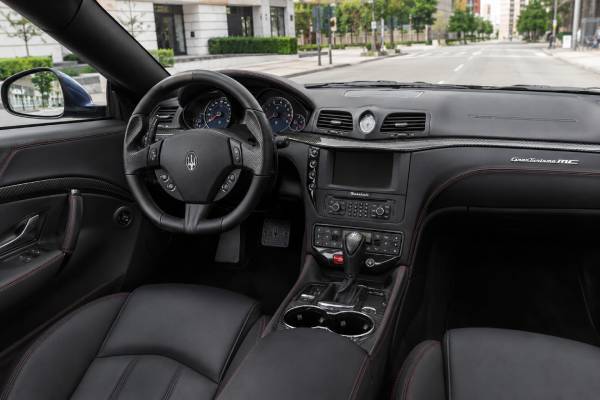
Inside, the 2018 car’s 8.4-inch touchscreen is the practical improvement. It supports Apple CarPlay and Android Auto, uses a rotary controller, and replaces much of the older button-heavy layout. Test every input, the reverse camera, audio, Bluetooth, USB ports, navigation, and steering-wheel controls. A frozen screen or intermittent camera may involve software, wiring, or module replacement.
Factory options can include exterior carbon packages, carbon or wood interior trim, contrast stitching, different leather and Alcantara combinations, premium audio, colored brake calipers, and wheel finishes. Carbon hood appearance varies with paint and exposed sections. A build sheet should confirm what was original.
MC identity checks should include:
- VIN and factory option data showing the MC trim;
- correct carbon-fiber hood and front aerodynamic components;
- MC-design wheels and badging appropriate to the market;
- automatic gearbox selector and front-mounted transmission layout;
- correct iron brake hardware unless a documented factory market specification says otherwise;
- interior trim and seat pattern matching the build record;
- model-year-correct grille, bumper, infotainment, and lights.
Aftermarket conversion parts are common because MC bumpers, hoods, side skirts, and exhaust pieces fit related M145 cars. A converted Sport may be attractive, but it should be described and priced honestly. Conversely, an MC that has lost its original hood, wheels, or trim may cost more to return to standard than expected.
Registration year can differ from build year, especially for imported or leftover-stock cars. Verify emissions labels, lighting, speedometer units, radio region, and local compliance. Cross-market parts and software support should be understood before purchase.
Carbon Hood, Aero, and Four-Seat Function
The MC’s bodywork adds functional cooling and high-speed stability while keeping the GranTurismo’s defining advantage: a beautiful Pininfarina shape with four usable seats. It is dramatic without becoming a two-seat special-purpose machine.
The carbon-fiber hood reduces mass over the front axle and incorporates outlets that help evacuate hot air. The deep front splitter and enlarged openings feed cooling and brakes. Side skirts manage airflow along the body, while the rear lip and diffuser treatment help stabilize the tail. These parts also sit close to curbs and road debris, so a lift inspection is essential.
Inspect carbon in direct, diffuse light. Healthy weave should be consistent, edges should sit flush, and clear coat should not show milky patches, yellowing, cracks, or lifting. Painted carbon can hide repair. A replacement hood may fit poorly or use different weave. Ask for accident and repair invoices, not only a clean visual impression.
Cooling air passes through low, exposed openings. Leaves and road debris can block the condenser and radiator. Bent fins, missing mesh, cracked ducts, or absent undertrays reduce effectiveness. The engine temperature should remain stable in stationary traffic with the air conditioning engaged.
The cabin remains richly trimmed. Front seats support long trips, rear seats can carry adults for shorter distances, and the trunk accepts weekend luggage. This usability separates the MC from more compromised exotics and makes the automatic gearbox logical rather than disappointing.
Late cars still show the platform’s age. Seating position, analog instruments, central clock, and physical controls feel traditional. The updated touchscreen improves connectivity, but the architecture does not imitate a new digital cockpit. Many owners consider that an advantage because the car’s main interaction remains the engine, paddles, hydraulic steering, and chassis.
Leather can shrink or dry, Alcantara can polish, headliners can sag, and soft-touch coatings can become sticky. Carbon door sills and console trim scratch. Frameless windows should drop slightly on opening and reseal cleanly. Water marks, wind noise, or slow glass movement suggest adjustment, regulator, seal, or voltage problems.
The exhaust defines the sensory experience. In normal use, valves manage volume. Sport mode brings a deeper idle and harder high-rpm note. Check valve actuators and vacuum control. A permanently loud aftermarket system may drone on the highway, trigger faults, or expose trim to excess heat. Retaining the factory exhaust supports both usability and value.
MC Drama With Automatic Ease
The late MC is at its best as a fast road car, not as an imitation race car. The automatic lets the driver enjoy the V8, steering, and body control without managing clutch slip in traffic, while the firmer chassis supplies more immediacy than a standard Sport.
In normal mode, the car pulls away cleanly and shifts unobtrusively. The V8 is flexible enough for relaxed travel, though its strongest response arrives only after a downshift. The torque converter makes parking, inclines, and stop-start traffic straightforward. That ease encourages owners to use the car more often.
Sport mode changes the atmosphere. Throttle response sharpens, the gearbox holds lower ratios, paddle requests arrive more decisively, and exhaust valves open. The shift is not as abrupt or quick as MC Race Shift, but it is consistent and does not require the same low-speed technique. Manual mode is most satisfying when the driver downshifts before the engine falls below its energetic range.
The claimed sprint to 100 km/h in the high-four-second range remains fast enough for public roads. More memorable is the way acceleration continues above 5,000 rpm. The engine becomes louder and more urgent rather than delivering one large initial torque event.
Hydraulic steering is accurate and naturally weighted. The long hood requires visual judgment, yet the front tires communicate load. Firm MC tuning limits body movement, but the car’s mass remains clear. It responds best to early, progressive inputs: brake in a straight line, settle the front, then add throttle as the rear takes load.
Ride quality is busier than in an adaptive Sport, especially on 20-inch wheels. A sound car should still feel controlled rather than brittle. Crashing, repeated bouncing, steering kickback, or tramlining may indicate old tires, bent wheels, weak dampers, worn arms, or incorrect alignment.
Iron brakes give strong, predictable response and are easier to use from cold than many ceramic systems. Repeated hard use builds substantial heat. Fresh fluid, correct pads, clear ducts, and adequate cool-down matter. Steering shake under braking can involve rotor deposits, wheel runout, or worn suspension joints.
Highway stability, supportive seats, rear accommodation, and climate control make long journeys realistic. The low splitter and broad turning circle complicate tight garages. Fuel consumption is heavy, but the large tank provides reasonable cruising range. The MC’s distinctive achievement is making an extroverted final-era Maserati easy enough to drive regularly.
Maintaining the Final Automatic V8 MC
The MC avoids the Stradale’s dry-clutch and carbon-ceramic costs, but it remains an aging high-performance GT. Preventive attention to oil leaks, cooling, automatic transmission service, suspension, brakes, battery health, and carbon bodywork is the economical approach.
Start the engine cold. Listen for persistent timing or cam-variator rattle, observe oil-pressure and warning behavior, and watch for smoke. Inspect cam-cover and front-cover areas, oil lines, and undertrays. Engine mounts can collapse, causing idle vibration, exhaust contact, or a thump when selecting gear.
Cooling requires a complete inspection: radiator, condenser, debris between cores, expansion tank, hoses, clamps, thermostat, water-pump area, and electric fans. Temperature must stay stable in traffic with the air conditioning running. Dried coolant marks or regular topping-up indicate a leak.
The ZF automatic should engage Drive and Reverse promptly when cold and hot. Investigate flare, harsh downshifts, delayed engagement, leaks, or shudder. A specialist fluid and pan/filter service using the correct specification and temperature procedure is sensible when history is absent. Differential fluid and mounts are separate maintenance items.
Suspension checks should cover dampers, springs, control arms, bushes, ball joints, tie rods, anti-roll-bar links, wheel bearings, ride height, and alignment. Determine whether the car has fixed MC or adaptive hardware before ordering parts. One-edge tire wear often signals more than a simple alignment adjustment.
Measure brake discs and pads, inspect both rotor faces, test the parking brake, and verify brake-fluid age. Calipers should release evenly. Confirm wheels are straight and tires match across each axle, carry correct ratings, and are not aged beyond safe performance use.
Battery voltage is a frequent source of misleading messages. Load-test the battery, check alternator output, and scan all modules. Operate the touchscreen, camera, parking sensors, windows, locks, both keys, seat functions, climate control, audio, lights, and trunk release. A maintainer supports an intermittently driven car but does not cure parasitic drain.
Carbon and lower aero pieces need inspection for impact and heat damage. Undertrays and ducts must be present. Correct lifting points should be used; crushed sills or distorted panels reveal careless workshop practices.
Annual service is valuable even at low mileage. Fluids absorb moisture, tires harden, fuel ages, seals dry, and batteries cycle while the car sits. A specialist familiar with late M145 diagnostics and parts supersessions can prevent small symptoms from becoming expensive failures.
Buying Without Confusing It for a Stradale
Buy the MC as the automatic, road-focused model it is. Confirm factory identity and price it against comparable MC cars, not against an MC Stradale whose transmission, brakes, and production story are different.
Before inspection, obtain VIN build data and original-market information. Confirm paint, interior, wheels, brakes, suspension, carbon package, and model-year equipment. Check that 2018–2019 cars have the correct updated front, rear, and infotainment components. Determine whether any body conversion or accident repair occurred.
The pre-purchase inspection should include a cold start, full diagnostic scan, lift examination, paint-depth and carbon assessment, battery test, tire-date check, brake measurement, and a long road test. Review invoices rather than relying on a service-book stamp. Mileage should progress logically across services, inspections, and registrations.
| Area | Positive evidence | Warning evidence |
|---|---|---|
| Model identity | Factory MC build data and correct automatic specification | Stradale claims based only on bodywork or badges |
| Engine and cooling | Quiet cold start, stable temperature, dry systems | Persistent rattle, smoke, coolant loss, overheating history |
| Automatic | Prompt engagement and smooth shifts at all temperatures | Delay, flare, slam, shudder, no fluid history |
| Chassis | Quiet suspension, straight wheels, matched recent tires | Knocks, wandering, bent rims, inner-edge wear |
| Carbon and cabin | Consistent finish and complete functioning equipment | Cloudy repairs, missing trim, water entry, hacked wiring |
During the road test, use both modes, test light and heavy throttle, make manual shifts, brake from several speeds, drive over a rough surface, and perform a hot restart. The car should track straight, hold stable temperature, and show no drivetrain warnings. Listen for wheel-bearing hum, differential noise, suspension knocks, exhaust rattles, and wind leakage around the glass.
Reserve money for baseline work. Tires, battery, fluids, brakes, mounts, an alignment, and one suspension repair can be due together even on a low-mileage car. Factor secure storage, insurance, specialist access, fuel, and model-specific body parts into the decision.
Avoid cars with unverifiable trim identity, severe splitter or underbody impact, structural repairs, overheating, repeated warning lights, old mixed tires, or sellers who refuse a scan and lift inspection. A well-documented repaint of a stone-chipped bumper is less concerning than untouched paint hiding poor mechanics.
The ideal buyer wants late M145 styling, a more focused chassis, four-seat practicality, and automatic ease. Someone seeking the most mechanical gearbox and ceramic brake experience should pursue a true Stradale instead. Chosen for the right reason and maintained proactively, the GranTurismo MC delivers a compelling final expression of the F136 era without making every low-speed journey a test of clutch technique.
An MC also deserves an insurance and parts plan that recognizes its body specification. The carbon hood, deeper bumper, splitter, side pieces, and late lighting can cost far more than equivalent standard-coupe panels, and a minor front impact may involve cooling ducts and parking sensors as well as visible paint. Ask whether the policy permits a Maserati-approved or composite-qualified repairer and whether agreed-value coverage is available. Photograph the underside, carbon weave, wheel finish, and panel gaps at purchase. Those records help settle later damage claims and provide a useful originality baseline when the car is sold.
Confirm that the original tire-inflation label, VIN labels, and emissions labels remain present after any repaint, since their loss can complicate authenticity and registration checks.
References
- Maserati GranTurismo model Year 2018 makes its world debut in New York 2017
- MY18 GranTurismo & GranTurismo Convertible star at Goodwood Festival of Speed 2017
- Maserati reveals new Ghibli and presents Levante, Quattroporte, GranTurismo and GranTurismo Convertible MY18 at Frankfurt Motor Show 2017
- Maserati Guides & Documentation 2026 (Owner Documentation)
- Maserati TechInfo 2026 (Technical Information)
Disclaimer
This article is for informational purposes and is not a substitute for professional diagnosis, repair, or inspection. Specifications, torque values, service intervals, and procedures vary by VIN, market, model year, and equipment; verify all critical details in the official Maserati service documentation for the individual car.
Please share this guide on Facebook, X/Twitter, or an enthusiast group if it helped you distinguish and evaluate the late GranTurismo MC.